Saul Ostrow

Saul Ostrow is an independent critic, curator, and Art Editor at Large for BOMB magazine.

This exhibition at Gladstone Gallery, though titled Peter Saul’s Art History, is less a sweeping survey of Saul’s interpretation of art history than a concentrated, slapstick chapter on Western modernism and perhaps his influences. It is composed of a sampling of works which Saul, over the course of his career, has revisited.
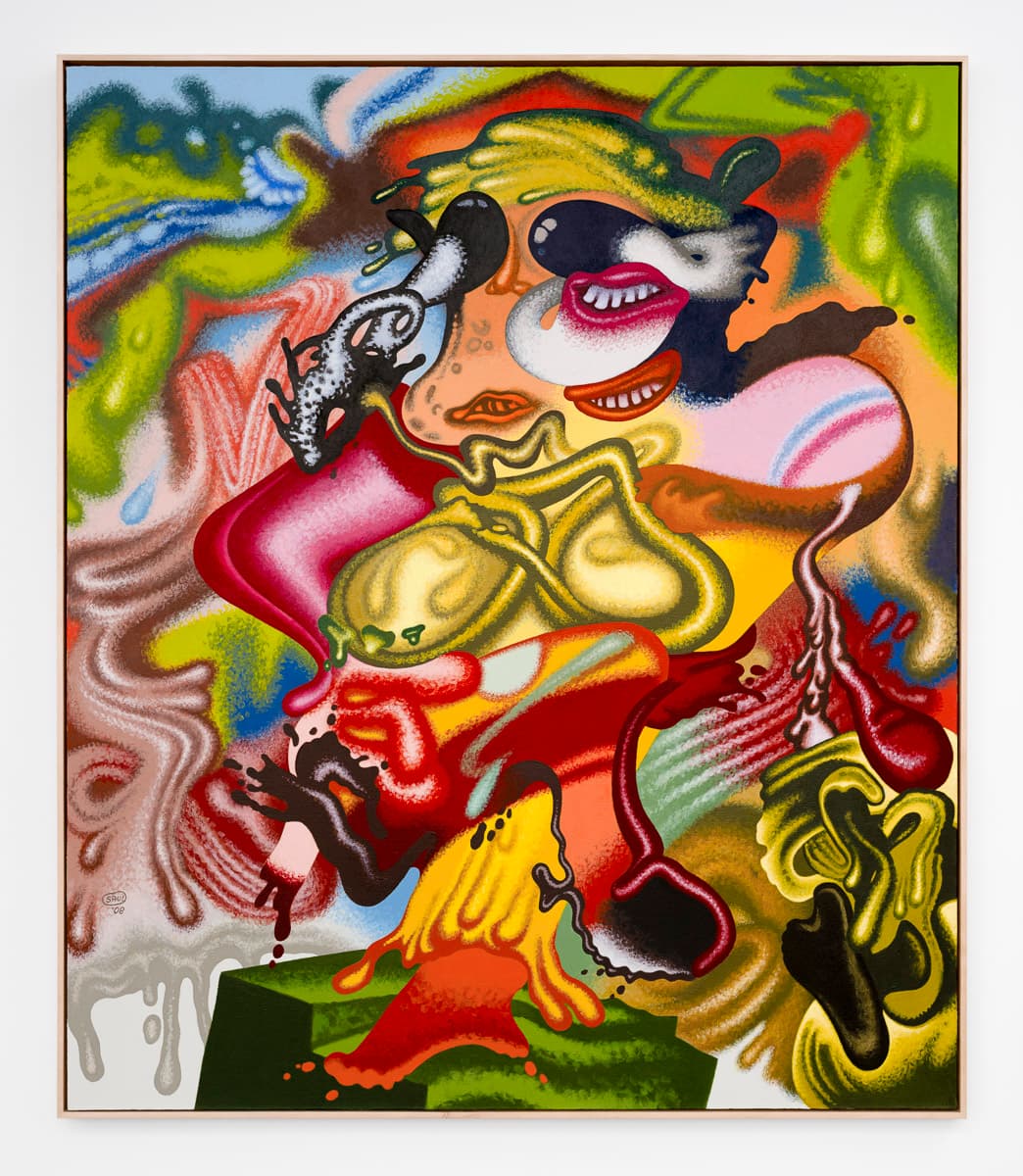
Peter Saul, Better than de Kooning, 2008. Oil and acrylic on canvas, 84 × 72 inches. © Peter Saul / Artists Rights Society (ARS), New York. Courtesy the artist and Gladstone. Photo: Anthony Flores.

James Rosenquist becomes newly legible when he is approached not as a canonical figure of Pop art, but as an artist tracking how social experience is reorganized by a world of proliferating images. The exhibition Waiting for an Idea at Off Paradise compresses the arc of his project into a compact—almost meta—diagram.
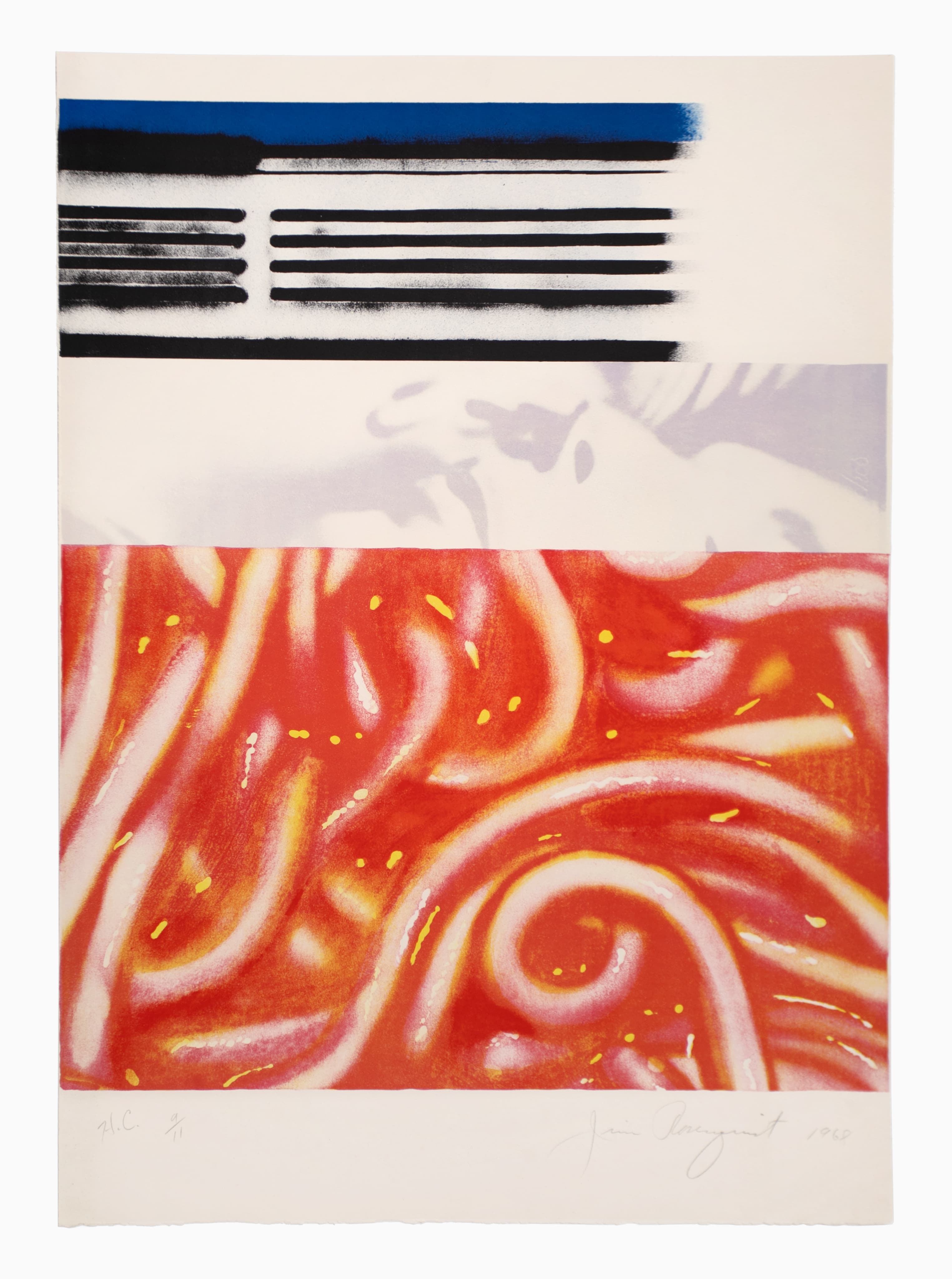
James Rosenquist, Forehead I, 1968. Five-color lithograph on Arches Cover White paper, 33 ½ × 24 ⅝ inches. Courtesy the James Rosenquist Estate.

Despite its promising title, I Am Gravity offers less than a compelling argument for Bill Bollinger’s work as either historically pivotal or presently relevant. What is at stake here is not merely a curatorial shortfall, but a continued failure to grasp how post-Minimalism constitutes a missing chapter in late modernism’s history.
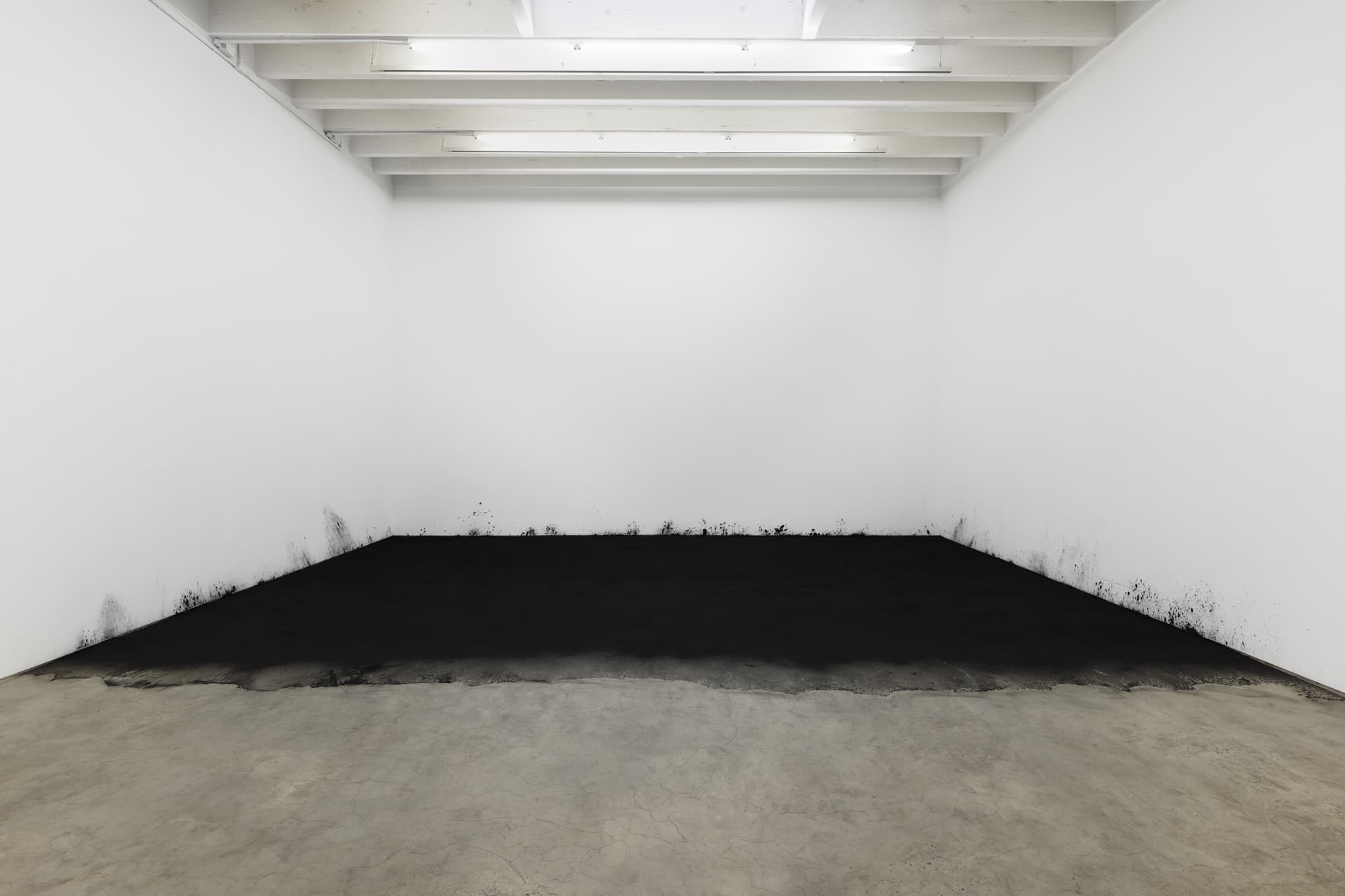
Bill Bollinger, Graphite Piece, 1969/2026. Graphite, dimensions variable. © Estate of Bill Bollinger. Courtesy the estate and Karma.

Upon entering the exhibition To the North Star, featuring works by Joe Overstreet (b. 1933, d. 2019) at Eric Firestone Gallery, one might initially assume that his career was defined by adapting to trends and approaches that dominated abstract painting from the mid-to-late twentieth century.

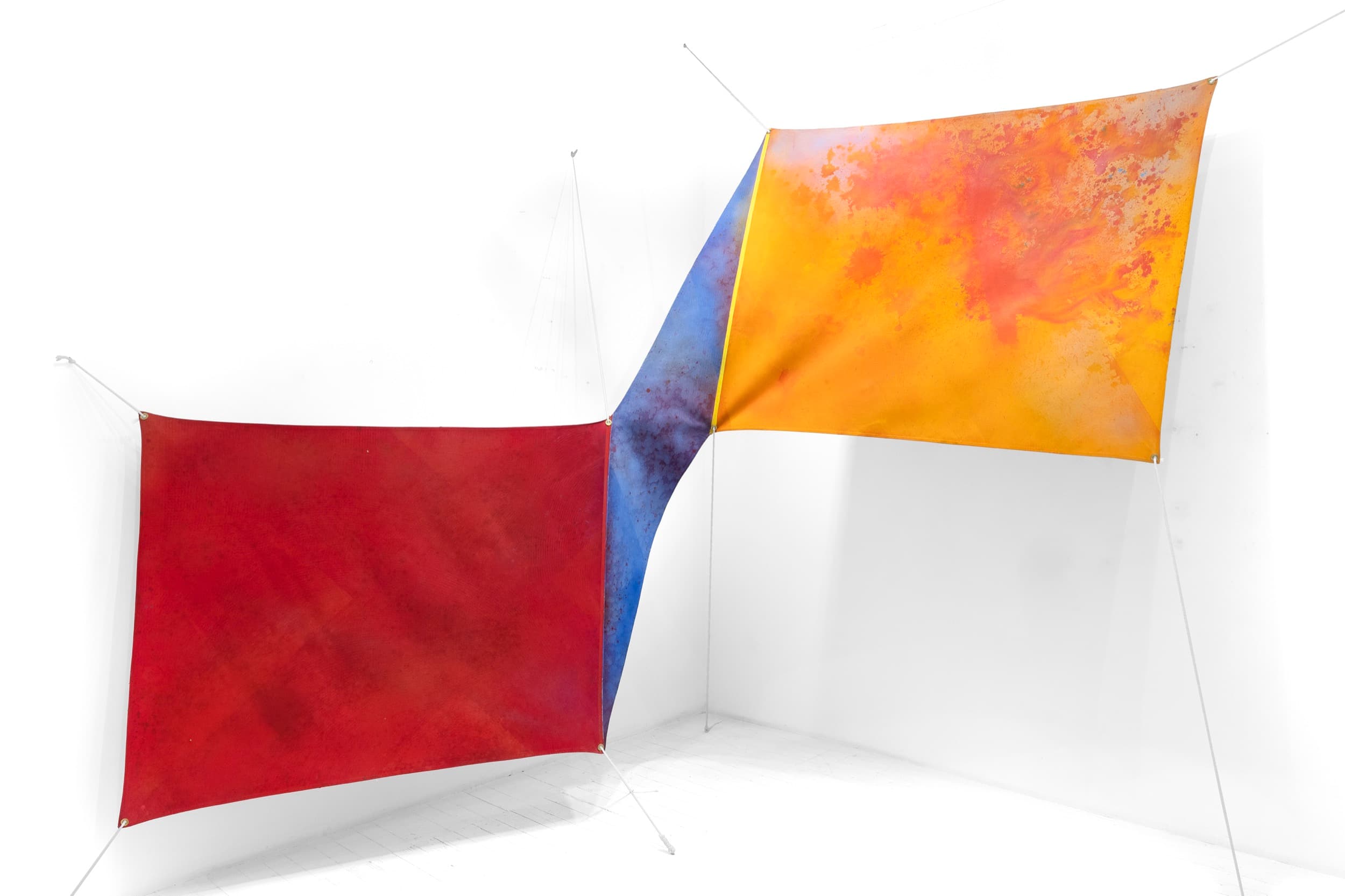
Joe Overstreet, The Beginning of Love, 1971. Acrylic on canvas, 97 × 144 ¼ inches. Courtesy Eric Firestone Gallery. © 2025 Joe Overstreet / Artists Rights Society (ARS), New York.

Renowned for his photorealistic paintings and complex woodcuts, Franz Gertsch’s subtle and layered approach is easy to miss when seen through a small selection like the eight works that make up Presence at Hauser & Wirth’s Wooster Street gallery.
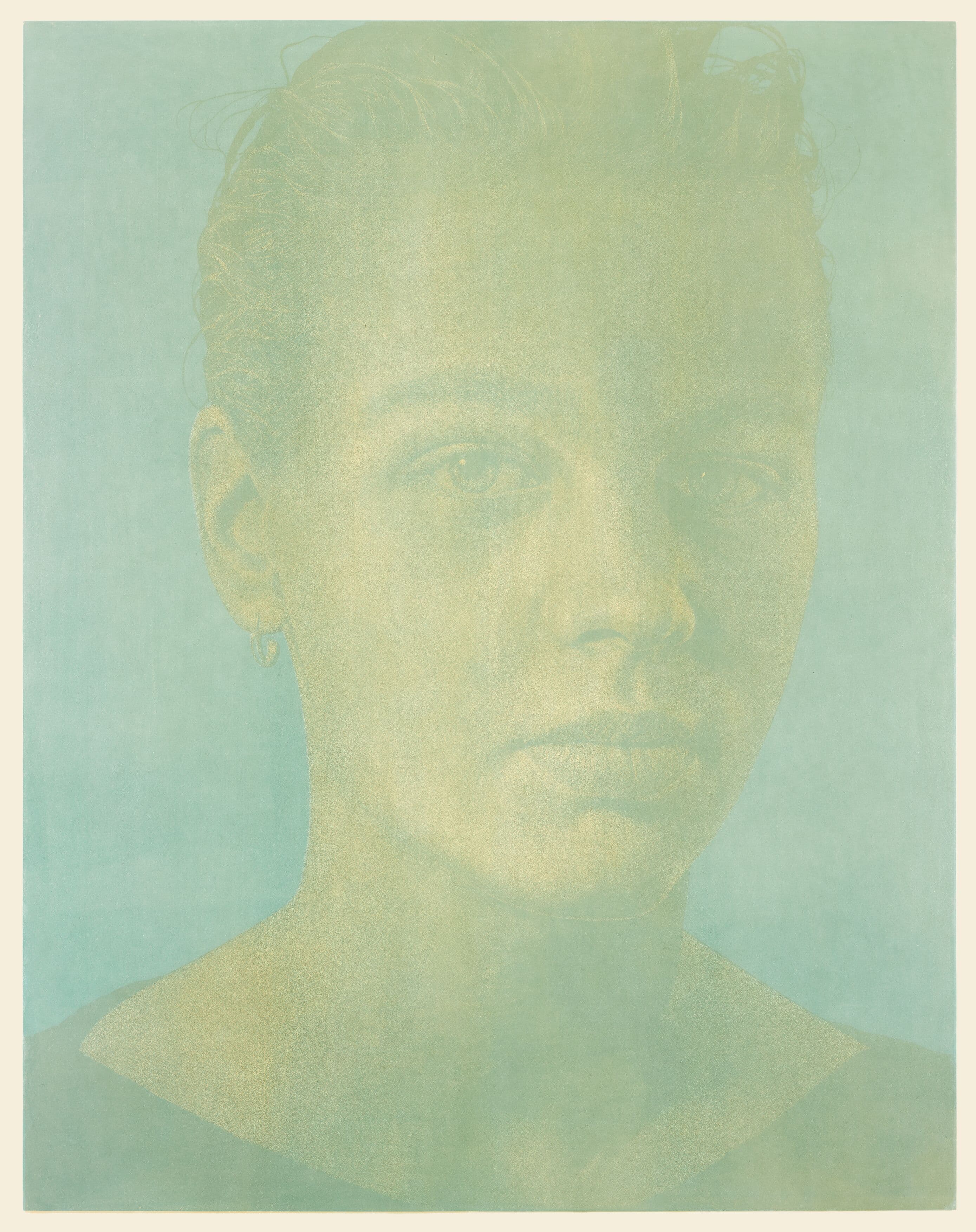
Franz Gertsch, Natascha IV, 1987-88. Woodcut (3 plates) on Kumohadamashi Japanese paper by Heizaburo Iwano, 91 ½ × 71 ⅝ inches. Courtesy Estate of Franz Gertsch and Hauser & Wirth. Photo: Dominique Uldry.

Remaining open to continual adjustment, Tom McGlynn transforms repetition into a generative principle, a painterly counterpart to Donald Judd’s modular rigor where variation arises through disciplined reiteration.

Tom McGlynn, Force Major, 2025. Acrylic on birch, 48 × 96 inches. Courtesy the artist and Rick Wester Fine Art.

The title of this exhibition, Galacticonexus—a neologism that fuses “galactic” and “nexus”—is itself highly revealing, as it draws upon the language of speculative fiction and conjures images of the architecture of cosmic interconnectivity. The analogy is apt, since the show consists of an expansive array of nineteen hanging wire sculptures dating from 1975 to 2025. Installed throughout Karma’s expansive Chelsea gallery, Saret’s sculptures are suspended at varying heights—some hovering just above the floor, others floating overhead—to evoke the vastness of space.


Alan Saret, Swan, 2002. Stainless steel and tin coated copper wire, 37 × 28 × 19 inches. Courtesy the artist and Karma.

AS OFTEN AS NOT, a posthumous exhibition of Lawrence Weiner’s work at Gladstone Gallery, showcases his iconic language-based approach to artmaking.

Installation view: Lawrence Weiner: AS OFTEN AS NOT, Gladstone, New York, 2025. © Lawrence Weiner Estate / Artists Rights Society (ARS), New York. Courtesy the Lawrence Weiner Estate and Gladstone.

When I first received the press release for Faktura / Tektonika at Sean Kelly, my anticipation was genuine. I was not expecting an art historical treatise, or a museum show but rather a contemporary view—an exhibition that would thoughtfully engage with these pivotal significant concepts in the present moment.

Jose Dávila, Fundamental Concern, 2022. Concrete, rock, boulder, glass sphere and ratchet strap, 90 ½ × 20 ⅞ × 17 ¾ inches. © Jose Dávila. Courtesy the artist and Sean Kelly, New York/Los Angeles.

Like many contemporary artists, Kennedy Yanko’s work looks overly familiar. This reflects the broader contemporary cultural tendency of artists recycling past forms and aesthetics.

Installation view: Kennedy Yanko: Epithets, James Cohan Gallery, New York, 2025. Courtesy James Cohan, New York. Photo: Phoebe D'Heurle.

Conceived and executed in 1969, the exhibition 48" Standards by Mel Bochner at Peter Freeman showcases works that, at the time of their initial presentation, would have been considered materially and conceptually unconventional, perhaps even radical.

Mel Bochner, Measurement: Crumpled 12", 1969. Brown paper, push pins, vinyl, 12 x 12 inches, as installed: 11 1/8 x 11 1/8 x 1/2 inches. Courtesy Peter Freeman, Inc., New York/Paris. Photo: Nicholas Knight.

Ironically, while Cady Noland’s work itself may not be explicitly critical or proactive, her approach to her career and interactions with the art world demonstrate a deep, critical awareness of her own position as a successful artist.

Installation view: Cady Noland, Glenstone Museum, Potomac, Maryland, 2024. Courtesy Glenstone Museum, Potomac, Maryland.

DRIVE II, currently on view at Hauser & Wirth, can be read as a nuanced and complex commentary on art, consumerism, and personal mythology. Cars are its principal referent. The cars that make up DRIVE II were all owned, used, and modified by Rhoades, but in no dramatic manner.

Installation view: Jason Rhoades: DRIVE II, Hauser & Wirth, New York,  2024. © The Estate of Jason Rhoades. Courtesy the Estate of Jason Rhoades and Hauser & Wirth. Photo: Thomas Barratt.
Though the pictorial mash-up that constitutes Joanne Greenbaum's works appears to be spontaneous—as if the paintings were the result of an unpredictable series of acts and reactions—here and there are events, such as the correspondence between overlays, that indicate her premeditation and forethought.
Joanne Greenbaum, Untitled, 2024. Flashe, oil, acrylic and marker on canvas, Diptych; overall: 90 by 160 inches. Courtesy Mitchell-Innes & Nash.
Jablon’s works are an exploration of the influence that language, and associations have on our perception—we see what we want to, or have been trained to. By calling our attention to the materiality of painting and the abstractness of language, he creates an encounter that challenges the idea that language can become a constraining structure that captures and confines our experiences and understanding of reality.
Installation view: Sam Jablon: Linger Longer at Morgan Presents, 2024. Courtesy Morgan Presents.
In the late 1960s, Harold Cohen took advantage of his access to the computer facilities at University of California San Diego, where he was faculty, to create a computer-programmed drawing machine: AARON (which is not an acronym). His project was in line with various efforts in the 1950s and ’60s to integrate technology and art, including, to cite just one important example, pioneering work by the Rand Corporation and Bell Labs in digital computer art and animation, which resulted in the development of a programming language for joystick, an interactive display, and a force-feedback device—all part of the larger project of developing human and machine interaction.
Harold Cohen, AARON KCAT, 2001. Screenshot. Artificial intelligence software. Dimensions variable. Whitney Museum of American Art, New York; purchase, with funds from the Digital Art Committee 2023.20. © Harold Cohen Trust.
Though at first David Rhodes’s paintings appear to be reductive, repetitive and formulaic, with time one may come to the conclusion that his works are refreshingly deceptive in that he makes paintings that inform thought rather than ones that illustrate soundbites, or are displays of subjectivity and taste.
David Rhodes, 1 September 2023, 2023. Acrylic on raw canvas, 23 x 15 inches. Courtesy the artist and High Noon Gallery.
So, it is with Pablo Picasso who produced an early body of work that made him a celebrity and eventually a meme. The effect of this is that the general audience does not see Picasso’s work or its merit, what they see is the legend behind the picture. Picasso: 14 Sketchbooks at Pace Gallery is an art historical endeavor that looks past mythmaking and offers an opportunity to see the evolution of his ideas.
Pablo Picasso, Compositions, from Carnet 007, Juan-les-Pins, 20 August–13 September 1925. © FABA. Photo: Hugard & Vanoverschelde / 2023 Estate of Pablo Picasso-ARS New York.
Given my interest in painting, I found myself going to Milwaukee to see an exhibition that promised to be taking the pulse of contemporary American painting—all the works in it had been made in the last five years. A show of fifty paintings by fifty different painters who the curators claimed were defining the field of contemporary painting seemed a bold move, amidst the general confusion that has been generated by AI, market manipulation, auction house publicity, critical pronouncements, and a general cultural malaise that has lingered since the 1990s.
David Diao, Rietveld's Berlin Chair Parts on Horizontal 3 Color Ground, 2021. Acrylic on canvas, 66 × 54 inches. Courtesy the artist and Greene Naftali, New York.
Photographs today are simulations, amalgams of effects and filters, whereas in the mechanical age (1840s–1960s) people tended to believe photographs were trace records, evidence—an indexical copy of something that was once in front of the camera. In other words, photographs were a disembodied specter. When looking at Charles Traub's photographs, we come to recognize the subject’s direct and causal connection is not to the camera but to the photographer’s eye.
Installation view: Charles Traub: Skid Row, School of Visual Art Flatiron Project Space, 2023. Courtesy School of Visual Art.
Postmodernism is an interim state, a hybrid patched together to accommodate changing material circumstances. The transition in the 1960s–’80s, from Modernism to Postmodernism marked the shift from valuing historical significance and criticality to the embracing of a post-historical perspective, which encouraged us to imagine ourselves freed from the vision of history as a continuum that shapes all things.
In the tradition of such artists as On Kawara, Stanley Brouwn, James Lee Byars, and Ray Johnson, whose work extensively consisted of ephemera—postcards, hand-drawn maps, notes, and collages—the conceptualist Joseph Grigely presents images and texts as artifice, evidence, and commentary.
Joseph Grigely, Music from St. Cecilia, 2012. 3 digital pigment prints, 24.6 x 19.5 inches each. Courtesy the artist, Krakow Witkin, Boston, MA and Air de Paris, Romainville, France.
These works’ pictorial strategies, and others from the 1970s on, though their initial effects are still op, align them with many of the now marginalized practices of post-50s hardedge and geometric abstract art. With this insight, I realized Riley’s practice extends beyond her association with Op art and that her work can be contextualized within the broader aesthetic discourses of early and late modernism.
Bridget Riley, Final Study for "Halcyon" [Repaint], 1971. Pencil and gouache on paper, 37 3/8 × 36 inches. Collection of the artist. © Bridget Riley 2023. All rights reserved.
Noël Dolla is a French artist, and if he is known at all in the United States it is for his participation in Supports/Surfaces, a collective of like-minded artists who in the late 1960s to 70s shared common ideas about the identity and symbolic function of art.
Installation view: Noël Dolla, Tulle / Dye, 1969 - 2023, Ceysson & Bénétière, 2023. Courtesy the artist and Ceysson & Bénétière.
The exhibition Project for a New American Century at the Whitney Museum installed on the fifth and eighth floors is a sampling of Josh Kline’s works done over the last fourteen years. The initial impression is that Kline’s work descends from the tradition of social realism and agit-prop in which art serves as a tool of social and political criticism and mobilization. However, what one soon realizes is how often it instead verges on melodrama.
Installation view: Project for a New American Century, Whitney Museum, New York, 2023. Courtesy Whitney Museum.
Simone Leigh makes highly refined and stylish sculptures that seemingly tell consciously constructed stories as well as unintended ones. The installation of this exhibition of her works at the Institute of Contemporary Art (ICA) in Boston is stark, dramatic, and elegant.
Installation view: Simone Leigh, ICA Boston, 2023. Courtesy ICA Boston.
In his effort to subvert capitalism’s visual representation of politics, economics, science, consumer culture, and everyday life, KP Brehmer adopted a graphic designer’s aesthetic to produce diagrams, postcards, inserts, multiples, posters, banners, and displays.
KP Brehmer, Portrait Graziella I, 1967. Cliché, print on cardboard, cotton balls and plastic, 39 1/2 x 33 1/2 x 2 inches. © The Estate of KP Brehmer. Courtesy of The Estate of KP Brehmer and Petzel, New York.
By abstracting Gaines’s processes and its operation we can tie his game of building and deploying systems to the real world—they are models of the way in which the particular loses its identity and becomes part of a category. Gaines’s works, then, function as analogies whose subject is the construction and discernment of identity.
Charles Gaines, Numbers and Trees: Charleston Series 1, Tree #1, Old Towne Road, 2022. Acrylic sheet, acrylic paint, lacquer, wood, 60 x 82 7/8 x 5 3/4 inches. © Charles Gaines. Courtesy the artist and Hauser & Wirth. Photo: Fredrik Nilsen.
Given a selection of earlier works in the lower gallery at Eva Presenhuber it is apparent that Deutsch has always been aware that what differentiates a mimetic image from an abstract one is that an image’s mimetic function of simulation is at its highest when the medium least asserts itself; inversely when the medium asserts itself most viewers see its materiality and not what may be encoded in it.
Installation view: David Deutsch: Hurly-Burly, Venus Over Manhattan, New York, and Galerie Eva Presenhuber, New York, 2023. Courtesy the artist, Venus Over Manhattan, New York, and Galerie Eva Presenhuber, New York, Zürich, Vienna.
It might be best to think of it as a tightly-knit show of selected works, which unravels about half-way through as Katz’s imagery becomes increasingly abstract.
Installation view: Alex Katz: Gathering, Solomon R. Guggenheim Museum, New York, 2022–23. © Solomon R. Guggenheim Foundation, New York. Photo: Ariel Ione Williams and Midge Wattles.
In 2021 on the occasion of his exhibition Green Ladder, I had written that artist William Corwin’s works are “discursive, and recursive, while his subject-matter and contents are heterogeneous, interdisciplinary, and multi-cultural. Often Corwin is a time-traveler filling his sculptures with esoteric, mystical, and mundane knowledge from the past. 
William Corwin, Long Boat, One Passenger, 2022. Cast Iron. Courtesy the artist and Geary Contemporary.
I have been asked to consider this moment as an opportunity to elucidate what we can learn from what happens when a major museum decides to expand and the contingent consequences of that decision as it affects the future of art within the city.

Close

Home