Lawrence Weiner: AS OFTEN AS NOT

Installation view: Lawrence Weiner: AS OFTEN AS NOT, Gladstone, New York, 2025. © Lawrence Weiner Estate / Artists Rights Society (ARS), New York. Courtesy the Lawrence Weiner Estate and Gladstone.
Word count: 1005
Paragraphs: 11
Gladstone Gallery
September 12–October 25, 2025
New York
AS OFTEN AS NOT, a posthumous exhibition of Lawrence Weiner’s work at Gladstone Gallery, showcases his iconic language-based approach to artmaking. Alongside the installation of works, which consist of distinct phrases installed on the gallery walls, the show is supplemented by related events at e-flux, including sound performances and screenings of Weiner’s films. Curated by the Weiner estate, the exhibition reframes many of the artist’s familiar textual strategies, which fall into various categories such as propositions, instructions, and hypotheticals. Many of them, though from differing periods, resonate with contemporary themes: place, position, transition, and boundary-crossing.
The exhibition features works in classic vinyl lettering applied directly to the wall—an “old school” approach that foregrounds language as both material and site. On the second floor, most of the works take propositional, descriptive, or instructional forms that reference physical acts of removal, breaching, or the crossing of boundaries. In a smaller adjacent gallery space, a table holds numerous books, and two framed drawings hang on the wall; these appear to be plans for more recent diagrammatic works. There is also a turntable and speakers and a long-playing album by Weiner. On the ground floor, each wall is filled with a distinct textual statement or proposition on a mural scale. Accompanying the show is a catalogue, structured so that each exhibited text is allotted its own page.
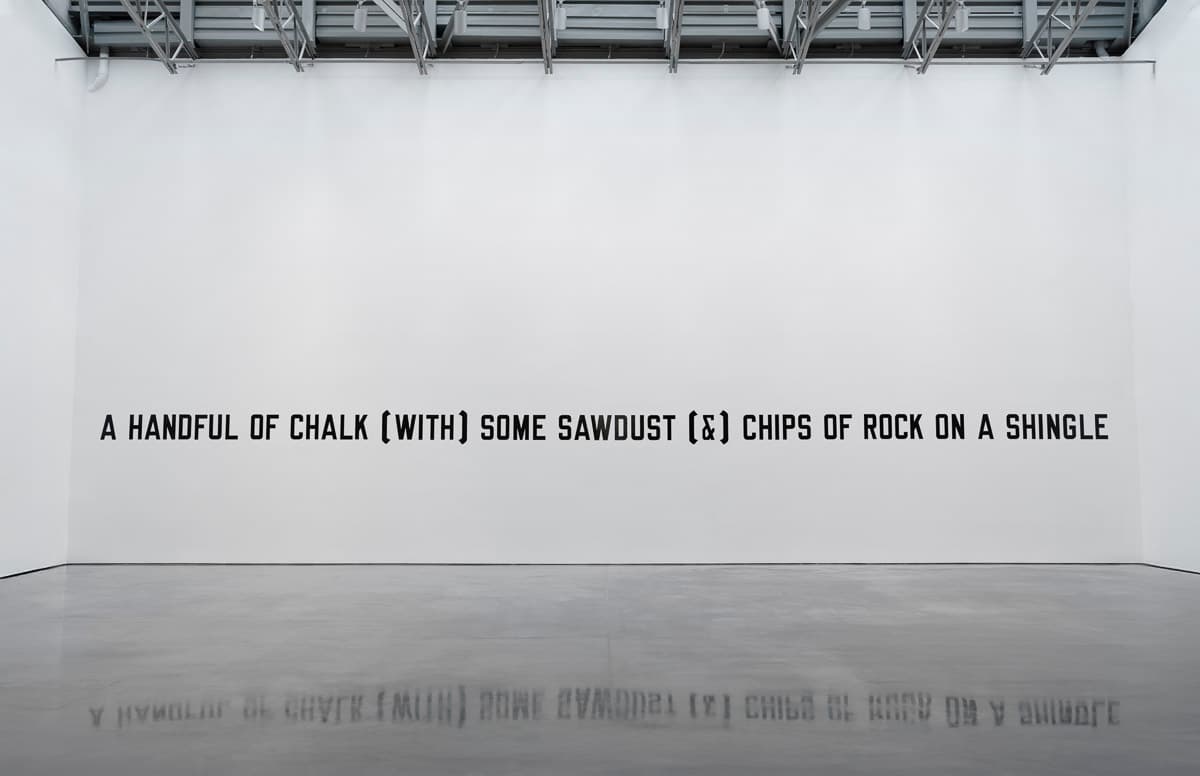
Installation view: Lawrence Weiner: AS OFTEN AS NOT, Gladstone, New York, 2025. © Lawrence Weiner Estate / Artists Rights Society (ARS), New York. Courtesy the Lawrence Weiner Estate and Gladstone.
Notably, the experience of reading the texts on the wall—where scale, placement, and public context activate the language—differs markedly from reading them confined to the printed page: the gallery setting renders Weiner’s work spatial and sculptural, highlighting the ongoing dialogue between presentation and interpretation. This interplay between documentation and encounter is not incidental, but rather returns to Weiner’s core concept of art as an open, recursive process. This is summed up in Weiner’s 1968 “Statement of Intent,” which is posted at the entry and declares that an artwork remains equally valid whether it is built, fabricated, or left unrealized, with meaning and realization shifted to the receiver.
Each mode of presentation literalizes his ethos, as the viewer completes the work, and the activation of authorship itself becomes a recurring gesture, looping from the wall to the page, from the gallery to the broader visual field. What began as a challenge to artistic conventions and market norms in the late sixties and seventies has with time lost its initial charge—these tactics became foundational for 1980s conceptual artists like Jenny Holzer and Barbara Kruger.
Less often noted, yet just as integral, is Weiner’s focus on visuality and material presence: his use of clear, sans-serif typefaces—and typography drawn from graphic design and signage—ensures every work’s legibility and permits his texts to be situated across common forms such as books, billboards, matchbooks, pins, banners, and building facades. This blurring of boundaries between art and mass media recurs through all phases of his practice. In the late sixties and seventies, artists’ approaches were increasingly shaped by developments in semiotics and media theory, most notably Marshall McLuhan’s mantra that “the medium is the message.” While Weiner’s wall texts are not directly modeled on Quentin Fiore’s layout for McLuhan’s The Medium is the Message (1967), there are notable affinities: both foreground the interplay between typographic form and conceptual meaning, highlighting the feedback loop between material presentation and linguistic or conceptual intent.
Weiner’s commitment to strategies—where repetition, context, and material process continually reframe meaning—finds its root in his early, materially experimental “Removal Paintings,” as well as in his later instructional and propositional works. Across each iteration, the work persists in its central claim that art’s meaning is not fixed but negotiated, re-enacted, and rediscovered, whether within the institution, the public realm, or the reader’s own imagination. In this there is a strong affinity between Weiner and the French group BMPT: both foreground anti-authorial strategies and skepticism toward both commodification and the “aura” of art. Their works are shaped by a similar questioning of tradition, form, and context.
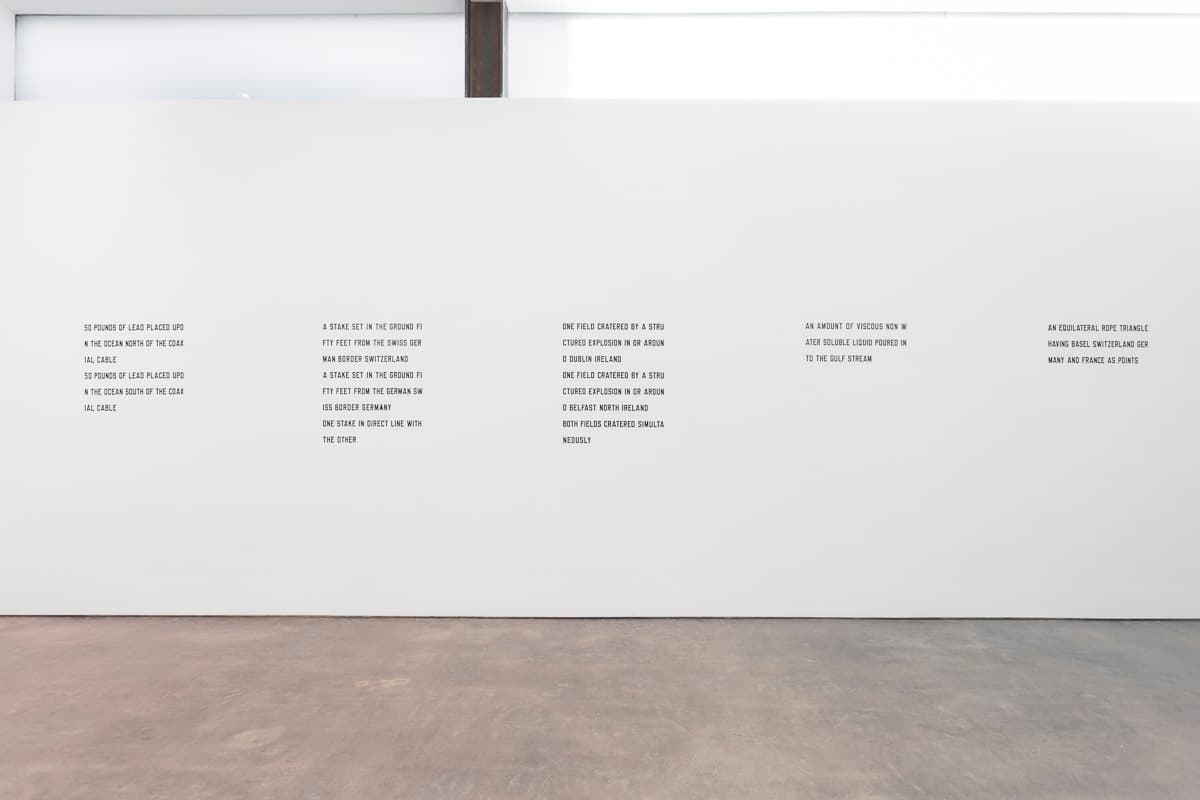
Installation view: Lawrence Weiner: AS OFTEN AS NOT, Gladstone, New York, 2025. © Lawrence Weiner Estate / Artists Rights Society (ARS), New York. Courtesy the Lawrence Weiner Estate and Gladstone.
The shift from traditional objects to actions and ideas marked a major turning point for Weiner. Likely it was influenced by minimalism’s emphasis on standardization and repetition as well as Fluxus, which encouraged artists to blur lines between art and everyday life. Instead of finished, static objects, Weiner’s works offered instructions or open-ended statements akin to John Cage’s open musical scores or Allan Kaprow’s scripts for interactive events (Happenings). Also, while Weiner did not participate in the concrete poetry movement, his approach to language—as sculptural, visual, and event-like—reveals a strong affinity with its concerns. Drawing on these influences, Weiner also committed to Marcel Duchamp’s belief that the work of art is finished by the viewer, who is an active co-creator of its meaning.
This reorientation of Weiner’s methodology was supported by Seth Siegelaub, an American art dealer, curator, author, researcher, and publisher who provided the curatorial and publishing infrastructure that enabled Weiner’s development. By facilitating alternative modes of art making and dissemination, Siegelaub organized exhibition catalogues and artists’ books that perfectly suited Weiner’s language-based, dematerialized practice. As a result, Weiner became identified with a core group of conceptualists that also included Joseph Kosuth, Robert Barry, and Douglas Huebler. This branch of conceptualism was committed not only to the investigation of semiotics but also to exploring art’s social and political valence.
In this respect, Weiner’s work also reflects the thinking of Herbert Marcuse, whose writings—especially One-Dimensional Man, widely read and discussed in the sixties and seventies—provided both a theoretical framework for critique and a sense of political urgency. As Siegelaub expanded the scope of conceptual art to challenge to art’s commodity forms, Weiner, in ongoing dialogue with this broader intellectual climate, developed a synthesis of Marxist, psychoanalytic, and utopian ideas that closely parallels Marcuse’s own efforts to reconceive art’s social function and capacity to disrupt conventions of perception and behavior. Weiner’s persistent interrogation of art’s role and its potential for resistance, even within institutional or historicizing contexts, continues to resonate in AS OFTEN AS NOT.
Saul Ostrow is an independent critic, curator, and Art Editor at Large for BOMB magazine.