ArtSeenDecember/January 2025–26
Franz Gertsch: Presence
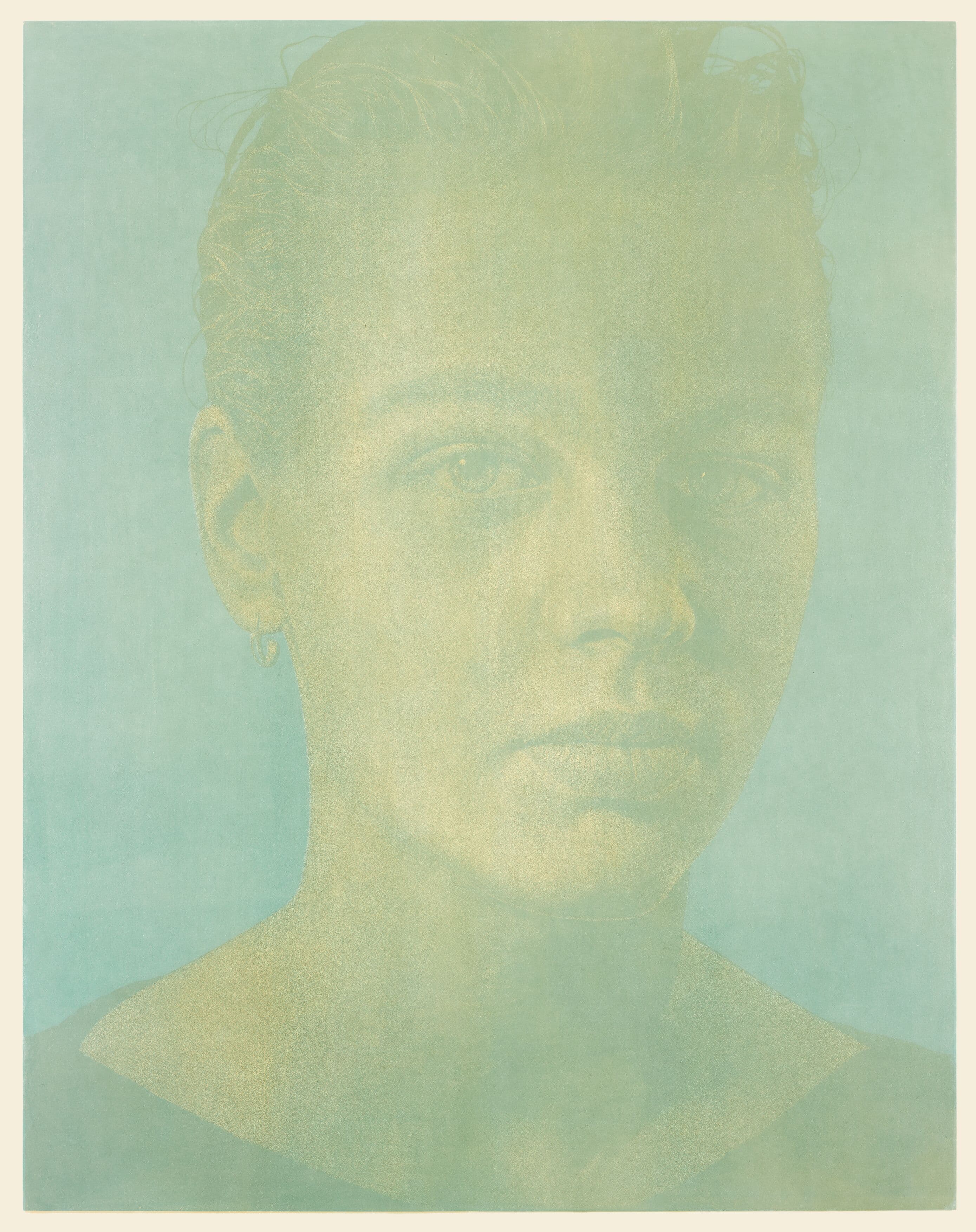
Franz Gertsch, Natascha IV, 1987-88. Woodcut (3 plates) on Kumohadamashi Japanese paper by Heizaburo Iwano, 91 ½ × 71 ⅝ inches. Courtesy Estate of Franz Gertsch and Hauser & Wirth. Photo: Dominique Uldry.
Word count: 879
Paragraphs: 10
Hauser & Wirth
November 11, 2025–January 31, 2026
New York
Emerging in the early 1970s from a European counterculture shaped by Americanization, anti-authoritarian activism, experimental lifestyles, and new forms of art and music, Franz Gertsch (b. 1930; d. 2022) distinguished himself through both technical virtuosity and his ongoing inquiry into the ways the real is constructed and re-experienced. Renowned for his photorealistic paintings and complex woodcuts, the artist’s subtle and layered approach is easy to miss when seen through a small selection like the eight works that make up Presence at Hauser & Wirth’s Wooster Street gallery. The intricacies of his paintings—and their resistance to immediate apprehension—tend to emerge only through sustained looking and comparison; a brief encounter seldom reveals the fact that Gertsch’s project is not simply one of skill, craft, or photographic realism.
Using the photographic image as a pretext to reconsider the relationships among perception, painterly process, and the construction of visual reality, Gertsch does not replicate photographic images for their own sake. Translating photographic data into paint becomes, for him, an investigation into the technical, visual, and conceptual ambiguities of perception and cognition. The illusion of mimetic realism—especially on a monumental scale—is never merely descriptive; it is patiently constructed through focused and prolonged attention, reflecting the recursive nature of perception itself. Rather than offering smooth, unified surfaces, his work, upon close inspection, proves irregular, elusive, and irreducible to a simple mimetic effect.

Installation view: Franz Gertsch: Presence, Hauser & Wirth, New York, 2025–26. © 2025 Franz Gertsch AG. Courtesy Estate of Franz Gertsch and Hauser & Wirth. Photo: Sarah Muehlbauer.
Unlike most photorealists, Gertsch foregrounds brushwork, irregularity, and textural density, transforming photography’s immediacy into a contemplative surface that resists equivalency. This resistance to seamlessness defines his relation to painting—as well as to photography—where the photograph is never a simple referent to be copied, but a starting point for a process governed by its own logic. Each work’s complexity unfolds gradually, foregrounding the primacy of seeing (observation) over recognition and turning each painting into a site for reflection on the limits and possibilities of an independent, recordable reality.
By resisting the apparent instantaneity of the camera, Gertsch reimagines painting and printmaking as time-intensive processes, using the illusion of realism to interrogate itself. His decision to work at billboard scale—akin to the monumental ambitions of Abstract Expressionist canvases—transforms viewing into a bodily, time-based encounter that requires the sustained attention his surfaces so quietly but powerfully demand. Unlike much of American photorealism—which often grounds itself in a logic of surface, commodity, anecdote, and social iconography—Gertsch’s work is rooted in phenomenological inquiry, marked by attentiveness to temporality and the texture of experience.
This distinction enables a critical dialogue with postmodern theorists such as Jean Baudrillard and Fredric Jameson, who argue that photorealism produces simulacra: seductive surfaces detached from substance, aestheticizing the spectacle of capital. For Jameson, this signals a logic of depersonalized replication; for Baudrillard, simulacra mask the absence—emptiness beneath a veneer of capitalism. Yet, Gertsch’s labor-driven, multilayered surfaces actively unsettle such readings. His work presses the viewer to confront the construction of the image itself, rather than submitting to its visual immediacy. Thus, he redirects our attention to the boundaries and variables that come with replicating in paint vision and its photographic representation.

Installation view: Franz Gertsch: Presence, Hauser & Wirth, New York, 2025–26. © 2025 Franz Gertsch AG. Courtesy Estate of Franz Gertsch and Hauser & Wirth. Photo: Sarah Muehlbauer.
In this context, Gertsch’s photorealism echoes that of Chuck Close, who employs a systematic grid to reconstruct and dissect photographic imagery, thereby foregrounding the constructed nature of mimesis. This approach sharply contrasts with Gerhard Richter, for example, who deploys blurring and overt painterly interventions to question the difference between photographic and painterly models of perception. Occupying a space between these two approaches, Gertsch maintains a discontinuous relationship between photography and painting, grounding his practice in the accretion of visual data. Through recursive layering, close-up detail, and an unsettling of the boundary between invention and fidelity, Gertsch draws the viewer into an open-ended act of seeing, where fixity is perpetually negotiated.
Gertsch’s work is also distinct from the photorealist portraiture of Rudolf Stingel, who since the mid-2000s has used photographic images as the foundation for paintings that introduce conceptual distance by meticulously transcribing not just the subject’s image but the characteristics of the photographic source: scratches, grain, and surface wear. For Stingel, photorealism registers absence, a vulnerable surface; for Gertsch, it functions as a method to reassert the situated, the sensuous, and the tactile.
It is precisely through this recuperation of the sensible that the political and social dimensions of Gertsch’s work emerge. If his work seems opaque to US audiences, it is not a matter of accessibility but critique: in a culture attuned to speed and simulation, Gertsch offers slowness and sustained focus as radical alternatives to the visual immediacy and surface consumption dominant in mass culture. In this act of resistance, the artist’s meditative practice becomes a critical intervention, inviting viewers to reconsider the politics of seeing and recognize both the limits of spectacle and the value of sustained material engagement. The politics of seeing, Gertsch—like John Berger—reminds us, resides in the refusal to see too quickly, too easily, or by the anecdotal logic prescribed by habit. With this critique compounded by a nearly Samuel Beckett-like restraint, it is little wonder that Gertsch’s works, despite how spectacular they are, have found limited recognition in the United States, where critical discourse continues to be bent to novelty, controversy, and the anecdotal.
Saul Ostrow is an independent critic, curator, and Art Editor at Large for BOMB magazine.