ArtSeenDecember/January 2025–26
Helen Frankenthaler: A Grand Sweep

Helen Frankenthaler, Jacob's Ladder, 1957. Oil on canvas, 113 ⅜ × 69 ⅞ inches. Courtesy the Museum of Modern Art, New York.
Word count: 721
Paragraphs: 6
The Museum of Modern Art
November 18, 2025–February 8, 2026
New York
Perhaps the biggest shock of my editorial career came when the Brooklyn Rail received a pitch to review an exhibition of Helen Frankenthaler’s woodcuts in London. I wasn’t surprised that Frankenthaler had made woodcuts, as I had seen several beautiful examples years ago in Boston: radical, resolutely abstract works building on Japanese printmaking practices that more immediately resembled watercolors than Albrecht Dürers. No, what surprised me was that the pitch described Frankenthaler as little known. I suspect it would have astonished Frankenthaler, too, for no one who encounters the five enormous paintings currently installed in the Museum of Modern Art’s atrium could be under any misapprehension of the artist’s authority or the scale of her ambition.
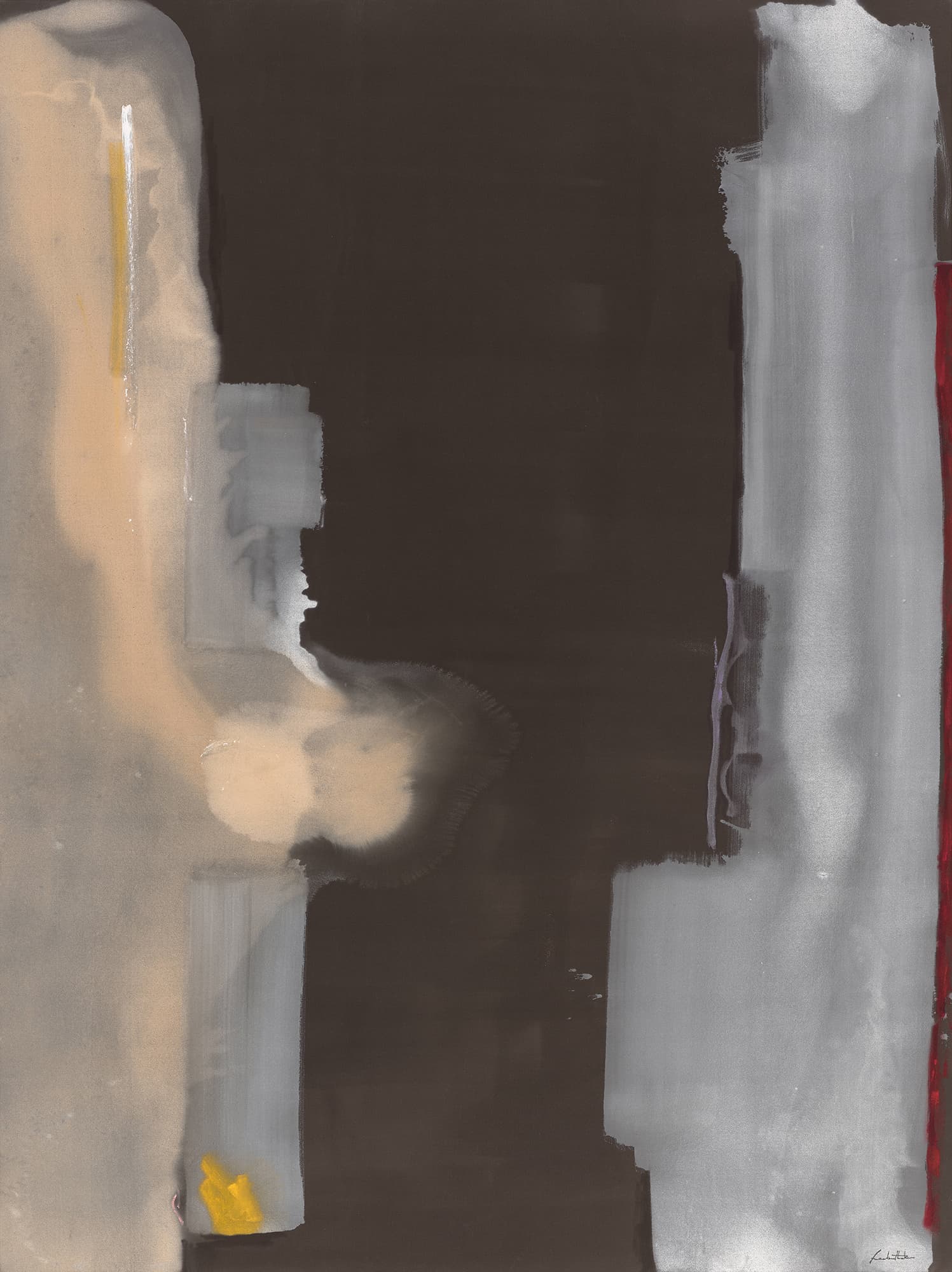
Helen Frankenthaler, Toward Dark, 1988. Acrylic on canvas, 118 ¼ × 88 ½ inches. Courtesy the Museum of Modern Art, New York.
A Grand Sweep covers thirty years of Frankenthaler’s career, ranging from the then-twenty-nine-year-old painter’s Jacob’s Ladder (1957) to Toward Dark (1988), finished when she was sixty—from hints of narrative and iconography to a melancholy looming of paint. Jacob’s Ladder was made five years after what is likely Frankenthaler’s most familiar painting, Mountains and Sea (1952), but it still operates in the same mode. There is the suggestion of a story or a landscape, contour lines make appearances along with Frankenthaler’s signature staining technique, forms are relatively small-scale compared to the size of the canvases, and the artist’s oil-paint palette hews to pastels. Frankenthaler reminisced that she was thinking of José de Ribera’s Jacob’s Dream (1639), seen in person during a 1953 trip to El Museo Nacional del Prado, while painting Jacob’s Ladder, and indeed, we encounter a vertical canvas with color most densely stacked at the bottom, so that the painting lightens as our eyes move up, guided by two inclining diagonals that almost form the tip of an upward-pointing arrow. Toward Dark hangs opposite Jacob’s Ladder across the atrium. Though also vertically oriented, its weightier strokes and earth-tone highlights resonate as those made by an artist in her full maturity: thoughtfully considered in contrast to an earlier limpidity. Toward Dark was given to the museum by the artist’s estate in 2023, occasioning this exhibition.
With Frankenthaler’s move from oils to acrylics, her forms become bigger, their edges sharper, their color somehow flatter or less dappled. Mauve District (1966) and Commune (1969) are both from the late sixties, at which point Frankenthaler had already been exhibiting seriously for more than a decade, and are paintings made after the moment of Abstract Expressionism had passed (notably, Frankenthaler’s marriage to fellow painter Robert Motherwell had begun to disintegrate and would end in divorce in 1971). There are still a few drips here and there, linking them to her first works and to the spontaneity so characteristic of that group of artists, but Frankenthaler was now redefining allover painting for her own practice. In place of the crowded, staccato rhythm of a painting like Jacob’s Ladder, forms now float in or occupy the canvas, languidly stretching, as in The Bay (1963) at the Detroit Institute of Arts and the paintings included here, or darting across, like the jolting orange diagonal in the Metropolitan Museum of Art’s Stride (1969). Frankenthaler’s painting acknowledges the furthest reaches of the picture plane without necessarily absorbing or even touching them.

Installation view: Helen Frankenthaler: A Grand Sweep, the Museum of Modern Art, New York, 2025–26. Courtesy the Museum of Modern Art, New York.
Remarkably, the fifth painting in A Grand Sweep manages to combine all of these elements—staining, landscape-spanning shapes as well as dotting boulders, whizzing lines, and even Stride’s pumpkin orange—and hold them in tension. Chairman of the Board (1971) is the exhibition’s only horizontal painting, and it is colossal at a bit more than sixteen feet long; this is the canvas Frankenthaler described as “a grand sweep.” In Chairman of the Board, a mass of orange staining is used as the ground. A “V” of unpainted canvas that swings from the top corners serves as a figure until it ducks under spills of pink, purple, tan, and bright green at the painting’s center. And then, in case that might create too much depth or time or allusion, the artist dashed a seven-pointed star in felt-tip pen through the center of everything. Not a defacement but a detonation, it bursts like a catherine wheel firework right out of the canvas, Helen Frankenthaler’s “explosive landscapes” caught in the act.
Amanda Gluibizzi is an art editor at the Rail. An art historian, she is the Co-Director of the New Foundation for Art History and the author of Art and Design in 1960s New York (2021, paperback 2025).