James Rosenquist: Waiting for an Idea
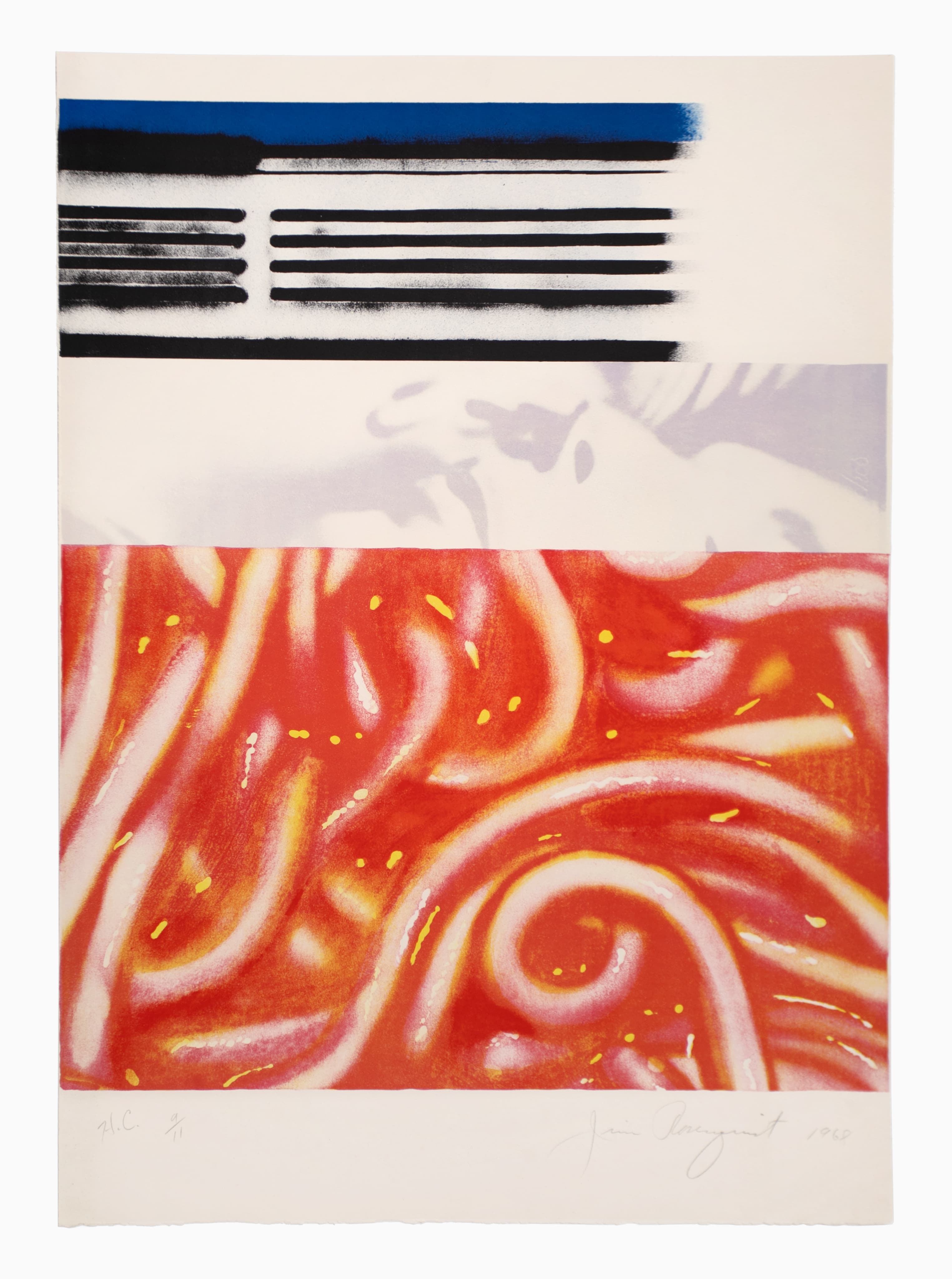
James Rosenquist, Forehead I, 1968. Five-color lithograph on Arches Cover White paper, 33 ½ × 24 ⅝ inches. Courtesy the James Rosenquist Estate.
Word count: 1020
Paragraphs: 8
Off Paradise
January 21–March 21, 2026
New York
James Rosenquist becomes newly legible when he is approached not as a canonical figure of Pop art, but as an artist tracking how social experience is reorganized by a world of proliferating images. In this light, his decontextualized representations slot directly into a larger argument about realism after modernism, in which “reality” arrives through the circulation of images rather than as stable objects or narratives. The exhibition Waiting for an Idea at Off Paradise compresses the arc of his project into a compact—almost meta—diagram, showing how his billboard pictorialism, translated into prints, reveals itself less as a spectacular celebration of commercial imagery than as a spectral form of Pop-Surrealism. In these works, Rosenquist begins to look less like a classic Pop artist and more like a prescient postmodernist: the prints anticipate a condition in which originality gives way to iteration, authorship to recombination, and the work of art functions as a node within an expanded network of visual exchange. As such, he appears as a kind of reluctant formalist for whom images function less as signs than as compositional components.
If his paintings are still read as engaged with the iconography of commercialism, his prints are more concerned with the way collaged, fragmented images promise meaning and then suspend it. Stripped of the physical scale and the photorealist charisma associated with his large canvases, Rosenquist’s familiar repertoire—spaghetti, car fenders, cosmetics, anonymized faces—no longer reads as a satirical or critical incursion into capitalist society; these elements instead appear as familiar remnants of an already image-saturated culture. A clear instance is Forehead I and Forehead II (both 1968), a pair built from the same stacked images of spaghetti, a face, and a car grille. Forehead I is rendered as a five-color print in which the spaghetti appears in vivid color, and Forehead II is a four-color version in which the spaghetti drops into black and white. Here the mechanical, reproductive nature of the print medium dampens whatever auratic charge might cling to such motifs, so that they register as familiar imagery redeployed as abstract elements more than as communicative signs.

Installation view: James Rosenquist: Waiting for an Idea, Off Paradise, New York, 2026. Courtesy the James Rosenquist Estate and Off Paradise, New York. Photo: Marc Tatti.
A Drawing While Waiting for an Idea (1966), executed on a paper towel, reads as a mordant acknowledgment that the traditional modernist notion of “the idea” arriving—whether as political program, formal breakthrough, or psychic revelation—had, by the 1960s, begun to feel systematically undercut and disposable, something to be used and thrown away once it had served its function, much like the towel itself. In place of an inspired, originary idea, Rosenquist substituted cut-and-paste procedures that expose how such “ideas,” as floating signifiers, are subject to free association and endless recombination. Here the print medium is not incidental but constitutive: layered processes of lithography and intaglio overprinting literalize the way images are compiled and reissued, so that the resulting composition becomes inseparable from, and to some degree about, its mode of production.
Compositions developed from small paper collages of mechanically reproduced images underpin much of Rosenquist’s print work. The 1979 collage of sources for Dog Descending a Staircase, which initially read as an artist’s study, reappear in editioned form as Dog Descending a Staircase (1980–82), making the passage from sketch to print an explicit part of the work’s logic. Under these conditions, “ideas” are no longer concepts to be deepened so much as arrangements to be managed, rearranged, and recirculated. Rosenquist’s montage technique thus functions as a diagram of realism’s revised terms: where nineteenth-century realism claimed to reveal the social by rendering it, his work proceeds from the recognition that social experience is already image-mediated, and his procedures—cropping; splicing; abrupt scale shifts; slick, impersonal finish—no longer stand at a critical distance from the world they depict but replicate the very operations through which that world is already given to perception. In the prints, this replication is sharpened by the thinness of the support and the shallowness of the surface as the image sits almost flush with the paper, closer to magazine or poster than to oil painting, reinforcing the sense that “reality” arrives as a succession of flat, interchangeable images.

James Rosenquist, Dog Descending a Staircase, 1980–82. Color lithograph/intaglio on cream wove Arches paper, 42 × 70 inches. Courtesy the James Rosenquist Estate.
Seen in this light, the familiar conflation of Rosenquist with Pop’s commodity fetishism looks increasingly inadequate. The prints still traffic in commodities, but not as isolated objects of desire; instead, everyday things appear as interchangeable components within a larger circuitry of standardized, reproducible images. What repeats are not discrete “things” so much as formats and schemas, and the evident pleasure taken in technical variation underscores the shift from the commodity as object to the commodity as visual regime. Rosenquist’s cropped, decontextualized fragments refuse narrative closure—their specific referents hardly matter, so long as attention is captured, interrupted, and redirected. In this sense, the prints do amount to a kind of realism in that they register a world in which there is little “behind” the image beyond further images.
What emerges from these works is the fact that Rosenquist is neither simply the billboard painter who smuggled the vernacular into the museum nor the Pop master whose collage conveniently anticipates media theory. In these prints he appears as a latter-day surrealist of the commercial unconscious, a printer-painter whose methods coincide with both the sublimity and the banality of the culture he seeks to lay bare. The pertinence of the prints, given their scale, format, and materiality, lies in their distance from the glossy commercial operations of their sources, while at the same time they expose the thin, almost imperceptible gap that separates Rosenquist’s fragmented images from the narratives he derives them from. In this sense, the title Waiting for an Idea calls to mind Samuel Beckett’s Waiting for Godot: what is at stake is not the arrival of some long-deferred “idea” that would redeem these images, but the recognition that nothing is coming to their rescue—that meaning is structurally deferred by the very circuits that produce and distribute images. If Beckett’s tramps wait in vain for a figure who never arrives, Rosenquist’s prints wait, equally in vain, for an “idea” that would stand outside the image-world they inhabit.
Saul Ostrow is an independent critic, curator, and Art Editor at Large for BOMB magazine.