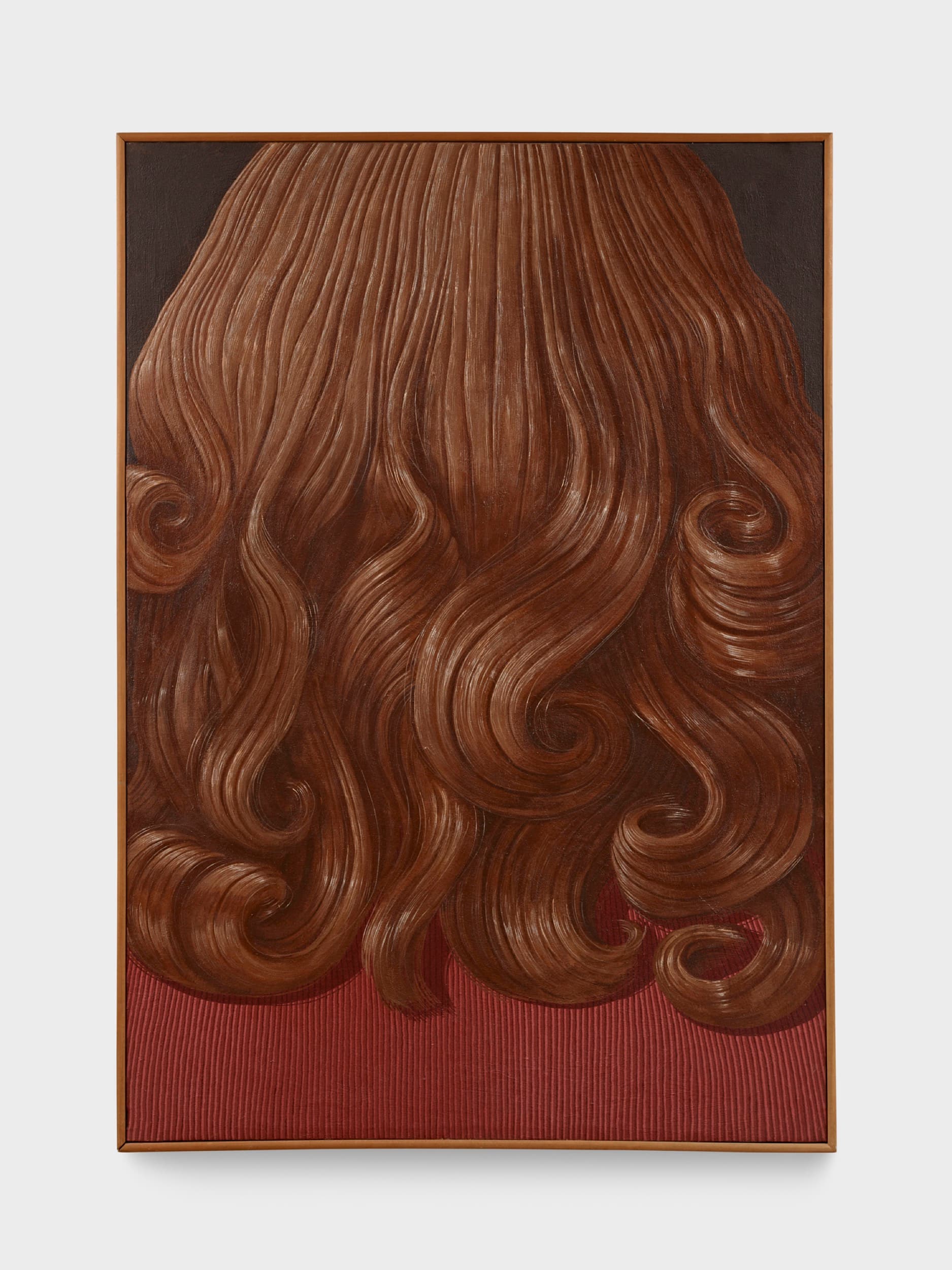
Domenico Gnoli, Curly Red Hair, 1969. Acrylic and sand on canvas, 79 × 55 ½ inches. © 2026 Artists Rights Society (ARS), New York. Courtesy Lévy Gorvy Dayan, New York.
Word count: 988
Paragraphs: 11
Lévy Gorvy Dayan
March 18–May 23, 2026
New York
Domenico Gnoli (b. 1933, d. 1970) was born in Rome and died in New York City. His circle of friends and associates embraced the overlapping worlds of postwar European modernism, high‑culture liberalism in the United States, and the emerging international nexus of fashion and art. In particular, Gnoli’s mature work is informed by fashion photography’s obsession with detail, the garment as sculptural form, and cropping as compositional strategy.
Before devoting himself fully to painting, Gnoli moved between illustration, stage design, and work for magazines such as Sports Illustrated and Fortune. Between 1965 and 1969, he produced an extensive body of large‑scale canvases. After a critically acclaimed first solo show in 1969 at Sidney Janis Gallery, he died in 1970 of cancer at the age of thirty-six, turning his brief career into a posthumous legend in Europe. But in the United States, he lingered in obscurity. If addressed at all, he is treated as an isolated “Pop‑related” curiosity.
It feels apt that Gnoli’s work re‑emerges precisely at the moment when contemporary art seems most emphatically to have run out of resources and models. What makes Gnoli’s work refreshing is that, formally, his paintings are anchored in the European concept of the tableau—the idea that a painting is a self‑contained pictorial stage, an event whose meaning and subject arise from within the painting itself rather than from external references. This tradition, largely unknown in the US, feels radical today, when so much painting, whether mimetic or abstract, seeks validation through discursivity rather than through the discipline of seeing: a slow, sustained encounter between eye, surface, and the strategic indeterminacies that remain painting’s greatest strengths.

Installation view: Domenico Gnoli: The Adventure of Domenico Gnoli, Lévy Gorvy Dayan, New York, 2026. Courtesy Lévy Gorvy Dayan. Photo: Elisabeth Bernstein.
A parting of hair, the bust of a woman in a tight dark red dress, or the patterned expanse of a bedspread fill the pictorial field so completely in Gnoli’s paintings that what should register as a detail—a fragment—becomes the terrain of sensation, vision, thought, and referentiality. In other words, these are not merely blown‑up details, representations whose completeness lies outside the painting’s frame; they are in themselves a complete reality. In this context, Gnoli might be thought of as a realist, but his realism is not mimetic. It is cognitive, psychological, and above all haptic: grounded in the way perception links thought and touch, and concerned with the interaction of image and body, attention and the world of things. In this sense, his paintings are the site of real relationships between isolated forms, the painted surface, and the conditions of looking and observing. The cropped view, the monumental scale, and the image’s flatness all set the stage for this phenomenological confrontation between the viewer’s gaze and the object’s presence, transforming the ordinary into an arena of mediation.
Gnoli’s measured, deliberate, unflinching attention to the surface of his paintings and to the stylization of the things they depict—an attention that is at once conceptual, compositional, and perceptual—reminds us that painting simultaneously sustains multiple functions. It is a site of thought, of imagery, and of sensory experience. Yet these modes do not reveal themselves sequentially. Instead they are co-present, folded into the single event of the tableau, within which the painting is understood as a self-sufficient world, withdrawn from narrative. Such a conception echoes what Michel Foucault described in his 1966 essay on Diego Velázquez’s Las Meninas (1656): the tableau as a system of visibility in which what can be seen, thought, and said are organized within the closed field of the picture. As such, the painting, rather than being a singular, illustrative composite that the viewer interprets, is an image system that must be taken apart.
Yet this analytical imperative conceals an intensity that complicates the very distance it demands. This practice belongs more to a European tradition in which images are constructed and encountered as machines, not as text to be deciphered. What Gnoli’s machines generate is never neutral. Their imagery and surfaces verge on the fetishistic and erotic, where the viewer’s gaze becomes implicated in the very intensities the work stages—a scrutiny that is simultaneously analytical and bodily. In this tradition, what appears as analytical distance ultimately collapses into something far more intimate and charged.

Domenico Gnoli, Striped Trousers, 1969. Acrylic and sand on canvas, 67 × 63 inches. © 2026 Artists Rights Society (ARS), New York. Courtesy Lévy Gorvy Dayan, New York.
Composed frontally and within the rectangle of the canvas, Gnoli’s works are classical in the sense that they are informed by a tradition that dates back to Piero della Francesca, whose geometry of space is not merely perspectival, but a way of ordering the world. Gnoli combines this classical structure with the psychic stillness of Giorgio de Chirico, where the painting’s surface becomes a stage upon which ordinary objects are granted an uncanny existence. Underlying both these qualities is the tactility of the early Netherlandish and Northern Renaissance painters, for whom depiction was a form of devotion to the visible world, with every fold of cloth, every contour of skin, rendered as an act of sustained attention rather than the mechanical recording of appearances or the elaboration of a decorative motif.
The precision and stylization of Gnoli’s imagery is not technical but strategic: each brushstroke is a negotiation between description and materiality, animating the object’s surface, and, through its resistance to narrative, eliciting a realism of affect and cognition rather than of likeness. For Gnoli, the tableau does not open onto the outside world so much as it folds that world into itself, admitting it only as a cropped, overdetermined referent.
Sense is derived through scrutiny. The enlarging, isolating, and re‑staging of fragments of the everyday—the seam of a suit, the toe of a shoe, the strap of a blouse—come to be read as sites where the surface of the body, the body of clothing, and the body of the painting (the tableau) coincide and are charged with a surplus psychic and social identity. In painting, a detail is never incidental; it is where the real begins.
Saul Ostrow is an independent critic, curator, and Art Editor at Large for BOMB magazine.