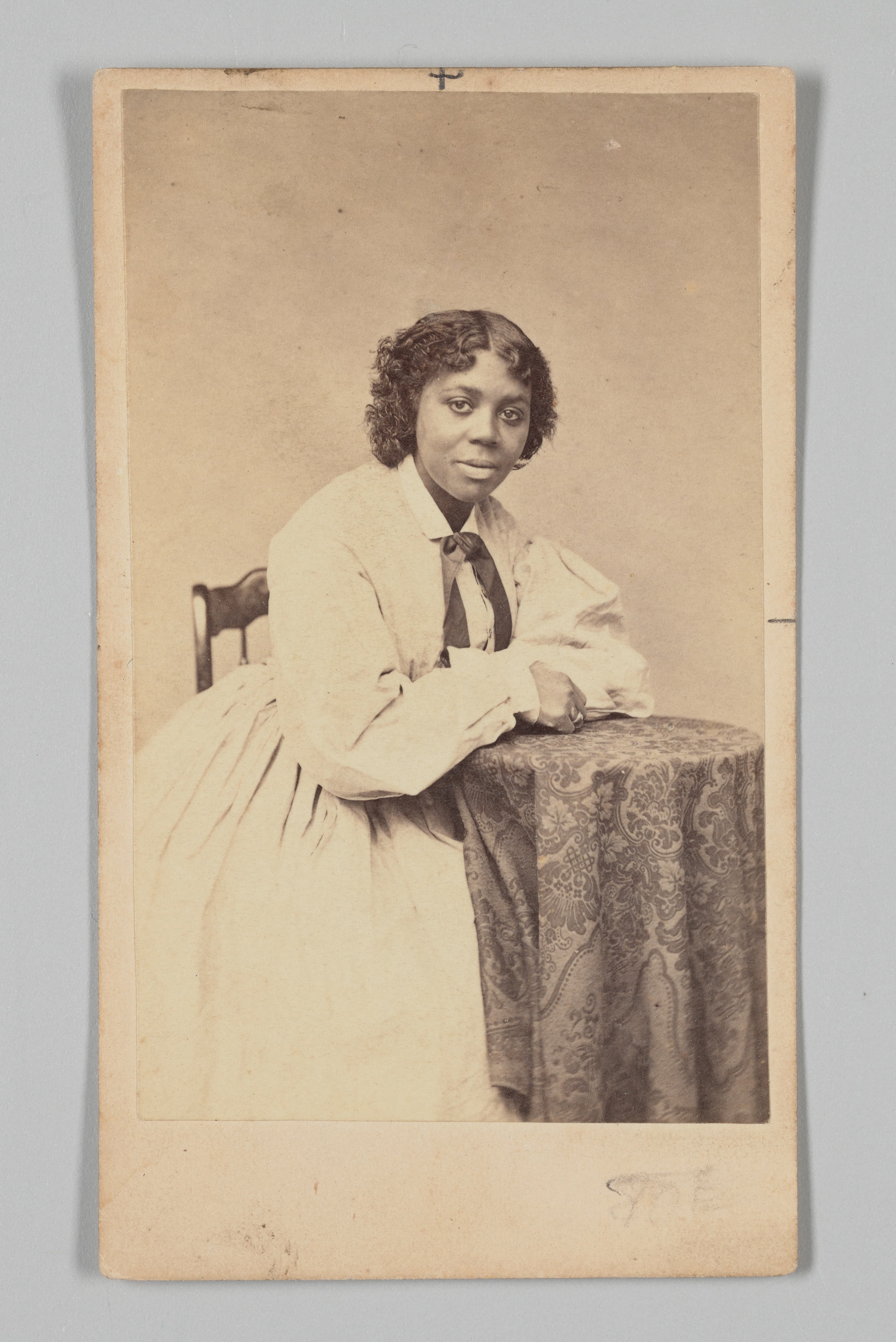
Augustus Marshall, Portrait of Edmonia Lewis, ca. 1870. Carte-de-visite albumen print. Courtesy the Smithsonian National Museum of African American History and Culture.
Word count: 1233
Paragraphs: 12
Peabody Essex Museum
February 14–June 7, 2026
Salem, MA
Before seeing any work in Edmonia Lewis: Said in Stone, Peabody Essex Museum visitors encounter a set of glass doors and a navy wall with text that reads:
In the last wintry days of 1865, the United States still smoldered after five years of civil war. Sculptor Edmonia Lewis stepped onto the streets of Rome and into a new world of possibilities. Championed by Black and white abolitionists from Boston, and welcomed by an international community of artists, she began a storied life in the Eternal City—
This historical context tells us Lewis’s career began before the Civil War and reached its peak right as Reconstruction ended, which demonstrates how her career was positioned during and in between these significant strides and setbacks in American history. The last sentence of the label, at the beginning of the show, ends in an em dash, a creative gesture that suggests the work of her life is unfinished, ongoing, or that it holds the possibility of detail, depth, or another layer to her. With that framing, we cross the threshold of the glass doors into Lewis’s first retrospective.
Was Edmonia Lewis (b. 1844, New York; d. 1907, London) a feminist? While I’m aware of the theoretical challenges of holding a presentist view toward history before new verbiage has formed, the question resounded in my mind, nonetheless. The word “feminism” has so many mixed associations, yet Lewis carved out her own narrative of political assertions to build an international career from art that didn’t relegate her to just being a “race woman.” One of the first eye-catching works is Forever Free (1866–67), in the first section of the exhibition, titled “Antislavery and Emancipation.” It shows the standing figure, a man, with soft musculature, breaking his own chains. Kneeling next to him is a woman in a pose of supplication. This work complicates the question of Lewis being a feminist because of the unequal posture. However, the work is a stark contrast to typical abolitionist imagery, the Black subject in repose with chains breaking or some force from above doing the chain-breaking; it asserts agency.
In the “Indigenous Artistic Worlds” section, Mississauga and Haudenosaunee belongings are paired to add context to the creative world in which Lewis was raised. It also serves as a matriarchal throughline with a side-by-side couple. Since the museum has identified the culture that produced this work but not the individual maker, they have recast the byline as “name once known,” and noted the importance of child-rearing with the intricate child carrier. Hiawatha’s Marriage (1870) infers an equality of Hiawatha and Minnehaha, who are in lockstep with their hands clasped, demonstrating Lewis’s dedication to social equality.

Edmonia Lewis, Forever Free, 1867. Carrara marble. Courtesy Howard University Gallery of Art, Washington DC / Licensed by Art Resource, NY. Photo: the Metropolitan Museum of Art.
With a furrowed brow, signifying anxiety, Hagar (1875) is depicted alone in contrapposto, a tipped-over water jug by her feet. This framing of the moment in her story amplifies the resolve of Hagar in the Biblical story to free herself in the wilderness. Her story is one that Womanist theologians identify with because her captivity involved the rape by and childrearing of slaveholders, which parallels the experience of Black women in America. In this depiction, Lewis does not include Hagar’s child Ishmael but instead makes her the protagonist of the story, her contrapposto posture denoting movement and self-determination. In the exhibition, the words of Lewis herself appear: “I have a strong sympathy for all women who have struggled and suffered. For this reason the Virgin Mary is very dear to me.”
The Death of Cleopatra (1876) was staged as a life-sized cutout with a picture of what it would have originally looked like in the 1876 Centennial Exposition. Unfortunately, due to its neglect for over a hundred years, during which it was exposed to the elements and found in too fragile of a condition to travel and fully be a part of Lewis’s retrospective. We see a reproduction of the work: an enthroned Cleopatra, covered in modest drapery with erect nipples, which suggests an aliveness while she is in the process of dying; her face is turned to the side, not in anguish but entering an eternal slumber. Lewis once again demonstrates her feminist bona fides through her depiction of the queen in a dignified posture on her throne, showing the metaphoric weight of authority that honors her royal position. Lewis’s refusal to eroticize Cleopatra further by dressing her modestly rather than scantily gave her dignity in death.
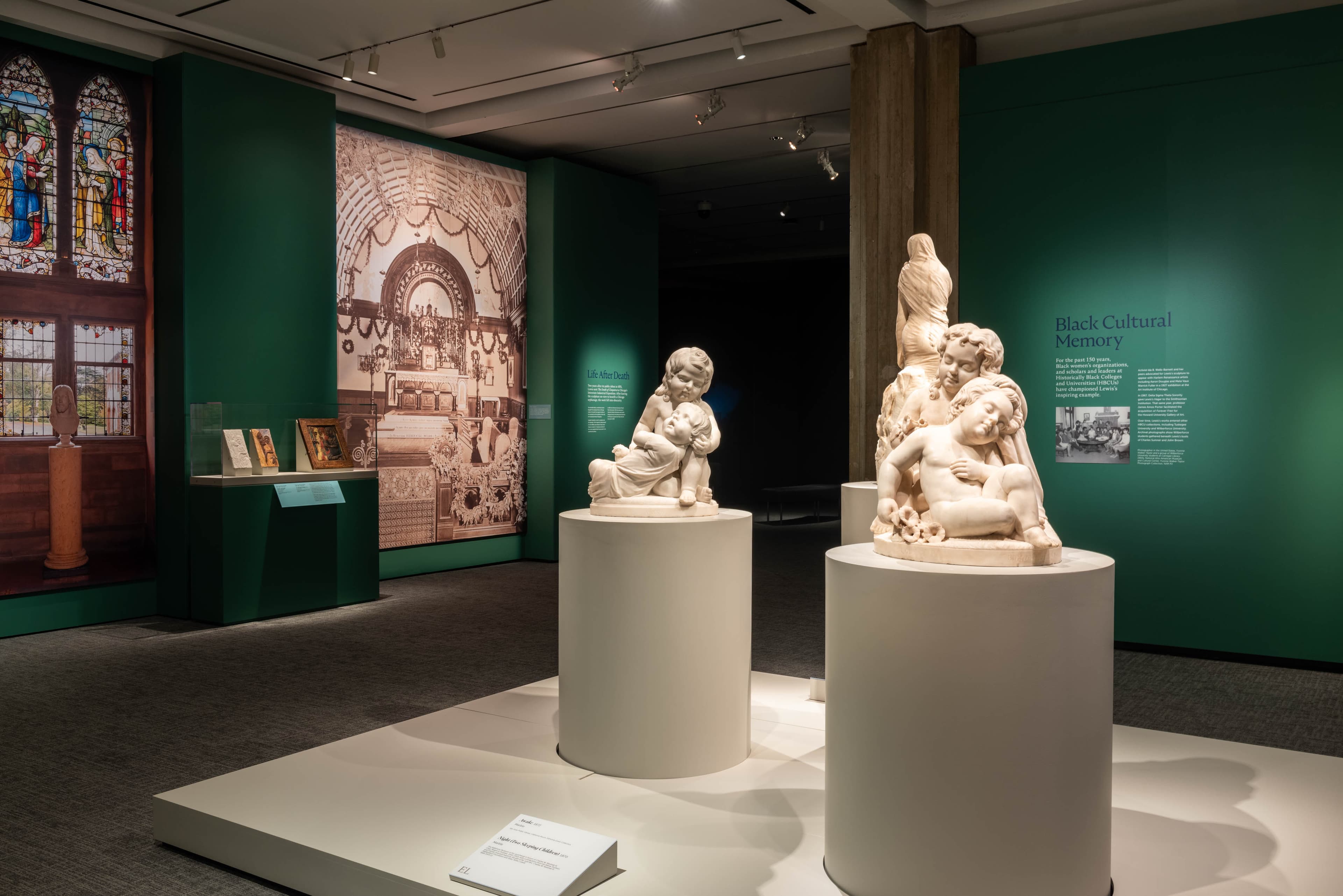
Installation view: Edmonia Lewis: Said in Stone, Peabody Essex Museum, 2026. Courtesy Peabody Essex Museum. Photo: Kim Indresano.
The plaster-casting iterative tutorial in the center of the show was particularly remarkable. The rest of the show was in conversation with the work of her contemporaries and later artists, yet it did not feel like a group show. There were many moments of wonder. One work, Indian Combat (1868), felt like an outlier both compositionally and conceptually, yet in a career retrospective in which many works are extant, it’s important to have gaps or a “half-presence” rather than none at all. In this work, three men are entangled in hand-to-hand conflict: one man is on the ground in between the other two, reaching up toward them as they fight. This dynamic positioning of intertwined limbs and fighting gestures—as well as the many levels of standing—demonstrate proportional mastery and anatomical correctness that could easily be foreshortened. However, it reminds the viewer that they may never know the artist’s full intentions in their work and that there were complexities in her thought process.
At the end of the retrospective is a contemporary artwork from Gisela Torres’s “Conjure No. 3,” which punctuates the exhibition as a metaphorical em dash. In a Reverie and Slumber video that plays in the two casts of Lewis’s face—one awake and one asleep or eyes closed. The refrain of the video repeats: “Is that all there is?” There is also a photo-transfer onto a marble shard that introduces a ghostly silhouette of a figure, a looming spirit dwelling in the landscape as a conjure woman. While Dr. Jeffrey Richmond-Moll, who co-curated the exhibition, said that Lewis is selectively remembered, he acknowledged that bastions of Black culture (e.g., The Links, INC., Delta Sigma Theta Sorority, Howard University, Lincoln University) stewarded her memory even when the Western art canon failed her. These were the many sources that he and his team drew from in their art historical detective work. Her erasure from the canon at large questions its importance and inherent coloniality.
Overall, what stands the test of time is the relevance of Lewis’s work, not just her technical prowess. She sculpted during war and political instability, and while she had support from abolitionists, their championing hinged on her “staying in her lane”—as would be said today. They were cultural financiers yet gatekeepers of who was allowed to depict prominent white figures or who could gain recognition for their artistry. The curator noted this as the “hypocrisy of social reformers and abolitionists in Boston.” Lewis received pushback from her white abolitionist supporters for depicting Robert Gould Shaw, who was from a prominent white family in Boston, as if it were above her station to portray such an important figure. To their mind, she would be better suited to making a portrait that a family commissioned. Volatility and gatekeeping are similar today, but Lewis prevailed despite many setbacks and manifested her utopian worldbuilding beyond her compositions—