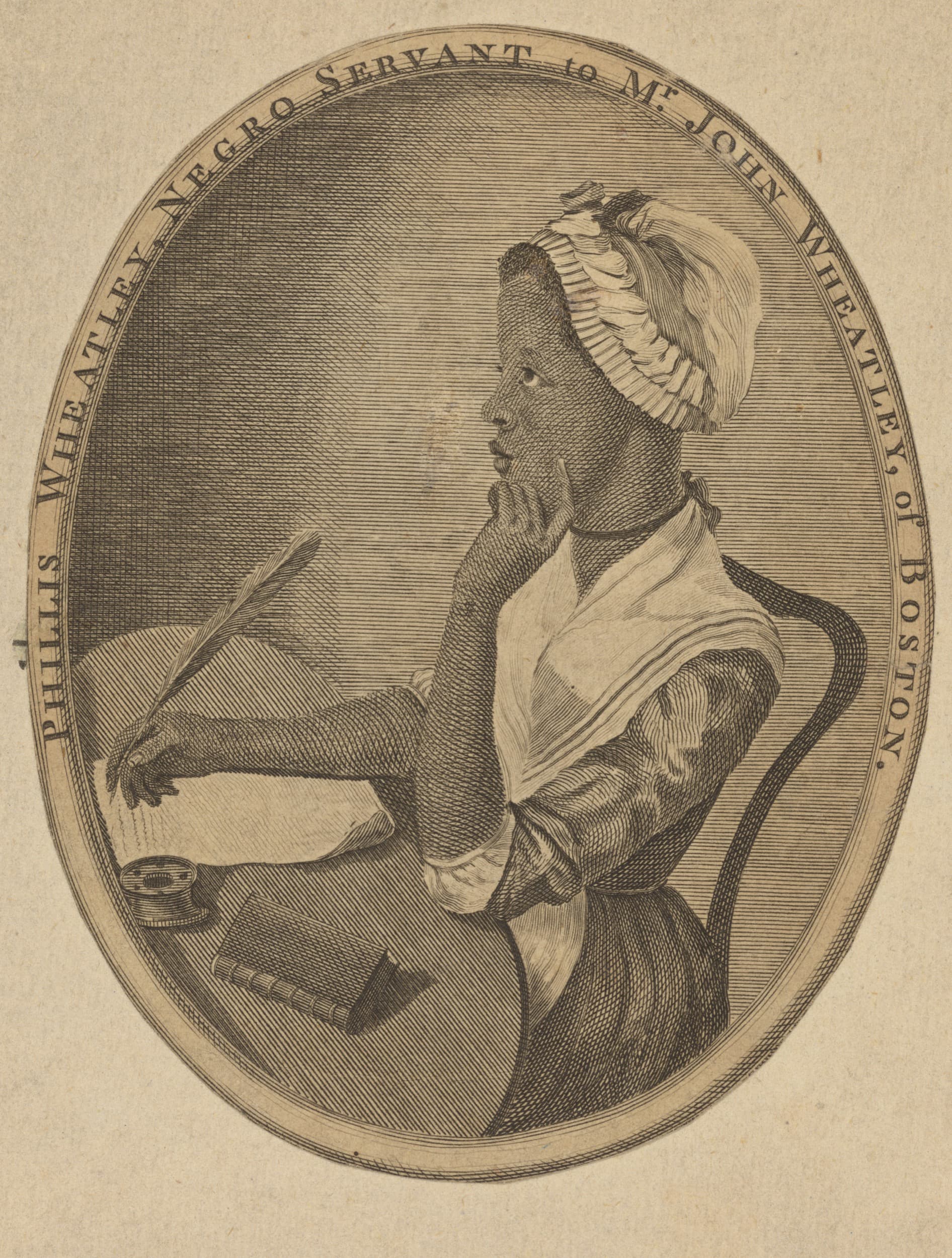
Attributed to Scipio Moorhead, Phillis Wheatley, 1773. Engraving, 5 × 3 ⅞ inches. Courtesy the Metropolitan Museum of Art.
Word count: 1146
Paragraphs: 7
The Metropolitan Museum of Art
January 19–August 2, 2026
New York
“In a revolution, as in a novel,” Alexis de Tocqueville wrote, “the most difficult part to invent is the end.” Marking the 250th anniversary of the Declaration of Independence, the Metropolitan Museum’s compact exhibition Revolution! lays bare the fiction that is the American war for independence. But if revolutions are invented, who are their authors? Juxtaposing documents, broadsides, and printed ephemera alongside portraits, political cartoons, and etchings, Revolution! proposes a prismatic reading of the nation’s founding myth, one in which multiple narratives compelled by numerous forces circle around well-known historical events, each opening perspectives onto the other, defying any simple reading of the nation’s origin story. Indeed, as Jill Lepore observed of the country’s founding in These Truths, “A nation born in contradiction will fight forever over the meaning of its history.”
There was perhaps no other force as central to shaping the revolution as the free market. Included in Revolution! is an earthenware teapot (1766–75) emblazoned with the phrase “No Stamp Act” alongside an example of the very stamp (1765–66)—its embossed Tudor rose and British crown depicted, affixed to a vellum scrap—which so enraged colonists. Passed in 1765, the Stamp Act imposed a levy on all paper goods for purchase in the thirteen colonies. Rankling gentry and merchant class alike, the Stamp Act was one of several mercantile interventions by Britain’s Parliament—the Tea and Sugar Acts among them—that struck at the very heart of the classical liberal arm of the revolution. Adherents, including Common Sense firebrand Thomas Paine, held fast to a belief in limited government and free market supremacy. Meanwhile, for the likes of Benjamin Franklin and John Adams, ideologically defined as they were by traditional republicanism, taxation without representation was a mortal assault on the civic values they believed central to a functioning democracy.

British (American market) Teapot, 1766–75. Made in England. Earthenware, height: 5 ¾ inches. Courtesy the Metropolitan Museum of Art.
Yet, as Revolution! sets out to demonstrate, both positions stood to benefit a narrow segment of the colonial population. The rhetoric of representation—the very language of liberty—did not extend to every member of society. As the New Left historian Howard Zinn stridently argued in A People’s History of the United States, for those entirely outside of its terms—Indigenous tribes, people of color, women—the revolution’s financial logic was indistinguishable from the economics of their own dispossession. Included in the exhibition is an engraving attributed to Scipio Moorhead titled Phillis Wheatley (1773). As she was no more than nineteen or twenty at the time of its publication in 1773, Poems on Various Subjects, Religious and Moral made Wheatley, an enslaved African brought to North America as a child, the first African American to publish a book of poetry in the colonies. In the etching, Wheatley strikes a contemplative pose: seated at a desk, quill to paper, left hand raised to her chin. A circular cartouche bounding the vignette of Wheatley features the text inscription, “Phillis Wheatley, Negro Servant to Mr. John Wheatley, of Boston.” The success of Wheatley’s publication took her to London—the etching was likely made during this period—where she was fêted by the British literary elites at the very same time American revolutionaries agitated for freedoms that would not extend to her. “The American War of Independence,” historian Donald Sassoon noted in Revolutions: A New History, “ejected the British but ignored slavery.”
More pointed still, several of the Declaration’s signatories were strident abolitionists—notably Benjamin Franklin, whose presence, directly or by association, appears in Revolution! second only to George Washington. Franklin was known to hand out pro-abolitionist medallions similar to the Josiah Wedgwood-designed black-and-white jasperware cameo (ca. 1787) included in the exhibition. Depicting an enslaved person, shackled and on bended knee with bound arms raised, the cameo’s image is crested by the abolitionist rallying cry: “Am I Not a Man and a Brother?” Notably, Franklin would spend his final weeks, in February 1790, submitting a petition to Congress calling for the abolition of slavery, only to have it tabled before his death. How, then, could Franklin and likeminded pro-abolitionist delegates such as Gouverneur Morris agree to embed the policies of slavery—the three-fifths compromise, the Fugitive Slave Act—in the Constitution? One answer is political pragmatism. Writing in his essay, “The Pathology of Modern Revolution,” historian Richard M. Brace contends the revolution’s rhetoric of liberty, equality, and natural rights was genuine, but only as it served the interests of the settlers consolidating their hold on the colonies. Franklin, Adams, and Morris all willfully traded the dispossession of Indigenous peoples and the perpetuation of slavery for the guarantee of Southern ratification needed to formally adopt the Constitution.

Engraved, printed, and sold by Paul Revere Jr., after Henry Pelham, The Boston Massacre, or, The Bloody Massacre perpetrated in King Street, Boston on March 5, 1770 by a party of the 29th Regiment, 1770. Hand-colored engraving and etching; second state, 10 ¼ × 9 ⅛ inches. Courtesy the Metropolitan Museum of Art.
Among the most striking juxtapositions in Revolution! are the inclusion of two engravings by Paul Revere Jr. that underscore the porous, dialogic character of the revolutionary narrative. The earliest of the etchings, dating from 1770, depicts the Boston Massacre, the bloody confrontation between colonial Bostonians and British troops sent to enforce tax collections on imported goods. Revere’s engraving of the confrontation—Customs House in the background, puffs of smoke emanating from red coat muskets, bloodied men felled in protest—would become a galvanizing image in service of the revolutionary cause, a depiction of colonial oppression at the hands of the British Empire. Revere’s second etching in the show, dating from 1772, portrays the figure of Metacomet—the Wampanoag leader who English settlers called King Philip. A century before the American Revolution, Metacomet led a war against the Massachusetts Bay and Plymouth colonies, following the colonists’ repeated attempts to claim Indigenous lands as their own. A bloody affair, the war left the colonial outposts in ruin and decimated a large number of the native population. The decision to exhibit both works affirms a throughline central to Revolution!: a traditionalist narrative of the American Revolution cannot stand without acknowledging the dispossession of the people who made it possible. Revere Jr.’s etchings, viewed together, can be seen as the exhibition’s argument in miniature: the silversmith, whose engraving of the Boston Massacre became the defining image of colonial grievance against British violence, also produced a commemorative image of an Indigenous leader who resisted the very same colonial society’s expansion.
Back to the original question: what are we to make of the Revolution and its end? At a time when the great experiment of democracy seems especially tenuous, what can be learned from the nation’s inception? An argument can be made that the revolution, which began 250 years ago, never ended. “Revolutions,” Gary B. Nash argued in The Unknown American Revolution, “are always incomplete.” The revolutions of the enslaved, the Indigenous, of women—none has reached its conclusion. The greatest lesson of Revolution! may be the simplest: that Alexis de Tocqueville was right about the end being the most difficult thing to invent, and Nash about it not yet being invented. Two-and-a-half centuries on, the revolution remains as it has always been: unfinished.
Joseph Akel is a New York-based freelance writer and editor. His non-fiction writing and criticism have appeared in the New York Times, the Paris Review, Frieze, and Vanity Fair, among others. Additionally, he has penned several artist monographs, most recently for artist Doug Aitken. Akel is currently working on his first novel. He holds a master’s degree in Art History from Oxford University.