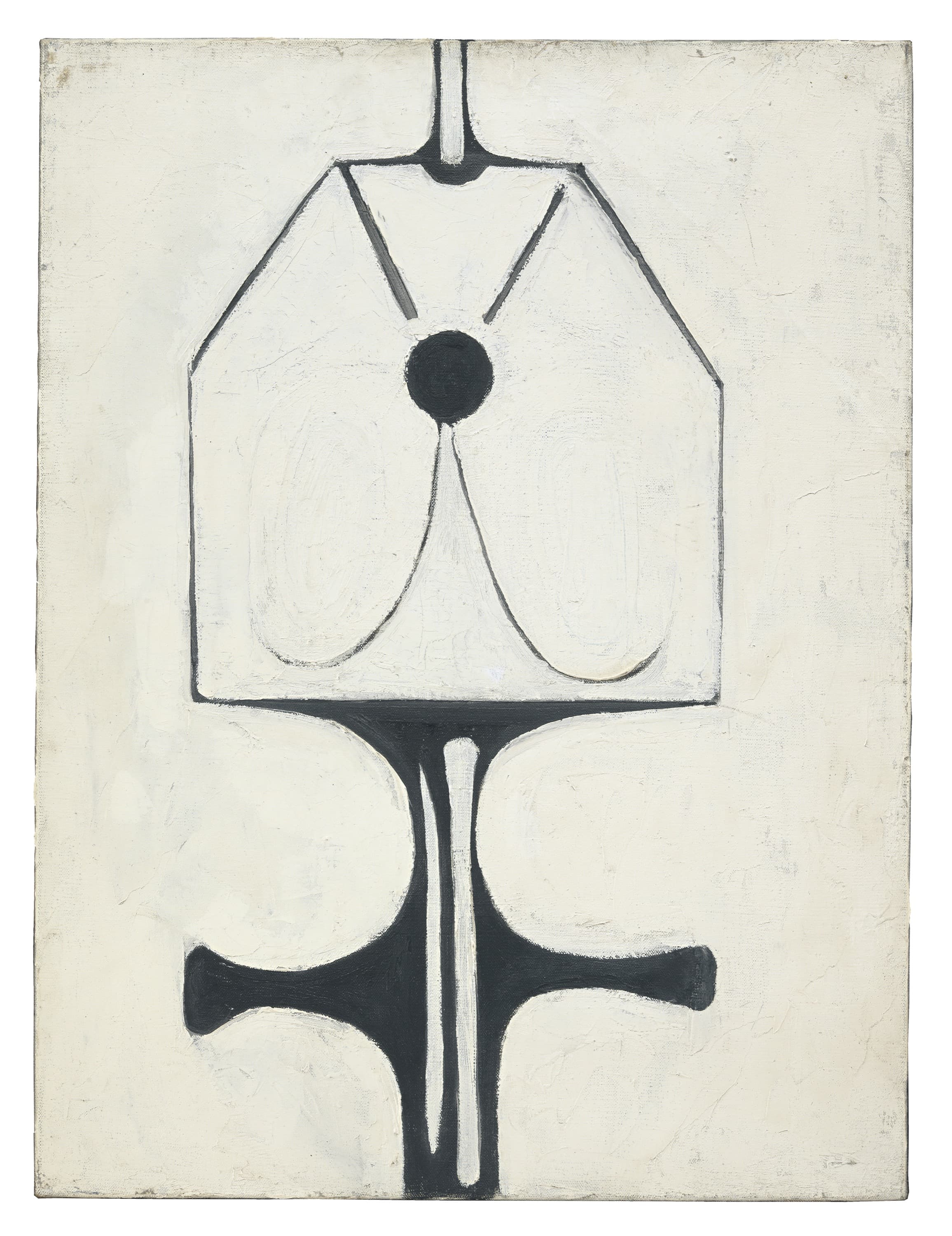
Ellsworth Kelly, Toilette, 1949. Oil on canvas with painted wood frame, 24 ¾ × 18 ¾ × ½ inches. Courtesy Ellsworth Kelly Studio and Parrish Art Museum.
Word count: 806
Paragraphs: 8
Parrish Art Museum
March 8–July 19, 2026
Water Mill, NY
In 1947, Ellsworth Kelly (b. 1923, d. 2015) painted a self-portrait in oil on tar paper showing a barefoot, confident young man holding a bugle in his right hand. His short jacket and jeans make him look vaguely like a young James Dean. The realist style of this painting, recalling so many American artists of the 1940s—Franz Kline in particular—must have made him proud. He brought the work with him to France and submitted it to Fernand Léger, seeking admission to his academy. The elder artist advised him to go back to Boston and play his bugle.
Not being admitted to Léger’s academy was a kind of fortunate fall for Kelly; he stayed in Paris anyway and struck out on his own. He understood something about himself, as he expressed in a note attached to his self-portrait: “I had to go my own way. I had the shapes: the curves and the triangles. What I needed to do was take the figure out.” As two of the seventeen works in this compact show, Ellsworth Kelly: Eight Decades at the Parrish Art Museum demonstrate, he did just that. Where another artist might have haunted the Louvre or imitated the myriad artists living in post-war Paris, Kelly studied insignificant details. Toilette (1949) and Window II (1949) reduce their respective subjects to geometry. They are both in black and white (one of Kelly’s signature combinations in his mature work) and constitute a total transformation. Both oils on canvas are cruciform, perhaps a reminiscence of how he was treated by Léger, but each has banished representation once and for all.

Ellsworth Kelly, Talmont , 1951. Oil on canvas, 26 × 64 ½ inches. Courtesy Ellsworth Kelly Studio and Parrish Art Museum.
Kelly’s metamorphosis parallels Kline’s 1948 transformation into a non-figurative artist, but where Kline’s career would take flight, Kelly struggled to find acceptance in the US until well into the 1950s. His second solo show with Betty Parsons Gallery in 1957 marked the first time the New York art scene, still dominated by Abstract Expressionism, took him seriously. But we must look back to 1951’s Talmont, a landscape format oil painting included here. The shapes scattered over the white canvas in no apparent order are green and slightly irregular, so not pre-figurations of Minimalism. This is a different kind of abstraction, and it is Ellsworth Kelly in full. All of Kelly’s wartime experience in the Ghost Army, a unit of the United States military whose mission was visual trickery, especially camouflage, come into play in this remarkable work. When we look at the random shapes in Talmont (named for a seaside village in southwestern France) we can with hindsight see the Kelly to come: shaped canvases, experiments with the push-and-pull of painterly perspective, and, most especially, color.

Installation view: Ellsworth Kelly: Eight Decades, Parrish Art Museum, Water Mill, NY, 2026. Courtesy the Parrish Art Museum and the FLAG Art Foundation. Photo: Jenny Gorman.
Kelly’s work in the sixties is represented by six black-and-white photographs he took during that decade while staying on the East End of Long Island. All barns, these examples of vernacular architecture are, for Kelly, exercises in three-dimensional geometry. More importantly, they look forward to his foray into sculpture, beautifully represented by Untitled (Totem) (2003), a ten-foot-tall painted aluminum obelisk. Here, Kelly reimagines the supportive columns of a hayloft that we might find in a barn, much in the way he reconfigured banal items for Toilette and Window II.

Ellsworth Kelly, Barn, Southampton, 1968. Gelatin silver print, edition of 6, 4 AP; 11 × 14 inches. Courtesy Ellsworth Kelly Studio and Parrish Art Museum.
In 1970, Kelly decamped to the village of Spencertown, New York. He now had a studio of 20,000 square feet, enough room to let his imagination take its course without reservation. Works like the eighteen-panel Color Panels for a Large Wall II (1978) or Blue Relief over Green (2004) could come into existence because the artist could see them in full in the studio. Blue Relief over Green consists of two joined panels: Kelly blurred the difference between painting and sculpture by using shaped canvases, but this piece is also an experiment in color perspective with the green constituting a distance and the blue a foreground. The same is true of Black Relief with White (1994), again two joined panels, the flying black arch like a distant planet viewed in partial eclipse. But even while creating this new kind of abstraction, Kelly never turned his back on drawing from nature. In 2008, he produced “Calla Lily I-IV,” a series of graphite drawings. Exercises in what could be called eidetic reduction, the works pare away everything about the lily until we are left with its aesthetic essence. The play of spidery veins is yet another experiment with illusory perspective and masterful draftsmanship.
Ellsworth Kelly: Eight Decades came about through a collaborative effort by the Parrish Art Museum, the Flag Art Foundation, and Jack Shear, president of the Ellsworth Kelly Foundation. The show’s curators, Scout Hutchinson, Jonathan Rider, and Caroline Cassidy present an admirable exhibition of Kelly’s oeuvre—comprehensible in scope, wonderful to experience.
Alfred Mac Adam is Professor of Latin American literature at Barnard College-Columbia University. He is a translator, most recently of Juan Villoro’s Horizontal Vertigo (2021), about Mexico City.