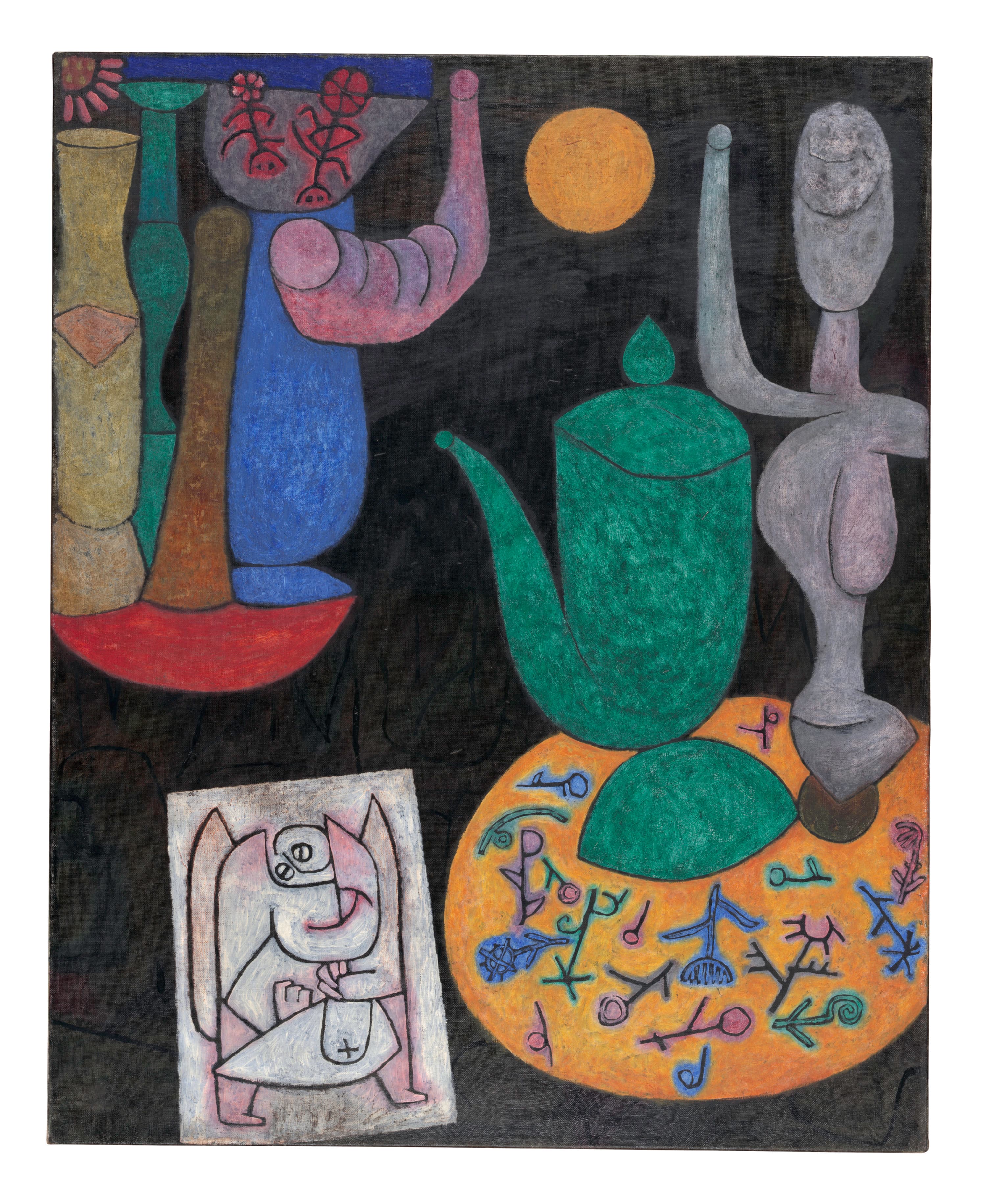
Paul Klee, Untitled (Last Still Life), 1940. Oil on canvas, 39 ⅜ × 31 ¾ inches. © 2026 Artists Rights Society (ARS), New York. Courtesy Zentrum Paul Klee, Bern.
Word count: 932
Paragraphs: 10
The Jewish Museum
March 20–July 26, 2026
New York
In a self-published poem, “Painter of the Mind” (Bilboquet, Paris, 1923), theater anarchist Antonin Artaud characterized Swiss-German artist Paul Klee as a maker of “certain cosmic syntheses / where all the secret objectivity of things / has been rendered apparent … / [and] the objects of the world / fall into order, — / and it seems as if he was only / writing down their dictation.” 1 A century later, eyes wide open, I bear witness to what Senior Curator Emeritus Mason Klein aptly names the artist’s “binary of freedom,” displayed in a multicolored supernova with gentle narrative flow inhabiting the airy second floor of the Jewish Museum in New York: Paul Klee: Other Possible Worlds, the first US museum exhibition to explore the final decade of his life.
In the essential prelude to Klee’s late years, Klein cites Surrealist painter André Masson’s praise of the artist as “the pedagogical maestro of the Bauhaus” at Weimar and Dessau, where Klee taught from 1921–31, indoctrinating students to the imagination of form as process, a drive toward becoming; he told them, “a free creation…which supersede[s] didactic principles with a new naturalness.” 2
Close at hand, we gaze at Around the Fish (1926) to decipher the dead fish centered upon a blue-violet plate, perpetually staring—as is so often the case with Klee’s depiction of eyes—its mouth desperate to shape language, while against a black void revolves a hieroglyphic constellation composed of a cylinder, a spindly herb, a misshapen mandala, a red-flagged planet, and a multi-phased moon.

Installation view: Paul Klee: Other Possible Worlds, Jewish Museum, New York, 2026. Courtesy the Jewish Museum. Photo: Graves Projects / Julian Calero.
Onward, for more privileged evidence, we enter the intimate alcove of the sepia-fogged, suspended world of Klee’s work on paper, Angelus Novus (1920). As of this writing, an impeccable reproduction holds space for the original, waiting to be shipped from the Israel Museum in Jerusalem, pending the cessation of war. Philosopher Walter Benjamin purchased this poignant winged work from the artist for one thousand marks (roughly 14 dollars in today’s money), cherishing it for two decades as his most prized possession until 1940, the shared year of their deaths. In his final published work, Theses on the Philosophy of History, Benjamin conjures the Klee-Angel, floating and ambivalent: “looking as though he is about to move away from something he is briefly contemplating. This is how one pictures the angel of history … [A] storm blowing in from Paradise … irresistibly propels him into the future to which his back is turned.” 3 Benjamin’s friend, the psychotherapist Charlotte Wolff, recalled that “He had a personal relationship with [Klee’s] picture as if it were part of his mind.” 4
The premonitory angel impels us into the darker premises of the exhibition, set in a bleak time when the Nazis closed down the Bauhaus; slandered the artist—“although he was not a Jew—defaming him as Paul ‘Zion’ Klee … the Galician Jew”5; labeled him a “degenerate;” and removed all of his paintings from museums. In 1933, the Klee family departed Germany for Switzerland, the country of his childhood and youth. And now, here we are, in a gallery with polished blond floors, off-white and ironically tinted raspberry-truffle walls, and ethereal lighting, confronted by Klee’s blunt query, “Is Europe Limping or Am I?”

Paul Klee, Around the Fish, 1926. Oil on canvas, 18 ⅜ × 25 ⅛ inches. © 2026 Artists Rights Society (ARS), New York. Courtesy the Museum of Modern Art and the Jewish Museum.
I find it strategically powerful that Mason Klein situates Mask of Fear (1932), Europa (1933), and Struck from the List (1933) on successive catalogue pages. The first, Mask of Fear, zooms in on an ambulatory, massive, oval-shaped, queasy-yellow head, transfixed eyes aimed at the viewer, its mouth truncated from the bottom third of the work. He—or it—is going somewhere, as shown by two pairs of feet pointing to the right. But where? The second, Europa, takes a macro view of the spreading crisis, revealing the stick-figure, Europa, in a careless pose, left arm disfigured into an “X,” blotting out the present scene. She seems oblivious to a blatant red exclamation-point, dangling in space, signaling the approaching panic. And the third, Struck from the List, is unreservedly personal, memorializing Klee’s aesthetic and “religious” disenfranchisement. Stigmatized by another giant “X,” muddled with earthy brown and ochre, this self-portrait is distorted into a lethal blend of anguish and agony.
The transition from these cultural trepidation canvases to the artist’s “National Socialist Revolution Drawings” from 1933, on view in the US for the first time, gives me a subversive chill. They stand arrayed under glass in dark wood, free standing easels, executed in chalk and/or watercolor or pencil on light-tan paper and/or cardboard. So to Speak, among other drawings, appears by turns ephemeral, sketchy, perhaps improvised—“taking lines for a walk,” to adapt Klee’s playful dictum. Other works are even more faded and tentative, until you lean forward, peer in, and allow feathery pencil-strokes to meld into anthropomorphic “transitional figures” (per the curator’s wall text), like sinister cartoons, their titles acting as sarcastic captions.
Turning away, I note, across what seems a vast distance, the artist’s Untitled (Last Still Life) (1940, thus titled by Klee’s son, Felix). Vibrant objects suspended, hope-infused, in a starless heaven, conglomerating styles and figures from a lifetime: miniature abstract flowers on a dish, a Cubist goggle-eyed hunchback sporting a crooked smile, and a teapot, its curving spout raised, winglike, toward a full orange moon. Despite the debilitating scleroderma that would claim his life at sixty, “Paul Klee kept on creating, believing that his works would be seen one day,” Mason Klein tells us at the conclusion of his eloquent monograph, “and trusting others to embark upon new beginnings.” 6
- Introduction to Some Poems by Paul Klee, translated by Anselm Hollo (Lowecroft, Suffolk, UK: Scorpion Press,1962), p.9
- Paul Klee, Pedagogical Sketchbook, translated by Sibyl Moholy-Nagy (New York: Praeger, 1953), p.12.
- Walter Benjamin, Illuminations - essays and reflections, translated by Harry Zohn, introduction by Hannah Arendt (New York: Schocken Books, 1968), p.257–58.
- Charlotte Wolff, as quoted in Walter Benjamin, A Critical Life, by Howard Eiland and Michael W. Jennings (Cambridge: Harvard University Press, 2014.), p.694, n.24.
- James S. Snyder, Helen Goldsmith Menschel Director, The Jewish Museum, press preview remarks, March 17, 2026.
- Mason Klein, Paul Klee: Other Possible Worlds, with contributions by Pamela Kort and Fabienne Eggelhöfer (New York: The Jewish Museum; New Haven and London: Yale University Press, 2026), p.106.
Neil Baldwin is an Editor-at-Large for the Brooklyn Rail.