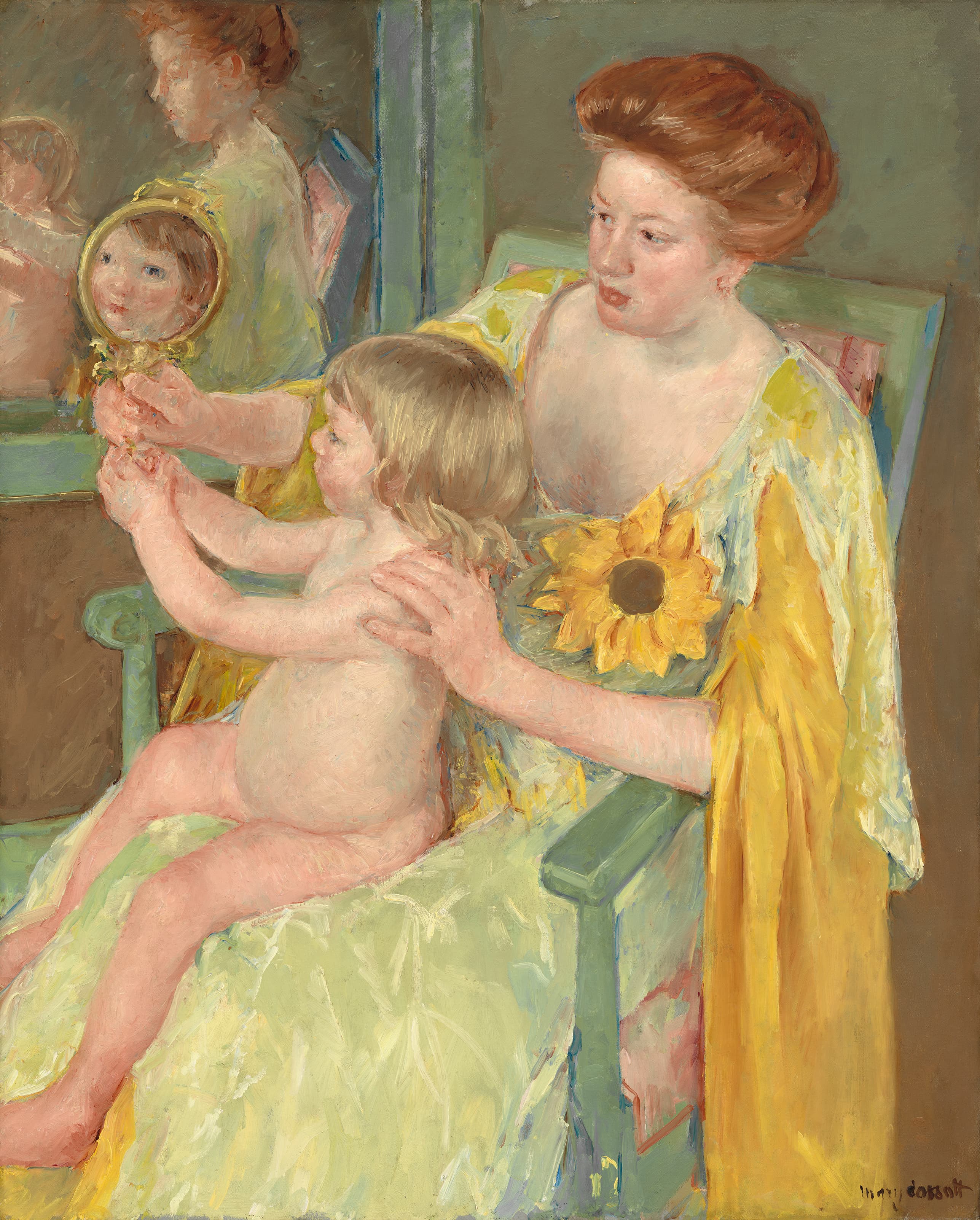
Mary Cassatt, Woman with a Sunflower, ca. 1905. Oil on canvas, 36 ¼ × 29 inches. Courtesy the National Gallery of Art, Washington.
Word count: 714
Paragraphs: 6
National Gallery of Art
February 14–August 30, 2026
Washington, DC
An American in Paris celebrates the centenary of Mary Cassatt’s death. If you enter this Pittsburgh-born artist’s exhibition coming from the impressive Impressionist galleries of the National Gallery of Art in Washington, DC, then inevitably you are reminded of the severe handicaps faced in the late-nineteenth-century French art world by even privileged women. Edgar Degas, who was her friend, could paint his ballerinas and brothels; Camille Pissarro, cityscapes; and Paul Cezanne, landscapes and still lifes. The whole world described prophetically in Charles Baudelaire’s famous essay “The Painter of Modern Life” (1863) is shown in these artists’ pictures. But in this exhibition, which is contained in three relatively small galleries, you enter a site of more limited subjects. There is a roomful of Mary Cassatt’s paintings of children and women, and, also, two rooms of her works on paper.

Mary Cassatt, Little Girl in a Blue Armchair, 1878. Oil on canvas, 35 ¼ x 51 ⅛ inches. Courtesy National Gallery of Art, Washington.
It is initially a little disappointing to look around here after seeing the more varied subjects of her male peers. When, however, we start to look, we can see how very varied these images are. Two Women Throwing Flowers During Carnival (1872) shows two young women embracing, their faces almost touching, in a juxtaposition which is a virtuosic exercise in composition. Portrait of an Elderly Lady (ca. 1887) depicts a woman frontally set looking to the side, in black with flowers in her hair. Her left hand rests on what looks like a picture frame. And Girl Arranging Her Hair (1886) has her looking at herself, apparently in a mirror that is outside of the picture. Here and in some other paintings, Cassatt uses mirrors to open up the space. Self-absorbed, the subject sits in front of objects on a table. Holding her braid, she looks away from the spectator. The figure in Woman with a Fan (ca. 1878/79) holds an opened fan. The artist’s signature is on the left edge, and there is a flower or maybe some sort of porcelain perfumier on a stand behind this totally self-absorbed figure. The woman in Woman with a Sunflower (ca. 1905) has the symbol of women’s suffrage movement—a sunflower—on her dress, and on her lap there is a naked child who turns her hand mirror towards the viewer, showing her face (women did not yet have the vote in either France or the United States). In The Boating Party (1893/94), a woman holding a child turns her back to a man who rows. In this complicated composition, the boat appears to be a container, holding the two people and the little girl. It flattens at the bottom, with a sail stretched out on the upper left-hand edge. In Children Playing at the Beach (1884) two well-dressed girls with pails, playing with sand, are absorbed in that activity. And in Reading “Le Figaro” (1878), the artist’s mother is reading the dominant Paris newspaper.

Mary Cassatt, Gathering Fruit, ca. 1893. Color drypoint, softground etching, and aquatint on laid paper, 18 ⅞ x 15 ⅜ inches. Courtesy National Gallery of Art.
The more I looked intently at this one roomful of paintings, the more I found that there was to see. If Giorgio Morandi could generate the variety of his images from mere bottles, then it is unsurprising that Cassatt was able to find visual stimuli depicting these children and women. In a very low-key way, Cassatt presents a surprising range of human relationships, as well as her painterly prowess. Woman with a Fan has some spectacular, bravura brushwork that approaches abstraction, and The Boating Party is radical in its flatness and the way shape predominates over informative detail.
I used to think that because she could not, as a female artist, readily paint the variety of subjects accessible to her male colleagues—like her friend Edgar Degas—Cassatt was a more limited painter. That’s why, I imagined, she’s not present in T.J. Clark’s canonical social history of Impressionism, The Painting of Modern Life (1985). An American in Paris shows that this claim was entirely mistaken. She created the materials for a masterful exhibition, a show for which all of my superlatives can barely do justice. The traditional subject comparison to these portraits is old master depictions of the Holy Virgin and Christ. If, then, we compare Cassatt to Giovanni Bellini rather than Degas, we are better prepared, I think, to understand her achievement.
David Carrier is a philosopher and art critic who has published books on topics such as the methodologies of art history, Poussin’s paintings, Baudelaire’s art criticism, and the aesthetics of comics.