Harold Cohen: AARON
Word count: 1240
Paragraphs: 9

On View
Whitney Museum of American ArtFebruary 3–May 19, 2024
New York
In the late 1960s, Harold Cohen took advantage of his access to the computer facilities at University of California San Diego, where he was faculty, to create a computer-programmed drawing machine: AARON (which is not an acronym). His project was in line with various efforts in the 1950s and ’60s to integrate technology and art, including, to cite just one important example, pioneering work by the Rand Corporation and Bell Labs in digital computer art and animation, which resulted in the development of a programming language for joystick, an interactive display, and a force-feedback device—all part of the larger project of developing human and machine interaction. Bell Labs would also eventually come to support the short-lived, high-profile organization EAT (Experiments in Art and Technology) founded by the engineers Billy Klüver and Fred Waldhauer and artists Robert Rauschenberg and Robert Whitman.
But this history, even as backstory, plays no role in the current exhibition. The Whitney was the first and only museum to collect multiple versions of the AARON software, but this is the first time since the 1990s (a mere thirty years) that the museum has chosen to showcase artworks produced by AARON or highlight its drawing process live in the galleries. This demonstrates how institutions can bury cutting-edge work and even when collecting it, may not integrate it into their historical or contemporary point of view. The show’s introductory text provides their rationale for the timing of the exhibition, as follows:
As artificial intelligence tools for image creation enter the mainstream with text-to-image software such as DALL-E, Midjourney, and Stable Diffusion, Harold Cohen: AARON examines the historical foundations of AI artmaking and provides a deep exploration of creativity, authorship, and collaboration in the context of AI.
But the exhibition does not do this. If one knows Cohen’s paintings from the 1960s, it is fair to say that while he succeeded in producing a sophisticated drawing program, he failed to upload into AARON his own quirky aesthetic and understanding of composition—both of which necessitate judgment and intentionality. Before Cohen began work on the AARON program, he was an accomplished painter and had been included in many international exhibitions. In 1966 he represented Britain at the Venice Biennale. His pre-AARON paintings were abstract and featured complex arrangements of diagrammatic motifs of differing scales and types. These he organized into dynamic all-over, non-hierarchical compositions—his abstract, fragmented shapes were pop-ish in style and brightly colored.

As his interest in computer technology grew, Cohen was driven by his curiosity about the capabilities of computers and a desire to explore the creative process through programming dedicated more of his time to developing AARON. As with any program (artist), AARON went through differing stages. Initially the program was defined by a small set of rules and forms. The early drawing produced by AARON early were often child-like or resembled glyphs. These were output onto paper using a “turtle” — a robot fitted with a marker. As Cohen developed his program the images generated grew more similar to the forms found in his paintings. As such, it would have been interesting if the Whitney had mounted a true retrospect of AARON with this output, which went back to Cohen’s own manually produced paintings.
In all the versions of AARON prior to 1980, Cohen exclusively dealt with programming AARON to be able to differentiate between figure and ground, inside and outside, and to function in terms of similarity, division, and repetition—all aspects of human cognition, which AARON without any object-specific knowledge, could use to generate images that described (mimicked), the “external world.” At times, Cohen would add forms, such as those of animals, only to remove them when they proved to be inconsistent with Cohen’s own research goals. Yet, it is also clear that Cohen in developing AARON compromised his own aesthetic and adjusted it to what his media (his programming and the plotters and robotic arms he designed) could accomplish.
The examples of AARON’s output that are on display at the Whitney seem less a product of Cohen’s aesthetic concerns than of AARON’s limitations. For instance, though Cohen was an abstract painter, focusing on the mimetic with AARON permitted Cohen to delve directly into the nature of intentionality and the gap between meaning and image-making in computer art. Subsequently, using AARON to make mimetic images aligned more clearly with Cohen's conceptual, rather than aesthetic concerns. It was the former that set his program’s goals, and consequently the resulting drawings, paintings, and animations tend to be fairly conservative—they are illustrative, in a coloring-book or watercolor manner. This seemingly represent the program’s generic default style. I assume that this is not Cohen’s specific intent, but a result of AARON’s database and programming, as well as the technical limitations Cohen encountered as he developed and upgraded the program over the years, seeking to give the program more decision-making power.
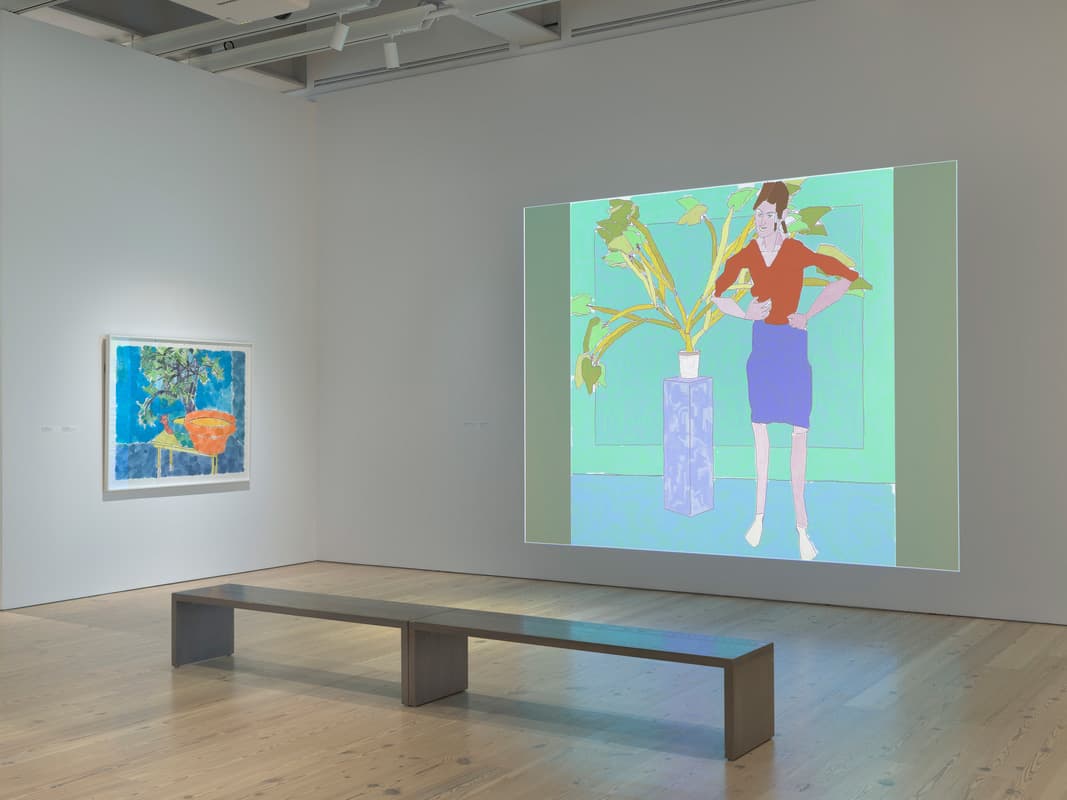
In the last few years of his life, Cohen revisited painting. Using paints and brushes, he painted over AARON's drawings, adding a layer of intentionality and greater complexity to the works. Obviously, this was not an abandonment of AARON or his original objectives, but rather Cohen seeking a different form of interaction with his creation. Ironically, the latest iteration of AARON, which was presented just before Cohen’s death in 2016, generated line drawings like those of the program’s earliest versions. Cohen would then export these to a paint program that permitted him to select a digital brush type and a color palette, then using his fingers on the screen, he applied color and texture to AARON’s drawn image. Before this last phase, it had always been necessary to bring AARON’s contribution out of the program’s space by printing its drawings on canvas or paper before coloring them. The Whitney exhibition consists of a limited selection of AARON’s figurative and floral compositions, two projections (one an animated floral mural), and an in-gallery demonstration by a technician whose job it is to change the paper on two plotters when AARON finishes making a drawing.
The two different plotters (both designed by Cohen) are running two versions of the AARON program—producing two different types of line drawings. Over the course of the exhibition, AARON will generate hundreds, if not thousands, of new drawings. As for the audience, the day I visited the exhibit, they were less concerned with AARON’s limited aesthetics than on the potential of the process to produce, without judgment, endless variants—here inadvertently the show comes closest to addressing Cohen’s curiosity about the fundamental operation of creativity, the relationship between artist and medium, and the nature of authorship. In all these regards, Harold Cohen is acknowledged to be the artist/programmer behind AARON, and as such he owns the intellectual property rights associated with AARON (the computer program). Cohen is also considered the author of all works produced by AARON and holds their copyrights. This is because he designed the rules and parameters that enable the program to create “original” artworks. As such, though designing AARON required accommodations on Cohen’s part, the AI AARON, technically, is really one more tool in Cohen’s toolbox.
Saul Ostrow is an independent critic, curator, and Art Editor at Large for BOMB magazine.