Sargent Claude Johnson
Word count: 1054
Paragraphs: 8
On View
The Huntington Library, Art Museum, and Botanical GardensFebruary 17–May 20, 2024
San Marino, CA
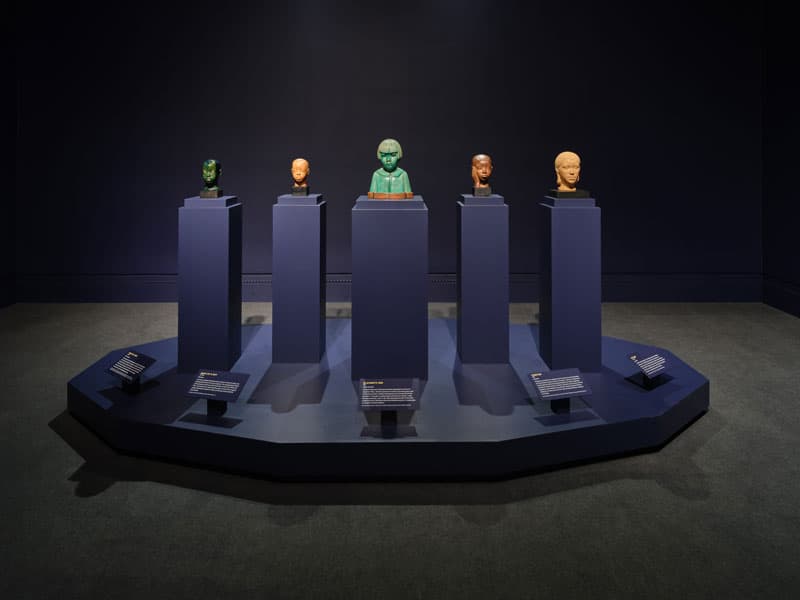
In an often-cited 1935 interview with the San Francisco Chronicle, Sargent Claude Johnson (1888–1967) described his interest in painted and glazed sculpture “not solely as a technical problem, but also as a means of heightening the racial character of my work.” The present retrospective at the Huntington Library, Art Museum, and Botanical Gardens represents the artist’s first in twenty-five years. In a resplendently jewel-toned room off the first gallery sits Johnson’s first museum acquisition, Esther (c. 1929), gifted in-part by members of the NAACP and the city’s Interracial Committee to the San Diego Fine Arts Gallery in 1930. On view for the first time in decades after recent restoration, its installation in a clique of sleek glazed stoneware and terracotta busts—each modeled on a young person from Johnson’s red-lined neighborhood in Berkeley—proposes multiracial solidarity at a moment when sculpture was often employed to highlight racial difference.
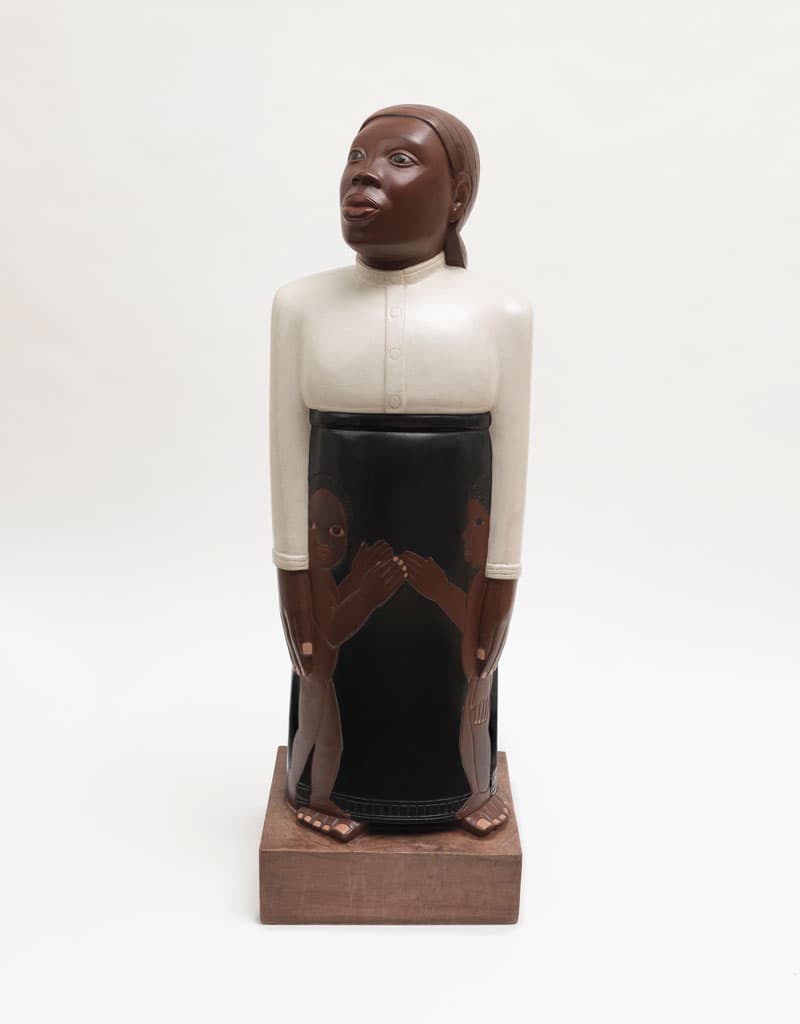
Esther and her peers gaze with resolution towards the sculpture Forever Free (1933) in the opening room. Forever Free serves as an exemplar, epitomizing Johnson’s distinct vision of modernism, a venerable portrait of a Black mother firmly embracing her two chiseled children that upholds Black dignity through material innovation. By plastering and painting linen-wrapped wood, a technique used during the Italian Renaissance, Johnson employs skills he learned at his day job as a framer. A multiracial artist who identified as Black, Johnson worked with the avowed goal of engaging an audience of Black Americans. He lived in the Bay Area for his entire mature career, and though he probably never visited New York, even as his work was regularly exhibited there from 1926 through the 1930s, he built a national reputation within the cultural movement frequently termed the Harlem Renaissance, named for the upper Manhattan neighborhood which exerted a gravitational pull on Black artists of the era.
His early work rejoins Black cultural theorist Alain Locke’s rallying cry to Black artists to look towards an African past. Johnson also looked elsewhere—to African American history and culture, to his Black and Asian American neighbors, to Latin America, and to Asia. Unlike his American peers who traveled to Mexico City, Johnson also went further south to study with Indigenous potters in Oaxaca. Curators Dennis Carr, Jacqueline Francis, and John P. Bowles insist on the importance of Johnson as the earliest, nationally recognized Black modernist on the West Coast. His vision, at once hyperlocal and transpacific, offers a vital corrective to even a geographically capacious framing of a transatlantic Black Renaissance emanating from Harlem.
It would be remiss to categorize Johnson’s work on separatist terms, despite his intended audience. As one of only three Black supervisors nationwide for the Works Progress Administration’s Federal Art Project (WPA/FAP), Johnson produced three large-scale public art commissions in the Bay Area. His role as a supervisor underscores the limits of Black visibility among professionally ranked New Deal artists. In 1933, Johnson was commissioned to create an installation for the auditorium of the California School for the Blind through the WPA/FAP’s predecessor, the Public Works of Art Project. Deinstalled when the school later moved, the organ screen (acquired by the Huntington from the secondary market after the University of California Berkeley haplessly relinquished it for a song in a surplus sale in 2009), stage proscenium, and lunettes are reassembled in the exhibition to approximate the original installation for the first time. Carved in redwood and selectively gilded, the screens belt out. One imagines syncopated sunlight streaming into the auditorium through perforations nested among the flourishing carved fruit trees on the lunettes and organ notes reverberating between the screen’s inhabited thickets. The multisensorial nature of the work exemplifies Johnson’s reverence for a predominately blind and visually-impaired audience. An additional lunette dedicated to Louis Braille, more recently used by the school as a haptic pedagogical tool, is displayed beside an interactive facsimile and accompanied by Braille translation. Visitors are invited to run their fingers over Johnson’s signature incisions.
Resembling an Assyrian relief, Johnson’s Athletics (1942), a 185-foot-long cast stone frieze of modern athletes remains in situ at the football field of George Washington High School in San Francisco. The exhibition represents it with preparatory material and a projected panoramic film that leisurely pans across the full length of Athletics, insisting upon close looking. Athletics was commissioned as part of architect Timothy Pflueger’s vision for a well-decorated public school in a neighborhood classified as “still-desirable” by the Home Owners’ Loan Corporation in 1937 because of its predominately white and white ethnic population. Indeed, Johnson began carving his racially ambiguous athletes just four years after Russian-born FAP muralist Victor Arnautoff completed his mural cycle in the school’s lobby, which, though critical of early US history, also unwittingly reinscribes the visuality of white supremacy. Commissions like Athletics underscore Johnson’s place in a sweeping federal effort to cement an American art canon, one more inclusive in prescription than in practice. Yet, the exhibition understates the thorny politics of representation and persistence of racism, and colorism, under the federal hiring practices of the New Deal coalition, though these issues are more carefully considered in the catalogue.
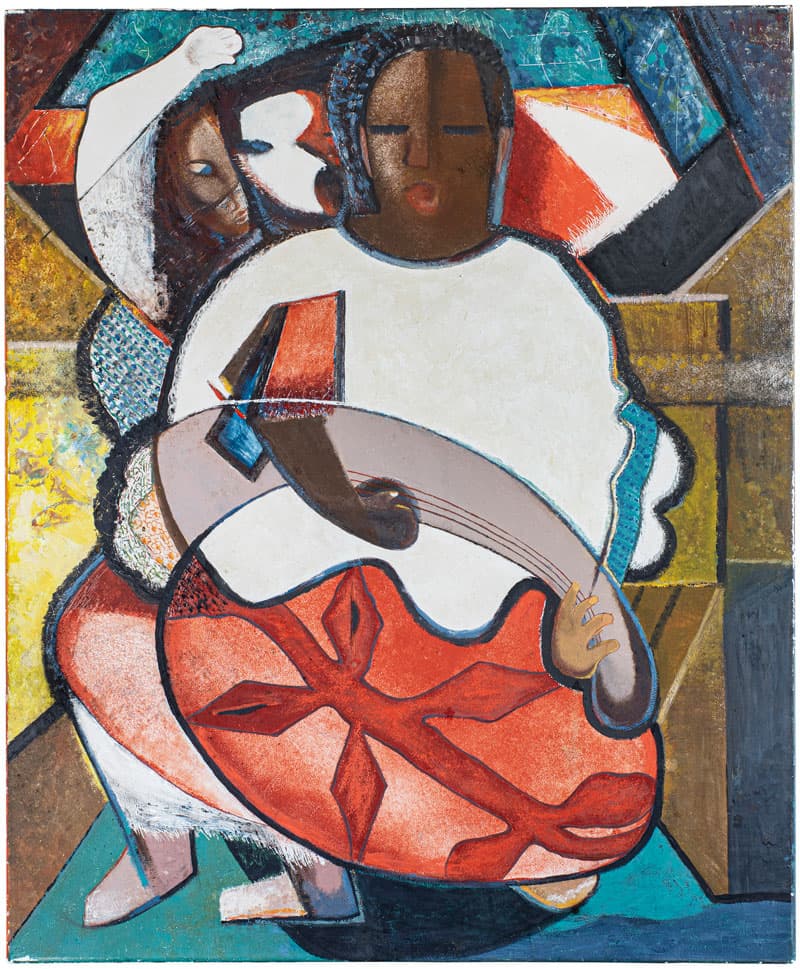
The final gallery includes examples of Johnson’s experimentations with enamelwork, a medium he learned in the late 1940s. Painting in enamel on steel, Johnson produced large-scale commercial commissions and small paintings, often quoting earlier works. Singing Saints (1967) translates the lyricism of his lithograph of the same title (1940) in the first gallery into vibrant and glossy figurative abstraction. With these revisions, Johnson returns to the Black Renaissance of an earlier period, materially working out its continued resonance for a new moment of Black liberation.
By traversing Johnson’s career in this way, the curators resist art history’s penchant for periodization and demonstrate how an artist’s practice is an accumulation of creative spheres traversed over a life. Johnson’s figures sing to each other across gallery thresholds, united in voice by the artist’s charge to cultivate a definitive audience and insist upon due recognition under New Deal liberalism.
Margot Yale is a curator, writer, and Ph.D. candidate in Art History at the University of Southern California.