Anna Ting Möller: grafting, for that which grows and that which bars
Word count: 868
Paragraphs: 9

On View
Tutu GalleryFebruary 3–March 16, 2024
Brooklyn
Anna Ting Möller’s transdisciplinary practice is propelled by an overpowering story of origin. In 2015, she traveled to Yueyang, a humid and warm port city in southwestern China, in search of her birth mother, to no avail. Instead, a woman whom she stayed with gifted her a symbiotic culture of bacteria and yeast (SCOBY), or what is colloquially referred to as a “mother.” Since then, Möller has been fermenting kombucha with tea and sugar using the same culture and transforming that kombucha into sculptures.
At the DIY apartment space Tutu Gallery, Möller’s New York solo debut grafting, for that which grows and that which bars is haunted by a sense of ambivalent loss driven by Möller’s failure to locate her biological kin, from whom she was separated before assimilating such kinship into the realm of language. What therapeutic terms cannot exhaust become rituals of translation and (counter)transference in the exhibition, an intimate séance for what is impossible or impermissible, beyond the confines of biological family.
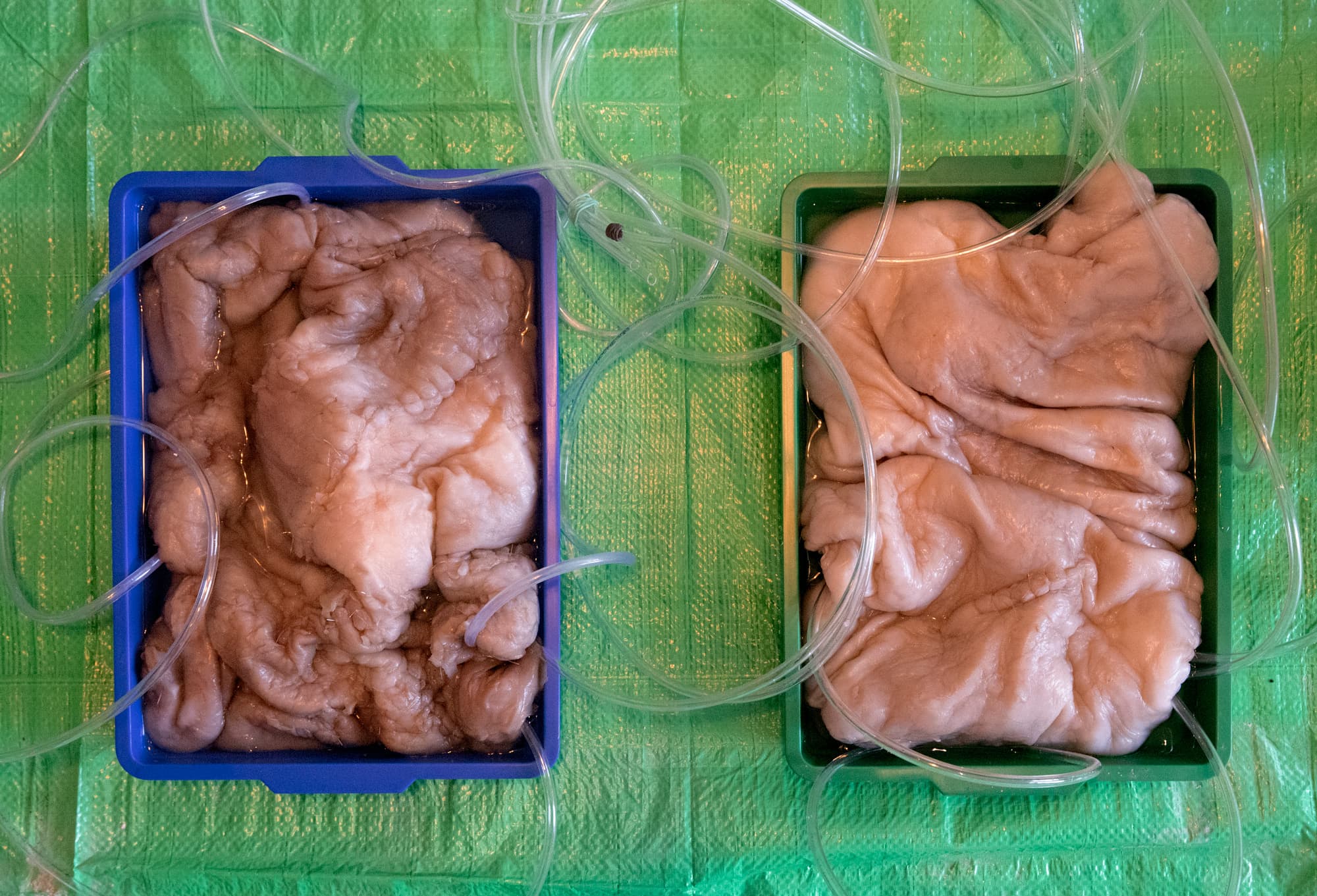
Whip and tongue (2024), a mixed-media apparatus installed in the center of the living room, attends to Möller’s employment of folk magic to address pre-linguistic trauma, with quasi-scientific precision and spiraling effects. Sitting on a large green tarpaulin are two baskets of glimmeringly hydrated kombucha, connected by clear tubes to other containers of liquid, two buckets and a bowl. Gloves and scissors accompany the self-sustaining system of hydration, though their exact use in the installation remains unclear. Whip and tongue enjoys a psychological depth for its seductive command of gallery-goers’ attention thanks to the nourished kombucha’s life-like quality. At the same time, the work’s proto-machine status affords it Romantic sensibilities that can only be found in gothic speculative fictions.
On the opening night, Möller presented an interactive performance, connecting her body to the live kombucha of Whip and tongue and enacting a psychodrama of life and death. The once flourishing kombucha, displaced from its usual environment and disconnected from its support system, nakedly lays on the tarp, shrunken, hardened, and darkened from overexposure to air. Möller laboriously breathed seeds of life into the kombucha through the tubes, with the ferocious traces of blue veins visible on her concentrated body, a metaphor perhaps for the messiness of mother-child relations, where care is an investment far too physical for words to carry.
Performativity, voluntary or not, continues to taunt the living room with exhilarating results. Tiny mountain (2024) is a metal and glass sculpture partially resembling a real door, yet it stays perpetually open. Visitors can only come to standstill with its monumental mark, which insists that at least within this living room, a deeply private set of vocabulary will without exception override linguistic conventions and set its own terms and conditions for describing the experience of motherhood, or lack thereof. House on the hill (2024) is a stoneware and glass sculpture in the shape of a bottle, standing in a corner of solitude. Its latitude, transparent and thin, veils an empty space of interiority, and seeks only frigid verticality until reaching the authorial weight of placing a cap, which cannot be surmounted. House on the hill silently observes, from an unbridgeable remove, Möller’s wayward ways of making kin in the absence of original.
On the walls, negotiations that question if reunion can take place in life or death expand. Tank life (2024), in which dried kombucha is woven into an acrylic sheet, is a primordial aquatic grid flecked by animalistic vitality. In line with Möller’s affinity toward non-linear genealogy, Tank life hints that the future of connectedness can only be comprehended and possibly regained through the oneness of pasts, where a mother even more ancient, measured only through the scale of ecological time, dominates the plane of existence. Indistinct (2024), where kombucha, wood, and textile are integrated together and remade in the image of an excavated offering plate, works through reproduction anxieties of charting the multiple and lands upon a struggle for making sense of the singular, the self, or the unseparated pair of mother and child, with all its ambiguous signs.

A few “Feng scales” (all dried-bodies kombucha sewn together through nylon threads) deepen Möller’s commitment to aerial politics. Feng, pinyin for wind, is traditionally a metaphor for explicating modes of governance in Chinese literati culture and a medium of divination according to the ancient science of feng shui. Here, feng is both the mystical object and tool of measurement, contouring the irreverent shapes of desire for reunion/return without conclusively cementing its excess.
Grafting, for that which grows and that which bars’s willful syncretism of materials retroactively confirms kombucha as a queer subject, with a drive toward the peripheral, clandestine, and conspiratorial, an appropriate medium for approaching transnational adoption as a colonial and queer project. In refusal of being overdetermined by narratives of trauma, Möller’s kombucha sculptures exercise the creative freedom for becoming otherwise in the face of life-altering events, forging otherworldly temporalities.
Qingyuan Deng is an emerging curator and writer working and living in New York City and Shanghai. He holds a BA in art history from Columbia University with a focus on Relational Aesthetics and experimental filmmaking.