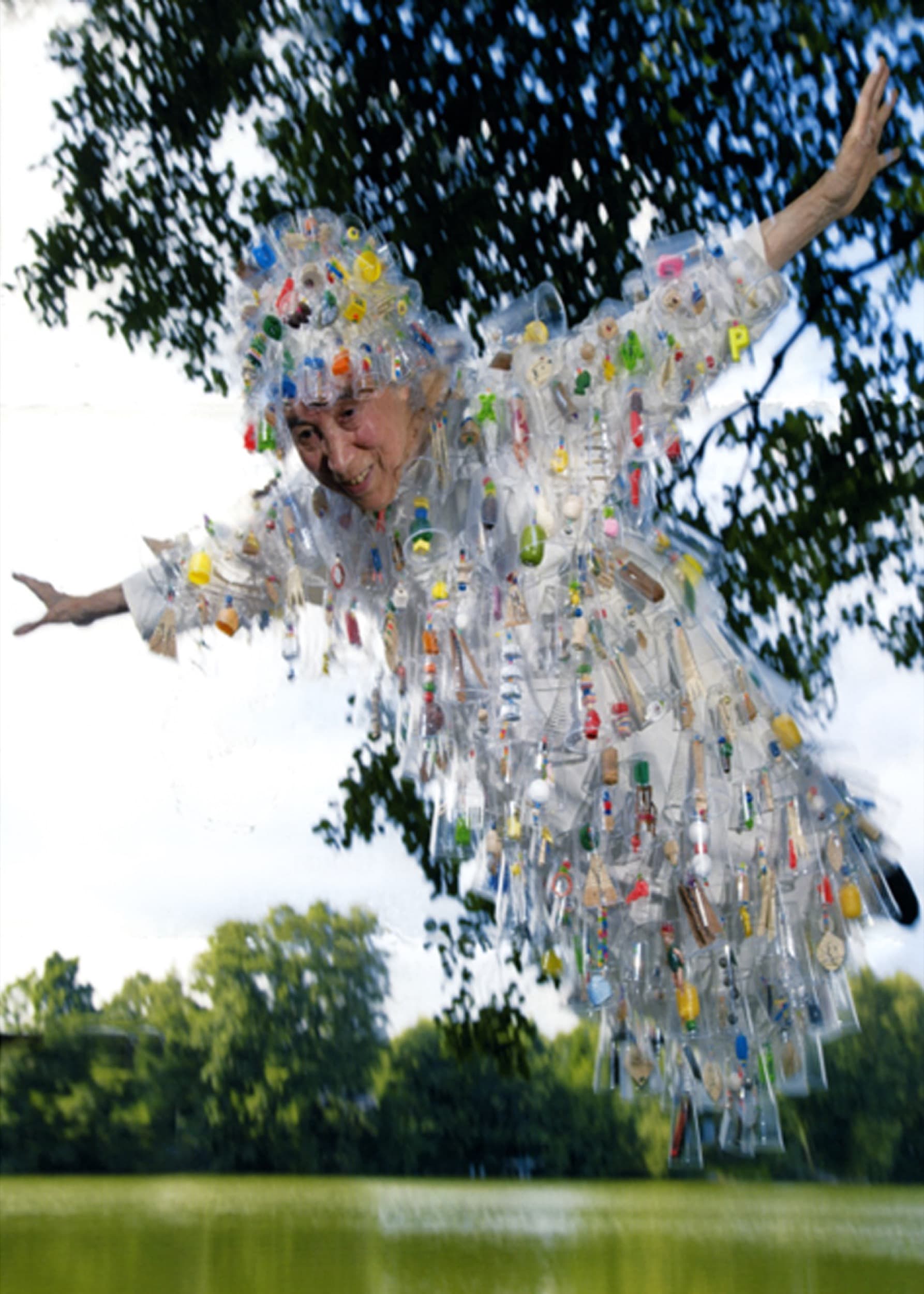
Remembering Takako Saito
Sarah Robayo Sheridan
Word count: 791
Paragraphs: 9
I met Takako Saito by inviting her to perform at a 2010 version of John Cage’s famous 1968 Reunion event at Toronto’s Ryerson Auditorium that had featured Marcel Duchamp and avant-garde musicians with an electronic chess board. Normally, reunions are for people you know. Instead, youthful folly led me to invite my artist-idols. Luckily for me, Takako lived her life guided by pure curiosity and commitment to experiment. She was ready to play. She asked for no credentials, only specific details of the configuration of the space so she could imagine the modes of interaction with the audience.
We corresponded entirely by fax machine and post. In 2010, as director of an artist-run space, we had only email and a combo printer/fax machine, which I despised. Cumbersome and prone to paper jams, it was a fearsome obstacle to my communications. But when Takako commandeered the line, her drawings and hand-written texts flowed over the spool of useless ads and transformed the hated machine into our portal to artistic synergy. Her handwritten missives combined a unique tenderness with a great deal of precise detail, as befit the most skilled fabricator of Fluxus editions. Every missive was populated by stylized renderings of faces: a line tracing a profile and a single dot for an eye.
She constantly reflected and refined details, while reserving the right to change and improvise. She deftly balanced spontaneity with very specifically selected parameters. Perhaps this is why chess performances figured so prominently in her work. She stuck to the rules of the game, but reinvented its possibility as a time-based sensory exchange, proposing such variants as spice chess, smell chess, sound chess, seesaw chess, chess for rats and squirrels, flower chess, and mountain chess.

Takako Saito, SeeSaw Chess,1988. Wood, metal pastry decorating tips, 9 ⅞ × 8 ¾ × 7 ⅞ inches. Photo: Takako Saito Archive.

Takako Saito, Chess For Rats And Squirrels, 2012. Wood, straw, wire and twine, 60 × 40 × 40 inches. Installed at Seewerk, Moers Palace Garden, Germany. Photo: Takako Saito Archive.

Takako Saito, Mountain Chess. Bermed earth with sod and inlaid stone pavers. Photo: Takako Saito Archive.
At Reunion 2010, we presented Canapé Chess and Wine Chess. Filled wine glasses for chess pieces: red for one player, white for the other. After the event, she thought that I had inadvertently violated one key condition of humor and play-based sensory inquiry. I had cast two professional players who knew the board so well that they didn’t really need to taste the wine to play.

Takako Saito, Fish Broiling Chess, 1988. Graphite on paper. 8 ¼ × 11 ⅝ inches. Photo: Takako Saito Archive.
To illustrate her point about remapping the normal terms of engagement via her chess performances, she pointed me to her Fish Broiling Chess, where players must broil fish one by one to get the pieces on the board. She wrote to me, “When I see this Fish Broiling Chess I always laugh. What a slow game! You must have a lot of patience.”
The process of learning requires openness, which is why early childhood is such a ripe time for development. Involved in the Sobi Creative Art Education movement in Japan, Takako profoundly understood how our senses guide our knowledge of the world. Takako embraced childlike awe and continued to see the world anew. This allowed her to greet the sound of brown rice cooking alongside the hammering of woodworkers as musical events, just as John Cage might. Both can be heard on the album “Spontaneous Music,” her gathering of sound recordings made from 1986–96. Listening to these tracks, I also hear her voice singing a made-up language that recalls the babbling of infants before their turn to representational language.

Takako Saito, Spontaneous Music, 2018. Vinyl LP. Edition Telemark. 864.01. Germany. Courtesy Takako Saito Archive.
Unsatisfied with performing only two existing pieces, Takako proposed a third new piece. It involved a harp prepared with her folded paper cubes. She then announced it would also involve a live nude. The supportive city cultural division began making inquiries amongst Toronto’s burlesque community. But when she showed me the tiny, but not scanty, breakaway costume covered in black and white chess board squares I realized that the nude performer would be 81-year-old Takako herself. What she had actually wanted were assistants to paint calligraphic designs on her body before she donned her costume to appear on stage. Spools of thread tossed to the audience were pulled to unravel the breakaway chessboard elements of her dress to reveal naked flesh and calligraphy fore and aft. She wanted to surprise and engage the audience as participants—and I guarantee that she surprised many.

Takako Saito, Sound Chess for Reunion Event, 2010. Ryerson Auditorium, Toronto. Left to Right: Takako in costume backstage; Harp prepared with paper cube ”sounds;” Takako performing; Takako throwing spools of thread to audience; Takako in the remains of the breakaway costume exiting the stage. Courtesy Takako Saito Archive. Photo: Sarah Robayo Sheridan.
I went looking through our correspondence. Out of an envelope fell a translucent sheet of paper torn in an arc and treated with a spray of paint and water drops. Running across the fragment in a bridge that mirrors the torn edge: Dear Sarah, I wish you happy new year 2011, Takako. Each sentence fragment sits in its own water-puckered island, dancing overhead of two figures. Their faces point upwards, as if speaking to one another while daydreaming on the ground. Two figures, the sender and the receiver, the central characters of her life’s work.

Takako Saito, Happy New Year 2011, 2010. Ink and watercolor on translucent paper. Courtesy Takako Saito Archive. Photo: Sarah Robayo Sheridan.
Sarah Robayo Sheridan is a Toronto-based writer, curator, and educator specializing in contemporary art. Currently, she is Assistant Professor of Visual Studies at the John H. Daniels Faculty of Architecture, Landscape, and Design at the University of Toronto, a Senior Fellow at Massey College, and the Executive Director of the Gershon Iskowitz Foundation.