Word count: 769
Paragraphs: 14

Takako & me at her Düsseldorf studio, 2014.
My pen-pal and friend, ninety-six year old Japanese-born artist Takako Saito passed away on September 30, 2025 at her Düsseldorf studio. We exchanged letters bi-weekly since 2002. Hers were always folded, contour-cut and drawn visual delights that sent her spirit as well as her thoughts.
Endlessly inventive, Saito pushed far beyond her Fluxus origins to become a prolific creator of drawings, paintings, artists’ books, sculptures, assemblages, installations, hand embroidered costumes, interactive performances, toys and games. She also created more shadowbox format works than any artist since Joseph Cornell. And like Cornell, all of her profusion of works were made by her own hand, without hired assistants or fabricators. Working until the end, Takako Saito: It’s All Play opened October 17 at the 49 Nord 6 Est—FRAC Lorraine museum in France.
Saito was highly respected and exhibited across Europe, and in Japan she was as renowned as Yoko Ono, Shigeko Kubota or Yayoi Kusama. Unfortunately, Saito is less well-known in America than others in her circle of original Fluxus artists because, after freeing herself from an untenable “hostage green card relationship” with George Maciunas, she left for Europe and never sought to exhibit in the US again. Consequently, there was no substantial catalogue of her work in English until the monumental 2017–18 Takako Saito: You and Me exhibition at the Museum of Contemporary Art, Siegen, Germany and the Museum of Contemporary Art of Bordeaux, France.

View into living/dining rooms. Not visible: completely hand painted floors and miniature sculptures mounted upside-down on the ceilings (accessible for mice by miniature ladders). Düsseldorf studio, 2014. Photo: Larry List.
I visited her at the bunker-like apartment building she settled into on the outskirts of Dusseldorf in the 1970s. She took over each vacated unit until she made a totally immersive experience of an entire floor. There was a living unit; an archive; a wood shop with power tools; a sculpture studio; and rooms for drawing, painting, bookbinding, and costume-making. Everything—floors, wavy contour-cut walls, furniture, bedspreads, curtains, clothing, tabletops, bookcases—was hand-made and decorated by Saito. The hallway, the whole length of the floor was open storage overflowing with her work.
Takako told me she learned woodworking during childhood from workmen at her family’s Fukui, Japan estate before studying child psychology at Japan Women’s University and Sōzō Biiku Undo (a theory of free expression through creative play). Her mantra became “no audience—everybody participate—everybody be involved.” After college she did interior construction work to afford to stay in Tokyo.
Saito combined the wisdom of a Zen master with the delight of a child. Her work might mistakenly seem whimsical or slight but, like a trickster or shaman, she conjured up profound sensory dislocations, displacements, and surprises.
At her You and Me Market or Do It Yourself Shop visitors could exchange whatever small items they had for any of her hand-made objects—even a newspaper, though these had been squeezed into palm-sized paper pulp balls, turning words into concrete poetry-objects.
Her Silent Music performances had people blow bubbles or dandelion blossoms through the air instead of sounding notes. She transformed music into something to be seen, but not heard.

Silent Music (Quintet), performance at Villa Croce Museo d´Arte Contemporanea, Geneva, February 2, 2002. Photo: Francesco Conz.
Likewise, in other performances she dropped hundreds of mute, hand-folded white paper cubes from overhead to become visible musical “movements.” On her 70th birthday she dumped dozens of paper cubes into the Rhine to float as a mute symphony until bio-degrading back into nature.
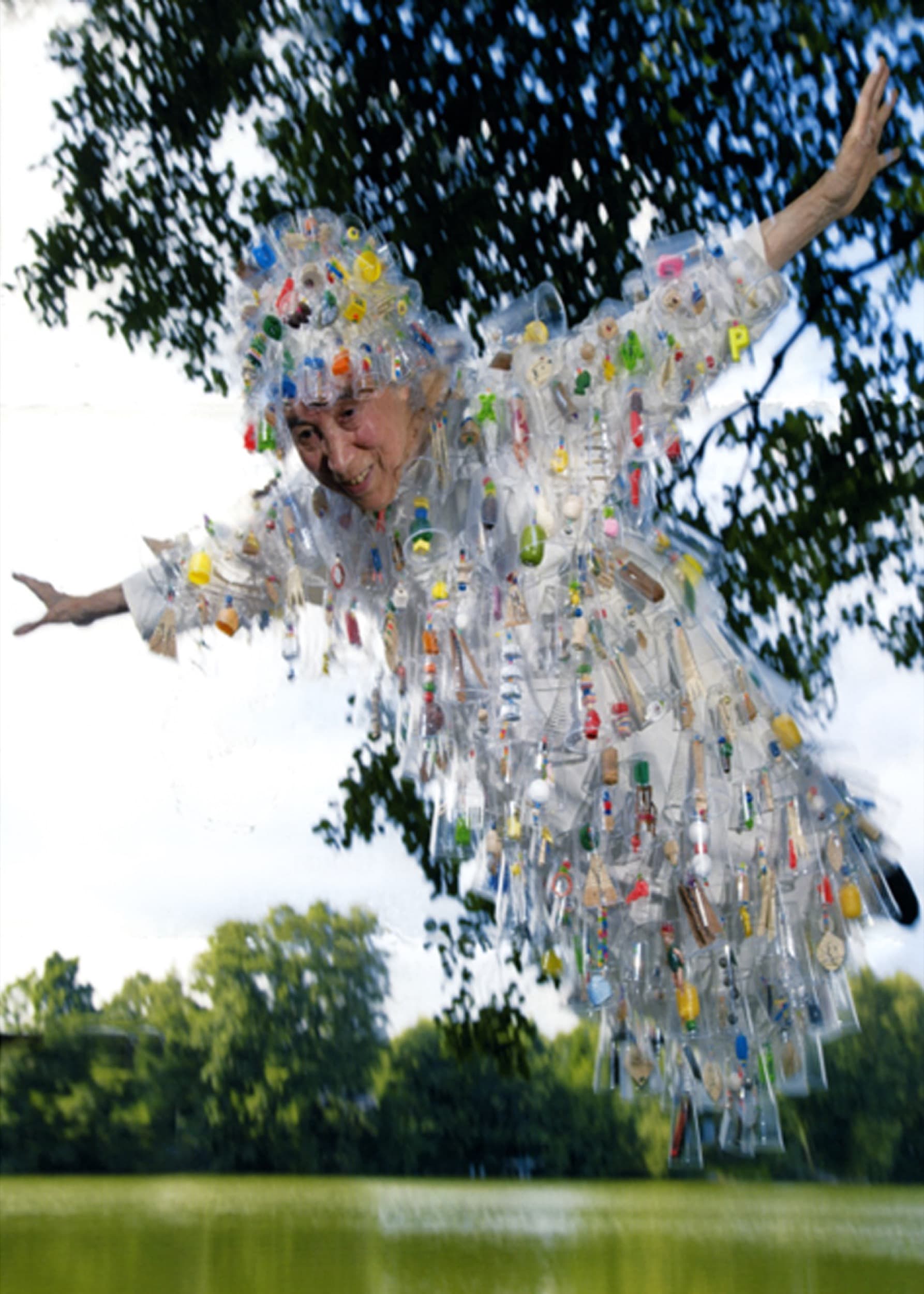
Threads pulled by audience members would unravel parts of her performance costumes to reveal painted patterns or naked flesh.

Canape Chess, performance at Reykjavik Art Museum, Iceland, 2009.

Wine Chess, performance at Reykjavik Art Museum, Iceland.=, 2009. Photo: Reykjavik Art Museum.
Outdoor straw chess sets were made to be re-shaped by hungry squirrels and mice.

Takako Saito, Weight Chess, 1965. Wood box with removable wood lid/chess board: 16 dark and 16 light wood boxes with material of different weight inside, 12 ½ × 12 ½ × 2 ⅗ inches. Later 1977 Artist’s Edition intended for Fluxus distribution. Photo: Takako Saito Archive.
Takako respected the rules of games but exploited “creative play” more than anyone since Man Ray and Duchamp. Her earliest games were Smell Chess, Weight Chess and Sound Chess. Each had 32 same-sized hollow wooden boxes – 16 dark and 16 light. Smell Chess pieces each had a different aroma; Weight Chess ones each had a different weight; and Sound Chess pieces each made a different sound when shaken, radically challenging our perceptions and expectations. As a player of a public Sound Chess performance I can attest that she profoundly transformed the quiet, cerebral game into a mind-blowing tactile and auditory experience. One of her later simple but most extreme designs was Linear Chess Set, which used standard pieces but a board only one square wide and 64 squares long.

Sound Chess, performance on November, 2019. Larry List (left) vs. Dieter Daniels (right). Museum of Contemporary Art, Bordeaux, France. Courtesy Takako Saito Archive. Photo: Kathy Grove.
Takako was petite, warm, and generous. She used a droll child-like sense of humor to camouflage her intelligence as she gently challenged our spatial, sensory, and conceptual norms. She invited us to re-think our relationship with the world and with each other by insisting that “everyone participate”…. “all must be involved.”
Larry List is a New York based independent curator and writer with interests in twentieth century and contemporary art focusing on Dada, Surrealism and Fluxus. Among his writings about Saito is “Takako Saito: Everybody Involved” for the catalogue Takako Saito: Dreams to Do. List’s most recent book is Permanent Attraction: Man Ray & Chess.