Life in Flux: Takako Saito
Midori Yoshimoto
Word count: 549
Paragraphs: 8
We as artists and human beings have an important task, that is, I think, to create ourself under every day’s new situation and new relationship with others without tying up oneself with old things, trying to challenge, to make oneself new and encourage others to. If not, I think there is no real meaning of being an artist.
– Takako Saito
Since leaving her well-to-do family home in Sabae, Fukui in the early 1960s, Takako Saito lived a life in flux, demonstrating the very philosophy of the art movement she once identified with. She challenged herself to try something new as she moved from one place to another in search of opportunities. Her peripatetic life came with financial insecurity but also allowed her to remain free of various burdens. At any moment, she was fully committed to creating, and she never gave in to external pressures.
From 1998, I frequently corresponded with her via airmail. She would often draw a face or stamp some images on the envelope, and letters were cut or folded in unique ways. Every letter was a work of art. After I had visited, I occasionally made an international call to ask questions as they came up. She kindly answered my questions and cooperated with my research.
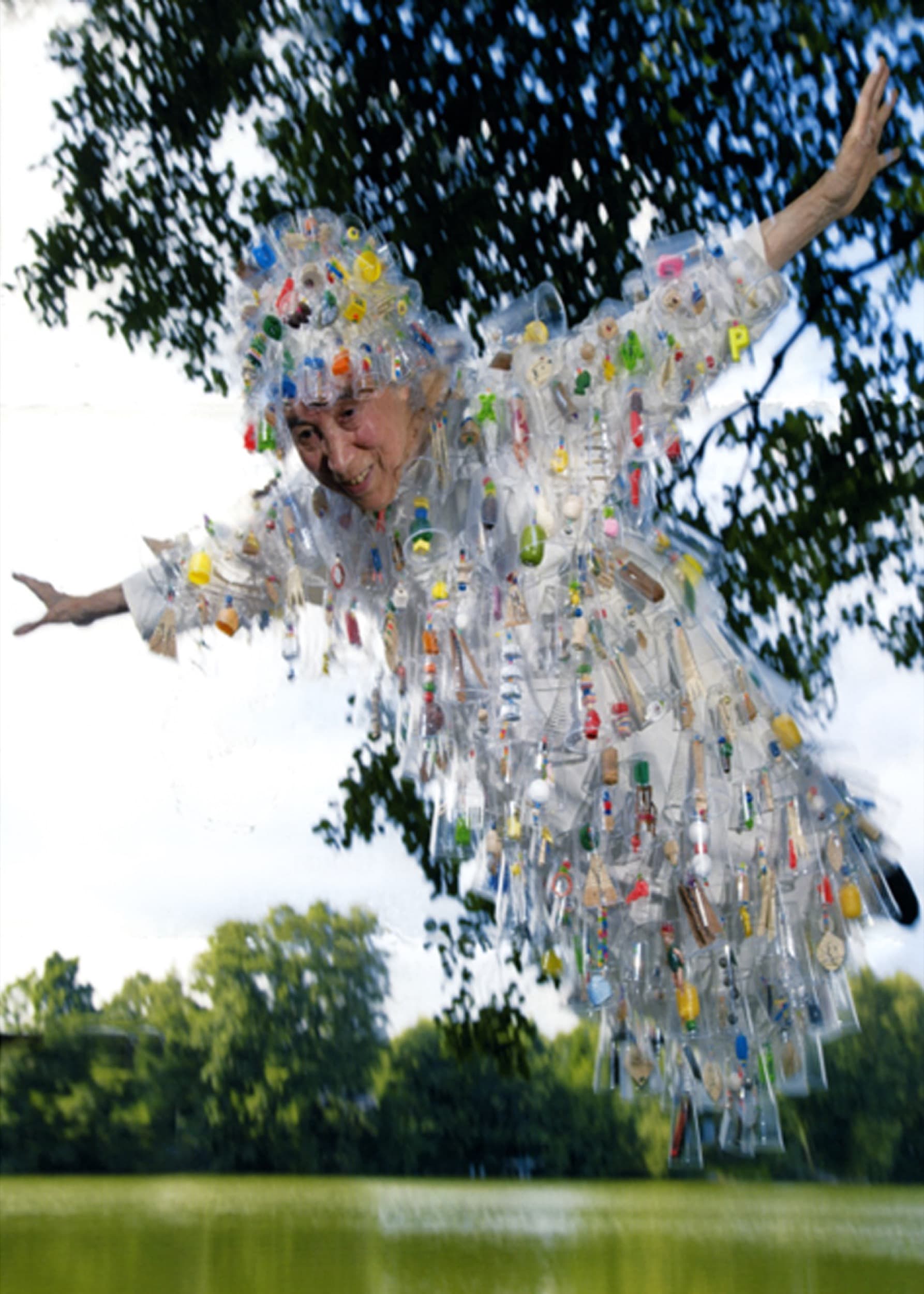
I visited Takako in Düsseldorf in September 2000 after researching her and her Fluxus peers for my doctoral dissertation. She welcomed me to her studio/home and told me her life story over several days. At the end of my stay, I participated in her Communicative Mode Show, which she co-organized with artist friends. I wore a white jacket and trousers on which she had drawn some words and sewn pockets. Pockets contained crumpled paper balls onto which Takako had written nonsensical words, such as “ha ha ha” or “ho ho ho.” An audience member would pick one of them, open it, and read the words. I interacted with the person by uttering similar words. This became my first-hand experience of an audience-participatory performance and left a lasting impression.

Takako Saito in her Pocket/Message Performance Costume interacting with the audience at her Communicative Mode Show. Düsseldorf, 2000, near the Rhine River. Photo: Midori Yoshimoto.
Twenty-five years since my initial visit, I returned to Düsseldorf this past June. She welcomed me into the new apartment she had relocated to from her studio of many years. She liked to show me her handmade books from different decades, organized on her covered shelves. As I flipped through the pages, she would tell me how she made them and what inspired her. Although she was ninety-six years old, her memory was crystal clear. Her playful spirit never left, and she seemed eager to create more.
The day before Takako passed, I received a letter from her, in which she told me she was glad to see me through a video call in August, when I had attended the opening of her retrospective show in her hometown of Sabae, Japan. She also told me she was very happy that I had visited her in Düsseldorf and wished me and my family all the best. After learning the sad news of her passing, I cried, but I knew well that she had no regrets and had always lived life on her own terms. You lived a full life and touched many people, Takako san! May your playful spirit and memory live forever!
Midori Yoshimoto is Professor of Art History and Gallery Director at New Jersey City University. She is the author of Into Performance: Japanese Women Artists in New York and other texts on Fluxus and Japanese women artists. She was co-curator of Out of Bounds: Women Fluxus Artists at The Japan Society, New York, 2023–24.