Word count: 780
Paragraphs: 12
I met Takako Saito in person for the first time on her sixty-sixth birthday, the last day of her exhibition in a small gallery. As a surprise for me and my art history seminar group, she had added cake to her performance installation Café Theater. It was new to me that making cake and coffee could be part of an artistic act. Her You and Me Shop was easier to grasp. For a small fee, we decorated snack bowls with materials and the glue provided, then signed them together with Takako. Was this the creation of a work of art to be displayed in the students’ homes, a creative mini-workshop, or a kind of artistic service? We didn’t get caught up in theoretical musings about this—it was all so accessible and warm.

Takako Saito, A Collection of Portraits of Takako, 1994. Wooden box, stenciled letters, 12 pebbles, 2 ⅜ × 8 ¾ × 15 inches. Courtesy Takako Saito Archive. Photo: Johannes Stahl.
Her first major catalogue from 1989 said “Find Takako”—and it has not always been easy to track her down in art history books or Fluxus diagrams. This may be due to the very different groups she was involved in: the Sōbi movement for creativity in Japan during the 1950s, the Fluxus scene in New York during the 1960s, the book artists around Beau Geste Press in Great Britain and in Italy in the 1970s, and finally the different art scenes of the Rhineland. What one always found in her and her work was humor, playful seriousness, and a constant amazement and search for undiscovered potential in material and people.
Art lovers’ lives are enriched by their engagement with art. And what do I owe to Takako Saito and her art? When invited to plan and produce a catalogue about her work, I was confronted with her refreshingly broad idea of what a book can be. In her “expanded concept of the book,” they are not necessarily made of paper, though in Takako’s hands, even paper can be challenging. To her, books could be small shelves, wooden boxes, or tree trunks filled with surprises: everything from poems to performance instructions.

Book gallery installation view. 2017. Museum für Gegenwartskunst, Siegen, Germany. Courtesy Takako Saito Archive. Photo: Johannes Stahl.

Takako Saito, Tree Trunk Books 1 – 5, 1994. Largest: 10 × 6 × 3 inches. Tree trunks containing hand-folded paper cubes with inscribed messages, numbered wine corks, ink. Courtesy Takako Saito Archive. Photo: Larry List.
Performances normally accompanied Takako’s exhibitions. This combination of artworks, time, and interaction with the audience was important to her. And she found strategies and forms to insure that such actions retained their dynamism. Her music book, her “Silent Music” series, and numerous productions for her Noodle Editions contain calls to action that made performances repeatable yet unique each time. Some wooden object boxes documented a collaged version of the paper cubes or other material used in performances, but with open hinged frames to allow the possibility of putting the material back into action again, later.

Takako Saito, Performance am Rhein 5, 1999, 2000. Paper cubes, photo-collage on glass, with easy-to-open wooden box frame. Courtesy Takako Saito Archive. Photo: Johannes Stahl.
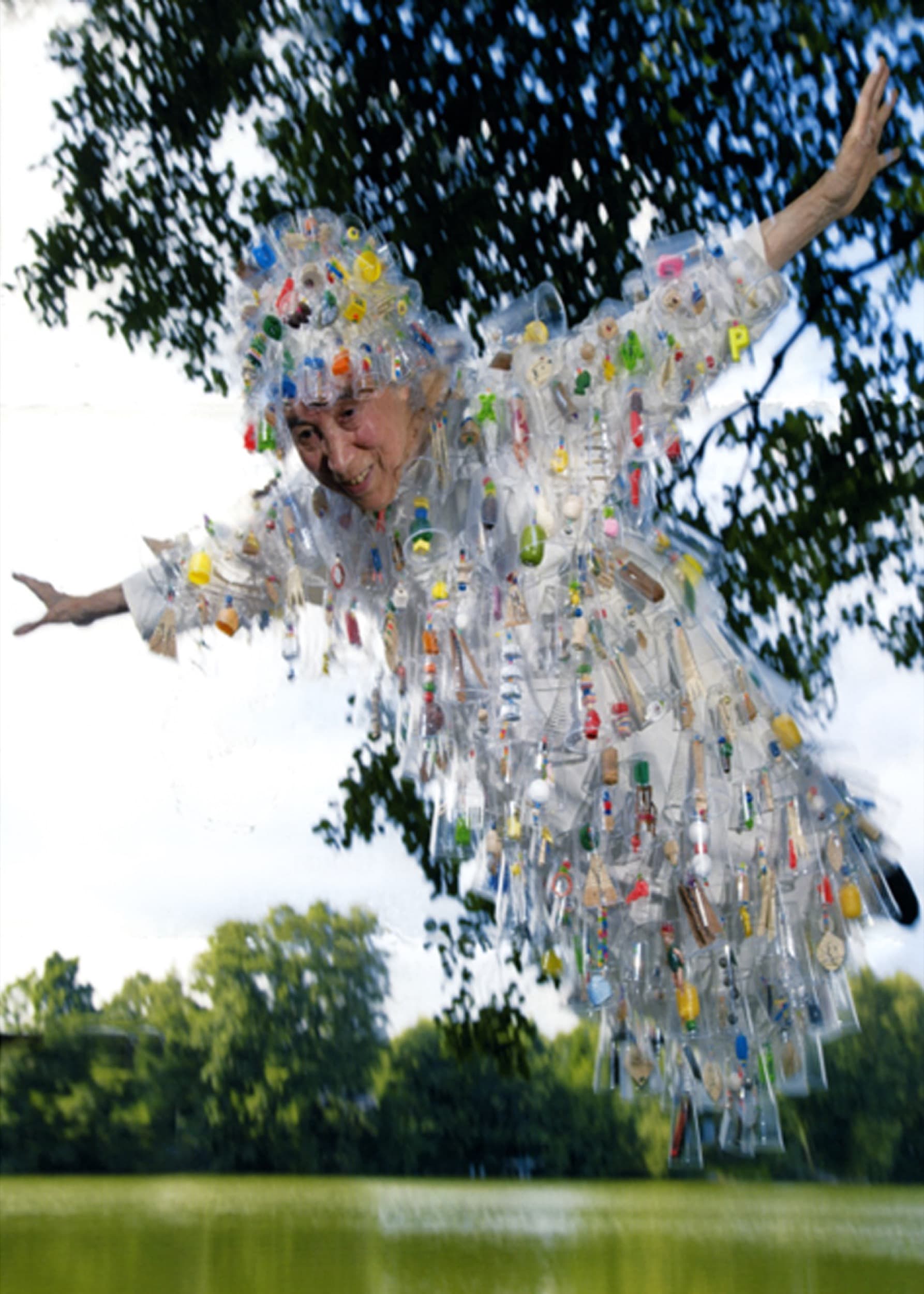
Her performance costumes also played an important role. Individually tailored by Takako, they combined upcycling with interactive usability. An outfit may have been designed to come apart during a performance because she attached parts to her audience. Or that it was intended to be drawn upon or cut away by co-performers. Or the garment may have been covered with pockets containing hand-written notes on tissue paper, so that audience members could grab a mini score for Takako’s “opera.”

Takako with breakaway costume, 2012. Munster. Courtesy Takako Saito Archive. Photo: Johannes Stahl.

Takako Saito, Pill Bottle, Pocket, and Shell costumes. Dusseldorf, 2023. Courtesy Takako Saito Archive. Photo: Johannes Stahl.
White paper cubes, which Takako produced in large numbers by hand, occupied a special place as a recurring ingredient in her performances—as play material, as an element of chance, as sound generators, and even when attached as rattling appliqués on her performance dresses.

Takako Saito pouring paper cubes onto audience from gallery mezzanine. 2018. Museum für Gegenwartskunst, Siegen, Germany. Courtesy Takako Saito Archive. Photo: Johannes Stahl.
Arcane materials and processes were of major interest to her. She conducted long, alchemical series of experiments investigating the interactions of different types of ink and water or vegetable juices and made astonishing discoveries. Other such long-term experiments included the “pranks” that the heat of candles or irons played on parchment paper of varying weights. In her “secrets of varnishes,” drops of varnish in close proximity to others diffused very differently in each case. Despite her systematic approach, she retained her sense of wonder, often remarking “That was a surprise!” when she showed her work to others.

Takako Saito, Pranks of the Candle Book No. 1, 2002. Parchment, red ink, 46 pages, stamped and arranged with braided fiber, 60 × 10 × 10 inches, variable. Courtesy Takako Saito Archive. Photo: Johannes Stahl.

Takako Saito, Geheimnisse von den Lacken. No. 3. (The Secrets of Varnishes), 2011. 2 different lacquers arrayed in orange peels tethered with twine. Courtesy Takako Saito Archive. Photo: Johannes Stahl.
Despite all of her humor and child-like wonder, Takako was serious—a very hard worker. As a foreigner living in Germany, Takako had to report to the authorities at regular intervals and when asked to leave her fingerprints, they were too work-worn to register. And in 2014 when I visited her in the hospital after she had had a bicycle accident, she wasn’t lying down but sitting fully dressed on the edge of the bed. Only her arm in a sling indicated that she had broken her shoulder. She explained “I told the doctor that I have to get well quickly. I’m a woman who has to work to live.”

Takako writing, 2025. Courtesy Takako Saito Archive. Photo: Johannes Stahl.
Johannes Stahl is a Cologne-based art historian and Saito’s close longtime friend, curator, and advisor. He co-curated the 2017–18 Takako Saito: Dreams to Do, a four-hundred-piece retrospective exhibition at Siegen Museum of Art, Germany and National Centre for Contemporary Art, Bordeaux, France and co-edited the accompanying catalogue in English, French, and German.