Pi– Pi–po, po - A Tribute to Takako
Julia Lerch Zajaczkowska
Word count: 759
Paragraphs: 10
It is a struggle for me and my fellow colleagues to sum up our feelings about the artistic legacy of this incredibly imaginative artist and friend in just a few words.
In the summer of 2021 six works by Takako Saito dating from the 1970s and 1980s were donated to the Kunstmuseum Bochum by a private collector couple. They had gotten to know Takako’s work through the Inge Baecker Gallery in Bochum and had enjoyed a long friendship with her as pen pals. Takako kept in touch with many people via letters that were works of art in themselves. This donation encouraged the museum to reach out to Takako to further investigate the significance of her work in relation to the art scene in North Rhine-Westphalia, Germany and beyond.
I was in my late thirties when I first met her at her Düsseldorf studio in autumn 2022 to organize her major solo exhibition Pi– Pi–po, po – A Portrait of Takako at the Kunstmuseum. I was excited and awed to meet this ninety-two-year-old artist who had lived and worked for nine decades on three different continents. While she had a great sense of humor and a casual manner, what impressed me even more was how hard working and productive she continued to be.
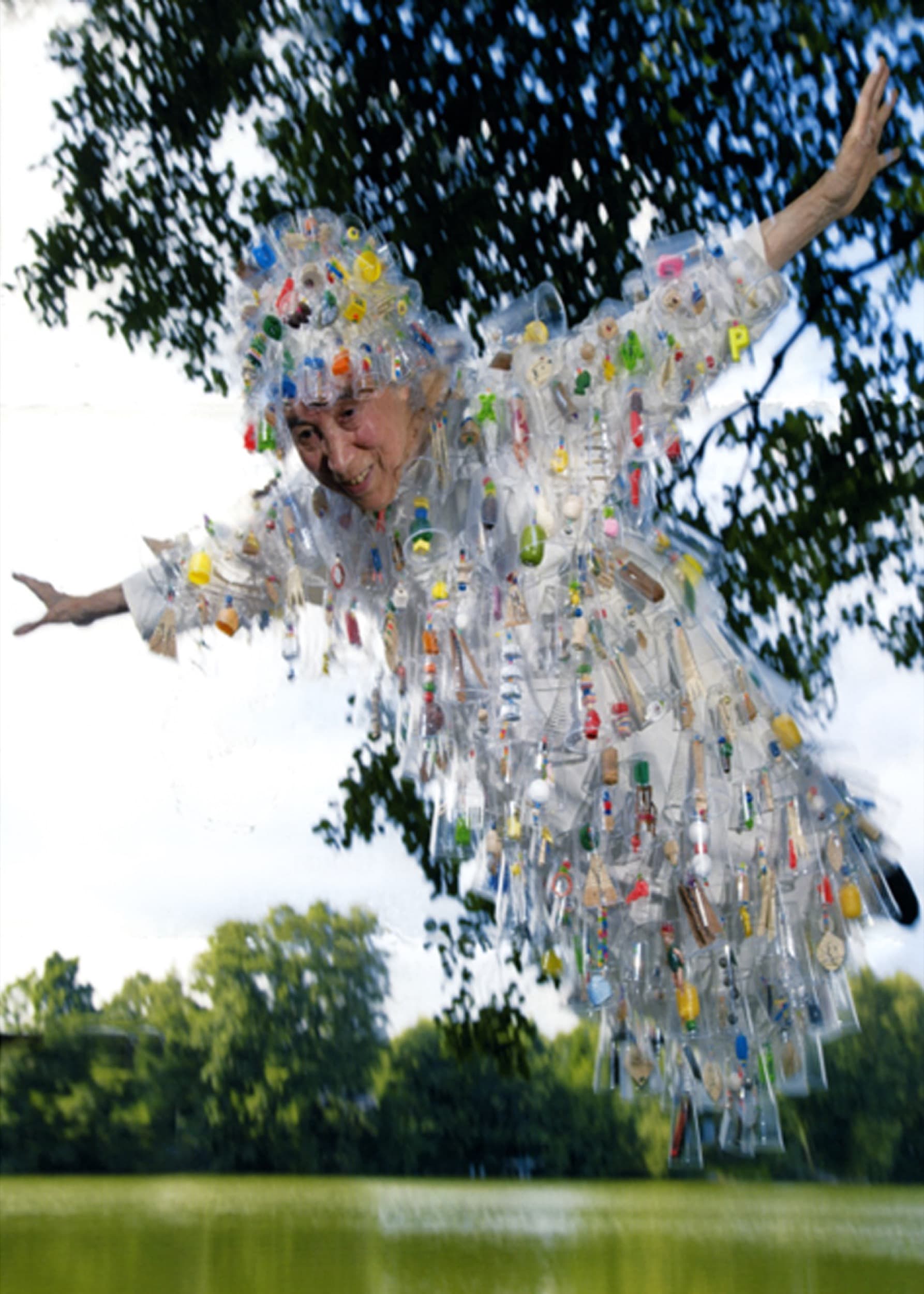
Over the decades, Takako had produced an incredible amount of works: games, drawings, performances, sculptures, books, suits, and ephemera. Even her studio apartment complex was a work of art in itself. Every piece of furniture, her clothes, every pillow, even the walls and floors, were designed and handcrafted by herself over the past forty years. Some of these architectural and design elements were recreated for the show.

Installation view: Pi - Pi, po, po - A Portrait of Takako, Kunstmuseum Bochum, Bochum, Germany, 2023. Book Dress No. 2 Performance Costume, 1998. Curved doorway opening and handpainted floor treatment were motifs copied directly from the artist’s studio home. Photo: Kunstmuseum Bochum / Heinrich Holtgreve.
The principle of Takako’s work was simple and contagious: do it yourself or better yet, do it together. Everything is special, oh, everything, and so we organised this entire show without writing one e-mail, a unique experience in my professional life. Every step was discussed via letter, phone call or regular visits in her studio in Düsseldorf where she shared her ideas, proposals, green tea, and dates.

Letters from Takako Saito preparing the exhibition at Kunstmuseum Bochum, 2023.
The retrospective exhibition in Bochum was dedicated to Takako’s friendships, material experiments, and her work in many different media. Artworks from the late 1950s to the 2020s filled the entire museum. We displayed for the first time ever early drawings from her time in Japan (1956–64) along with her legendary chess sets; extraordinary books; videos of her performances in Germany, Belgium, and Italy (1988–2006); and the performance dresses, sound installations and paper sculptures connected to these.

Performance Videos, Silent Music Material Boxes, and John Cage Men’s Suit Performance Costume. 2006.
Pi ̶ Pi ̶ po, po, the title of the exhibition proposed by Takako Saito, based on the Dadaist principle of nonsense of words and sound, has no meaning, or does it? Depending on the rhythm and the way it is pronounced, a little music of its own is created. She called me once she decided on the title of the show, repeating it a couple of times, fast and slow until I finally understood: Piiiiiiii Piiiiiii -po po.
Her curiosity and enthusiasm for interactions extended also to material interactions. She enthusiastically told me that when she drew with Japanese ink onto the surface of a pool of water it behaved differently depending on where the water was from. She blotted the ink patterns gently onto cotton coffee filters and dried them in order to capture the images. When she had water damage in her studio she asked the plumbers if she could use the water sucked out of the wall. Surprised and excited by how differently this “wall water“ reacted with the ink compared to water from Reggio Emilia, Italy, or her friends' pond, or the Rhine River in Dusseldorf, she created a whole series of coffee filter paintings and displayed them in eight wooden frames with edges carved to echo the shapes creted by the ink and water.

Takako Saito, “Coffee Filter Painting Series.” Japanese ink, cotton coffee filters in hand-carved wood frames. Photo: Kunstmuseum Bochum / Heinrich Holtgreve.
Evident in her way of life and her interactions with people and materials, Saito was comfortable in the world around her. Takako’s encounters with audiences were like her encounters with water and paper—conducted with curiosity and care. As she had early on in Fluxus, she enacted artistic interventions in everyday life using simple, accessible means. Yet, simply classifying the entirety of her life work in the “Fluxus” category would fall far short of encompassing the greater breadth and depth of her legacy. To the very end she devoted herself entirely to being an artist. Her whole attitude towards life was radical and unique.
Julia Lerch Zajaczkowska
Julia Lerch Zajączkowska is curator and deputy director of Kunstmuseum Bochum, Germany. Curator of Pi–Pi–po, po – A Portrait of Takako in 2023, she has since initiated acquisition of additional Saito works to add to a large recent Fluxus bequest, forming an in-depth study collection in this area.