Elizabeth Buhe

Elizabeth Buhe is a critic and art historian based in New York.

Diane Simpson has gained considerable visibility since her retrospective at the Institute of Contemporary Art, Boston in 2015–16 and her inclusion in the 2019 Whitney Biennial. Now—at the age of ninety—she is the subject of a career survey of sculptures and works on paper from the mid-1970s through 2022 at the American Academy of Arts and Letters in upper Manhattan.
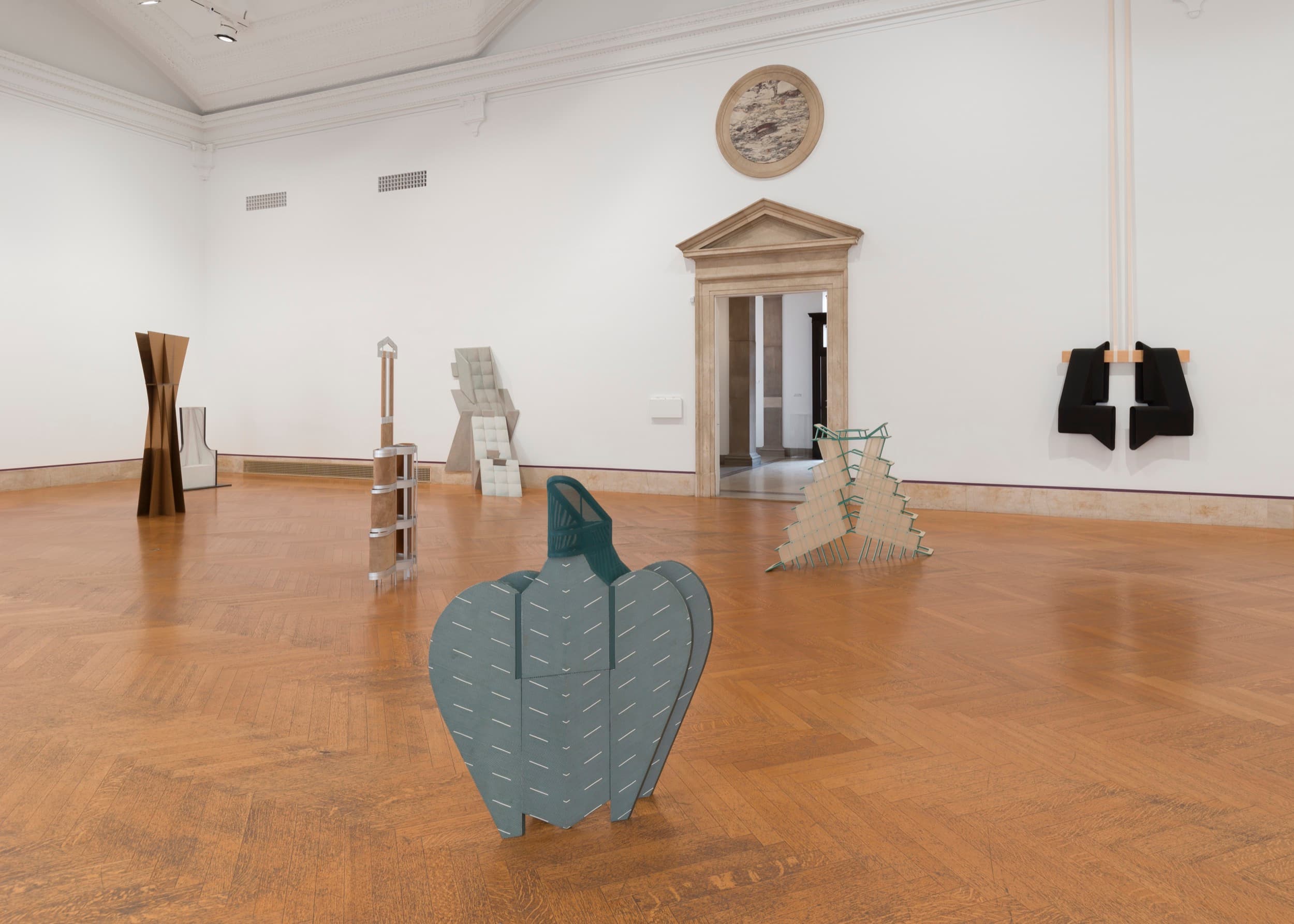
Installation view: Diane Simpson: Formal Wear, American Academy of Arts and Letters, New York, 2025. Photo: Charles Benton.

The overwhelming sensation that Sigrid Sandström’s nineteen paintings at Anat Ebgi in Tribeca impart is one of movement.

Sigrid Sandström, Dust Plunge, 2025. Acrylic on canvas, 26 ¼ × 20 ½. © Sigrid Sandström. Courtesy Anat Ebgi.

When I encountered Lumin Wakoa’s paintings at Deanna Evans Projects in 2021, I was struck by the way her scumbled paint mapped out forms that seemed to be melting and dissolving into each other.

Portrait of Lumin Wakoa, pencil on paper by Phong H. Bui.

A short trek into Storm King Art Center brings you to an unassuming installation of rocks lying low in the natural grass, mostly obscured from visibility until you climb the shallow hill on which they sit.

Dionne Lee, between the falling leaf and the surface of rock (detail), 2025. Courtesy the artist and P.Bibeau, NY. Photo: Jeffrey Jenkins.

Diana Al-Hadid creates freestanding sculptures, wall-based relief paintings, and works on paper to examine the narrative frameworks that inform human culture. Born in Syria, Al-Hadid immigrated to the United States as a child and grew up in Ohio. On the occasion of her exhibition, unbecoming, at the Eli and Edythe Broad Art Museum at Michigan State University, Al-Hadid joined Elizabeth Buhe on the New Social Environment (Episode #1240). Their conversation, edited for print, touches on a range of topics, including the relationship of the body to architecture, what it means to be unbecoming, and why images of women in motion are so important to the artist.

Portrait of Diana Al-Hadid, pencil on paper by Phong H. Bui.

In her current single-gallery exhibition at the American Academy of Arts and Letters, Teresa Baker presents seven recent works on AstroTurf that draw from these elements in order to pose ambitious questions about how we make sense of the land around us and what painting’s role in this process might be.

Teresa Baker, Twenty Minutes to Sunset, 2023. Spray paint, acrylic, buckskin, yarn, and artificial sinew on artificial turf, 118 × 105 inches. Courtesy of the artist and de boer, Los Angeles & Antwerp. Photo: Charles Benton.

Coinciding with New York City’s spring art fairs, Berry Campbell Gallery is presenting a thorough and impressive mini-retrospective of Mary Ann Unger.

Mary Ann Unger, Untitled, 1997. Clay, 12 1/4 x 8 x 3 inches. © Mary Ann Unger. Courtesy Berry Campbell Gallery, New York.

All the works in Star Rose, Rose Star combine emerging and Indigenous technologies, including dying, weaving, beading, and basketry, some of which Sarah Rosalena learned from her Wixárika relatives.

Installation view: Sarah Rosalena: Star Rose, Rose Star, Sargent’s Daughters, New York, 2025. Courtesy Sargent’s Daughters.

The most immediately remarkable aspect of the works on paper by Loretta Dunkelman now on view at Polina Berlin Gallery are their lustrous surfaces: blocks of oil-wax chalk in blues and pinks so heavily worked that they appear burnished.

Loretta Dunkelman, A Letter to Constantine, 1976. Oil-wax chalk and pencil on paper, 9 3/8 x 12 inches. © Loretta Dunkelman. Courtesy the artist and Polina Berlin Gallery, New York. Photo: Steven Probert.

A trumpeting angel soars through the center of a wheel in Ada Friedman’s Performance Proposal, Helen Rides VII: Wing and Wheel 3 (2020–24), a painting about the size of a concert poster. The implied movement of the winged creature emerging from the wheel suggests a separate spatial plane behind, which Friedman denotes with an uneven field of blue acrylic.

Installation view: Ada Friedman and Helen Adam: Ballads, David Peter Francis Gallery, New York, 2024. Courtesy David Peter Francis Gallery.

Some of the words I wrote down just after entering Ellen Siebers’s fourteen-painting show on the Upper East Side were “velvet,” “Inness forest,” “autumn,” and “ghost.” It is striking that most of these associations suggest an expansiveness evoked by texture or the fullness of depth, because Siebers paints relatively small, on square or rectangular birch panels of 12 by 12 inches or less.

Ellen Siebers, Bather, 2024. Oil on panel, 8 x 8 inches. Courtesy the artist and Franklin Parrasch Gallery.
The fifteen fabric sculptures on view in Phygitalia demonstrate that Florencia Escudero is an exceptional artist, capable of aligning diverse materials with her rigorous conceptual aims so skillfully that sometimes it is difficult to separate the two.
Installation view: Florencia Escudero: Phygitalia, Rachel Uffner, New York, 2024. Courtesy Rachel Uffner.
Joy Curtis’s large-scale or wearable sculptures at Klaus von Nichtssagend, all made of fabric and hand-dyed by the artist with natural pigments, begin to suggest answers, moving us progressively farther from the stuff of material reality into abstractions that, presumably, we cannot see.
Joy Curtis, Ocean Grandma, Sympathetic/Parasympathetic, and Future Organs, 2022–23. Plant dyes on cotton, silk, and hemp; denim, kapok, steel, and bronze wire, 102 × 90 × 144 inches. Courtesy the artist and Klaus von Nichtssagend Gallery.
Loie Hollowell has been painting sex and pregnancy for the past decade. Over that time, her artistic approach to these subjects has transformed in ways that rely on her own felt experience of embodiment, and two exhibitions now on view, one at Pace Gallery and one at the Aldrich Contemporary Art Museum in Ridgefield, Connecticut, provide ample evidence of this fact.
Loie Hollowell, Yellow Mountains, 2016. Oil paint, acrylic medium, sawdust, and high-density foam on linen mounted on panel, 48 x 36 x 3 inches. Collection of the artist. Courtesy Feuer Mesler Gallery.
At Teruko Yokoi’s retrospective at Marlborough Gallery, which includes fifty works spanning from 1957 to 2012, I had the feeling that the paintings were somehow twinkling or gleaming as I walked through the galleries.
Teruko Yokoi, Violet, 1980. Acrylic on canvas, 45 3/4 × 32 inches. Courtesy the artist and Marlborough Gallery.
Amy Butowicz’s nine large-scale drawings now clipped to the wall at Peninsula feature hands, feet, and other less identifiable body parts pressing into or encircling each other like the doubled-over folds of stretched putty. Clearly a thematic of touch is at play, but in a way different from the artist’s earlier work, which was more squarely abstract or else alluded to nature, design history, or aspects of human form alone. In a crucial development, several works at Peninsula, by contrast, include horse anatomy, primarily hooves and haunches.
Amy Butowicz, Groundwork, 2023. Sumi ink, graphite, watercolor & gouache on paper, 52 x 36 1/2  inches. Courtesy the artist and Peninsula Art Space. Photo: Aqua Rose.
The twenty-five works on view in Diana Al-Hadid’s debut solo show at Kasmin present an artist at the height of her powers, practiced in aligning the behavior of her materials—primarily gypsum, bronze, steel, and linen pulp paint—with the conceptual contours of her message.
Diana Al-Hadid, The Bronze Chamber of Danae, 2023. Mixed media, 115 x 94 x 2 5/8 inches. © Diana Al-Hadid. Courtesy the Artist and Kasmin Gallery.
Stepping into Light from Water at Wave Hill in the Bronx is a little bit like time travel, or space travel, or both. Artists Heidi Howard and Esteban Cabeza de Baca present a different worldview than the one that fuels New York City’s supertall buildings, logic of accumulation, and newly-shellacked Tribeca galleries.
Heidi Howard, Night Pond, 2023. Acrylic on canvas, 77 x 122 inches. Courtesy the artist and Garth Greenan Gallery. Photo: Charles Benton.
A playful line, cutting around and across abstract constellations of squares, tiny stars, or triple helixes, is consistent throughout Courtney Childress’s seven new works on view at Deanna Evans Projects. The line takes up various guises, as a knotty string, chain links, an incomplete halo, or a very long wave that snakes back and forth across the front of the canvas in horizontal stripes. Unlike the continuity of a drawn line or the coherence of a gestural brush mark, Childress’s twists and translucent fields are made by using barbed needles to meticulously push colored wool fibers through an unprimed canvas, or by tacking hand-felted yarn down onto that same surface.
Installation View: Courtney Childress: Fuzzy Logic, Deanna Evans Projects, New York, 2023. Courtesy Deanna Evans Projects.
Clare Grill’s nine new paintings on linen at Derek Eller are breathtaking in their expansiveness. Usually I don’t foreground my own embodied responses to art in my writing, preferring instead to extrapolate an observation that surfaces as interpretation. But my actual gasp before these paintings was so visceral that it warrants mention.
Installation view: Clare Grill: At the Soft Stages, Derek Eller Gallery, New York, 2023. Courtesy Derek Eller Gallery.
Nearly fifty works—metal sculptures, unique pieces of jewelry, and works on paper—at Michael Rosenfeld Gallery amount to a mini retrospective of American sculptor Harold Cousins’s work. Collectively they show the sweep of a career open to brave experimentation and Cousins’s searching eye for the power of simple forms found in surrounding culture.
Harold Cousins, Tall Gladiator, ca.1953. Copper on copper and steel base, 28 x 9 x 9 inches. © Estate of Harold Cousins. Courtesy Michael Rosenfeld Gallery LLC, New York, NY.
Adebunmi Gbadebo is an extraordinary artist, capable of manipulating, with rare intelligence, carefully-selected materials that align closely with her works’ affective power.
Adebunmi Gbadebo, Production 3, 2022. Black hair, cotton, rice paper and Indigo dye, 84 x 36 inches. Courtesy the artist and Claire Oliver Gallery.
Stockman’s project reads as epistemological rather than ontological in orientation. She queries not what painting is, but how it is what it is and, especially, how we come to know this.
Lily Stockman, Swimming at Night, 2022. Oil on linen, 48 x 36 inches. Courtesy Charles Moffett. Photo: Ed Mumford.
Maureen St. Vincent’s six pastel drawings (all 2022) now on view at Hesse Flatow are surreal, grotesque, and seductive. Amoebas squirm and snails slide. In Biancabella and the Snake, a slender onyx serpent winds through a landscape of puffy pink or yellow biomorphs, its body cleaved improbably by an undulating vulva hovering at compositional center. In Price’s Daughters, a braided umbilical cord penetrates a six-fingered shell while its twin’s upper lobe bears a butterfly-shaped hole. Through this puncture an orange-trimmed background spills forth its blue insides, confounding the laws of space. Here, base organisms are pristine: nowhere do we find a slime trail’s glimmer.
Maureen St. Vincent, Price's Daughters, 2022. Soft pastel on paper with artist frame, 37 x 44 x 3/4 inches. Courtesy the artist and HESSE FLATOW, New York. Photo: Chris Grunder.
The eleven paintings and single sculpture in Astrid Terrazas’s first solo show at P·P·O·W encompass far-reaching spatial and temporal terrain through powerful, graphic figuration.
Astrid Terrazas, How to Make it on the LAND!, 2022. Oil on canvas, 74 x 54 inches. Courtesy Astrid Terrazes and P-P-O-W, New York.
The ten fabric sculptures on view in too bad for heaven, too good for hell at Mrs. prove that Rose Nestler is an exceptional artist, able to align the formal manipulation of her materials and the conceptual contours of her message so closely that the result is both wholly her own and wholly convincing.
Rose Nestler, Spun Out, 2021. Fabric, tulle, foam, thread, wood, paint, staples, cork, 60 x 60 x 13 inches. Courtesy Mrs., Maspeth.
If we understand the world Corbett’s art builds through the pressure of fingers and brush to extend beyond the gallery’s reach, we find a powerful model for problem-solving poised to yield an ever-adapting environment flexible enough to accommodate needs that are, as of yet, unknown.
Installation view: Shawanda Corbett: To the Fields of Lilac, Salon 94, New York, 2022. Photo: Elisabeth Bernstein.
Lumin Wakoa made all of the 17 paintings on view at Deanna Evans Projects this year, beginning many at outdoor sites—including her own front garden—near her home in Ridgewood or her nearby Bushwick studio. This was in part occasioned by the pandemic, which made commuting via public transit inadvisable. The result is a body of work self-confidently located within the tradition of plein air painting,
Lumin Wakoa, Blooming Tree at Trinity Cemetery, 2021. Oil on linen, 12 x 9 inches. Courtesy Deanna Evans and Etienne Frossard.
There is a wicked alchemy to Katelyn Eichwald’s work. Her modestly-sized paintings of ordinary subject matter—piled rope, a gleaming white turret, a shadowy clockface—bewitch us, like scrims, portals, or talismans might.
Katelyn Eichwald, Thirsty, 2021. Oil on linen, 36 x 48 inches. Courtesy the artist and Fortnight Institute, New York.
One of the questions posed by Huguette Caland: Tête-à-Tête (Head to Head) at the Drawing Center is how the artist’s works link embodiment with experience of the built environment—or how they are, as one wall label notes, “at once bodies and maps.” Both of these terrains have been subjected to the kind of seeing, measuring, and regularizing that is the inheritance of colonial modernity, but Caland reorders this logic through soft, sensorily evocative form, winding continuous lines, and layered mark-making that yields densely hatched thickets vibrating with electric poppies.
Huguette Caland, Homage to Pubic Hair, 1992. Mixed media on paper mounted on panel, 10 x 10 inches . C
Mayer’s exhibition is contemplative and compact, a deep dive into a body of work not seen since it was first exhibited in the late 1970s and early 1980s.
Rosemary Mayer, Spell, 1977. Watercolor, ink, and graphite on paper, 26 x 20 inches. Courtesy Gordon Robichaux, NY. Photo: Greg Carideo.
With Baudelaire’s compendium as their touchstone, gallerist and artist Karen Hesse Flatow and guest curator Nicole Kaack show that Baudelaire’s chief concerns remain productive terrain for an emerging generation of artists whose diverse work is gathered in The Symbolists: Les Fleurs du mal at Hesse Flatow.
Astrid Terrazas, Retrato familiar, 2020. Acrylic on canvas.43 x 33 inches. Courtesy Hesse Flatow.
Unlike those in which we find the Rückenfigur, that singular figure of the romantic sublime, Golden’s vast landscape is not a verdant expanse unperturbed by human hands but something like its opposite: the apparent site of both personal and natural disaster. Yet evacuated of human presence, the narratives suggested here remain open to our imagination.
Samara Golden, in collaboration with The Fabric Workshop and Museum, Philadelphia, Upstairs at Steve's (installation detail), 2020. Mixed media. 80' 7" x 17' 6" x 16'. Photo credit: Carlos Avendaño.
In looking at the canvases of Emily Mason now on view at Miles McEnery we sense not so much a relation to a certain place or thing, but a lifetime of visual experiences put down onto canvas through a keen process of filtering. The result in Mason’s work is necessarily nonspecific yet points nonetheless toward layers of feeling: light reflected off a rippling canal, a gleaming gold surface, flowers in mid-summer.
Emily Mason, Within The Orchard, 1986 Oil on canvas, 52 1/4 x 52 1/4 inches. Courtesy the Emily Mason and Alice Trumbull Mason Foundation and Miles McEnery Gallery, New York.
Entering Leilah Babirye’s show at Gordon Robichaux feels like walking into a solemn space loaded with gravitas—a regal court of yesteryear or, at least as I imagine it, Brancusi’s studio. This is another way of saying that the 39 wooden and ceramic works and the handful of monotype prints on view here command an extremely powerful sense of presence.
Leilah Babirye, Abambowa (Royal Guard Who Protects the King), 2020. Glazed ceramic, 7 3/4 x 4 x 2 inches. Courtesy Gordon Robichaux, NY. Photo: Greg Carideo.
A signal feat of Abstraction in the Black Diaspora and other similar efforts that draw attention to formally adjacent but culturally distinct iterations of artistic practice is that they dislodge entrenched hermeneutic methods that are part and parcel of the dominant narratives themselves.
Tariku Shiferaw, Kenya, 2020. Acrylic on canvas, 72 x 108 inches. Courtesy False Flag.
Under deceleration’s magnifying glass, our deliberate politics of self-care is extended, in Stockman’s hands, to the odds and ends that surround us. The artist’s meditation on these circumstances in the Moffett paintings takes her work in a new direction, while still tethering it to her familiar language of softened geometric forms.
Lily Stockman, New Dahlia, 2020. Oil on linen, 14 x 11 inches. Courtesy Charles Moffett, New York.
Shvarts’s work engages a remarkably capacious set of considerations: the interpersonal and the institutional, the practical and the theoretical, a historical act and its circulation. These concepts expose the systems that structure our societies, revealing their inequity while encouraging us to imagine how our own bodies are already ensnared within them.
Installation view: Aliza Shvarts: Purported, Art in General, New York, 2020. Photo: Dario Lasagni.
Crisp, clean, cool, no-frills, matter-of-fact—these and similar adjectives constitute a familiar lexicon for the work currently on display in Judd, the appropriately tight, monosyllabic title MoMA has given its Donald Judd retrospective, the first in New York in over 30 years.
The title’s synecdoche—in which something modestly sized stands for something larger—resonates throughout the exhibition, whose unassuming scale belies the ambition of the work, which extends beyond the museum’s walls and reaches into both the past and the future.
Ellen Lesperance, Velvet Fist, 2014-2015. Courtesy Adams and Ollman, Portland and Derek Eller Gallery, New York. © Ellen Lesperance.
From anecdotes relayed in “Profiles in Leadership,” we learn, among other things, that David Copperfield has been employed by a political campaign to disappear candidates about to commit verbal self-sabotage, that Vladimir Putin has prepared muffins from the flesh of a shark he single handedly overpowered, and that Fidel Castro categorically evaded women to avoid being poisoned.
Deb Sokolow, Mr. Richard M. Nixon's Difficulties with Ovals, Version 2, 2019. Graphite, crayon, colored pencil, pastel, and collage on panel diptych, 50 x 76 x 1 1/2 inches.
The show at PPOW consists of 22 paintings and two wall-bound sculptures (all 2019). Five large paintings depict reposing, peachy-porcelain nudes arranged on shallow, tree-framed outcroppings, surrounded by the detritus of extravagant feasts: dishes loaded with fruit, meticulously-crafted cakes, chalices alight with flames, even an oyster shell full of pearls. This bounty, however, is haunting.
Sanam Khatibi, An hour before the Devil fell, 2019. Oil and pencil on canvas, 70 7/8 x 90 1/2 inches. Courtesy P.P.O.W.
Body is vessel in the nine new paintings by Loie Hollowell that make up Plumb Line, the artist’s debut show with Pace. With a strong, centrally-placed vertical line as her organizing principle, Hollowell delivers human forms distilled into a succinct vocabulary of curved shapes: bisected disks, almonds, and ovals, plus stacked rows of half-circles crowned by a glowing orb.
Loie Hollowell, Standing in Light, 2018. Oil paint, acrylic medium, sawdust, and high density foam on linen mounted on panel, 72 x 54 x 3 1/2 inches. © Loie Hollowell. Courtesy Pace Gallery.

Close

Home