Light from Water: Heidi Howard & Esteban Cabeza de Baca, with Liz Phillips
Word count: 1219
Paragraphs: 6

On View
Wave HillLight from Water: Heidi Howard & Esteban Cabeza de Baca, with Liz Phillips
August 19–November 26, 2023
The Bronx
Stepping into Light from Water at Wave Hill in the Bronx is a little bit like time travel, or space travel, or both. Artists Heidi Howard and Esteban Cabeza de Baca present a different worldview than the one that fuels New York City’s supertall buildings, logic of accumulation, and newly-shellacked Tribeca galleries. The power of their guiding conceptual approach creeps up on you slowly as you wind your way through the show’s three galleries and the extended terrestrial and aquatic gardens where the exhibition space, a former residence called Glyndor House, is sited. They offer a philosophy of unity and lived reciprocity among living things, in which humans have much to learn from nature. Through two dozen paintings, several planters and ceramic pots, two large-scale figurative sculptures, and a pond-like wavetable by sound artist Liz Phillips (Howard’s mother), we feel connected with a natural world that is manifestly here with us now. This horizontal way of thinking is inclusive and generous, presenting an alternative to the vertical hierarchies of colonialism, of science, of modernism.
In Howard’s Night Pond (2023), a woman silhouetted against a twilit garden opens herself toward a watery expanse, the horizon between them broken only by the paintbrush she holds in her hand. In Cabeza de Baca’s open-air Host (2022, in collaboration with Howard), a seated human in bronze is split open, the space between its two halves stuffed with planted lavender, native grasses, chili, asters, and Virginia creeper. It offers the brilliant vision that, fundamentally, we are all made up of plants. We sense a deep respect for plant life, natural life cycles, the value of community, and Indigenous ways of knowing—ethical positions that flow through both artists’ work like an underground matrix of waterways. Spirals, spiderwebs (as in Iris and Spider [2023]), and the starburst patterns of indigo-dyed supports formally dramatize these concepts of reciprocity and interconnection. Only the most effective art aligns theory and practice, and Light from Water shows that Howard and Cabeza de Baca do so remarkably well by opening their work to chance procedures, to their communities, and to each other.
This is the first showcase of their collaborative work, which is grouped together in the exhibition’s South Gallery. Here we find the show’s beating heart: the fuchsia, goldenrod, and green triptych Braiding Sweetgrass (2023). Through the irregular stacking of acrylic layers, we see glimpses of the New York cityscape and the tie-dyed canvas below. The extended arms of a central spiral reach onto either side panel, the whole covered by the gestural evocation of swirling skies and a flower-studded field. At the top appears the painting’s only figure: the Sky Woman of Indigenous origin stories who gave birth to the world by carrying handfuls of seed and spreading life-giving mud over the back of a turtle. Thus Turtle Island was created—North America before the imposition of geopolitical borders. The painting takes its title from botanist Robin Wall Kimmerer’s book of the same name, which advocates for sustainable living by learning from nature’s intelligence: the way chestnut trees communicate, flowers of complementary colors grow alongside each other to attract pollinators, waterlily capillaries act as a salve for human grief. The clarity of Howard and Cabeza de Baca’s conceptually and materially interdisciplinary project reveals that such ways of thinking and working are entirely natural and model a path toward climate action.

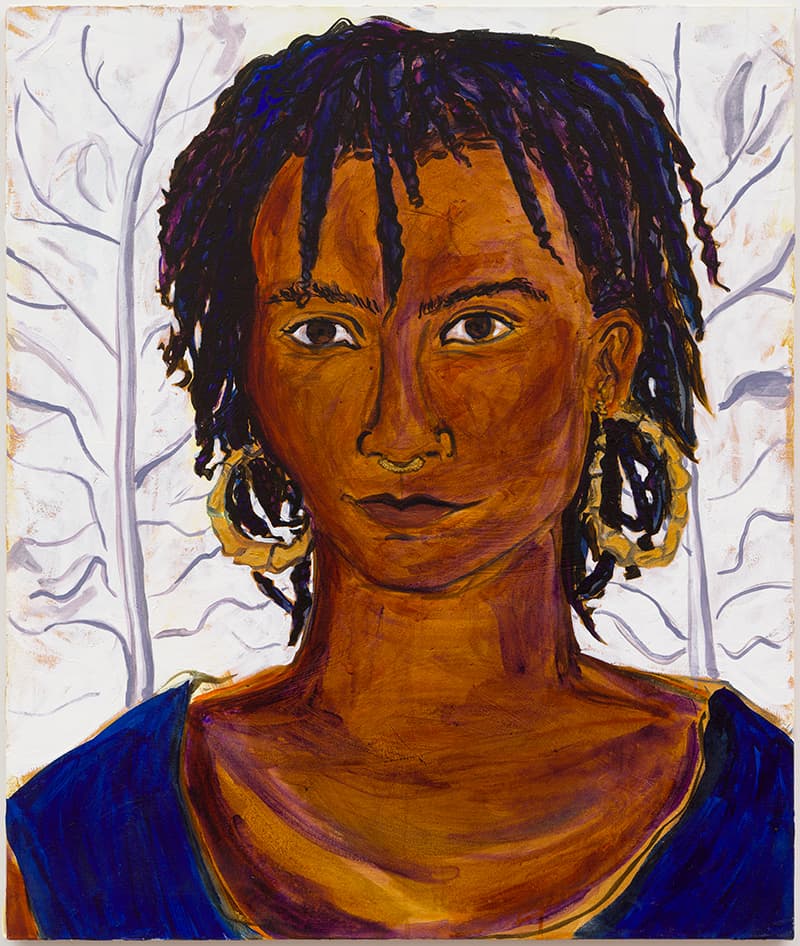
In the North Gallery, Howard’s paintings, plant pots, and artist-modified furniture encourage a slower pace of repose and contemplation. Around the room’s perimeter, portraits of female and gender-nonconforming creators look on. Howard is well known for building community by painting portraits of artists and writers, then inviting them over for dinner afterward. Howard’s responsiveness in the act of making—to the mood of a sitter, cultural references that hold special significance to them, or the conversation’s tone—mean that the paintings consciously seek their origin from interpersonal connection rather than attempt to record likeness. The paintings render these affective qualities through density of pattern, the economy of dancing line, and saturated color. Metallic paint comprising the skin of sculptor LaKela Brown (2023) lends her a literal glow, while the elongated chamomile stems melting around Alison Cayne (2022) also seem to arise from her, alluding to produce-based sauces the sitter’s sustainable cooking company makes and also, retrospectively, linking to the horticulture of Wave Hill. This is the largest of the three galleries, and seems to reflect on the need to have one’s own space to make creative work, and to ask how the spaces in which we live and work are gendered. Portraits of Howard and Cabeza de Baca, partners who live together in Queens, adorn the back of a single standing mirror. An invitation to think about mutual influence, the mirror condenses the exhibition’s core concerns by bringing themes of introspection and refraction together with the observation of light and water.

In the central gallery, Cabeza de Baca’s work is a hymn to pre-colonial and pre-industrial ways of living on the land. A Chicano artist born in California, he has discussed painting as a “retrieval device” for returning to ancestral sites in New Mexico—and these canvases were painted outdoors in the Southwest, as well as in Wave Hill’s gardens and his studio in Queens. While Cabeza de Baca’s most recent showing at Garth Greenan (June–July 2023) foregrounded familial relations in paintings of Kachina dolls as well as those of people in community, there are few human figures here. Instead, swirling oval forms left visible through latex masking cut right through bright layers of acrylic desertscapes whose horizons tend toward vertical or diagonal tilts. His choice to foreground landscapes at Wave Hill is in clear dialogue with the romantic vistas Thomas Cole and Frederic Edwin Church painted of the Hudson River, whose views are framed by neighboring windows. But paintings like 8 Fold Way (2023) show, rather than erase, Indigenous ways of knowing. That egg-like shape takes the form of a rock the artist found in a cave in Mexico while also depicting the view seen though that cave’s opening, and the central blue orb of Pueblo bonita (2023) holds a sun dagger, an ancient way to mark the passage of the solstice by noting where a band of sun falls on spirals carved into a rock wall near Chaco Canyon. In the clay vessels grouped around the fireplace, Cabeza de Baca placed pumpkin seeds—nature’s way of storing energy for the lean months—which he also planted in the soil beneath Host outside. Both Howard and Cabeza de Baca encourage learning from nature in Light from Water, which in turn suggests that acts of making are less individual than we may usually allow. As Wall Kimmerer wrote of flowers’ natural tendency to pair, “its wisdom is that the beauty of one is illuminated by the radiance of the other.”1
- Robin Wall Kimmerer, Braiding Sweetgrass: Indigenous Wisdom, Scientific Knowledge and the Teachings of Plants (Minneapolis: Milkweed Editions, 2013), 47.
Elizabeth Buhe is a critic and art historian based in New York.