Diane Simpson: Formal Wear
Word count: 1148
Paragraphs: 10
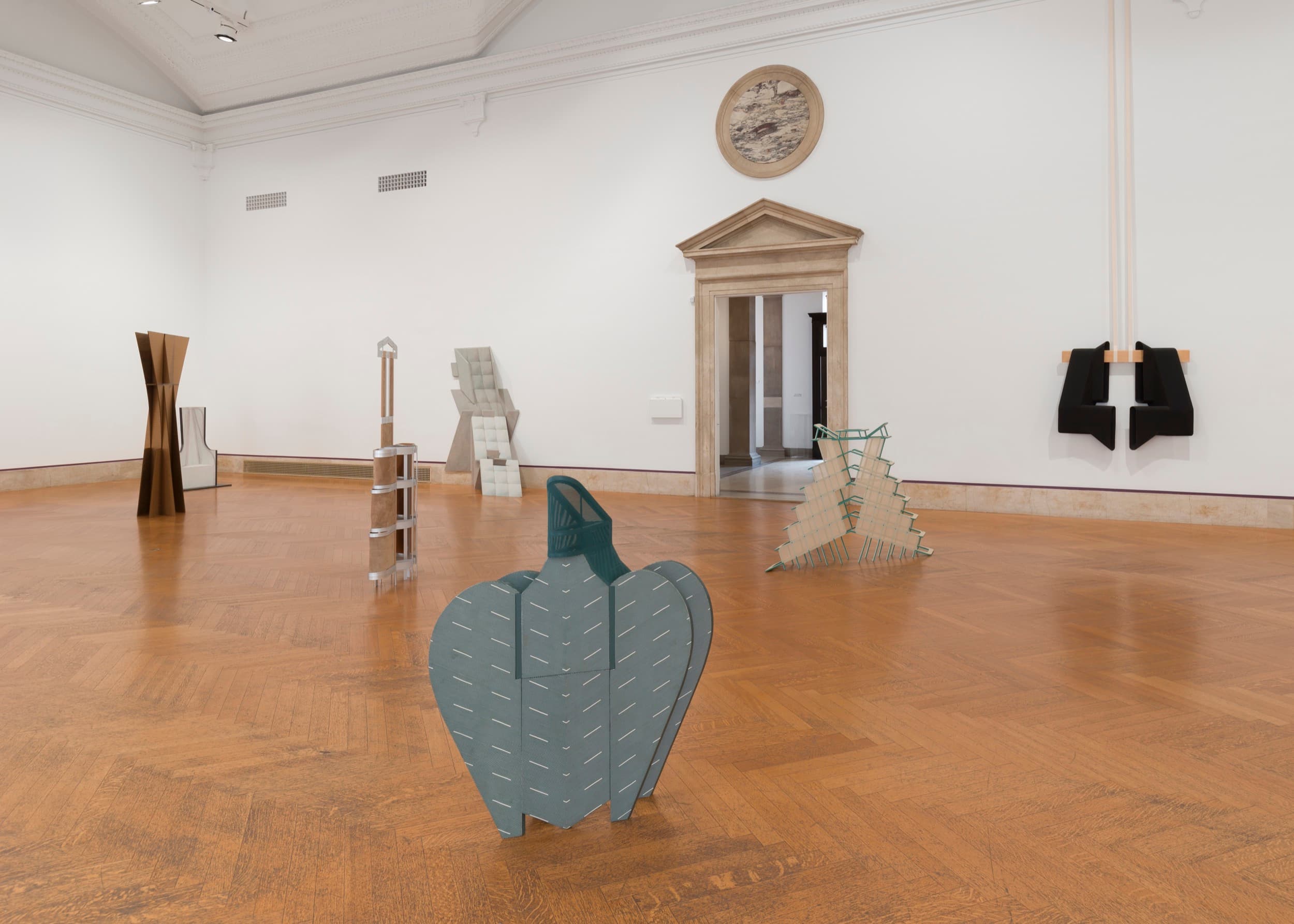
Installation view: Diane Simpson: Formal Wear, American Academy of Arts and Letters, New York, 2025. Photo: Charles Benton.
American Academy of Arts and Letters
September 27, 2025–February 8, 2026
New York
Diane Simpson has gained considerable visibility since her retrospective at the Institute of Contemporary Art, Boston in 2015–16 and her inclusion in the 2019 Whitney Biennial. Now—at the age of ninety—she is the subject of a career survey of sculptures and works on paper from the mid-1970s through 2022 at the American Academy of Arts and Letters in upper Manhattan, as well as a concurrent show of outdoor sculptures at the Art Institute of Chicago (her hometown). The American Academy of Arts and Letters exhibition in particular shows Simpson to be an artist worthy of all this recognition and more. It also reveals her as a figure who does not easily align with art historical narratives linked to the Chicago Imagists or Post-Minimalism, either of which we might imagine to undergird or explain her work.
Simpson made much of her art at home, first at the dining room table and then in the garage as she scaled up in size, all while raising her children. As Audrey Wollen wrote in an essay accompanying the American Academy of Arts and Letters show, Simpson’s light, transportable, and self-assembled works “wear her problems, the rooms in the house where she lived, and her resulting systems of ad hoc solutions, on their (literal) sleeve.” To me, this constellation of identities (artist, mother, suburban, solve-as-you-go) is particularly useful for understanding her work. For while it was once customary to assess the challenges faced by artists who are mothers as setbacks, Simpson thoroughly normalizes this position alongside a broader cohort that includes Janine Antoni, Ruth Asawa, Eve Biddle, Louise Bourgeois, Jackie Brookner, Madeline Donahue, Loie Hollowell, Mary Kelly, Hein Koh, Sally Mann, Marisa Merz, Ree Morton, Karin Schneider, Amy Sillman, and many more who mother(ed), even if they did not all bear children themselves.
The artists from this list transpose elements of domestic life or care into their practices, as Simpson does via allusions to household objects and childhood wonders: chairs, paper dolls, origami, dress up. Simpson’s chair sculptures in the American Academy of Arts and Letters exhibition—Chaise (1979), Neighbor (2021), and Winged (2022)—are all askew, as if inhabiting a dream world where their frames have been tugged out of joint by a marionette string. Likewise, Peplum IV (2015) straightens the ruffles of the eponymous sartorial flourish in four perforated aluminum panels, creating a child-sized hollow form whose eggplant enamel edges carry the work’s ornamental logic beyond the work and into the gallery architecture itself. A painted stripe of the same color runs low along the wall. Like a hinge between wall and floor, this ribbon provokes us to question the boundary between Peplum IV’s implied body and its surroundings, and, more broadly, between any body and its environment.
But there is also a more profound way that Simpson’s works engage her position as an artist, one that operates at the level of ontology rather than resemblance. In translating any given artwork from sketch to sculptural incarnation, Simpson disavows the conventional practice whereby a 45-degree angle on the page represents 90 degrees in real space. Instead, she retains that same 45-degree angle in three dimensions, yielding sculptures that seem to slant or fold in on themselves. The result of this play with distortion are sculptures that disrupt our expectations of both how things look and the very rules of spatial projection and apprehension.

Installation view: Diane Simpson: Formal Wear, American Academy of Arts and Letters, New York, 2025. Photo: Charles Benton.
Look, for instance, at Green Bodice (1985), which derives its shape from the torso and puffed sleeves of a historical garment. Examining the pencil drawing on vellum graph paper on view downstairs at the American Academy of Arts and Letters, we might expect the drawing’s depicted depth to yield a sculptural volume whose front plane sits perpendicular to its sides. Instead, the resulting sculpture looks just like its drawn counterpart, two parallel planes lifted off the page almost without any spatial translation or expansion taking place. One of the earliest works on view in the exhibition, Pleated Column #2 (1978), shows us that things must be seen in the round to be fully understood. Made of four interlocking pieces of cardboard that slot into each other, Pleated Column #2 also features illusionistic planes drawn onto the surface in pencil, such as a triangle that mirrors the shape of a sculptural projection just alongside it. The two genres of triangle align only if we position our eyes at a particular height relative to the sculpture, underscoring the fact that the movement of the viewer’s body returns multiple perspectives, and that these are malleable by design.
Artists have engaged directly with the laws of spatial recession in many historical moments. Donald Judd and Jan Dibbets dealt with planes and linear perspective in their serial sculptures and photographs (respectively) of the 1960s, contributing to a constellation of work that collectively ushered in a new postmodernism. In the sixteenth century, Hans Holbein the Younger’s singular painting The Ambassadors famously deployed anamorphosis to explore the limits of vision and human knowledge, defining an era that inaugurated a new humanistic worldview. The ambition of Simpson’s work places her in the company of these artists, whose work not only diagnosed but catalyzed paradigm shifts that deeply impacted art and the way that broader populations understood themselves relative to culture and current events.
What does this mean in Simpson’s case? It might first seem intuitive to conclude that she looked askance at accepted rules, thus distorting convention (perhaps ironically, by literalizing it) in her work. But her contribution runs deeper than that. By tinkering with the laws of projection—an authoritative language for prototypes of all kinds—Simpson takes aim at assumptions about what kind of knowledge is mappable, including what and who exceeds its usual operations. Simpson makes plain that in order for an isometric drawing to make sense, we have to buy into a logic of accuracy and disclosure whereby measurements can be taken directly from the drawing, and at least three faces of an object are visible simultaneously. We must also maintain a viewing position directly in front of the object for it to register properly. As Yve-Alain Bois wrote in the 1981 article “Metamorphosis of Axonometry” concerning El Lissitzky’s use of axonometric rather than linear perspective, “the eye is no longer fixed in a specific place, and the view is no longer trained or ‘petrified’. It was exactly this liberation of view, this optical release, which Western geometry has found so unacceptable since its beginning in ancient Greece.”

Installation view: Diane Simpson: Formal Wear, American Academy of Arts and Letters, New York, 2025. Photo: Charles Benton.
It seems to me that among Simpson’s great achievements is her use of a spatial system like isometry against itself. Her work shows precisely how unnaturally such systems capture everyday experience, and asserts that the forever responsive and shifting positions of caregiver and mother occupy a central—indeed essential—place within this liberation of view.
Elizabeth Buhe is a critic and art historian based in New York.