Sarah Rosalena: Star Rose, Rose Star
Word count: 789
Paragraphs: 6

Installation view: Sarah Rosalena: Star Rose, Rose Star, Sargent’s Daughters, New York, 2025. Courtesy Sargent’s Daughters.
Sargent’s Daughters
January 10–February 15, 2025
New York
At Sargent’s Daughters, Sarah Rosalena’s debut New York solo show features eight wall-bound tapestries woven with yarn colored primarily in reds, blues, and blacks alongside seven vase-like ceramics, each adorned with strings of beads (all works 2024). Initial impressions of linear regularity, emerging from the tapestries’ toned striations and the ceramics’ stacked rows of coils, are overwritten and ruptured by more organic shapes that cohere as floral or geometric forms. In the tapestries, star and rose motifs are sometimes embedded in what seems to resemble an overall image, like a vista of receding terrain (Star Rose Bloom); at other times they appear as if seen straight-on (Infinite Bloom). Discerning what we might be looking at takes some time. The weavings’ images could derive from sources such as riverbeds or craters, yet the degree of abstraction that results from Rosalena’s dense weave destabilizes the clarity that we expect of telescopic imagery or indexical processes like photography. When we look into the ceramic pieces’ depths, we find that they have no bottoms, an eloquent confirmation that Rosalena’s work disrupts expectations, capitalist use value, and facile conceptions of progress. These are not vessels at all: Rosalena’s work proposes a wider discourse, both expansive and expanding.

Sarah Rosalena, Star Rose, Rose Star, 2024. Hand-dyed walnut/indigo yarn, wool yarn, cotton yarn, 41 x 32 x 1 inches. Courtesy the artist and Sargent’s Daughters.
All the works in Star Rose, Rose Star combine emerging and Indigenous technologies, including dying, weaving, beading, and basketry, some of which Rosalena learned from her Wixárika relatives. The artist deploys a digital Jacquard loom to weave the textiles and uses a 3D printer to build up the ceramics in thin, looped coils of clay mixed from traditional stoneware and earthenware. In this way, her works testify to the simultaneity of ancestral and developing forms of knowledge, challenging the future- and production-oriented linearity of progress and its denigration of the perceived past. Rosalena’s star and rose motifs, which are traditional to Indigenous and Wixárika design, show natural forms in kinship with deep-rooted knowledge systems. The stunning tapestry Star Rose, Rose Star features several blooms with four petals, and each petal in turn contains an eight-pointed geometric shape. Some flowers appear clearly and others less so, while still others are partial, as if altered by a glitch or partly submerged by other patterns. According to the exhibition press release, when a star or a rose is woven into a textile, the other appears on its reverse. The interdependency and interchangeability of these forms, as well as their structural interreliance, raises integral questions about visibility, knowledge, and the spatial ontologies of representation. One form regenerates the other in perpetual reciprocity.
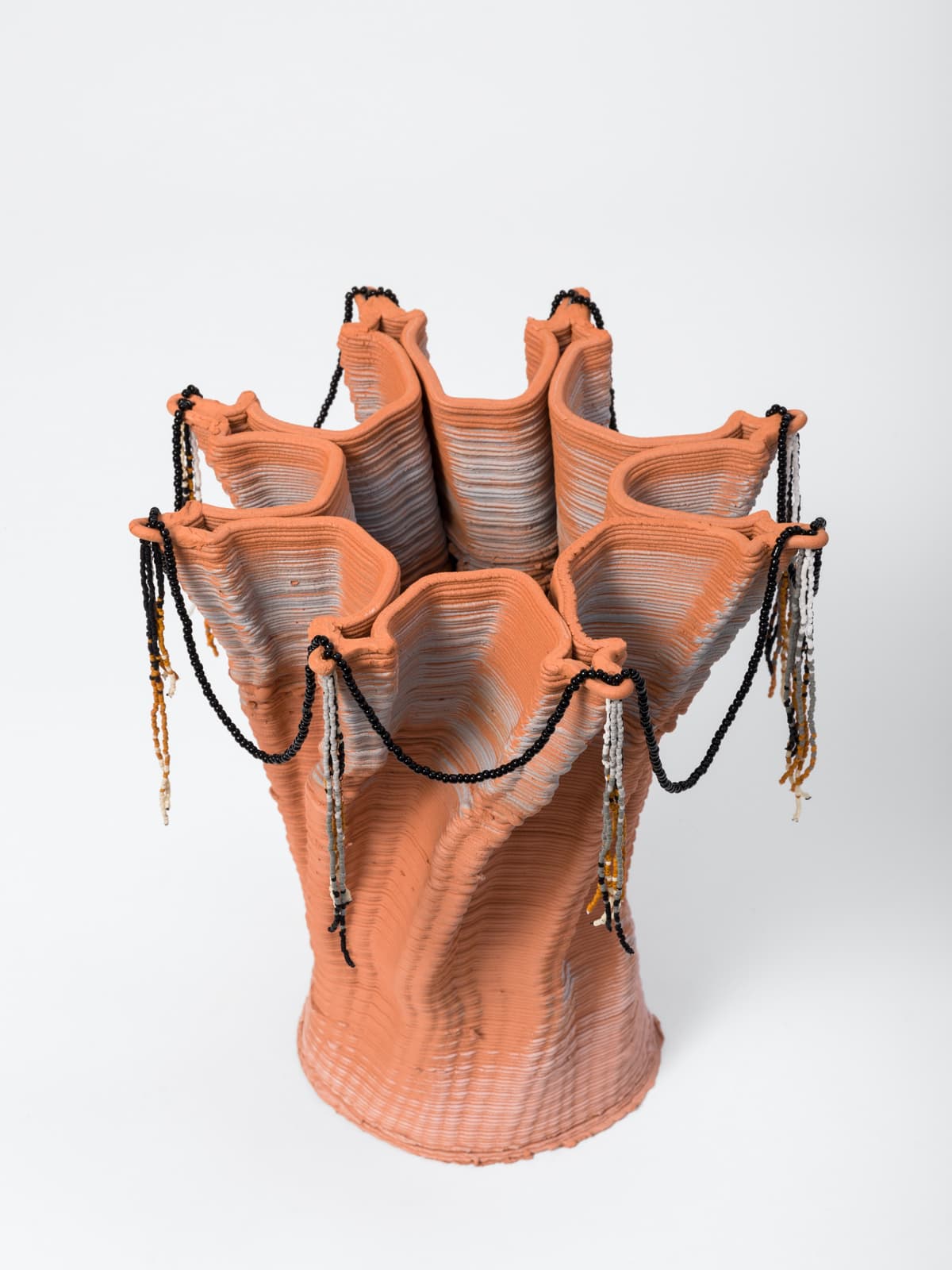
Sarah Rosalena, Omnidirectional Origin, 2024. Seed beads, nylon thread, 3D printed stoneware/earthenware, 7.5 x 7.5 x 8.5 inches. Courtesy the artist and Sargent’s Daughters.
Standing in front of Rosalena’s textile works, I felt unsure if the image was oriented upside down and if I was looking into space or at a flat surface. Spiral Arm Rose, for example, offers a glimpse of the Milky Way’s spirals, yet the loose strands of yarn hanging from the right and left side of the work suggest that the work coexists in spaces that are both governed by gravity and free from it. Likewise, the beads that hang down from the upper lip of Rosalena’s ceramic works are also directed by the pull of gravity, yet each ceramic piece is bottomless like a well, whirlpool, galaxy, or portal to another realm. Omnidirectional Origin, the only ceramic work which takes the form of a star with eight (rather than six) points when viewed from above, shows us how Rosalena posits a kind of expansion that moves outward in every direction from a single point—a clear disruption of Western epistemologies that use cardinal directions, cartography, and borders as tools of control and possession. While the artist has said that the eight-pointed star symbolizes “the potential of a cosmos outside of the Western gaze,” the six-pointed form is at home in the terrestrial and cosmic realms equally. Inspired by roses and stars, and represented in four other ceramics on view here, it is a fragment of a larger fractal, or a pattern that repeats infinitely.
Rosalena’s works are especially powerful in our present moment. It is difficult to encounter Star Rose, Rose Star without also confronting the new presidential administration’s promises to resume damaging neocolonial resource extraction, enact historical erasures on Earth, and to plant the United States flag on Mars. Indeed, Rosalena’s works were on view the day that the President renamed the tallest mountain in North America “McKinley,” displacing its Koyukon name “Denali.” There are likely darker executive orders to come. Rosalena’s brilliance is that she offers us deeply conceptual works of art that also supply worldviews capable of resisting this tide by foregrounding Indigenous ways of making that sustain, rather than exploit, the land as kin.
Elizabeth Buhe is a critic and art historian based in New York.