Ann McCoy

Ann McCoy is an artist, writer, and Editor at Large for the Brooklyn Rail. She was given a Guggenheim Foundation award in 2019, for painting and sculpture. www.annmccoy.com

Today, when big gestures are often the rule and superior connoisseurship can seem like a rarity, this hauntingly exquisite selection of Raquel Rabinovich’s work is a respite from the world’s chaos.
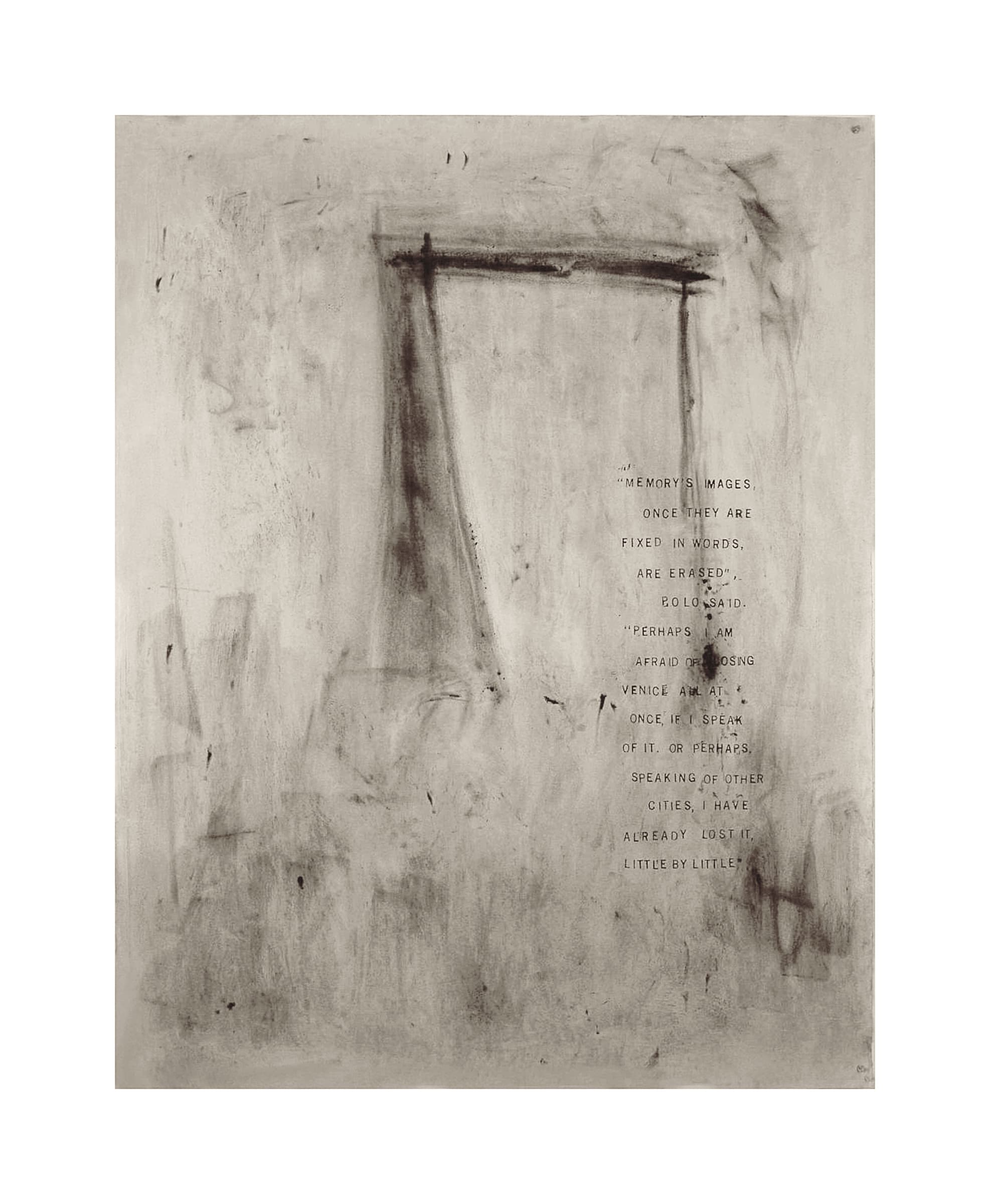
Raquel Rabinovich, Invisible Cities 6, 1984–85. Graphite wash and rubber stamped black ink on Arches paper, 58 × 44 ½ inches. Courtesy Hutchinson Modern & Contemporary. Photo: Douglas Baz.

At Galerie Lelong we see paintings begun after Elda Cerrato (b. 1930, d. 2023) returned to Argentina in 1964 from Venezuela. While there, she had studied George Ivanovich Gurdjieff’s (b. 1866, d. 1949) “Fourth Way” esoteric teachings.  
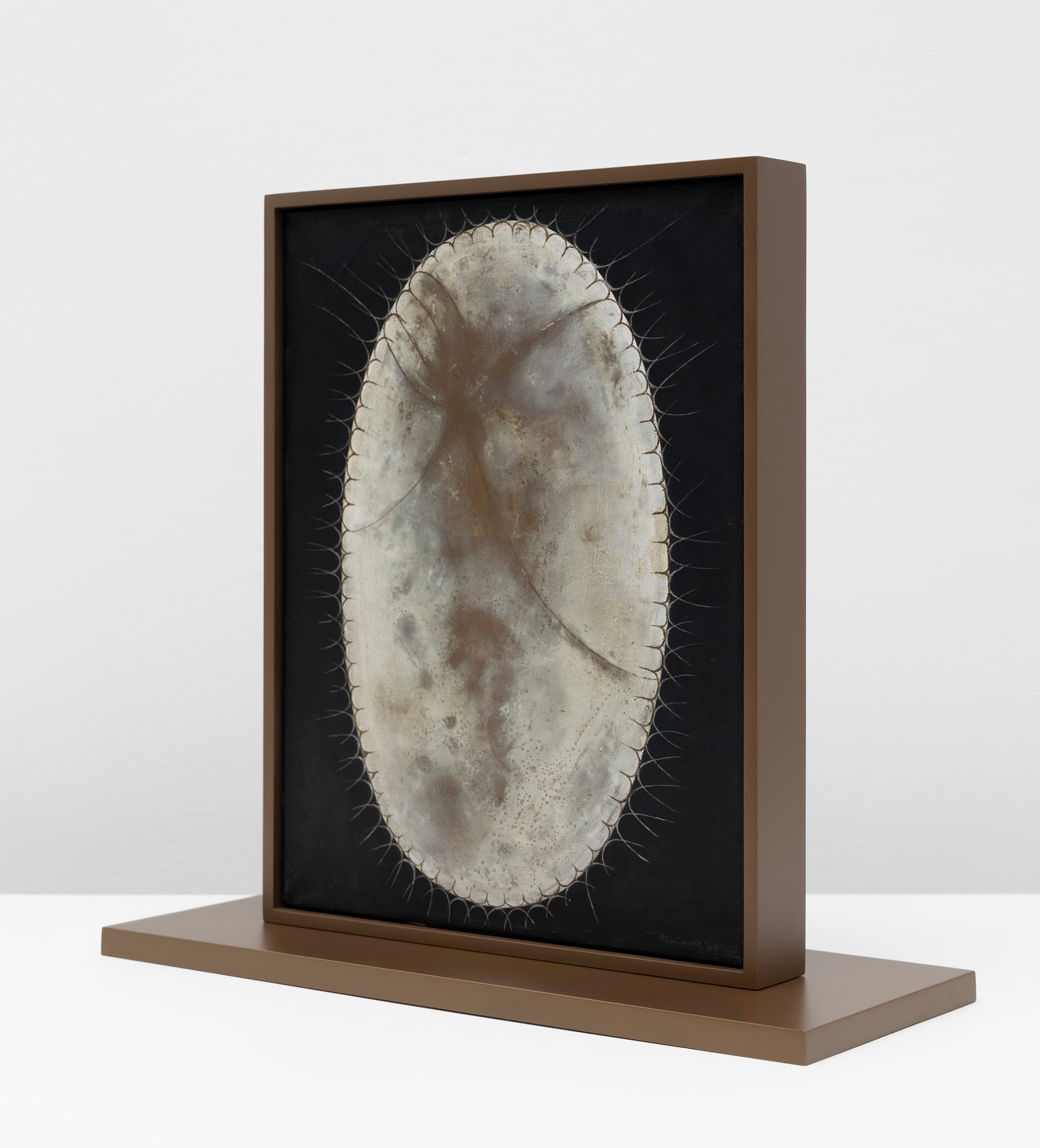
Elda Cerrato, Redundancia en las experiencias relativas al Okidanokh. Faz 1. Acumulación energética presente. Faz 2. Acumulación energética ausente. (Serie Producción de energía. Redundancia en las experiencias relativas al Okidanokh), 1967. Oil and enamel on canvas, 18 ⅛ × 14 ⅛ inches. © The Estate of Elda Cerrato. Courtesy Galerie Lelong, New York.

In our dark time, when great beauty in the service of divinity has become a thing of the past, modern day pilgrims are again being moved by the cathedrals along the Camino de Santiago route and by devotional objects like these shown at the Frick. To dismiss these objects as examples of monarchic excess or colonial plunder robs them of their ability to transport us to higher realms.
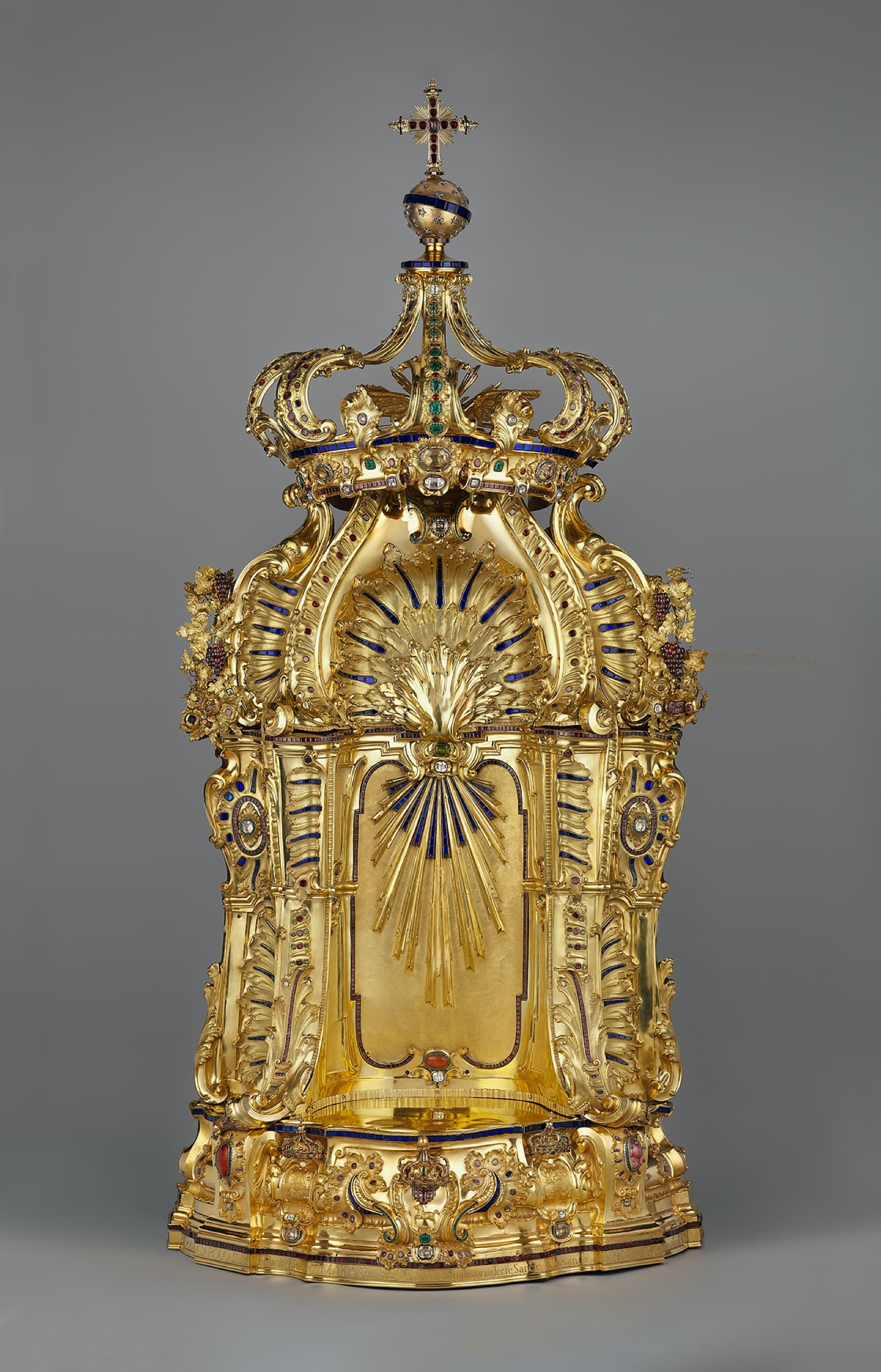
Pietro, Eutichio, and Sebastiano Juvarra, Throne of Eucharistic Exposition, 1665. Silver, gilt silver, gilt copper, glass, precious and semi-precious stones, 73 ¼ × 43 ½ × 15 inches. © The Frick Collection. Courtesy Terra Sancta Museum, Jerusalem. Photo: Joseph Coscia Jr.

The exhibition Utopia: Three Centuries of Sexuality in‬ American Cults and Communes documents the role of religious communities as incubators for redefining group relations, exploring sexuality as a path to accessing the divine, and finding interdimensional identities.

Fayette Hauser, Wally Musing On His Drag, 1971. Digital print. Courtesy the artist.

Lucy Skaer’s work has always inhabited long stretches of the timeline, incorporating materials like mahogany logs pulled from riverbeds. Her memorable use of old materials to pull the viewer into lost worlds and poetic dimensions is unique: time can move backwards.
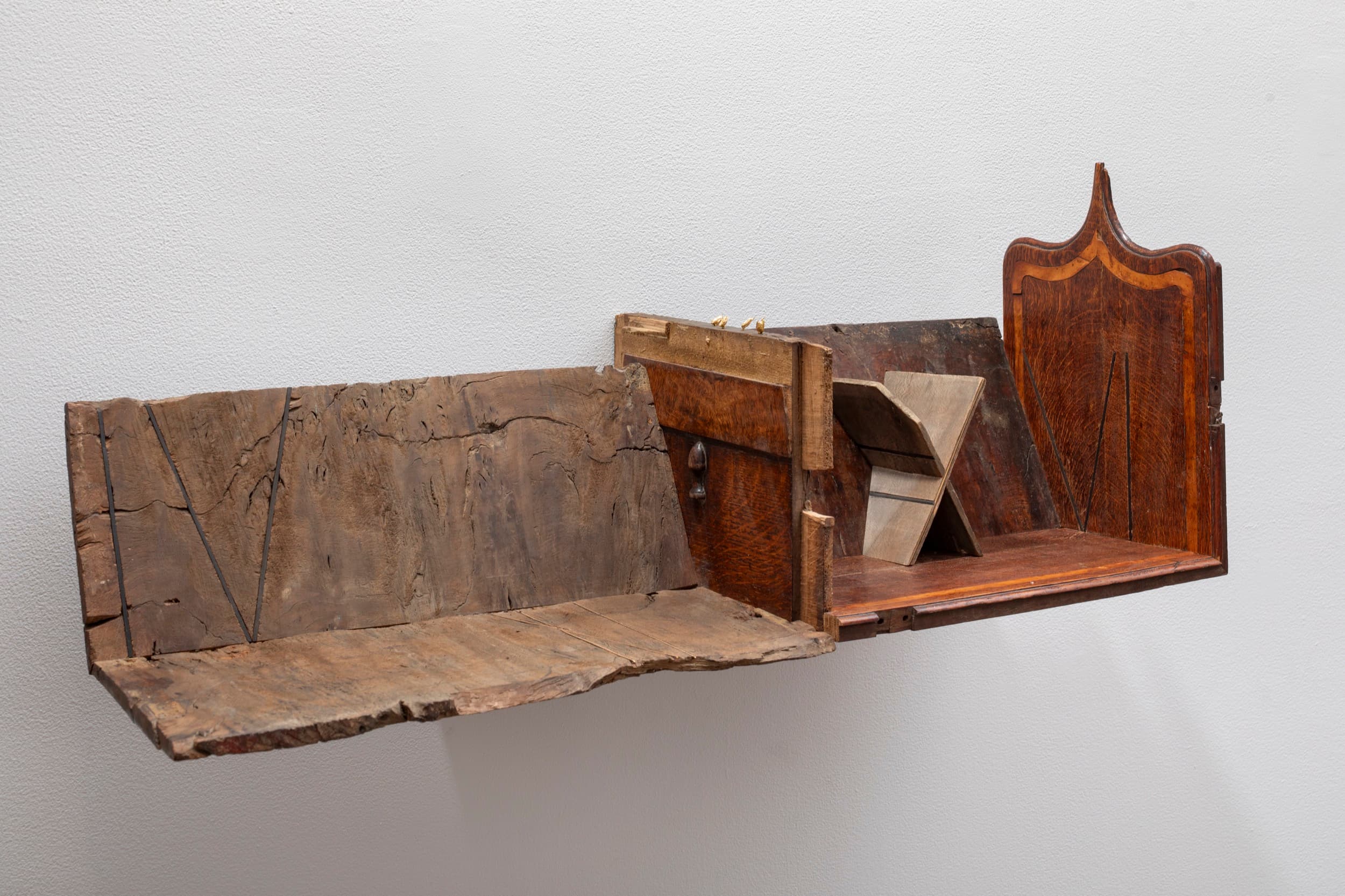
Lucy Skaer, Counting House III, 2025. Antique oak, boxwood, ebony inlay, 22-karat gold. Courtesy Peter Freeman, Inc. Photo: Nicholas Knight.

Christening herself Cameron, Marjorie Cameron Parsons Kimmel (1922–95) was no mere mortal. She considered herself to be an elemental, a nature spirit, an avatar transported from the mists of antiquity.

Cameron, Black Egg, n.d. Paint on cardboard. 11 x 8 inches. Courtesy Nicole Klagsbrun and the Cameron Parsons Foundation.

In his film Self-Portrait as a Coffee-Pot (2024), on display at Hauser & Wirth, William Kentridge describes the studio as a giant head. Cinematically, we are party to his thoughts and to the making of the works displayed in the gallery.

William Kentridge, Washer, 2023. Bronze, 52 3/8 x 28 3/4 x 37 3/8 inches. © William Kentridge.Courtesy the artist and Hauser & Wirth. Photo: Anthea Pokroy.

Wolfgang Laib’s latest exhibition at Sperone Westwater, Towers of Silence, opens with the artist’s hand-written quote from Lao Tzu. Laib’s tribute to the ineffable, the numinous, and the soul feels like a clarion call. 

Wolfgang Laib, Shrine near Pudukottai, South India, 2002. Gelatin silver print on baryta paper, 16 1/4 x 12 inches. Courtesy the artist and Sperone Westwater.

To celebrate the centenary of Etel Adnan’s 1925 Beirut birth, New Yorkers are being treated to two extraordinary gallery exhibitions showcasing different periods and facets of the artist’s work, along with a symposium organized by Omar Berrada and Simone Fattal.

Etel Adnan, Tamalpaïs, Sausalito, 1988. Watercolor and ink on paper, 13 x 15 ¾ inches. © The Estate of Etel Adnan. Licensed by Artists Rights Society (ARS), New York. Courtesy Galerie Lelong & Co.

The modernist priesthood of art critics had largely expunged the sacred. Paintings were reduced to formal concerns like drapery styles and perspective, and discussions about the meaning of something like the Annunciation became irrelevant.

Ann McCoy, Wolf Tongue Mill, 2022. Pencil on paper on canvas, 9 x 14 feet. Courtesy the artist. Photo: Peter Dressler.

With phenomenal connoisseurship, comprehensible categories, the inclusion of periphery artists, and the catalogue’s diverse scholarship, Orphism is amplified in the Guggenheim's Harmony and Dissonance: Orphism in Paris, 1910–1930, and we experience a re-enchantment and new ways of seeing old works.

Robert Delaunay, Red Eiffel Tower (La Tour rouge), 1911–12. Oil on canvas, 49 1/4 x 35 3/8 inches. Courtesy Solomon R. Guggenheim Museum, New York, Solomon R. Guggenheim Founding Collection. Photo: Midge Wattles, Solomon R. Guggenheim Museum, New York.

Pulling open the black curtain, the viewer encounters Olafur Eliasson’s magical phantasmagoria, Your psychoacoustic light ensemble (2024), a sound and projection piece with laterally moving globes of light that transverses cosmic, scientific, and psychological dimensions.

Olafur Eliasson, Your psychoacoustic light ensemble, 2024. Spotlight, glass lens, mirror foil, tripod, transducer, embedded computer system. Dimensions variable. Courtesy the artist and Tanya Bonakdar Gallery, New York / Los Angeles. Photo: Pierre Le Hors.

Helène Aylon’s genius was like an alchemical process that has undergone many transmutations, reaching higher states of purity, refinement, and subtlety. Coming from an Orthodox Jewish tradition, her work lived in these “empty spaces where / a female presence has been omitted.”

Helène Aylon, The Book That Will Not Close, from the installation Epilogue: Alone with my Mother, 1999. Collection of Helène Aylon Estate. Courtesy Leslie Tonkonow Artworks + Projects, New York. © Helène Aylon.
This long-overdue, first retrospective by an eighty-year-old Chicana artist is one of the stellar events of the season. Many East Coast viewers are unaware that Mexican history, in former territories like New Mexico, predates the Pilgrims at Plymouth Rock (1620).
Installation view: Amalia Mesa-Bains: Venus Envy Chapter I: First Holy Communion, Moments Before the End, 1993/2022. San Francisco Museum of Modern Art. Courtesy El Museo del Barrio. Photo: Matthew Sherman.
In Carol Wainio’s pictorial realm the fabled creatures of Jean de La Fontaine and Aesop, haberdashery-clad rabbits, and children plucked from Victorian illustrated postcards dwell in forests that are part Gustave Doré, part Jean-Antoine Watteau, and are expressionistically rendered.
Carol Wainio, The Artist, 2024. Mixed media on paper, 50 1/2 x 39 inches. Courtesy the artist and Arsenal Contemporary Art. Photo: Richard-Max Tremblay.
María Magdalena Campos-Pons in her incarnation as her alter ego FeFa, with painted face and flowing robes, has transformed the Brooklyn Museum into a sacred precinct where Yoruba spirits walk among us. In this dark time, with few transformational rituals at our disposal, Campos-Pons as a kind of priestess comes to our aid.
María Magdalena Campos-Pons, History of a People Who Were Not Heroes: Spoken Softly with Mama, 1998, installation by Campos-Pons with sound by Neil Leonard. Collection of Ottawa, National Gallery of Canada, purchased 1999. Image courtesy the artist.
Harry Smith lives on as a spirit through his yearly film showings at Anthology Film Archive. As hierophant, he reminded his devotees there were alternative paths outside the prevailing critical discourse, the museums, and the commercial art world.
Harry Smith, Film No. 1: A Strange Dream (still), ca. 1946–48. 16mm film transferred to digital video, color, silent; 3 minutes. Courtesy Anthology Film Archives, New York. © Anthology Film Archives.
In perhaps his most poignant projection installation to date, William Kentridge revisits the music of Dmitri Shostakovich. Kentridge’s Metropolitan premier of Shostakovich’s satirical opera The Nose (2010) was a celebratory kaleidoscopic panoply of Russian Constructivist artistic innovation.
William Kentridge, Oh To Believe in Another World, 2022. 5 channel film installation; 15 minutes. Courtesy the artist and Marian Goodman Gallery. Copyright: William Kentridge. Photo: Alex Yudzon.
Kahlil Gibran’s The Prophet (1923) is one of the best-selling books of all time: Elvis Presley’s well-worn annotated copy of The Prophet was found posthumously among his effects. Gibran, a popular Lebanese American poet, artist, and mystic remained fixed in the collective spiritual imagination for decades; Gibran, a Maronite Christian, included other religions, Sufi mysticism, Jungian psychology, Buddhism, and Theosophy in his mix.
Kahlil Gibran, The Divine World, 1923. Charcoal, 11 x 8 1/2 inches. Gibran Khalil Gibran Museum. Courtesy the Gibran National Committee.
This is an exhibition for the viewer who loves watching the silent films of Georges Méliès—for a trip to the moon or a mermaid submerged in a goldfish tank. A trip to Microscope Gallery fills that bill. Here, four exceptional Asian women artists take us on a time-travel into imaginary realms where mythology, science fiction, and complex narratives converge.
Installation view: A Dweller on Two Planets, Microscope Gallery, New York, 2023. Courtesy the artists and Microscope Gallery, New York
Chrysanne Stathacos occupies the position of the Pythia (prophetess at Delphi) in an art world much in need of a connection to the Mysteries. The Mysteries have been the foundation of all great civilizations, and their demise has always signaled a decline—after the Mithraic priests and later the Gothic leader Alaric and Christian monks invaded the shrine of Eleusis, Greece fell from dominance. Stathacos is a unique prophetess, bridging East and West, and comes to us in our time of cultural collapse.
Installation view: Chrysanne Stathacos: The Re-Turn, anonymous gallery, 2023. Photo: installshots.art.
In an age when few dread eternal damnation and the torments of hell no longer function as a deterrent to bad behavior, a stunning exhibition at the Asia Society Museum expands our knowledge of this infernal nether region.
Installation view: Comparative Hell: Arts of Asian Underworlds, Asia Society Museum, New York, 2023. Photo: Bruce M. White.
This treasure-trove of artifacts from regions stretching from the Balkan Mountains north to the Carpathian Basin on view now at NYU’s Institute for the Study of the Ancient World is a revelation and engenders an overdue revision of ancient history.
Earring, 250-200 BCE, gold, Sinemorets, Bulgaria, L. 8 cm, H. 4.5 cm, National Museum of History, Sofia, Bulgaria: 51269-51270. Photo © Field Museum, photographer Ádám Vágó.
The exhibition title, Aubrey Beardsley, 150 Years Young, refers to Beardsley’s (1872–1898) birth 150 years ago, and the freshness of his work today. He was a consumptive who died at the tragically early age of twenty-five, and here we see the scope of his early genius.
Aristophanes, The Lysistrata of Aristophanes: Now First Wholly Translated into English and Illustrated with Eight Full-page Drawings by Aubrey Beardsley. London: [Leonard Smithers], 1896. Mark Samuels Lasner Collection, University of Delaware Library, Museums and Press.
Barton’s drawings are windows into his modest rooms, jail cells, church sanctuaries, and San Francisco’s gay clubs. His work chronicles a period when queer men flocked to San Francisco, yet he was not part of the celebrated gay scene around the King Ubu Gallery founded by Jess Collins and Harry Jacobus with Robert Duncan, and he was not known to other San Francisco artists like Wallace Berman and Bruce Conner.
Rick Barton, Untitled [Signature self-portrait], 1961. Pen and ink, 8 x 51/4 in. (20.3 x 13.3 cm).Rick Barton papers (Collection 2374), UCLA Library Special Collections, Charles E. Young Research Library, University of California, Los Angeles
Karla Knight’s mysterious spaceships transport the viewer into other-worldly dimensions at a time when much of the art world can feel grounded by an ideological flat earth society. Like Hilma af Klint, whose works were channeled from higher masters in the astral plane, Knight’s remind us that art can originate from realms both mysterious and incomprehensible. Positivism, Adorno’s anti-occultism, and the “liberation” of art from its spiritual mission have dominated much recent discourse. When reading Knight’s statement—“I would say a visionary is someone who is a good listener, and a bridge between two worlds”—this critic wanted to applaud. Her works resonate and affect us deeply and draw the viewer into deeper meditations with their presence. Karla Knight’s art is pulled from the artist’s own psyche and lifts us into the fourth dimension where the spirit resides. It bucks many recent collective theoretical trends.
Karla Knight, Wave 1, 2022. Oil, flashe, and pencil on paper mounted on linen 31 x 23 inches. Courtesy the artist and Andrew Edlin Gallery, New York.
The eruption of Vesuvius in 79 CE preserved the world of Pompeii and Herculaneum like a bee in amber. Serious excavations, beginning in the mid-eighteenth century, began to pull the curtain back on these intimate lives that were terminated in an instant.
Painter at work, 1st century CE. Fresco. House of the Surgeon, Pompeii. © Photographic Archive, National Archaeological Museum of Naples.
Nordman joins Gaea and contemporary feminist theorists like Luce Irigaray in demanding a break from the phallogocentric and imagining a new creation myth. In her “Plato’s Hystera” (hystera is Greek for uterus) from Speculum of the Other Woman (1974), Irigaray advocates that we consider the cave as a place of origins. This is in opposition to the heliocentric view of the outer world as the source of enlightenment.
Installation view, Maria Nordman: AT THE START, Marian Goodman Gallery, New York, 2022. © Maria Nordman. Courtesy the artist and Marian Goodman Gallery. Photo: Maria Nordman and Alex Yudzon.
Descending into the cellar at TOTAH feels like entering a sanctum sanctorum, the holy of holies. The leitmotif of this exhibition could be the theme of intimacy, images feeling like handheld windows into the artist’s psyche.
Wallace Berman, Untitled (Jack Ruby), 1964. Photograph with hand written poem, 28.5 x 29 inches. Courtesy TOTAH.
The vast expanse of Smithson’s artistic vision is staggering, and in this exhibition, we are transported on a geological timeline from the Proterozoic to a futuristic possibility of entropic collapse.
Robert Smithson, Entropic Steps, 1970. Pencil on paper, 19 x 24 inches. Courtesy Holt/Smithson Foundation and Marian Goodman Gallery. © Holt/Smithson Foundation, Licensed by VAGA at ARS, New York. Photo: Alex Yudzon.
Justin Matherly has positioned two monumental busts of the divine physician Asklepios on either side of the gallery entrance: Eat yourself fitter (2020) and Eat yourself fitter (2019). Six cast modified gypsum statues of Telesphoros, the dwarf-like nocturnal companion of Asklepios, may be found in the corners of each room: T1-T6 (2020).
Justin Matherly, Eat yourself fitter, 2019. Fiberglass resin, epoxy resin, acrylic lacquer spray paint, UV varnish, 96 x 56 x 77 inches.© Justin Matherly. Courtesy Paula Cooper Gallery, New York. Photo: Steven Probert.
Shari Mendelson’s hauntingly beautiful sculptures—some part human, part animal, part divine—transport the viewer down the timeline into other worlds and dimensions. Their fragility and translucent luster are reminiscent of glass from antiquity and make us forget their humble origins.
Installation view: Shari Mendelson: Animals, Idols, and Us, TIbor de Nagy, New York, 2020. Courtesy Tibor de Nagy.
In the ’70s and ’80s I had written a few pieces about fellow women artists who could not get any coverage, because men got most of the ink. It began as a sort of public service for my sister artists, marginalized and discouraged.
Ann McCoy, Dream of The Invisible College, 2018, pencil on paper  on canvas, 9 by 14 ft. Courtesy the artist.
That a contemplative artist like Agnes Pelton (1881–1961) is having an exhibition in a shuttered museum, as her viewers are experiencing enforced reclusion during a pandemic lockdown, has a profound synchronicity.
Agnes Pelton, Light Center, 1947–48. Oil on canvas, 36 x 25 inches. Collection of Lynda and Stewart Resnick. Photo: Jairo Ramirez.
Zalopany is a master of pastel drawing, an artform usually associated with French masters like Jean-Baptiste Siméon Chardin, Edgar Degas, and the American Mary Cassatt. While many artists work from photographic and archival material, the artist’s images of native Hawaiians resonate because they are part of a personal journey to recover a culture destroyed by missionaries and colonial exploitation.
Michele Zalopany, HRZ, 2019. Pastel On Canvas, 68 x 70 inches. Courtesy the artist and Steven Harvey Fine Art Projects.
The Ishtar Gate was created in the service of the gods for the divine protection of the city, manifested divine powers on earth as the entry point of the gods into the city, and formed Babylon’s political and religious center. It represented the culmination of centuries of religious thought, technological advances, and artistic achievement.
Reconstructed panel of bricks with a striding lion, Neo-Babylonian Period (reign of Nebuchadnezzar II, 604-562 BCE). Molded and glazed baked clay, Processional Way, El-Kasr Mound, Babylon, Iraq. Courtesy The Metropolitan Museum of Art, New York.
One Last Trip to the Underworld is the world premiere of four video works by sculptor and stop-animation video artist Nathalie Djurberg and electronic composer Hans Berg. The artists give us not the underworld of antiquity, but a contemporary fall down the rabbit hole into the Freudian unconscious of repressed desires, perversity, and what Freud called day-residues.
Nathalie Djurberg & Hans Berg, Damaged Goods, 2019. Stop motion animation, 6 minutes, 28 seconds. Courtesy the artist and Tanya Bonakdar Gallery, New York / Los Angeles
Vaughan’s Circle (2004), a stunning six-foot square canvas by Brian O’Doherty, was the jewel in the crown of perhaps the best abstraction exhibition of the summer, The Unusual Suspects: A View of Abstraction at the D. C. Moore Gallery, curated by Richard Kalina.
Brian O'Doherty, Vaughan's Circle, 2004. Acrylic on canvas, 72 x 72 inches.
In Verily! the Blackest Sea, the Falling Sky (2017), a two-channel video work, Peggy Ahwesh takes us on a journey from the ocean’s primordial depths, filled with squids and Leviathans, into the reaches of outer space.
Peggy Ahwesh, Verily! the Blackest Sea, the Falling Sky, 2017. Two-channel HD video, 9 minutes 22 seconds. Courtesy the artist and Microscope Gallery.
Archie Rand glides onto the scene, part mystical rebbe, part Diogenes, carrying a lamp, by day, which he shines in our faces, in his search for an honest man.
Archie Rand, 1A, 2005. Acrylic on canvas, 24 x 20 inches. Courtesy TOTAH.
In his doctrine of anámnēsis, or recollection, Plato makes a distinction between eternal Forms and their resemblances in human perceptions.
Nancy Holt, Holes of Light, 1973/2018. Installation view, Dia:Chelsea, New York, 2018. © Holt/Smithson Foundation and Dia Art Foundation/Licensed by VAGA at Artists Rights Society (ARS), New York. Photo: Bill Jacobson Studio, New York, courtesy Dia Art Foundation, New York.
With this first American large-scale exhibition of Hilma af Klint’s profoundly moving art, it is as though a needle has been lifted from a well-worn record called “the entrenched history of abstraction,” and any attempts to place the needle back into the grove will henceforth prove difficult.
Installation view: Hilma af Klint: Paintings for the Future, Solomon R. Guggenheim Museum, New York, October 12, 2018–April 23, 2019. Photo: David Heald. © 2018 The Solomon R. Guggenheim Foundation.
In 1986, PS1 Contemporary Art Center, as it was then known, held the first solo museum exhibition of Sue Coe’s work in New York. It was titled The Malcolm X Series. Thirty-two years later, as MoMA PS1, the institution now gives Ms. Coe her second solo exhibition in New York, Sue Coe: Graphic Resistance.
Sue Coe, Baboon Heart Transplant, 1985. Mixed media, oil, and collage on paper and canvas, 
52 x 77 inches. &copy Sue Coe. Courtesy Galerie St. Etienne, New York.
Helen O’Leary’s work, which has its formation in Irish linguistics, gives us an inspired version of an Irish art rooted in a sense of place in rural Ireland. The late nineteenth century Gaelic revival (Athbheochan na Gaeilge), advocated for a return to the Irish language, and O’Leary’s psyche is firmly planted in that tongue. O’Leary’s art originates from a life lived on a farm in rural Ireland, and a spiritual connection to that land and rural way of life. In a time when many younger Irish artists have adopted critical theory, digital technology, and international styles severed from their cultural roots, O’Leary’s work possesses a life-lived authenticity and hands-on craftsmanship that sets it apart.
Helen O'Leary, Home is a Foreign Country #9, 2018. Polymer, Pigment, Chalk and Constructed Wood, 27 x 25 x 5/ inches. Courtesy the artist and Lesley Heller Gallery, New York. Photo: Eva O’Leary.
The intangible mystery of this work transports this viewer to an archaic place in consciousness when nature and mankind were inseparably fused in peaceful coexistence and respect.
Joan Waltemath, M’s Crossing (1,2,3,5,8 west), 2015 – 17. Oil, lead white, marble dust, haematite, copper, iron oxide, aluminum, interference, florescent, mica and phosphorescent pigment on prepared natural and black canvas sewn from individual pieces, 172 x 168 1/2 inches. Photo: Fars Owrang
It is affirming to see an exhibition like Stations of the Cross, based on a Catholic pilgrimage and devotional practice, in a world plagued by attacks on both Orthodox Christianity and Catholicism.
Michael Takeo Magruder, Lamentation for the Forsaken (Face of Christ), 2017. Courtesy and © Michael Takeo Magruder.
An elongated, “keystoned” vertical projection, updated daily and made from ash adhered to a slide, fills the gallery’s first wall.
Bradley Eros, waterworks: ice (3.16.18 A, B, C), 2018. Water, plastic, celluloid, metal, dimensions variable. Courtesy the artist and Microscope Gallery.
“I believe language as song and as text possesses a kind of quietness, a space that allows words’ power to evoke and move emotions. I’m interested in the soft space behind language.”
Portrait of Lesley Dill, pencil on paper by Phong Bui. Based on a photo by Zack Garlitos.
Lisson Gallery has mounted a stunning, historically important, museum quality first New York solo exhibition of the work of Channa Horwitz, an artist who died in 2013 at the age of eighty.
Channa Horwitz, Sonakinatography Compostition # 9 0 To the Top diminished, 2011, Casein on mylar 20 x 13 3/4 inches. © Estate of Channa Horwitz. Courtesy Lisson Gallery
Strange Muses I (2017) is remarkable on multiple levels. It was created not to show the here and now, but to take us into what could best be described as a liminal space...
Benjamin Kress, Strange Muses I, 2017. Oil on linen, 56 x 42 inches. Courtesy the artist and Callicoon Fine Arts. Photo: Sean Fader.
The latter part of the Victorian era was a romantic age of celebrity archaeologists: Howard Carter’s discovery of Tutankhamun’s tomb captured the public’s imagination, as did Leonard Woolley’s excavations of the burial pit at Ur. Sir Arthur Evans unearthed and restored Knossos, and Heinrich Schliemann excavated Mycenae—rescuing Homer’s lost civilizations from the mythological mists of time.
Émile Gilliéron, Blue Monkey in a Rocky Landscape, After a fresco from the House of the Frescoes, Knossos. Watercolor on paper, 60 x 83 cm. The Ashmolean Museum, University of Oxford. Bequeathed by Sir Arthur Evans. Image © Ashmolean Museum, University of Oxford.
Joséphin Péladan’s (1858-1918) portrait by Jean Delville (1895) as “Sâr Mérodack,” white robed and posed like a Byzantine Christ Pantocrator “ruler of all” with an arm raised in benediction, greets the exhibition’s viewer.
Ferdinand Hodler, The Disappointed Souls (Les âmes déçues), 1892, Oil on canvas, 120 × 299 cm, Kuntsmuseum Bern, Staat Bern. Photo credit: Courtesy Kuntsmuseum Bern, Staat Bern
Making Space: Women Artists in Postwar Abstraction has work by many of the same artists as its 1995 predecessor Elizabeth Murray, Modern Women (1914 – 73)—work by seventy women from the MoMA collection.
Dorothy Dehner, Encounter, 1969. Bronze, si× parts, each 50 × 7 × 7 inches, 40 × 6 × 6 inches, 39 × 5 × 5 inches, 38 × 4 1/2 × 4 1/2 inches, 27 1/2 × 5 × 4 1/2 inches, and 14 1/2 × 5 × 4 inches. The Museum of Modern Art, New York. Committee on Painting and Sculpture Funds and partial gift of the Dorothy  Dehner  Foundation for the Visual Arts, 2010.  © 2017 Dorothy  Dehner  Foundation for the Visual Arts
Helène Aylon sat down with Ann McCoy at the Brooklyn Rail’s Industry City headquarters to discuss her upcoming traveling exhibition, Afterword: For the Children (Hadassah-Brandeis Institute and Kniznick Gallery, Waltham, Massachusetts, March 20 – June 16, 2017; Jerusalem Biennale, October 2017).
Portrait of Helène Aylon. Pencil on paper by Phong Bui.
Creation myths provide blueprints for their respective societies, on both a conscious and unconscious level. Lenore Malen, whose past work on utopian societies traverses history, in this exhibition takes us back to biblical Eden to ascertain where things went off the rails.
Video still: Lenore Malen, Scenes from Paradise,  2015. Courtesy the artist.
In this time of war and uncertainty, Carolee Schneemann, the best artist embodiment of Aphrodite we have, has brought us two exhibitions that take us, with her uncompromising authenticity, into places rarely visited.
Carolee Schneemann, Maquette for Venus Vectors, 1987. Plexiglas and marker. 9 × 24 inches. © Carolee Schneemann. Courtesy PPOW.
Slavs and Tatars, perhaps the smartest artist collaborative around, have returned for their first New York exhibition since Beyonsense at MoMA (2012).
Installation view: Afteur Pasteur, Tanya Bonakdar Gallery, New York, September 8 – October 22, 2016. Courtesy the artist and Tanya Bonakdar Gallery, New York. Photo: Jean Vong.
Tony Oursler: The Imponderable Archive consists of 680 items culled from 2,500 photographs, news clippings, books, and assorted objects from the artist’s collection.
Installation view: Imponderable. The Museum of Modern Art, New York, June 18, 2016 – January 8, 2017. © 2016 The Museum of Modern Art. Photo: Jonathan Muzikar.
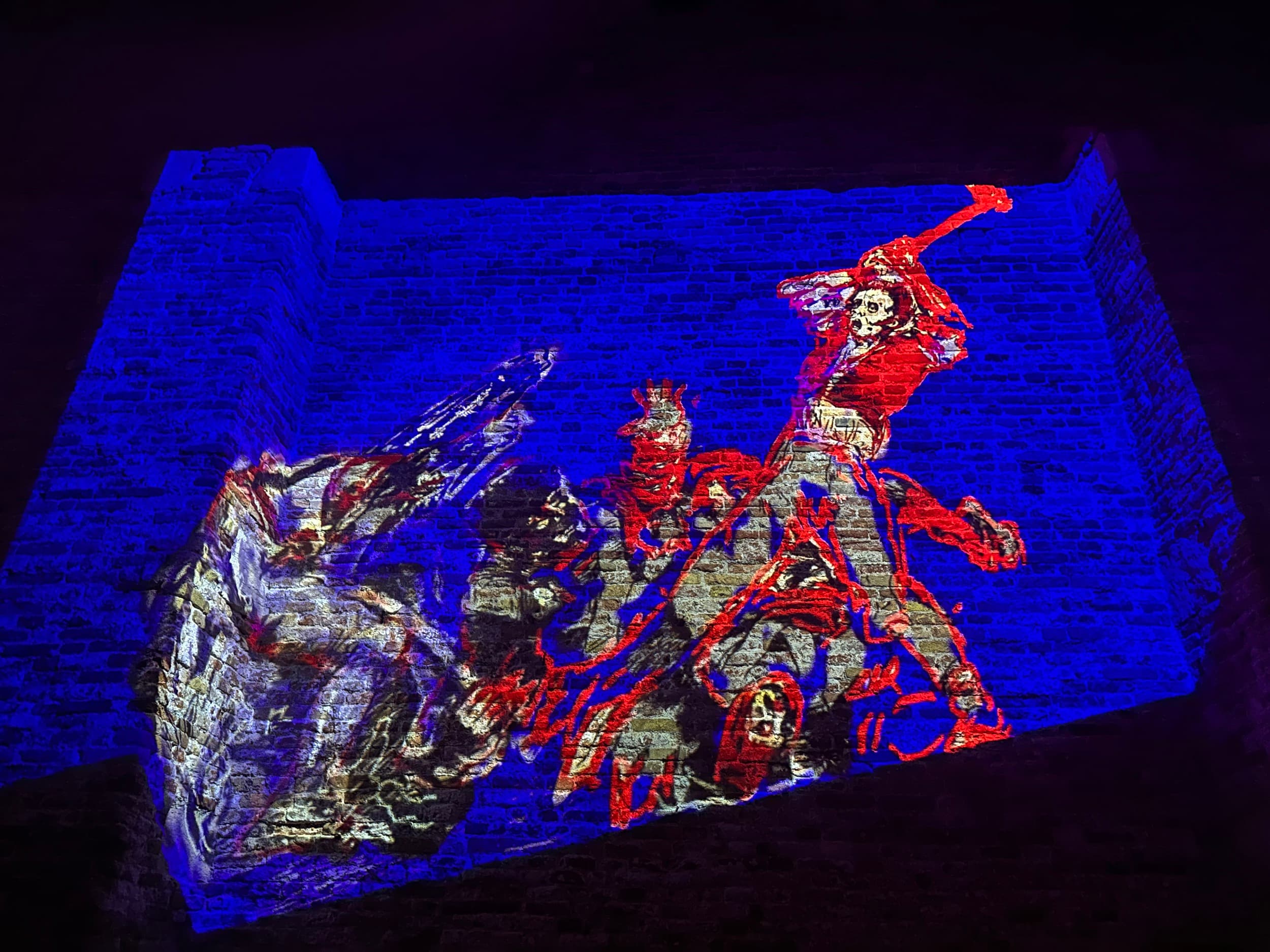
William Kentridge’s Triumphs and Laments opened April 21 – 22, 2016, in Rome. On a 550-meter-long, ten-meter-high section of the Tiber embankment wall between Ponte Sisto and Ponte Mazzini, eighty figures, pulled by power washing from the grime on the walls, depict Rome’s greatest victories and defeats from mythological times to the present.
Portrait of William Kentridge. Pencil on paper by Phong Bui. From a photo by Marc Shoul.
Recycling Religion represents a missed opportunity for a necessary discussion of a complex subject. “Recycled Thinking” would be a more appropriate title for this mishmash of tired Pop art, simplistic religious clichés, gadgetry, and scatology, that comes across as a traveling promotional for Marat Guelman’s stable and his new museum complex in Montenegro.
Irwin, Was ist Kunst Hugo Ball (Bishop Metodij Zlatanov, Metropolit of Macedonian orthodox church, with Hugo Ball), 2008 / 2010. Courtesy Galerija Gregor Podnar, Berlin.
William Kentridge and his South African collaborative team have landed in New York City and New Haven this fall, leaving us with remarkable opportunities to see their work.
A scene from Berg's Lulu. Photo by Ken Howard/Metropolitan Opera.
What a celebration! Have we forgotten that before Nancy Spero was shown at MoMA, in 1976 she was picketing the place, demanding that an exhibition include fifty percent women?
Installation view: Greater New York, MoMA PS1, October 11, 2015 - March 7, 2016. Image courtesy of the artists and MoMA PS1. Photo Pablo Enriquez.
Entering the main gallery of Sperone Westwater, the viewer is dwarfed by Red Gravity (2015), a stunning, two-story-high, circular red clay drawing filling the height and width of the main wall. A suspended glass balcony allows the viewer to see the top half, which enhances the work’s scale.
Richard Long, Half Moon, 2015. Red slate, 21 1/2 x 196 7/8 x 98 1/2 inches. Courtesy Sperone Westwater, New York.
The monumental Living Pyramid rises from the lawn of Socrates Sculpture Park in Long Island City like a futuristic mirage, with a base thirty feet on a side. It marks a return to New York public art for this eighty-three-year-old artist.
Agnes Denes, The Living Pyramid, 2015. Socrates Sculpture Garden, Long Island City, New York. Courtesy Socrates Sculpture Park.
The Cuban artist Yoan Capote is an embodiment of the archetypal Hephaestus, the Olympian god of the hammer and forge, so undervalued in today’s art making. Capote builds much of his work using classical sculptural techniques, and represents the best of a Communist worker tradition.
Yoan Capote, Immanence, 2015. Mixed media including hinges, wood doors, metal armature, 120 × 180 × 180 ̋. © Yoan Capote. Courtesy the artist and Jack Shainman.
To capture the encyclopedic scope, breadth, and dimensionality of Joyce Kozloff’s exhibitions, a magic carpet is a prerequisite.
Joyce Kozloff, "Palestine" (2013). Collage, digital archival inkjet print, 36 × 47˝. Courtesy of the artist.
To explore the profound impact of Shadows, one must begin with Alfredo Jaar, the architect. Jaar’s site-specific spaces at Lelong have no equivalency in contemporary architecture.
ALFREDO JAAR Shadows
Two stunning simultaneous exhibitions by the Scottish artist Lucy Skaer give New Yorkers their most comprehensive view of the artist’s range to date. Skaer represented Scotland in the 52nd Venice Biennale, was a finalist for the Turner Prize in 2009, and has had solo exhibitions at the Kunsthalle Wien in Vienna, the Kunsthalle Basel, and the Fruitmarket Gallery in Edinburgh.
Lucy Skaer, "My Terracotta Army, my Red Studio, my Amber Room II," 2013. 530 tenmuko-glazed stoneware lozenges (374 on view), overall dimensions variable each approximately 1 7/8 × 11 × 7 1/4 ̋.
Kristin Jones came by the Rail to discuss her collaborative project TEVERETERNO for the revival of Rome’s Tiber River with Ann McCoy. The artist has been working to adopt an 1,800-foot long stretch of the river, and turn it into a site for contemporary art, a first for Rome.
Kristin Jones and Daniel K. Brown, Luminalia (2007), created for TEVERETERNO’s 2007 Flussi Correnti program, Piazza Tevere, between Ponte Sisto and Ponte Mazzini, Rome. Image by Daniel K. Brown and Erika Kruger.
Ann McCoy met with Raquel Rabinovich at her Rhinebeck studio to view her work and archives. Rabinovich discussed her life in Argentina, a country she has had to leave twice for political reasons, her life as a world citizen in Paris, Copenhagen, Edinburgh, and New York, and her afternoons with Jorge Luis Borges.
Portrait of the artist. Pencil on paper by Phong Bui.
The museum’s façade and lobby vinyls of “The One and Only Madinat New Museum Royal Mirage” luxury hotel are by G.C.C., a collective of eight artists with roots in the Gulf.
Abdullah Al Saadi, "Camar Cande's Journey, 2010 – 11" (detail). 151 watercolor paintings, video, color, sound; 59:41 min, overall dimensions variable. Commissioned by Sharjah Art Foundation. Courtesy the artist. Image: Courtesy Sharjah Art Foundation.
Fresh off the plane from New Mexico, Eve Andrée Laramée sat down at the Rail headquarters with Ann McCoy to discuss art, science, alchemy, and the nuclear legacy they share.
Portrait of the artist. Pencil on paper by Phong Bui.
At 68, I was part of the second feminist charge in Los Angeles. I was among the first group of women to gain anything resembling an equal share (thanks to Marcia Tucker) in the Whitney Biennial of 1973.
The idea for this issue of the Brooklyn Rail came from a conversation I had with Donald Kuspit regarding his book The End of Art, as well as discussions I have had with artist Michael Zansky, whose art begins with a Freudian perspective and travels into uncharted realms.
Portrait of Ann McCoy. Pencil on paper by Phong Bui.
There is nothing new about the idea of symbolic space. Doug Wheeler’s second installation at the David Zwirner gallery brings to mind the French Enlightenment fantasy architectural monument spheres of Étienne-Louis Boullée.
DOUG WHEELER
Ann McCoy discusses Michael Zansky's show, A Vacation on Mars with God, on display at Stux Gallery.
Michael Zansky, "Departure 4," 2009. Oil on canvas 32 x 32". Image courtesy of Stux Gallery.
Ann McCoy met with Krzysztof Wodiczko at De Robertis Pasticceria & Caffe in the East Village—which has functioned since the ’80s as his studio and office—to discuss his video projections on statuary and some of the psychological aspects
of the work.
Portrait of the artist. Pencil on paper by Phong Bui.
Nalini Malani recently flew to Japan to receive the Fukuoka Arts & Culture Prize and to open her solo exhibition at the Fukuoka Asian Art Museum. A book about her dOCUMENTA (13) installation: Nalini Malani: In Search of Vanished Blood with essays by Carolyn Christov-Bakargiev, Arjun Appadurai, and Andreas Huyssen was produced by Hatje Cantz last year.
Portrait of the artist. Pencil on paper by Phong Bui.
Vulnerability implies that a greater force will threaten a more fragile one. As a woman I have been acquainted with the word since childhood. Women, small kittens, and sparrows fit the definition of the vulnerable.
Video still: "The Dance Language of the Bees, 2008" from the film by Lenore Malen.
When I think of art the Kwakiutl come to mind. The Kwakiutl had no word for art but art was everywhere, in all aspects of their lives. Every utilitarian object was a work of art, whether it was a grizzly bear or otter bowl, a whale spoon, or a heron fishhook.
Kwakiutl transformation mask. Source: Aldona Jonaitis 1991: pp. 42, 43.
Michelle Stuart and Ann McCoy met at the Rail headquarters on a recent August afternoon to discuss the intersections of art, archaeology, exploration, and animism. Both daughters of the West, they also spoke about riding sidesaddle, synchronicity, and stupas.
Portrait of the artist. Pencil on paper by Phong Bui.
Subliming Vessel is the first major exhibition devoted to Matthew Barney’s drawings. “Vessel” references the alchemist’s flask, a container for the incubation of images and processes rooted in the unconscious.
"Official Offering a Votive Figure of Osiris," Egypt, 26th dynasty, ca. 640–600 B.C. Matthew Barney, "Djed: The Case for Saving Detroit," 2010. Photo: Graham S. Haber. Courtesy of Gladstone Gallery.
Hermes is a cattle thief, messenger, trickster, boundary crosser, and a god who represents a lot of artists.
GALI TIBBON/AFP/Getty Images
The Artful Recluse: Painting, Poetry, and Politics in 17th-Century China opened in the midst of the mercantile Armory Show madness.
Xiang Shengmo (1597-1658), “Invitation to Reclusion(detail),” 1625-1626. Ink on paper, handscroll. Los Angeles County Museum of Art, Los Angeles County Fund.
Paul Laffoley and Suzanne Treister are two rare artists who don’t fit into the current art discourse focused on politics and critical theory. Laffoley and Treister are more suited to a gathering in the Samovar Tea Room at the Museum of Jurassic Technology than a Whitney lecture.
Paul Laffoley, "The Ectoplasmic Man," 2011. Ink, acrylic, vinyl lettering on board, 21 1/8 x 21 1/8". Credit Line: Courtesy of Kent Fine Art, New York.
1966 was a hard time to be a woman at Yale. There were perhaps three women students in a class of men, and no female professors.
Judith Bernstein, "Fun-Gun," 1967. Bullets and Acrylic on Distressed Canvas, 57 x 60".  Collection Karen & Paul McCarthy.

Close

Home