ArtSeenDecember/January 2025–26
To the Holy Sepulcher: Treasures from the Terra Sancta Museum
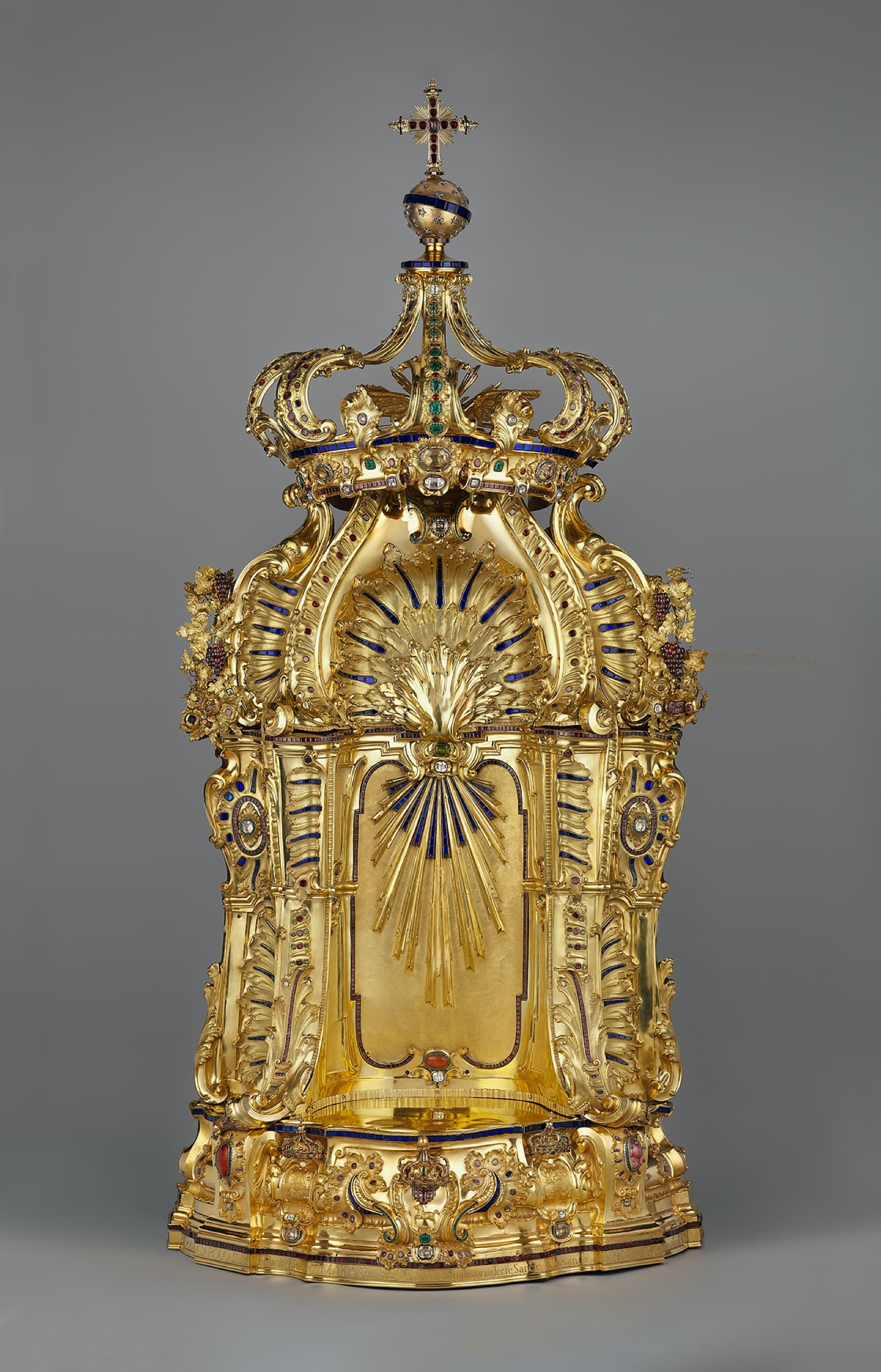
Pietro, Eutichio, and Sebastiano Juvarra, Throne of Eucharistic Exposition, 1665. Silver, gilt silver, gilt copper, glass, precious and semi-precious stones, 73 ¼ × 43 ½ × 15 inches. © The Frick Collection. Courtesy Terra Sancta Museum, Jerusalem. Photo: Joseph Coscia Jr.
Word count: 1229
Paragraphs: 9
The Frick Collection
October 2, 2025–January 5, 2026
New York
The Frick Collection has brought us a spectacular treasure trove of liturgical vestments and gold and silver objects of Catholic worship never before seen in the United States, courtesy of the Franciscans. These objects were a portion of the alms sent to the Church of the Holy Sepulcher in Jerusalem in the sixteenth through the eighteenth centuries by the Catholic rulers of Europe. The Church of the Holy Sepulcher, the holiest place in the Christian world, is the site of Christ’s tomb and resurrection. In 325, Emperor Constantine ordered the construction of an imperial basilica on the site; his mother, Empress (and later Saint) Helena, supervised the construction and rediscovered many of the relics of Christ’s passion. Here we see one such relic, preserved inside Robert Landry’s (act. in Paris 1618–35) Reliquary of the True Cross (1628–29). Just before entering the exhibition galleries, we encounter an eighteenth-century wood and mother-of-pearl Model of the Church of the Holy Sepulcher, showing the state of the structure after its reconstruction by the Crusaders. The current basilica, which has survived many perils and partial reconstructions, still functions as the heart of Christendom.
Every Orthodox Julian calendar Easter, a lamp placed on Christ’s tomb ignites the torches of pilgrims on the night of the Holy Fire, and this flame is flown around the world. During the Latin Gregorian calendar Easter, some of the objects in this exhibition are used for services within the church. Today, the Holy Sepulcher is shared by the Armenian, Greek Orthodox, Coptic, Syrian, and the Catholic officiates. The objects on display in this exhibition were crafted well after the Great Schism of 1054, when the Catholic Church broke with the Eastern Orthodox. Around 1217, the Franciscans became the representatives of the Latin church in Jerusalem, preserving these objects over centuries, many examples of which have not survived in Europe or elsewhere. The exhibition coincides with the building of the Terra Sancta Museum in Jerusalem and is a tribute to the conservatorship and scholarship of the Franciscans. That these treasures have been preserved in Jerusalem through periods of Ottoman rule and other wars is miraculous and a testament to the friars. The Franciscans’ legacy is complex: a large portion of the alms sent also provided schools, workshops for crafts, bakeries, publishing houses, and charitable institutions.
The exhibition is called To the Holy Sepulcher to emphasize that the objects and pilgrims traveled to this site in Jerusalem. Last year, roughly a million and a half pilgrims walked the Camino de Santiago, so perhaps the opening of this exhibition and the new museum is part of a zeitgeist, and pilgrims are once again embarking on quests. In our dark time, when great beauty in the service of divinity has become a thing of the past, modern day pilgrims are again being moved by the cathedrals along the Camino de Santiago route and by devotional objects like these shown at the Frick. To dismiss these objects as examples of monarchic excess or colonial plunder robs them of their ability to transport us to higher realms. We need beauty now more than ever, especially in a contemporary art world where religious art has become anathema and this level of resplendent beauty a rarity. This exhibition comes during the Christmas season as a gift to New Yorkers, at the Frick which houses Giovanni Bellini’s St. Francis in the Desert (ca. 1475–80.) The miraculous preservation of these treasures by the friars in Jerusalem gives us hope.

Installation view: To the Holy Sepulcher: Treasures from the Terra Sancta Museum, the Frick Collection, New York, 2025–26. © The Frick Collection. Courtesy Terra Sancta Museum, Jerusalem. Photo: Joseph Coscia Jr.
Entering the first room, the viewer is overwhelmed by a large silver relief, The Resurrection (1736) by an anonymous Neapolitan sculptor. Possibly made for the tomb from which Christ emerged, it depicts the risen Christ with an arm extended upward triumphantly. The fine chasing on the cloak and general style may have been influenced by the Italian painter Francesco Solimena (1657–1747). The smooth sensuous modeling of the Christ figure makes it seem to glow from within; this is an image of transcendence.
The collection of chalices, basins, and large sanctuary lamps is stunning. Yet it is the collection of formerly unseen vestments, many of which have not survived in Europe, that is a surprise. The silk velvet and gold thread Chasuble from the Dark Purple “Arma Christi” Set of Pontifical Vestments (ca. 1600), was sent by the Commissariat of the Holy Land in Lombardy. The Chasuble is decorated with the Arma Christi [Weapons of Christ], objects associated with the passion: the crown of thorns, a ladder with a lance and a sponge, a column, and whips. Their dark color suggests they were used on Good Friday.

Installation view: To the Holy Sepulcher: Treasures from the Terra Sancta Museum, the Frick Collection, New York, 2025–26. © The Frick Collection. Courtesy Terra Sancta Museum, Jerusalem. Photo: Joseph Coscia Jr.
Another stunning set of liturgical vestments, the Red Pontifical Vestments: An Antependium, Three Copes, and Two Dalmatics (1619) by Alexandre Paynet (or Penet) (act. 1615–56)—donated by Louis XIII of France and his wife, Anne of Austria, as regent for their underage child, Louis XIV—are decorated with fleurs-de-lis and the arms of France and Navarre. The central panels with the dove of the Holy Spirit are masterpieces of religious iconography. Even more remarkable, these vestments are the only French examples of this importance to have survived. A video made by the Frick documents them still being used yearly during the feast of Pentecost. Another breathtakingly beautiful gold silk trio, Cope, Chasuble, and Dalmatic from the Set of Pontifical Vestments with the Coat of Arms of King Louis XV of France (1741), was sent by the Commissariat of the Holy Land in Paris. The fabric is one of the finest examples of French weaving from the district of Lyon. Copes (flat capes) are worn during processions. The brocaded fabric’s underside couching was a technique invented by the painter Jean Revel, and the overall floral decorative motif possesses a painterly multi-layered depth. The red pomegranate flowers and pomegranates symbolize rebirth and the resurrection.
Perhaps the exhibition’s crowning piece is the Throne of Eucharistic Exposition (1665) and the Six Candlesticks and Four Vases (ca. 1673). Another video produced by an earlier venue, The Calouste Gulbenkian Foundation, shows monks carrying the candlesticks and flower vases down the street to be used at Easter in the Holy Sepulcher. The fact that these objects are still used for worship takes them out of the realm of simply museum pieces. A monstrance used to display the host or bread, a Holy Sacrament, is usually placed in the structure of a throne of eucharistic exposition. This particular Throne of Eucharistic Exposition was a gift from Philip IV of Spain (r. 1621–65) and made by Pietro Juvarra, a master goldsmith from Messina. The candlesticks made in the same workshops were gifts of Philip IV’s son, Charles II. The goldsmithing and silversmithing is without parallel, and again, examples of many of these objects no longer exist in Europe. Gold and silver objects were often melted down during times of war and revolutions. Viewing these many chalices and patens, sanctuary lamps, basins, croziers, and ciboriums used during services reinforces the importance of their roles in these sacred rites. This exhibition, a rare privilege, is not to be missed and inspires the pilgrim to visit the soon-to-be opened Terra Sancta Museum in Jerusalem. The exhibition will travel to the Kimbell Art Museum, Ft. Worth, TX, beginning March 15.
Ann McCoy is an artist, writer, and Editor-at-Large for the Brooklyn Rail. She was given a Guggenheim Foundation award in 2019, for painting and sculpture. www.annmccoy.com