Word count: 884
Paragraphs: 12

Installation view: Wolfgang Laib: Towers of Silence, Sperone Westwater, New York, 2025. Courtesy Sperone Westwater.
Sperone Westwater
May 1–June 7, 2025
New York
Tao does not act
yet it is the root of all action
Tao does not move
yet it is the source of all creationIf princes and kings could hold it
everyone under them would naturally turn within
Should a doubt or old desire rise up
The nameless Simplicity would push it down
The Nameless Simplicity frees the heart of desire
And reveals its inner silenceWhen there is silence
one finds peace
When there is silence
One finds the anchor of the universe within himself—Lao Tzu, Tao Te Ching, Verse 37 (6th c. BCE)
Wolfgang Laib’s latest exhibition opens with the artist’s hand-written quote from Lao Tzu. Laib’s tribute to the ineffable, the numinous, and the soul feels like a clarion call. Viewers despairing at the machinations of art market mercantilism and spiritless fabricated works produced by legions of assistants will see this exhibition as an antidote to the soulless malaise affecting much of the art world. Laib is a modern-day version of John Bunyan’s 1678 The Pilgrim’s Progress: From This World to That Which Is to Come. Laib spends solitary months in the forest collecting pollen and extended periods in India. His pilgrimage includes Asian spiritual practices such as Buddhism. These works are prophetic, showing us a way forward, while simultaneously occupying a timeless realm. Silence and communication with the divine are a theme here and provide a welcome departure from the material-bound flat earth society called critical theory.

Wolfgang Laib, Shrine near Pudukottai, South India, 2002. Gelatin silver print on baryta paper, 16 1/4 x 12 inches. Courtesy the artist and Sperone Westwater.
In the main gallery we see five large beeswax towers, all titled Towers of Silence (all 2024). Our first thought is of the Parsi Towers of Silence, where carrion birds transport the flesh of the departed to heaven. Laib’s towers suggest another elevation process, the upward movement of the spirit—the tower as an archetype, a place of higher perspectives. William Butler Yeats, Vita Sackville-West, Carl Jung, and monastics from both East and West all used towers to rise above the entanglements of material earthly existence. Laib’s beeswax towers are hauntingly empty, suggesting abandonment. The need to reoccupy them recalls John Milton’s “Il Penseroso”: “Or let my lamp at midnight hour, / Be seen in some high lonely tow’r.” We need to light our lamps, often extinguished by secular modernity, and largely absent in the art world. These towers also become citadels, above the darkness. Laib’s towers have both ancient architectural features like ziggurats and modern rows of windows. We feel invited to be occupants. They invite us to meditate and transition from an earthly perspective to a more spiritual one. Here, we sense an eternal return to spiritual spaces and practices.
Smaller versions of these beeswax towers were premiered in 2019 at the Cappella Pazzi in the Basilica of Santa Croce; Cappella Magi in Palazzo Medici Riccardi; the chapel of Sepulchre, Cappella Rucellai, in the church of San Pancrazio at the Marino Marini Museum; and the San Marco Museum in Florence, Italy. Laib’s installation of the towers in the Rucellai Chapel on a marble altar was the first time a contemporary artist had shown work in this hallowed precinct. Here, one sacred space occupies another. Towers were also part of a large group of smaller beeswax houses and ziggurat shaped structures shown in Laib’s exhibition City of Silence, at Thaddaeus Ropac Ely House in London in 2022.
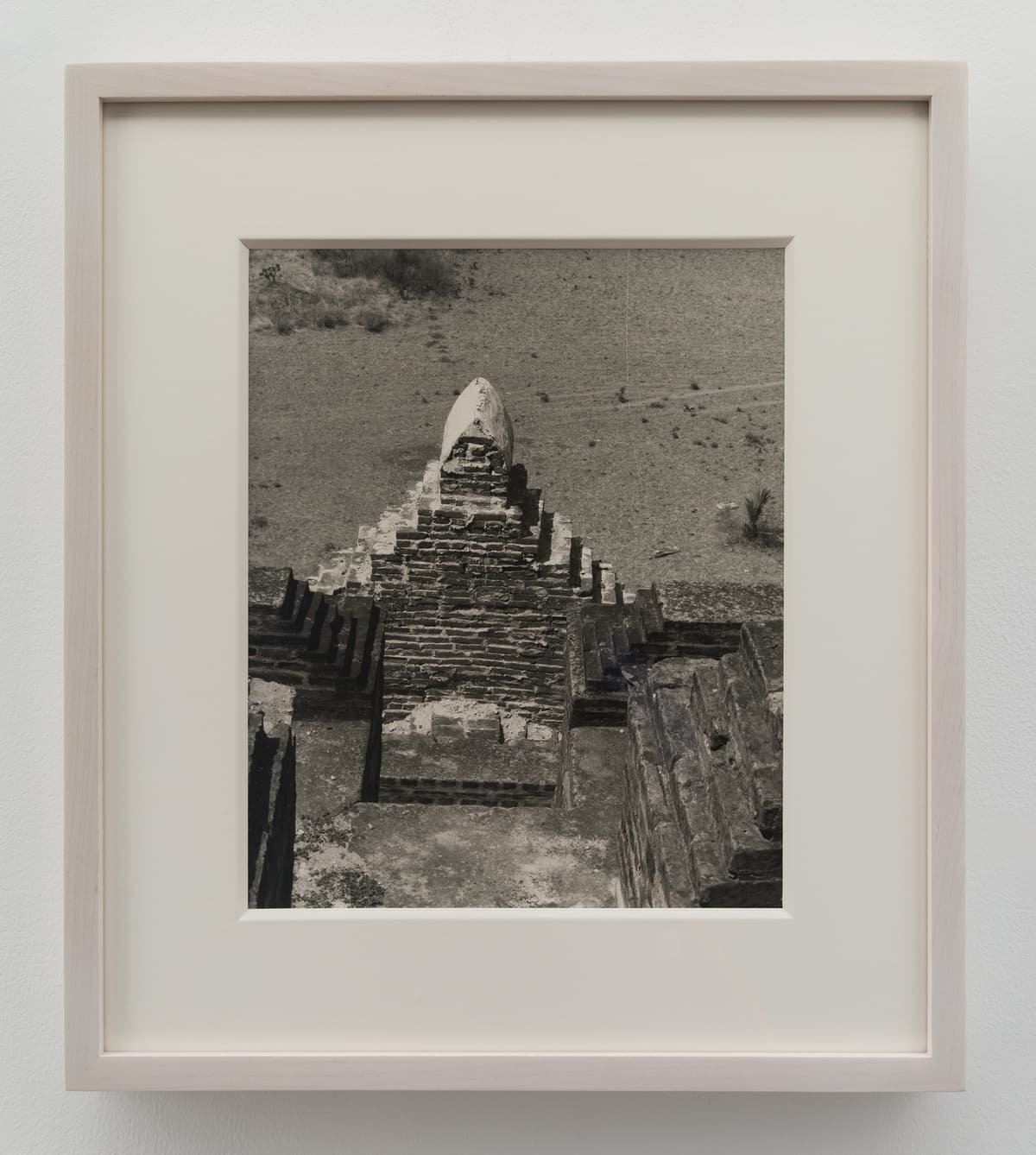
Wolfgang Laib, Bagan, Burma (Myanmar), 2000. Gelatin silver print on baryta paper, 10 x 8 inches. Courtesy the artist and Sperone Westwater.
Beeswax has long been a part of religious practice: Orthodox churches use solely beeswax candles. Rudolf Steiner wrote extensively about the miraculous products of the hive, the colony as a model for harmonious existence, and positive Venus energies. Laib’s towers suggest all of these attributes. For example, beeswax takes on the varied colors of the plants the bees engage with. The artist, who is generally very hands-on, in this case sourced the wax from a candle factory, as it takes a lot of bees to produce a small amount of wax. The towers are hollow and are constructed from poured sheets of wax. They feel handmade, irregular, not mechanically fabricated. The artist’s hand is present, and this adds to their magic.
A selection of works on paper, all titled Towers of Silence (all 2025) and made with pencil and oil pastel on Hahnemuehle paper and Arches paper, lines the walls. These hauntingly delicate drawings are a cross between architectural references and examples of sacred iconography. With their elegant simplicity and subtle rendering, they are a tour de force. A series of photographs acts as architectural references for the architecture found in the beeswax towers. These gelatin photographic prints, such as Shrine near Pudukottai, South India (2002) and Bagan, Burma (Myanmar) (2000), are masterful photographs as well as architectural source material.

Wolfgang Laib, Rice House, 2010. White marble, rice, 7 7/8 x 4 3/4 x 20 7/8 inches. Courtesy Sperone Westwater.
I have long celebrated Wolfgang Laib since he brought forty-five Brahmin priests to officiate at the Rite of Fire at the Fondazione Merz in 2009. A lot of our museums today could benefit from such a sacred ritual to drive the money changers out of the temple. Laib, with his exhibition at Sperone Westwater, shows us what we are sorely missing in much of the collective. This is an exhibition I would highly recommend to the disillusioned. There is hope.
Ann McCoy is an artist, writer, and Editor-at-Large for the Brooklyn Rail. She was given a Guggenheim Foundation award in 2019, for painting and sculpture. www.annmccoy.com