Etel Adnan
Word count: 1232
Paragraphs: 9

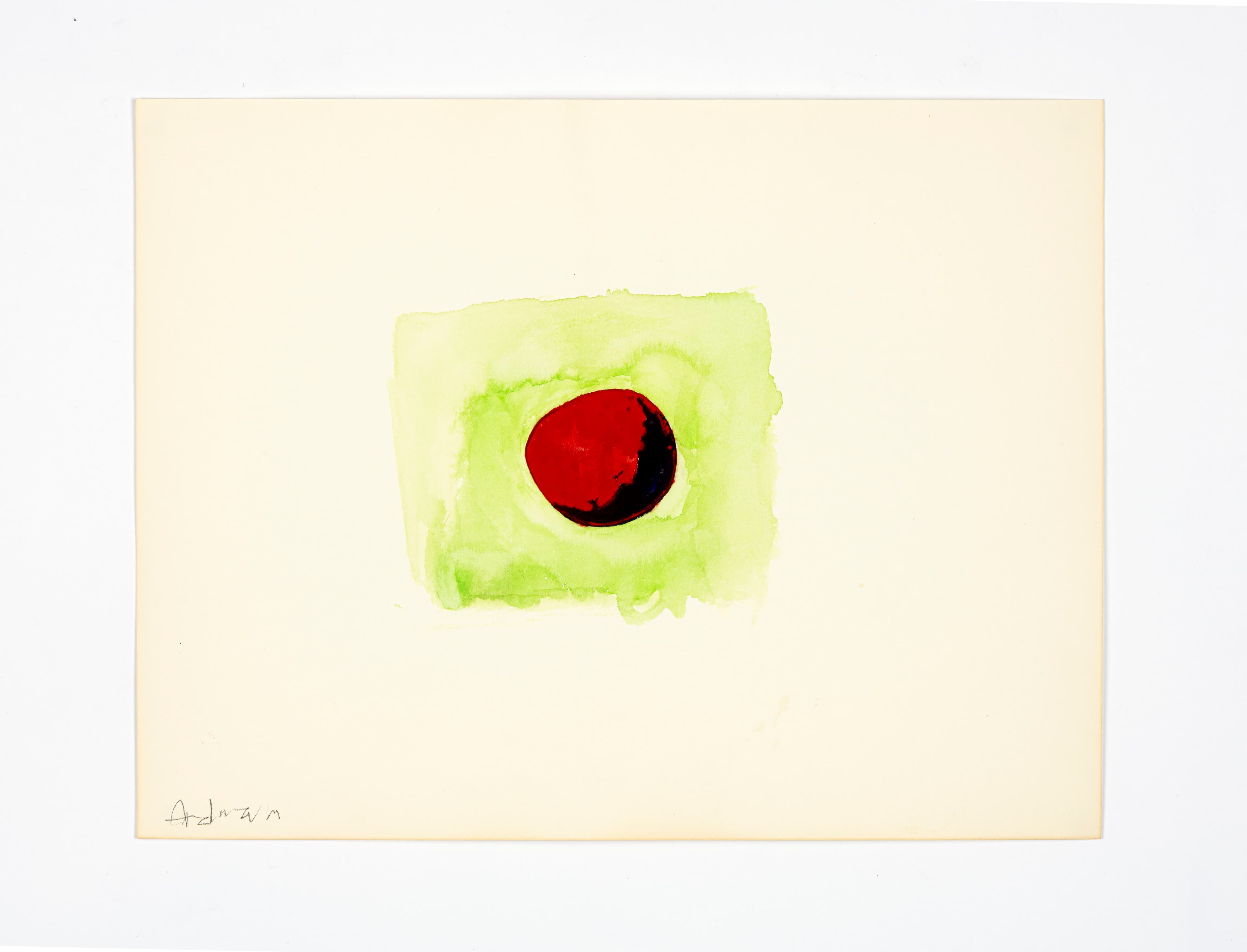
Etel Adnan, Tamalpaïs, Sausalito, 1988. Watercolor and ink on paper, 13 x 15 ¾ inches. © The Estate of Etel Adnan. Licensed by Artists Rights Society (ARS), New York. Courtesy Galerie Lelong & Co.
Galerie Lelong & Co.
February 13–April 5, 2025
New York
White Cube
January 22–March 1, 2025
New York
To celebrate the centenary of Etel Adnan’s 1925 Beirut birth, New Yorkers are being treated to two extraordinary gallery exhibitions showcasing different periods and facets of the artist’s work, along with a symposium organized by Omar Berrada and Simone Fattal. Adnan, a Levantine poet, novelist, journalist, and visual artist of the diaspora, feels timely as a survivor of polarized political upheavals and uncertainty. The daughter of a Muslim Syrian Ottoman father and a Greek Orthodox Christian mother, Adnan bridged cultures while changing languages, mediums of expression, and careers during her travels between Beirut, Paris, and California. As a polyglot, self-taught painter, and philosophical observer, Adnan’s protean genius is stellar, and we see it on full display in these exhibitions.
At Lelong, in the first United States survey of Adnan’s works on paper (1960 through 2021), Adnan’s life’s pilgrimage is sketched out before us. I kept thinking of Victorian travel diaries from a time when women were mostly restricted to small watercolors and drawings transported in folios. That same intimacy exists in the works seen here. Adnan’s drawings, many made on domestic tabletops, inhabit a feminine realm. Perhaps the outdated French term, femme d’intérieur, could be recoined to encompass the psychic interiority nurtured in domestic spaces. At Lelong are many domestic still lifes—drawings and watercolors of vases of flowers and bowls of fruit. We are told her house was filled with tables, and we can imagine her works being made on one of them.

Etel Adnan, Montagne Sainte-Victoire 7, 1990. Pencil and watercolor on paper, 9 ¼ x 12 ⅝ inches. © The Estate of Etel Adnan. Licensed by Artists Rights Society (ARS), New York. Courtesy Galerie Lelong & Co.
Adnan’s work is about memory and nostalgia. Places are observed over long periods and are later rendered from memory. Their origins feel rooted in a personal cosmology—in her words: “geographic spots become spiritual concepts.” California’s Mount Tamalpais, the artist’s Olympus, and “best friend,” is also celebrated in her prose essay, “Journey to Mount Tamalpais” (1986). At Lelong, we see many versions of this mountain in both ink and watercolor, executed from memory over different periods and in different locations. Montagne Sainte-Victoire, seen in five versions (all 1990), is perhaps her tribute to Cézanne, who considered it his sacred mountain. The red dot sun, Adnan’s point de départ and recurring symbol, first appears in Untitled (ca. 1960s), an ink and gouache work. Many of the untitled drawings from the 1960s feel like personal notations, filled with mysterious symbols. Similar signs, symbols, and hand-drawn glyphs appeared later in her book-length 1980 poem published in French, L’Apocalypse arabe.
Etel Adnan, Untitled, c. 1960s. Ink and gouache on paper. 10 ⅝ x 14 inches. © The Estate of Etel Adnan. Licensed by Artists Rights Society (ARS), New York .Courtesy Galerie Lelong & Co.
O Moon (ca. 1960s), a six-panel drawing (taken from her poem of the same name) is composed of stylized linear excerpts of the lines written in English. Later, we will see a kind of stylized Arabic calligraphy in the leporellos (folded scrolls in book form). She first acquired the leporellos in San Francisco from Rick Barton, who brought them back from China, through what she described as a “mystic transfer.” These scrolls were used by Adnan in a way reminiscent of the Chinese literati, who combined art, calligraphy, and literature. Adnan, who learned to write in French and later English, said she “painted in Arabic.” Her own non-classical version of Arabic calligraphy merged with poetry and literature across these folded scrolls. In Flight of Birds (2021), it is hard not to think of the Sufi poet Attar of Nishapur’s twelfth-century Conference of the Birds, with text taken from the Qur’an where Solomon and David are taught the language of the birds. In the leporellos, Adnan worked from Arabic texts initially, and her version of calligraphy morphed into lines and personalized symbols. Un vol d’oiseaux (2021) unfolds in a long vitrine like a musical score. Erquy The Edge (2021) is a linear narrative of the town in Brittany where Adnan visited in the summers of her later years, complete with bicycles, sail boats, and houses.
At White Cube, we encounter a stunning selection of paintings made between 2003 and 2020, a ceramic mural, leporellos, pastels, and an impressive selection of her tapestries. Adnan’s interest in weaving began with childhood trips accompanying her father to the Damascus bazaars, where magical carpets featured woven gardens. Later, in Beirut, a Russian teenage friend introduced her to Rainer Maria Rilke, and she became obsessed with his poetic descriptions of the six tapestries of The Lady and the Unicorn, which she would see later in France. A series of letters to her friend Claire Paget published by Les Cahiers de l’Oronte in Beirut in 1972, describe her lifelong relationship to weaving. Adnan first took a weaving class with Ida Grae at San Rafael’s Dominican College where she was teaching. In Tunisia, she met the first weaver to realize one of her drawings as a tapestry and in Egypt, the young weavers of Harrania. Hal Painter, the San Francisco weaver, made several tapestries from her drawings in 1967. The many tapestries at White Cube were produced from Adnan’s 1960s drawings by Lucas Pinton of Maison PINTON, a producer of tapestries for artists such as Joan Miró and Alexander Calder. Some, like Autour des Lacs (2019), were produced during her lifetime and some, like Été en Fête (2022), were finished posthumously. Adnan says it best: “Several of my tapestry projects were taken out of the dream they were plunged into, in my drawers, during so many years. They were—or are—being realized, since this first contact with Lucas Pinton and Jacques Bourdeix, the head of the workshop.” At White Cube, we are treated to two floors of her color-saturated tapestries, each one having required extended periods to accommodate the intricacy of the artist’s designs.

Etel Adnan, Été en Fête, 1960’s, 2022. Tapestry. 52 9/16 x 69 5/16 inches. Photo: Thomas Lannes. © White Cube
Apple Tree (2021), a large, posthumously produced ceramic mural filling the western wall at White Cube, is meant to be the showstopper, yet it is the small paintings that capture the viewer’s gaze. Most of the untitled paintings were produced in Paris and are of modest scale (around 13 by 16 inches). Although many were completed in a day, it is the lengthy preparation that produces the result. They are like alchemical distillations—requiring hours of meditation on a landscape, and the condensation of decades of memories. They feel loaded with psychic energy, and this is perhaps why they are so powerful. An autodidact, Adnan was saved from an art school education to find her own way. Her compositions with flat, interlocking, abstract shapes, were made using a palette knife to manipulate uniform colors. Elements in the landscapes are reduced to simple, uniformly colored shapes that coexist peacefully in the picture plane. The selection of paintings seen here is memorable.
In a vitrine upstairs at White Cube, one of Adnan’s most hauntingly beautiful leporellos, Untitled (2017), rests like a crown jewel. Bands of watercolor run parallel to the folds. “When you make a watercolor,” she mused, “you know how it feels to be the sea lying early in the day in the proximity of light.” Fittingly, the White Cube exhibition has the title This Beautiful Light. A small book of Adnan’s interviews, The Beauty of Light (2024, Nightboat Books) is a nice companion piece for both exhibitions. Her own art criticism, published from 1972 to ’74 in French in the Beirut newspaper Al-Safa, is well worth the read and should be required reading for art critics.
Ann McCoy is an artist, writer, and Editor-at-Large for the Brooklyn Rail. She was given a Guggenheim Foundation award in 2019, for painting and sculpture. www.annmccoy.com