Mark Bloch

Mark Bloch is a writer, public speaker and pan-media artist from Ohio living in Manhattan since 1982. His archive of Mail/Network/Communication Art is part of the Downtown Collection at the Fales Library of New York University. www.panmodern.com

A larger than life photo replication and the numinous painting in it provide twin centerpieces for Morris Hirshfield: Brooklyn Tailor, co-curated by Maresca, the teen photographer-turned-curator with the very Carroll Janis who once frolicked in the mansion as a boy.

Morris Hirshfield, Nude at the Window (Hot Night in July), 1941. Oil on canvas, 54 × 30 inches. Courtesy Ricco/Maresca Gallery.

The critic, author, translator, curator, and occasional performer had been archiving and organizing his life’s work with a sense of urgency, presumably wanting it read and researched by future generations. But a sweet modesty kept the lid on widespread awareness of his genius.

Henry Martin’s Selected Writings, Conversations, and Correspondences

Dick Higgins (1938-98) was an influential vanguard poet-artist who attended composer John Cage’s course in experimental composition at the New School starting 1958 before becoming one of the earliest Happenings artists.

The Experimental films of Dick Higgins

Daring to use tradition to challenge tradition, Denzil Forrester breathes new life into various twentieth century “isms” that some might say have run their course, staring down the uncomplicated folksiness of his subject matter. His populist work started as squiggly documentation of live events, which then evolved into paintings.

Denzil Forrester, Eula & Sons (TBC), 2024. Oil on canvas, 79 7/8 x 107 7/8 inches. Copyright Denzil Forrester. Courtesy the artist, Stephen Friedman Gallery, London and New York, and Andrew Kreps Gallery, New York. Photo: Todd-White Art Photography.
This show reveals a disciplined methodology, formally affirming the origins of Ray Johnson’s obsessive, almost scientific disposition that he carried forth into later work. Johnson could have become a Minimalist, and the art world would be much lesser for it.
Ray Johnson, Ladder World, 1949-51. Tempera on board, 27 3/4 x 27 1/4 inches. Ray Johnson Estate, New York. Courtesy Craig Starr Gallery.
Along the West African coast in the 17th, 18th, and 19th centuries, before the first slave ships arrived, offshoots of English were spoken, evolved from years of trade between multilingual Africans and Europeans. Later, after slavery began in the United States, a uniquely African American creole language, Gullah, developed along the 180 miles of coastline between northeastern Florida and southeast North Carolina including the off-shore Sea Islands and in Black communities in Charleston and Savannah.
Installation view: Claude Lawrence: Reflections On Porgy And Bess at Venus Over Manhattan, New York, 2024. Courtesy Venus Over Manhattan, New York.
Now, for a new hashtag generation that Porter saw coming, a substantial collection of his analog “founds” have been compiled anew into a self-help book for post-modern times, something between candor and caricature, integrity and irony.
Bern Porter’s Now It Can Be--Why Did It Fail Before?
Ay-Ō’s Happy Rainbow Hell is the first American museum show for the ninety-two year old, Tokyo-based Fluxus artist who ceased art-making in 2017, though he is a veteran of tributes in his native Japan. Centering around eighty rainbow serigraphs the museum has acquired, this treasure trove creates an ideal port of entry for a presentation by Assistant Curator of Japanese Art, Kit Brooks, to the little-explored, contemporary yet timeless Ay-Ō Flux-story.
Ay-Ō 靉嘔, rainbow night 9, from the series, "Rainbow Passes Slowly", Showa era, 1971. Silkscreen; ink on paper, 21 7/16 × 28 15/16 inches. Courtesy of Ay-Ō, National Museum of Asian Art, Smithsonian Institution, Washington, DC: Gift of Margot Paul Ernst in memory of Mr. and Mrs. Norman S. Paul. © Ay-Ō.
The sonorous rumblings of Artists Space’s deep, overdue investigation into the work of performance, sound, and digital composition pioneer Yasunao Tone takes us from the early 1960s to the present via the artist’s examinations into emerging technologies, and their use and misuse in the creation of sound. Curator Danielle A. Jackson has compiled a comprehensive exhibition of rare ephemera, ranging from Tone’s irreverent graphic scores to manipulated sound objects and gizmos to performative actions imaginatively documented.
Installation view: Yasunao Tone: Region of Paramedia, Artists Space, New York, 2023. Courtesy Artists Space, New York. Photo: Filip Wolak.
Solmi’s solo exhibition Joie de Vivre at the Morris Museum traces his journey from Bologna, Italy, as the son of a butcher born in 1973, to his latest turn as a societal voyeur in the United States, transforming this elegant outpost of the Smithsonian, a little known but spacious museum in deepest Northern New Jersey, into a digital space truly worthy of the term “metaverse.”
Federico Solmi, Douche Bag City, 2010. 15-channel digital animation, 15 LCD monitors, custom frames, 2 min 33 sec, overall: 6 × 222 × 2 inches. © Federico Solmi, courtesy of the Carl & Marilynn Thoma Foundation.
Johnson shot three thousand 4 by 6 inch consumer-grade photos in thirty-five months on 137 single-use, point-and-shoot Fujicolor Quicksnap cameras.
Elisabeth Novick, Untitled (Ray Johnson and Suzi Gablik), 1955. New York County, New York State. Gelatin silver print, 11 × 14 inches. Courtesy the Ray Johnson Estate.
John Willenbecher’s work is an art of anticipation. His precise forms anticipate the seriousness of Minimalism, while his paradoxically playful objects beg to be handled, a quashed call to participation impossibly choreographed behind glass.
John Willenbecher, Game with Sixteen Balls, 1962. Box construction, 17 1/2 x 12 x 4 1/2 inches. Courtesy Craig F. Starr Gallery. Photo: Dan Bradica.
In their first solo presentation in New York in over 40 years, the Boyle Family’s “earthprobes” are disorienting re-creations of randomly selected areas of the earth’s surface, made from resin, fiberglass, and found materials, that combine Robert Smithson’s earthiest visions with the uncanny eeriness of a Duane Hanson clone.
Boyle Family, Demolition Fire Study with Lock and Trivet, 1989. Mixed media, resin, fibreglass, 48 1/8 × 48 1/8 inches. © Boyle Fanily; Courtesy of the artist and Luhring Augustine, New York.
This beautiful and well-researched book joins a selection of the artist’s collages with texts by his friend, the late critic William S. Wilson. But the star of this show is Johnson, whose magnificent, uncanny, and sublime collages require little explanation that he himself did not provide in abundance during his self-truncated lifetime.
Ray Johnson and William S. Wilson: Frog Pond Splash
I have often felt I was crazy as an artist who doesn’t feel the need to make art. I’ve received so much of it over the years I don’t care if I ever see or make another image. That is why I write.
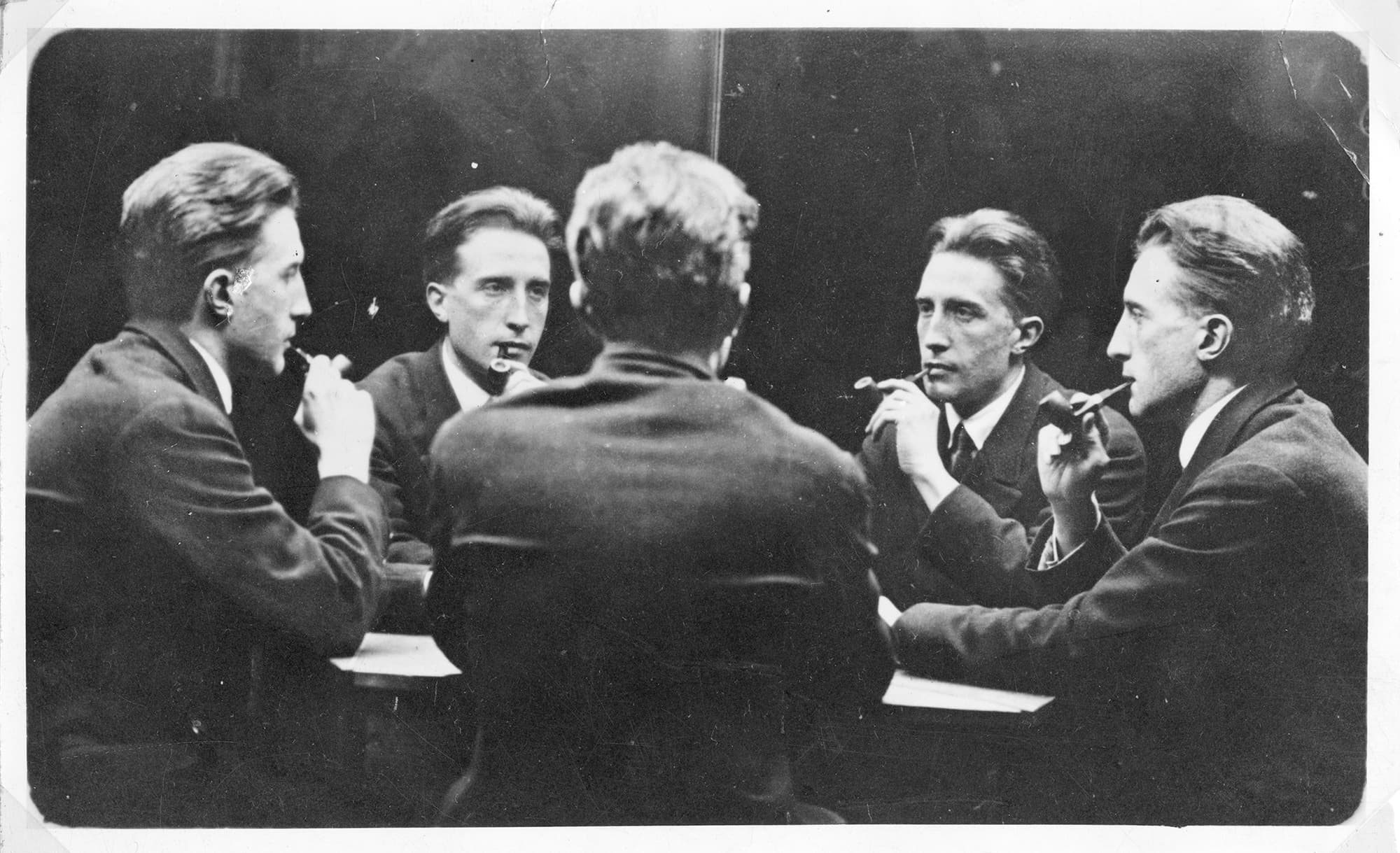
Ray Johnson (October 16, 1927-January 13, 1995), Untitled (Duchamp profile). Detail of Johnson's last letter to Mark Bloch, received 12/22/94, photocopy with rubber-stamp. Collection Mark Bloch/Postal Art Network,  © The Ray Johnson Estate.
I have often wondered: how is it that so many of the post-conceptual, post-minimalist, performance, and video artists that have made up New York’s vibrant downtown arts scene over the last three decades all seem so familiar to each other?
Courtesy Primary Information and Printed Matter.
These 42 mostly black and white works, the original “thug life” drawings, have a lovable but menacing charm—a deep wrongness that somehow looks right.
Joe Massey, "Tell me I cant do the split," 1946. Ink on paper, 11 x 8 1/2 inches. Courtesy Ricco/Maresca, New York.
Steve was a force of Nature, driven by compassion & curiosity. He was opened to everything & everyone. He was naked inside & outside with no boundary between.
Portrait of Steve Dalachinsky, pencil on paper by Phong Bui.
T.C. (Tommy Wayne) Cannon painted Native American portraits outside against skies with potato-shaped clouds and in interiors against “magical circle” wallpaper patterns with unlikely color combinations. He transformed the garments and neckwear of his subjects to bring out the gravitas from their faces and posture, creating jolting, psychedelic yet monumental tributes, political in their mere existence and as solid and American as Mount Rushmore.
T.C. Cannon,  Mama and Papa Have the Going Home Shiprock Blues, 1966. Acrylic and oil on canvas. Institute of American Indian Arts, Museum of Contemporary Native Arts, Santa Fe, New Mexico. © 2019 Estate of T.C. Cannon. Photo Addison Doty.
Best known for her intricate and enigmatic multimedia assemblages, Mary Bauermeister (b.1934), long defied categorization. She matured amidst Pop and Minimalism but instead echoed explorations of the very personal and a multi-layered maximalism.
Mary Bauermeister (b.1934), Brian O'Doherty Commentary Box, 2017, ink, stone, offset print, glass, glass lens, paint brush, metal and wood tools and painted wood construction, 17" x 24 3/4" x 4 1/8", signed; © Mary Bauermeister; Courtesy of Michael Rosenfeld Gallery LLC, New York, NY
Something in the air wafted into New York’s cultural scene as the 1950s became the 1960s with the dance world no exception.
Anna Halprin, The Branch, 1957. Performed on the Halprin family’s Dance Deck, Kentfield, California, 1957. Performers, from left: A. A. Leath, Anna Halprin, and Simone Forti. Photo: Warner Jepson. Courtesy the Estate of Warner Jepson.
Coinciding with MoMA’s Judson Dance Theater: The Work Is Never Done and Paula Cooper Gallery’s 50 Years: An Anniversary exhibition, Peter Moore: 1968 is just that: a collection of photographs taken in a single remarkable year by the ubiquitous Moore (1932 – 1993) of Judson artists such as Yvonne Rainer and Steve Paxton as well as a number of their downtown bohemian peers ranging from Philip Glass to Charlotte Moorman and others.
Installation view, Peter Moore: 1968, Paula Cooper Gallery, New York, 2018. Photo: Steven Probert. 
The photographs show Thomas Hart Benton restoring America Today at The New School, September 11, 1968.
The understated exhibition, Notes From Downtown is a victory lap around the tail end of a divine comedy for Jonas Mekas’s.
Jonas Mekas, A Walk, 1990. Analog Video with voice over by Jonas Mekas, 58 minutes, Dimensions variable. Courtesy James Fuentes. Edition of 3 plus II AP.
Had intolerance not been rampant in 1963, the deserved anti-heroic notoriety Jack Smith received when Flaming Creatures appeared, following screenings for initiated friends in ’62, might have been for fearless dedication to his vision; instead it made him a gay icon.
Installation view of Jack Smith: Art Crust of Spiritual Oasis, June 22 – September 9, 2018. Courtesy of Artists Space, New York. Photo: Daniel Pérez
The Great East Japan Earthquake of 2011 pounded the souls of many young Japanese artists.
Installation shot, Forsaking Pop: A New Generation from Japan. (2018) Courtesy WhiteBox.
Settangeli pledged to devote his considerable gifts and career to the ideals of the Samurai, Japanese warriors from the 10th through 19th centuries, and their six virtues: filialness, loyalty, fidelity, justice, charity, and courtesy.
Atsuki Settangeli, Samurai Woman No.069, 2018. Oil on canvas,  28.5 x 24 inches. Courtesy WhiteBox.
This show unwraps the early years (1953 – 1959) of Japan’s influential post-war avant-garde art collective, Gutai, with a tale of innovation that presents prescient pre-Pop and pre-performance captured in its earliest moments.
Kazuo Shiraga, Torimono, 1958. Oil on paper, mounted on canvas, 181.9 x 242.9 cm. © Kazuo Shiraga.
Johan Wahlsrom’s recent show, Life Is Good, is smaller than last year’s Distorted Happiness.
Johan Wahlstrom, Stupid White Men. Urethane, color pigments on canvas, 40 x 90 inches. Courtesy the artist and Georges Bergès Gallery.
Jeffrey Perkins’s George is an important new addition to the twin canons of art and anti-art.
George, 2017. Directed by Jeffrey Perkins. Courtesy Jeffrey Perkins.
The Estate of General Idea (1969-1994) had their first exhibition with the Mitchell-Innes & Nash Gallery on view in Chelsea through January 13, featuring several “ziggurat” paintings from the late 1960s, alongside works on paper, photographs and ephemera that highlight the central importance of the ziggurat form in the rich practice of General Idea.
General Idea (a project of Ron Gabe, aka Felix Partz), Burning Ziggurats, 1968, Set of 4, gelatin silver print, 9 x 12.5 cm each, Courtesy Mitchell-Innes and Nash.  © General Idea.

Close

Home