Denzil Forrester: Two Islands, One World
Word count: 719
Paragraphs: 11
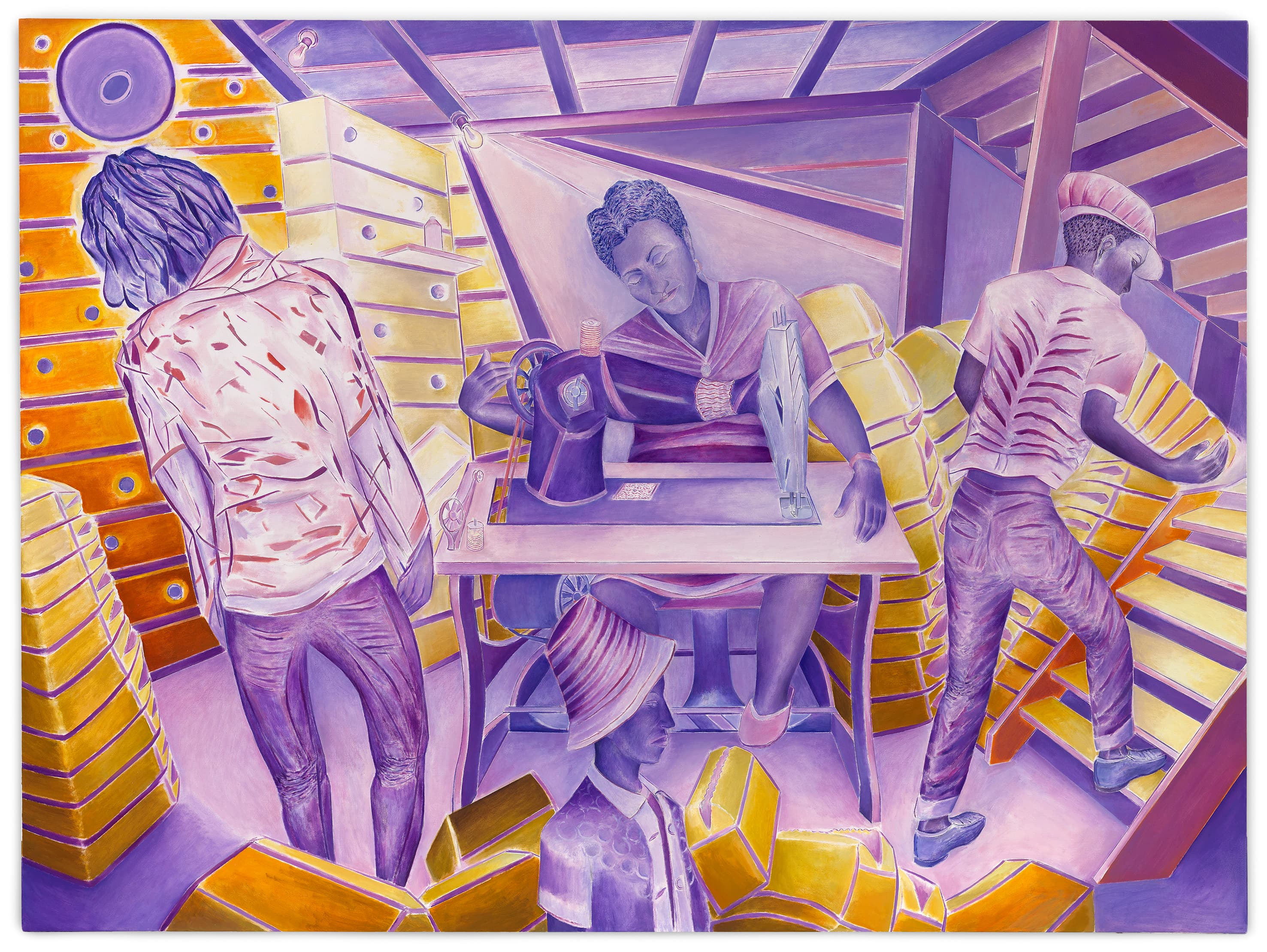
Denzil Forrester, Eula & Sons (TBC), 2024. Oil on canvas, 79 7/8 x 107 7/8 inches. Copyright Denzil Forrester. Courtesy the artist, Stephen Friedman Gallery, London and New York, and Andrew Kreps Gallery, New York. Photo: Todd-White Art Photography.
Stephen Friedman Gallery
Andrew Kreps Gallery
October 25–December 18, 2024
New York
Daring to use tradition to challenge tradition, Denzil Forrester breathes new life into various twentieth century “isms” that some might say have run their course, staring down the uncomplicated folksiness of his subject matter. His populist work started as squiggly documentation of live events, which then evolved into paintings. Forrester moved with his mother from the West Indies to London where he married and embarked on a fine arts education. In 2016 he moved to Cornwall, where Ben Nicholson once cast shadows. As one of only a few Black residents of the town, Forrester had a laugh painting Black people he invented sunbathing there, he told an interviewer.
His twin cubist-derived, modernist shows curated by Sheena Wagstaff are similarly playfully resolute recollections of the chaos, carnivals, noise, and color that preceded his life in the UK. He has called his youthful work “quite cubistic,” adding, “but the cubists got their stuff from Africa anyway.” At age twenty-seven he was compared to another Brit, Edward Ardizzone, who travelled sketching war scenes and spontaneous children’s book illustrations the way Forrester depicts dub and reggae nightclubs.

Denzil Forrester, Tutti-Frutti, 2024. Oil on canvas, 107 7/8 x 79 7/8 inches. Copyright Denzil Forrester. Courtesy the artist, Stephen Friedman Gallery, London and New York, and Andrew Kreps Gallery, New York. Photo: Todd-White Art Photography.
After making annual trips to Paris in the late seventies, he fell for Monet and Cezanne, followed by a 1983–1985 Rome residency that brought a fascination with old masters such as Caravaggio, who perhaps inspired contrast in his non-carnival imagery. During a two-year residency in New York between 1986 and 88, he saw color only in graffiti, responding in a melancholy, monochrome blue that later merged into book covers and murals he created from his dub-inspired canvases—as populist as New York’s street art.
Since then, his brush strokes and compositions have repetitively responded to repetitive dub music grooves, laying out stories from a personal mythology: crowded basements emanating reggae vibes are interchangeable with images of his mother in another basement, earning money for her family at a sewing machine, or his 1981 proximity to the death of a young friend in a police van.
In a jittery account on a sheet of notebook paper shown in a vitrine of clippings and memorabilia at Andrew Kreps, we learn Denzil’s friend Winston Rose’s family was called too late as ten cops seized control, indicative of the police brutality proliferating 1980s London. Like a life ended abruptly, Denzil’s handwritten story also tellingly halts mid-sentence. In one of Forrester’s 1982 paintings, Three Wicked Men, titled for a reggae recording about a businessman, a policeman and a politician, Forrester removed a DJ and added a coffin.

Denzil Forrester, Blue Jay, 1987. Oil on canvas, 107 3/4 x 75 7/8 inches. Copyright Denzil Forrester. Courtesy the artist, Stephen Friedman Gallery, London and New York, and Andrew Kreps Gallery, New York. Photo: Todd-White Art Photography.
In Mad Professor (2024), DJs on stage resemble judges presiding over their court or preachers delivering sermons to reverent congregants, heads bowed. In 2024’s Tribute to Shaka (a favorite DJ), vinyl or CDs reach up like urban towers much like that open casket pierced a jostling dance crowd. The mother is suddenly a DJ-like figure sewing at a club’s vortex with downstairs washing machines proxies for amp or turntable stacks.
Throughout his career Forrester elegantly depicted bowing heads amongst gesturing hands, fingers, and bodies. Occasionally, figures gaze directly at the viewer, eyes open, accompanied by second figures glancing left or right. The focused looks are murky, ambiguous, disturbingly vague, staring from an impatient haze.
Like cascading modernist movements, Forrester’s crowds have gradually morphed into linear calligraphic constructions coalescing in patterned clothes or as figures gathered in hordes as his past spreads stylistically across new work. Three-part (ceiling, stage, audience) “tutti-frutti” rooms of congregants like Altar (2024) repeat in polymer etchings, pastel sketches and paintings. Curator Sheena Wagstaff calls these environments places of “joy, respite and community.” Works such as Jungleheart (1995) and DJ Mix (1998) bridge gaps from his 1980s drawings to today, mashing London dub into seaside nightlife with radiant Cornish luminosity transforming his palette into oranges, pinks, and purples.
While his practice’s arguably strongest period—around 2000— featured defined figures, clothes, and expressive gestures carefully painted, these forms eventually exploded into simplified lines, painterly shapes, and bold hues reminiscent of Fauvism, coaxed into the kaleidoscopic swirly arrangements of Orphism, a key moment in the twentieth century between Cubism and Abstraction. Circles erupting out of spotlights, speakers, spinning turntables and disco balls detonate transformative geometric possibilities in transit across time.
Mark Bloch is a writer, public speaker and pan-media artist from Ohio living in Manhattan since 1982. His archive of Mail/Network/Communication Art is part of the Downtown Collection at the Fales Library of New York University. www.panmodern.com