Louis Block

Louis Block is a painter based in Brooklyn.

One night, Lois Dodd set out down the road from her house to make a painting. The moonlight was so strong that she could work without a flashlight, having memorized the configuration of pigments on her palette. Broad strokes of ochre, blue, and gray describe her view from the middle of the street. The resulting painting, Hathorne Point Road by Moonlight (1992–93), is now part of Framing the Ephemeral
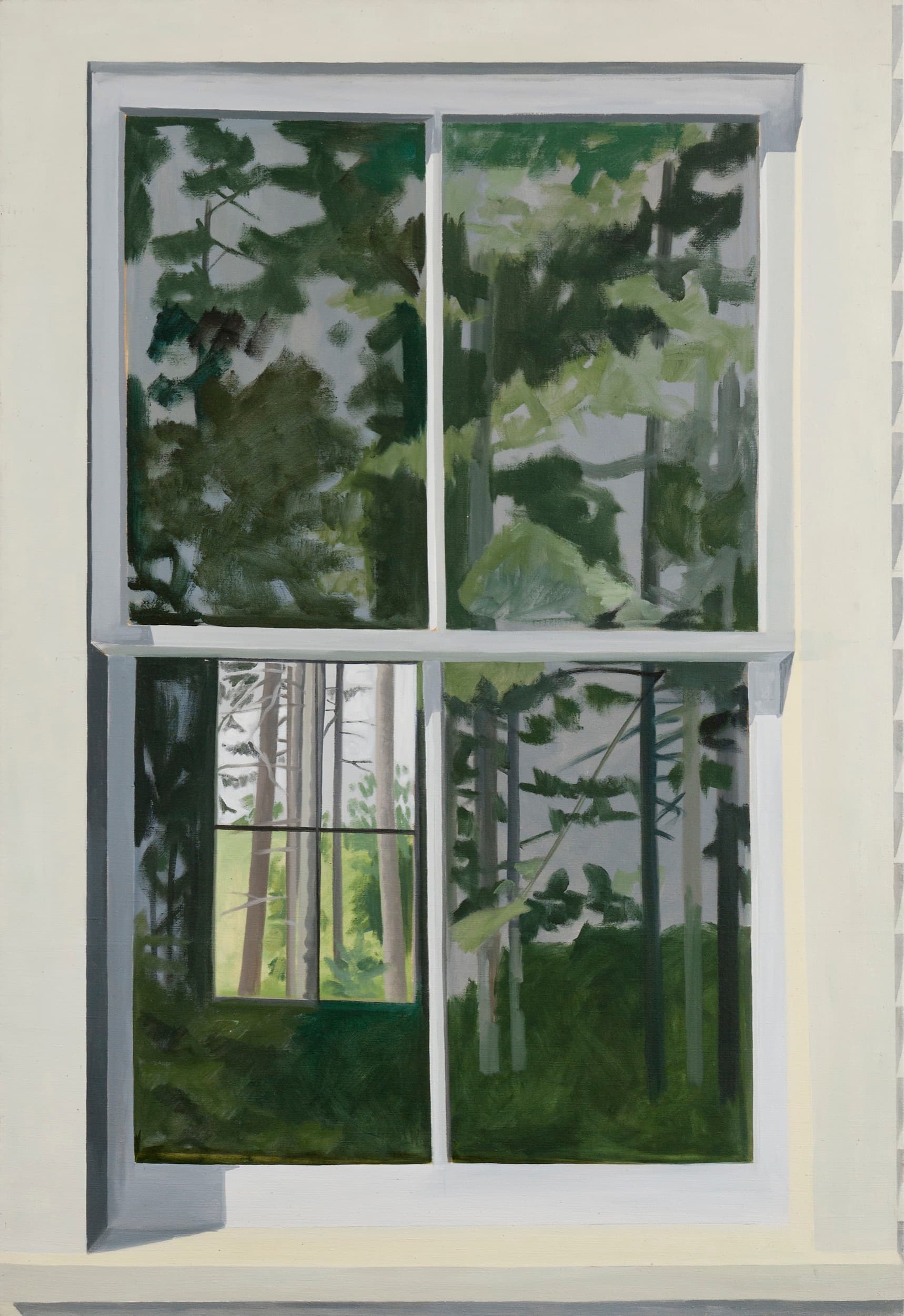
Lois Dodd, View Through Elliott’s Shack Looking South, 1971. Oil on linen, 53 × 36 inches. Museum of Modern Art, New York. © Lois Dodd. Courtesy Alexandre Gallery, New York.

Many of Jodie Manasevit’s recent paintings are made up of units too self-contained to be called blotches or daubs of paint; yet they are often too imprecise to be called dots.
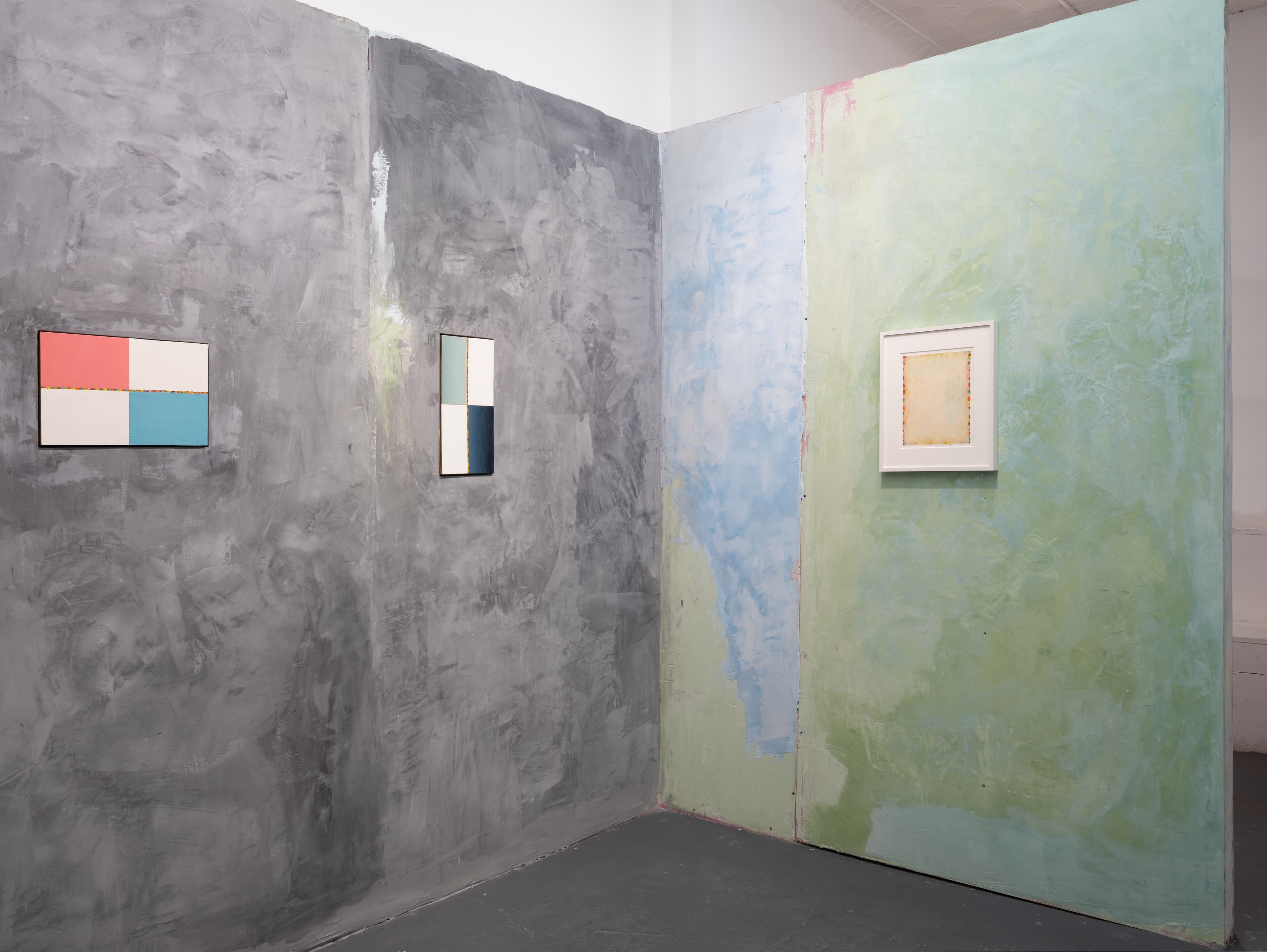
Installation view: Jodie Manasevit: Cathected, Ghostmachine Gallery, New York, 2025. Courtesy Ghostmachine Gallery.

The shapes in Patricia Treib’s canvases are painted with a vernal insistence, like shoots and petals still torquing into their final forms. For her current show, the artist reprises familiar motifs: garment patterns, an ornate clock, the area between a torso and an arm; base images that act less as repeated subjects and more as liquid armatures for Treib’s brush.

Patricia Treib, Antiparian, 2025. Oil on canvas, 85 x 64 inches. Courtesy Bureau, New York.
Amy Sillman, who describes abstract painters as “doomed to work in between hoping and groping,” has provided the premier example of how far a painting can be pushed and brought back; her canvases teem with stop-and-start traces, film-still swipes of action, and veils of limbs bending time like metastatic clock faces. The stakes of abstraction, of “lumpen form,” as Sillman has written, can have to do with “body politics” and “care and repair,” or with “merely try[ing] to beam out an electrifyingly personal and strange signal that wakes up the receiver for a moment—one weird moment that could shift the sense of things.” Strange and weird point to the unknown, and to the simple paradox that a painting is something you make because you’ve never seen it before. So what happens in finishing is a fastening of the mind’s kernel to the pulp of this world.
Amy Sillman, Albatross 1, 2024. Acrylic and oil on linen, 75 x 66 inches. © Amy Sillman. Courtesy the artist and Gladstone Gallery. Photo: by David Regen.
In paint, recognition always butts up against necessity, creating the temptation to name something where there is just some thing. I remember standing in front of a Thomas Nozkowski painting six years ago, staring into its central green mass, which was like moss floating in the canvas’s fleshy pink.
Thomas Nozkowski, Untitled (4-120), 1986. Oil on linen on panel, 16 x 20 inches. © Thomas Nozkowski. Courtesy Pace Gallery.
It is fitting that this centennial celebration of Kelly’s birth is held in the limestone pavilions at Glenstone, massive structures that cut down into a tranquil slope and offer staggered views of the landscape and water gardens from quasi-subterranean but light-filled galleries. With over seventy of Kelly’s works on view, the exhibition feels compact, but not necessarily incomplete.
Ellsworth Kelly with cornstalk, Chatham, New York. 1973. © Ellsworth Kelly Foundation. Courtesy Matthew Marks Gallery.
Lois Dodd’s show Outside In opened on the first real snowfall of the season, and both her new paintings and the melting flurries were a reminder of the agency involved in seeing—the muscle required to shift focus between objects and sort the flux of the world into something familiar.
Lois Dodd, Blizzard Cushing, 2021. Oil on Masonite, 9 7/8 x 16 1/8 inches. © Lois Dodd. Courtesy the artist and Alexandre Gallery, New York.
In some dictionaries, “coral” has a useless etymology. The English comes from the Old French coral, from the Latin corallium, from the Greek korállion—all sharing the same sense: coral. The word comes from itself, and itself, and itself, and then substance.
Kern Samuel, A good rain is coming, 2022. Acrylic on sewn canvas, 27 x 25 inches. Courtesy the artist and Derosia, New York.
If Ezra Tessler’s recent paintings call to mind pillows, it is not only due to their lumpy disposition, but also the harmony between surface, substrate, and support that lends them a dreamlike quality. His constructions of wire, resin, and paper pulp swell outwards, their edges failing to contain the colors and patterns that wrap around their backs.
Ezra Tessler, Space is the wake of time, 2023. Paper pulp, wire, and aqua resin, 29 1/2 x 21 1/2 x 2 1/2 inches. Photo: Shark Senesac.
The Austrian artist Leopold Strobl has a straightforward way of working: he looks through the pictures in daily newspapers, selects a scene, cuts it out, mounts it on thicker paper, and then covers much of the surface in colored pencil and graphite.
Leopold Strobl, Untitled, 2019. Graphite and colored pencils on newsprint clip mounted on paper, 2.7 x 3.8 inches. Courtesy Ricco Maresca, New York.
If there is a chaos in Barbara Friedman’s new paintings, it is just that: a maw of possibility, full of glistening teeth, gums, and tongues, eyes peering out, each one the beginning of a world.
Barbara Friedman, A Blooming, Buzzing Confusion, 2022. Oil in linen, 37 x 28 inches. Courtesy the artist.
Painting, as medium, is always just that—a vehicle to channel things from one world to another; that it should encounter some friction seems natural. In Tom McGlynn’s work, that friction is more than significant.
Installation view: Tom McGlynn: What Gives, Rick Wester Fine Art, New York, 2023. Courtesy Rick Wester Fine Art.
It is uncommon for painting to be pulled apart at its threads with such care. Kern Samuel’s preoccupations with the medium are obsessive and unabashedly earnest; each of his deconstructions is mirrored in an equivalent statement of confidence.
Kern Samuel, Together Again, 2021–23. Turmeric, paprika on paper mounted to fabric, pieced together with stitching, 23 x 23 inches. Courtesy Derosia, New York.
In the lead up to Churchman’s first show of monotypes at Matthew Marks, I visited their studio in Tribeca. Surrounded by paintings in progress, notably a giant diagram of a black hole, we sat down for an interview.
Portrait of Leidy Churchman, pencil on paper by Phong H. Bui.
These canvases might be deciphered over hours of observation, tracking the drifting daylight across brushstrokes to determine exactly which pigment, applied in which order, formed these pictures. I’m envious of that exercise. But I’m also content with my situation, where there is room left for magic.
Heidi Hahn, Flex, Rot, and Sp(l)it 9, 2022.
 Oil on linen
, 76 1/4 x 60 1/4 in
ches. Courtesy Nathalie Karg.
Uttech’s paintings allow for these varied experiences and glimpses to exist at once, decades in the wilderness compressed into kaleidoscopic views.
Tom Uttech, Nin-Babishagi, 2022. Oil on linen, with artist's frame, 91 x 103 inches. Courtesy Alexandre Gallery, New York.
What does it mean for topography to unfold like this, to be made rather than a simple fact? Peering through a storefront window at this canvas, the most saturated colors describe tracts of land and bodies of water, darker colors suggest shadows in the landscape, and the ghostly imprints of revision—pinks and violets against each other—read as memories, transcriptions of light hitting the landscape.
Installation view: EJ Hauser at WINDOW, 2022. Left: Late Spring, right: Big Early Summer. Courtesy Anton Kern, New York.
Absent any punctuation, How to Get Free of the Rectangle reads as a directive. Decades ago, it might have been a longing question, but now painting’s rectangle has been bent, torn, re-sewn, and looped in on itself, so it might be easy to scoff at the premise and how far removed it is from the radical. But this modest survey accomplishes a small miracle: it justifies painting’s bullish intrusions into other mediums.
Savannah Knoop, Leap Year (October/November/December 2020/January 2022), 2022. Newspaper, Aqua-Resin, and pigment, 72 x 80 x 7 inches. Courtesy Nicelle Beauchene, New York.
In the late sixties, Hantaï abandoned the rounded biomorphic contours for an all-over approach, seeking an increased flatness in the finished paintings, a project that occupied him for the rest of his career. It is this period of intense production, from the late-sixties through the seventies, that the current show surveys.
Simon Hantaï, Tabula, 1976. Acrylic on linen, 77 15/16 x 76 3/4 inches. © Archives Simon Hantaï/ADAGP, Paris. Photo: Robert Glowacki. Courtesy Gagosian.
The show is dominated by two monumental diptychs that reprise the same cartoonish motif on a shared wall. In a coy move, the left two canvases are spaced closer together than the right ones, and, taken as a whole, the four panels can read as a procession of decorative elements interpreted through self-conscious painterly devices.
Michael Krebber, Doll in Pink, 2021. Oil color on linen, 96 x 144 inches. Courtesy the artist and Greene Naftali, New York.
The oldest painting in this collection of landscapes, still lifes, and portraits, was begun in 1998 and completed 20 years later. That span is indicative of Holzman’s process, where surfaces are built up and removed over years, their pentimenti giving form to a final image.
Eric Holzman, Tree by the River, 2019–21. Oil on canvas, 28 x 22 inches. Courtesy Equity Gallery, New York.
This book documents five of the artist’s projects on color, separating the visual and the verbal, the interior and the exterior.
Richard Tuttle’s The Role of the Story Teller
Martha Tuttle’s paintings can be defined by belonging, in that they are seriously invested in a material process that takes the craft of the medium as part of its subject.
Martha Tuttle, After Cadillac Ranch, 2021. Wool, silk, graphite, pigment, and dye, 72 x 48 inches. Courtesy the artist and Tilton Gallery, New York.
In this show titled Aspen Drift, there is a surprising absence of blur. Cerith Wyn Evans’s neon sculptures describe form in such exacting terms as to evoke something diagrammatic, like glowing renderings of discrete movements suspended in the air.
Cerith Wyn Evans, Neon Forms (after Noh I), 2015. White neon, 139 x 118 7/8 x 83 7/16 inches. Photo by the author.
Wong Ping’s world is full of hyper-contrasting gradients within forms, and the neon sheen of his characters’ various body parts appears less like an effect of light than some sickly glaze on a dessert. In the New Museum’s darkened galleries, frames rush past almost too quickly, and scenes of longing and sex—mostly not actual sex, but frustration, budding fetishes, fantasies—are gemlike and addicting.
Wong Ping, Jungle of Desire, 2015. Single-channel video, sound, color; 6:50 min. Courtesy the artist; Edouard Malingue Gallery, Hong Kong / Shanghai; and Tanya Bonakdar Gallery, New York / Los Angeles.
In John Dilg’s paintings, dusk and dawn are suffused with green, and the color seems as inevitable as the setting and rising of the sun. His is an old green, like celadon or lichen, that makes the hues of spring shoots seem rather showy.
John Dilg, Headdress, 2011. Oil on canvas, 20 x 16 x 1 1/2 inches. © John Dilg. Courtesy the artist and The National Exemplar Gallery, Iowa City. Photo: Lance Brewer.
Wynter applies oil pastel in lines that swirl and smear across the paper, so that his compositions are bound by the density of their own centers rather than any external structure or gravity. An entire language of marks seems to unfurl and come back into focus.
Kemar Keanu Wynter, The Gun Hill Plate, 2021. Oil stick, oil pastel, acrylic, charcoal, and grommets on French cardstock, 19 x 19 inches. Courtesy Tiger Strikes Asteroid, New York. Photo: Daniel Johnson.
Primeval and metamorphic, this language is a departure for Warren, and represents a new way of engaging with the body. Where her former sculptures were concerned with the grotesque, and touch was an incessant reminder of the distorting gaze transforming every bulbous outcropping into breast or phallus, these forms are more intimate.
Rebecca Warren, A Glyph (detail), 2020. Hand-painted bronze on painted MDF pedestal, 74 7/8 x 17 x 14 1/8 inches. © Rebecca Warren. Courtesy Matthew Marks Gallery.
The title of Monique Mouton’s current show at Bridget Donahue, Inner Chapters, evokes something of a trance: the state that a novel creates when the plot accelerates but the end is not yet in sight, when the gamble of picking up the book has paid off.
Monique Mouton, Love Quotient, n.d. Watercolor, oil, soft pastel, pencil on paper; silver gray and graphite on cherry frame 33 5/8 x 81 1/2 x 2 1/2 inches. Courtesy the artist and Bridget Donahue, NYC. Photo: Gregory Carideo.
Louis Block speaks with artist Rachel Eulena Williams about memory and transformation in her two solo shows, and finding order within disorder.
Rachel Eulena Williams, pencil on paper by Phong H. Bui.
Louis Block speaks with artist Hilary Harnischfeger about materials and process, geology, science fiction, and the influence of the landscape.
Portrait of Hilary Harnischfeger, pencil on paper by Phong H. Bui.
MacKinven’s scenes approach history painting in both scale and mood, but fall just short. This is a good thing, as a step further would overload the pictures with meaning, and a step back would thrust their subjects into banality.
Alastair MacKinven, Untitled, 2020. Iron powder and oil on canvas, 63 x 63 inches. Courtesy Reena Spaulings Fine Art.
Good painting gives us pause because it is so absorbed in a proprietary language that we must approach it on foreign terms. We cannot begin to shape our own words without our bodies becoming enlisted in the object’s way of making meaning in the world.
Suzan Frecon, mars stealing the night, 2019. © Suzan Frecon. Courtesy the artist and David Zwirner.
Lê’s pictures are about intense desire, which draws us to make form in this world. They seem to say that the weight of history is omnipresent, but shifting—each reiteration sutured together from more disparate sources, lit from a dustier sun.
An-My Lê, Night Operations VII, 2003-4. © An-My Lê, courtesy the artist and Marian Goodman Gallery, New York, Paris, and London.
On the occasion of his solo show at Peter Blum Gallery, painter Erik Lindman speaks with Louis Block about landscape, refining gesture, and the Perceval myth.
Portrait of Erik Lindman, pencil on paper by Phong H. Bui.
Baltimore-based painter Jo Smail speaks with Louis Block on the occasion of her retrospective at the Baltimore Museum of Art, reflecting on her career in South Africa and the US, recovering from a stroke, painting emptiness, and the influence of Clarice Lispector.
Portrait of Jo Smail, pencil on paper by Phong H. Bui.
What brings me back to a painting is often a feeling, like a nagging muscle memory, of wanting not only to see, but to sense the painting’s facture.
Edgar Degas, Portrait of a Woman in Gray, c.1865. Oil on canvas, 36 x 28 1/2 inches. The Metropolitan Museum of Art, New York.
Louis Block speaks with painter and writer Merlin James in his Glasgow studio in the lead up to his forthcoming show, River at Sikkema Jenkins Gallery.
Portrait of Merlin James. Pencil on paper by Phong H. Bui.
Shaun Leonardo’s current exhibition posits a simple act of resistance: to excavate these optical memories, sifting through their noise. In his repeated drawings of news photographs surrounding violence against Black men, Leonardo builds a system that questions a singular image’s capacity for truth-telling.
Shaun Leonardo, Freddie Gray (drawing 2), 2015. Charcoal on paper, 8 1/2 x 11 inches. Courtesy the artist.
That these two pieces join subject and form through a harmony of image and support is not proof of any substantial connection between their author’s oeuvres, and the pair may not warrant extended consideration. But, faced with the work’s current proximity, why not revel in its strange, absorbing links?
Purvis Young, Untitled, c.1990. Acrylic on Wood, 59 x 48 inches. Courtesy Shin Gallery, New York.
The Metropolitan’s concise retrospective—an abbreviated version of what was shown at London’s Royal Academy—presents the printmaker and painter as a merciless interpreter of his environment and its characters.
Félix Vallotton, The Theatre Box, 1909. Oil on canvas, 18 1/ 8 x 14 7/8 inches. Private collection. Photo © Fondation Félix Vallotton, Lausanne.
Seeing and remembering are at odds. Memories—if they are to be shared with others—are packaged in a specific way: flat, rectilinear, still. This fact is not contingent on photography; we have a natural tendency to break narratives up into stills.
Sinéad Breslin, Arfus, 2017. Oil on canvas, 47 x 47 inches. Courtesy Marc Straus.
For the past half-century or so, Ed Clark has been making plastic paintings that live up to the name.
Ed Clark, Untitled, 2004. Acrylic on canvas, 77 x 51 1/8 x  3/4 inches. © Ed Clark. Courtesy the artist and Hauser & Wirth. Photo: Thomas Barratt.
The exhibition foregrounds Crawford’s projects in other media (photography, printmaking, and film) alongside the larger scale oil paintings for which he is known.
Ralston Crawford, Torn Signs, April 15, 1974-1976. Oil on canvas, 54 x 72 inches. Vilcek Collection. Courtesy the Vilcek Foundation, New York.
"They seem to be going somewhere, leaving you in a state of questioning, very similar to a film still."
Portrait of Marcus Jahmal, pencil on paper by Phong Bui.
Suter’s work feels both settled in place and open to the possibility of change. Painted both indoors and outdoors, her canvases are subject to the unstoppable forces of nature—hurricanes, flooding, critters—but do not resist their effects.
Installation view, Vivian Suter, at Gladstone Gallery, New York, 2019. Courtesy the artist and Gladstone Gallery, New York and Brussels. Photo: David Regen.
This exhibition at the Met gathers over 100 of his daguerreotypes, less than a tenth of his total production, focusing on his extensive travels east through the Mediterranean from 1842 to 1845. Though it only occupies a few small galleries of the museum’s photography wing, the collection is filled with small pictures of a vast geographic scope.
Joseph-Philibert Girault de Prangey, Olympieion, Athens, Viewed from the East, 1842. Daguerreotype, 7 1/16 x 9 7/16 inches. National Collection of Qatar.
In this show of nine canvases, all painted in 2018, EJ Hauser mines an ever-shifting vocabulary of form. The language here lies somewhere between literal and mythological, spoken and remembered.
EJ Hauser, big blue mountain bed, 2018. Oil on canvas, 70 x 55 inches. Courtesy Derek Eller.
These paintings insist on the meditative quality of their content. Truitt intensifies the resonance of these fields of color not by doing away with form and line, but by pushing it to the periphery.
Anne Truitt, Run Child Run, 1986. Acrylic on canvas, 60 x 60 inches. © annetruitt.org / Bridgeman Images / Courtesy Matthew Marks Gallery.
What is most disconcerting about Fixator is what it lacks. The voids between its structural elements seem to weigh more than the solid ceramic and metal structures  making up the imaginary body now resident in PS1’s creaky galleries.
Julia Phillips, Fixator (#2), 2017. Partially glazed ceramics, nylon screws, and metal structure. Courtesy MoMA PS1. Photo: Kris Graves.
It is this immeasurable space between visual belief and betrayal that Thomas Demand mines in his intricate photographs. For his new show at Matthew Marks, Demand combines stills, animations, and sound to consider the textures themselves of experience.
Thomas Demand, Tent,  2016. C-print mounted on Diasec, 86 5/8 x 118 1/4 inches. Courtesy Matthew Marks.
This generous retrospective traces the development of an extraordinary career in color photography, from the late sixties until Singh’s sudden death from a heart attack in 1999.
Raghubir Singh,Man Diving, Ganges Floods, Benares, Uttar Pradesh, 1985 Photograph copyright © 2017 Succession Raghubir Singh.
The largest painting in Andy Cahill’s new show spans over thirteen feet wide. In it, an androgynous creature points a finger-gun at a man crawling up an increasingly vertiginous path toward a house already out of reach, lost to the inevitability of one-point perspective.
Andy Cahill, A Tale As Old As Time, 2017. Urethane on canvas, 62" x 162". Courtesy Safe Gallery.
Goya’s prints and Eisenstein’s 35mm films serve as an introduction to Longo’s massive charcoal drawings.
Robert Longo, Untitled (X-Ray of Venus with a Mirror, 1555, After Titian), 2016-17. Charcoal on mounted paper, 110 x 92  in. © Robert Longo, Courtesy the artist, Metro Pictures, New York, and Galerie Thaddaeus Ropac; London, Paris, Salzburg.

Close

Home