Lois Dodd: Framing the Ephemeral
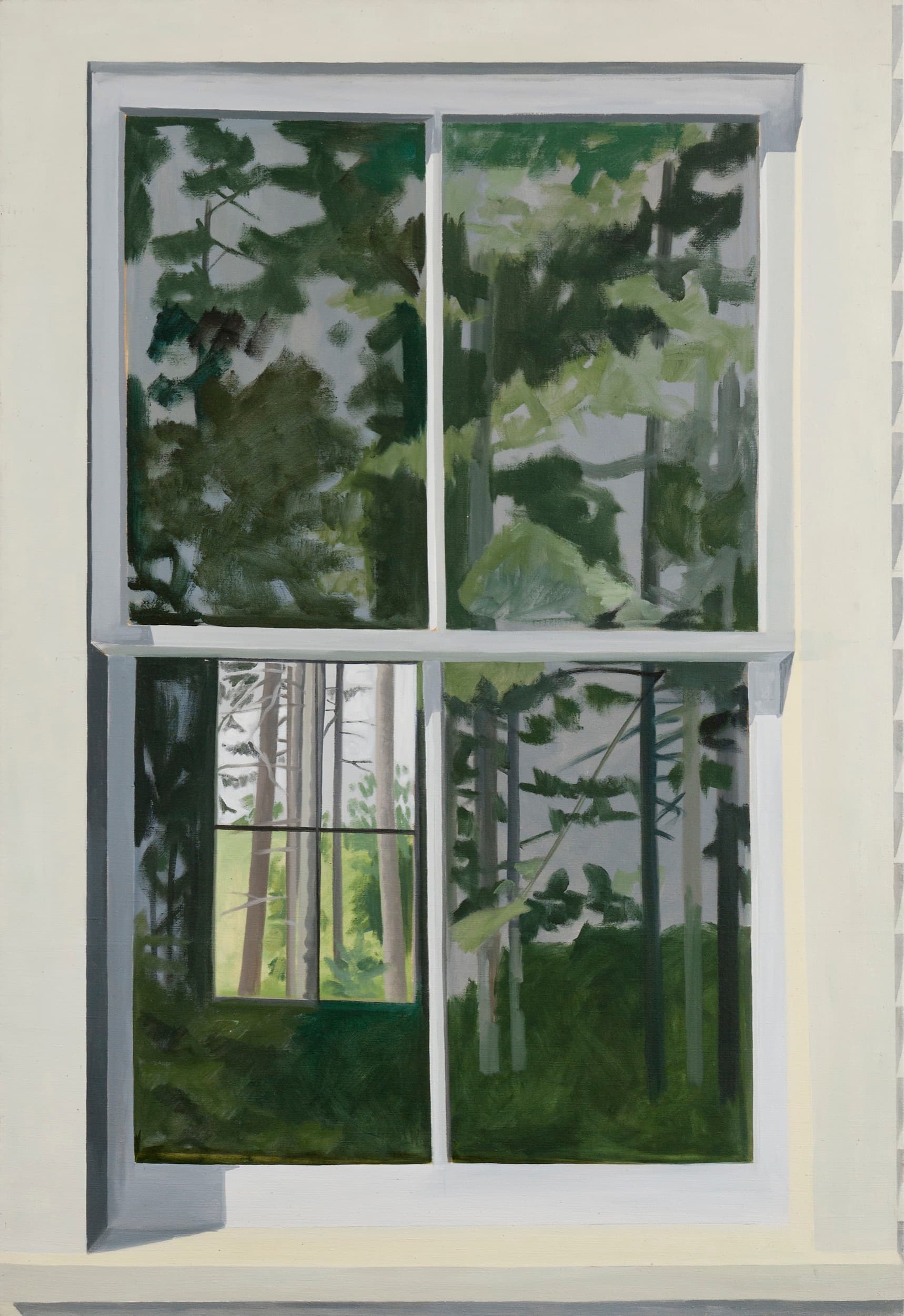
Lois Dodd, View Through Elliott’s Shack Looking South, 1971. Oil on linen, 53 × 36 inches. Museum of Modern Art, New York. © Lois Dodd. Courtesy Alexandre Gallery, New York.
Word count: 2744
Paragraphs: 13
Kunstmuseum Den Haag
August 30, 2025–April 6, 2026
The Hague, Netherlands
One night, in the nineties, after the Maine mosquito season had passed, Lois Dodd set out down the road from her house to make a painting. The moonlight was so strong that she could work without a flashlight, having memorized the configuration of pigments on her palette. Broad strokes of ochre, blue, and gray describe her view from the middle of the street: towering trees casting their shadows onto the spectral road rising up to meet a mirrored piece of sky. The resulting painting, Hathorne Point Road by Moonlight (1992–93), is now part of Framing the Ephemeral, a large survey of the artist’s work at the Kunstmuseum in The Hague. If it felt strange at first to encounter a retrospective of a contemporary American master in the Netherlands, examples of Jacob van Ruisdael, Johannes Vermeer, Jan van Huysum, Adriaen Coorte, Maria van Oosterwyck, and others at the Rijksmuseum and the Mauritshuis quickly reminded me of Dodd’s kinship with a deep tradition of looking not only at grand vistas, but also of depicting plant specimens, domestic interiors, and vernacular architecture. The exhibition’s curator, Louise Bjeldbak Henriksen, has hung several of the Kunstmuseum’s Piet Mondrians next to Dodd’s paintings, reasserting her engagement with modernism and reminding us of Mondrian’s deep roots in the landscape genre. In a recent interview, Dodd claimed that her “trees wouldn’t stand up unless they knew something about geometry.” Where the rigid structure of the window paintings offer an obvious comparison to the grid of Mondrian’s Neoplasticism, consider also a small 2008 painting of a plum tree, its bare limbs fracturing the yellow ground much like Mondrian’s trees a century earlier.

Lois Dodd, Hathorne Point Road by Moonlight, 1992–93. Oil on linen, 46 × 78 inches. © Lois Dodd. Courtesy Alexandre Gallery, New York.
Another Dutch masterpiece, Meindert Hobbema’s Avenue at Middelharnis (1689), with its sweeping, straight-on view buffeted by tufts of alder connecting road and sky, comes to mind when standing before Dodd’s night painting. Where Hobbema’s daylight avenue is a site of activity, with neat rows of tree trunks leading into town, Dodd’s nocturne is solitary, its shadows turning into dreamlike crenellations. In its extreme perspective and the chiseled notches of the dark firs, it recalls the flickering positive and negative shapes of Edgar Rubin’s vase illusion. Both paintings share a certain measured acceleration in their view down (or up) a path, like what John White describes so ecstatically in Masolino’s painted arcades at Castiglione d’Olona, where “space runs on … for sheer pleasure.” Pleasure in Dodd’s work derives equally from the surge of her visions and from the friction of translating them onto canvas; set alongside centuries of rigorous engagement with the landscape, the exhibition bolsters the sense of continual reinvention in her decades of plein air painting.

Lois Dodd, Blaisey’s Shacks, 2003. Oil on linen, 38 × 60 inches. © Lois Dodd. Courtesy Alexandre Gallery, New York.
Rather than present a chronological overview of an almost eighty-year career and trying to construct an evolution of styles decade-by-decade, Henriksen has grouped the exhibition’s rooms loosely by subject—night landscapes, interiors, forest views, etc. Prioritizing season and locale (be it the East Village, New Jersey, or the coast of Maine) suits the work, as does asserting the importance of its vantage points: looking out the window, at a reflection, or through the trees. The exhibition opens with a gallery devoted to winter scenes, dominated by careful modulations of gray that reveal the sun’s slanted advance across the land. In Blaisey’s Shacks (2003), Dodd sets down the sharp geometry of woodsheds against a field bleached pale by the brumal light. Diagonal shadows painted in quick strokes of steely green issue from those structures, creating the effect of grass matted with frost, yet untouched by the day’s warmth. In the background, chunks of barely-blue sky pierce through the foliage and overwhelm any detail in the dark branches, just as such high-contrast spots really would continually trouble the pupil on a sunny day. Notice the virtuoso efficiency of Dodd’s hand: how the sunlit grass is painted in sloping horizontal strokes of yellow, while the shadowed portions are built up of short, vertical marks, as if the temperature of matter itself were determining its texture in the eye. And while Dodd is a master realist, using minimal color to portray exactly the blinding oppositions of winter light, she is also a thoughtful composer, positioning her easel a couple degrees off of perpendicular with the rightmost shed to catch just a sliver of its illuminated front, and lining up the closest shed with the edge of the trees so that the vertical of its left edge is continued in the trunk of an evergreen a hundred yards beyond.

Lois Dodd, Water Gap, Ice Breaking, 1978. Oil on linen, 36 × 54 inches. © Lois Dodd. Courtesy Alexandre Gallery, New York.
As I made my way through the exhibition’s different galleries, passing from closely-cropped interiors to dense views of the garden, figure studies, and woodland scenes, I kept returning to the fourteen winter paintings, which spanned four decades. Every one of these works seemed to represent a different register in responding to the incongruities of each condition of light. Take two views of the Delaware Water Gap on the border of Pennsylvania and New Jersey, painted in the successive winters of 1978 and 1979. In the 1979 panel, Dodd zoomed in on Mt. Tammany as it slopes down to the Delaware. The morning sun casts everything in an even light, and the surface of the river is painted a bright white. The earlier canvas, roughly three times as large, takes a wider view from further upriver. Here, Dodd is more concerned with the contrasting textures that have been plunged into afternoon shadow, from the deep violets and ochres of the trees to the dense white of the snow-covered ice. Only at the top of the picture, high up on the ridge, does Dodd catch the last of the day’s light—ashy purples of bare trunks rising up and giving way to an orange glow. There is the sense that, unlike Claude Monet at Rouen, this sunset was not sought out, it was merely there. And, as the afternoon light projects the line of the southern ridge onto the mountain, and the zigzagging diagonals of the valley lead the eye into the foreground where ice fractures into its own smaller peaks and ridges, the picture takes on geological weight, describing millennia of erosion.

Lois Dodd, Spider Web with Clover and Grass, 2004. Oil on linen, 50 × 58 inches. © Lois Dodd. Courtesy Alexandre Gallery, New York.
Throughout the exhibition, the microcosmic-macrocosmic view of pictures like these abounds, not only when Dodd paints the walls of a quarry with blocky brushstrokes for instance, but also when Henriksen’s curatorial placements find visual affinities across the paintings. Purple rounds of globe thistle in a 1996 work mirror the shadowed moon in a lunar eclipse picture nearby, while the undulating reds and oranges of burning house paintings from 2007 recall the meandering marks of her early expressionist canvases. The more time spent with the exhibition’s roughly one hundred paintings, the more those morphological similarities begin to cut across subjects and seasons. A dewy spiderweb, for example, stretching out among clovers and tendrils of grass, begins to resemble the almost tentacular shape of a half-frozen pond, and the spiny center of a dried echinacea flower shares a likeness with rays of morning sunlight burning through fog.

Lois Dodd, 7 to 8 AM, Spring, 1968. Oil on Masonite, 16 × 16 inches. © Lois Dodd. Courtesy Alexandre Gallery, New York.
In 1952, having graduated from the Cooper Union and spent a year in Italy, Dodd co-founded the Tanager Gallery in the East Village, the first of a group of artist-run co-ops that would eventually settle on 10th Street. There, she was part of a robust downtown scene, right next to the studios of Willem de Kooning, Milton Resnick, Pat Passlof, and Philip Pearlstein. In the sixties, Dodd began making paintings from the windows of her loft on Second Street, which overlooked the New York Marble Cemetery and a men’s shelter on the Bowery. That view, of a long rectangle of grass butting up against the windowless backs of buildings, afforded her the opportunity to pare down her compositions to pure blocks of color, catching the momentary specificities of the raking light, sometimes interrupted by the foreshortened bar of the window sash. The process of looking both at and through something would continue to occupy Dodd. It wasn’t that she was unaffected by the artistic movements taking place during the fifties and sixties, but the primacy of her setup—planting the easel and tracking the light—always won out over any preconceived strategy. She turned her sights to interior views of the loft reflected in mirrors, and explored the coast of Maine, finding compositions in the windows and façades of neighbor’s houses and dilapidated shacks.

Lois Dodd, Pond, 1962. Oil on linen, 58 × 65 inches. © Lois Dodd. Courtesy Alexandre Gallery, New York.
She first traveled to Maine in 1951 with Bill King, Alex Katz, and Jean Cohen—all former Cooper Union classmates—renting a cottage near Skowhegan. Three years later, Dodd, Katz, and Cohen split the cost of a house in Lincolnville, and Dodd would return there to paint during the summers alongside a community that included Katz, Yvonne Jacquette, Rudy Burckhardt, and Neil Welliver. The Maine pictures of the late fifties and early sixties were painted indoors, in the former chicken house on the Lincolnville property, and were based on drawings of the surrounding landscape and its herds of cows and other animals made outdoors. Drawn lines on bare linen interspersed with thick patches of color (sometimes local, sometimes invented) dominate those early paintings. In Pond (1962), crisscrossing marks describing limbs, ripples, and swirls confuse the textures of water, sky, and foliage, so the entire canvas becomes a patchwork bounded by routes the eye took through the scene. It is perhaps the only painting in the exhibition that shows Dodd leaving room for air between elements; though firmly grounded in observation, it is one of her most abstract works.

Lois Dodd, Fallen Tree Section, 1980. Oil on linen, 60 × 40 inches. © Lois Dodd. Courtesy Alexandre Gallery, New York.
When, in 1963, Dodd sold her third of the Lincolnville house to Alex and Ada Katz to buy her own property further down the coast in Cushing, she began to take the paintings—on canvas or Masonite panels—directly outdoors. Art historian Faye Hirsch has tracked the output and pace of Dodd’s production through the mid-sixties, from only four paintings in 1962 to forty-six in 1967. In the ensuing decades, Dodd has maintained a staggering production while shuttling between Maine, Manhattan, and her Blairstown, NJ house. Her mythic resolve for plein air painting extends past even those moonlit episodes: when she used to paint large compositions in the woods over multiple days, she strapped canvases to the trunks of trees and covered them with plastic overnight, returning the next morning. She has often described the process of choosing a discrete section between tree trunks to fill in each day, a working method that Renaissance fresco masters might find familiar. It’s clear, in comparing her giant forest scenes to the panoramas of a painter like Rackstraw Downes, that Dodd’s vision has actually been concerned with division, finding disparate enclosures that can be filled in one at a time. Even if, in the early Pond, the paint handling is radically different from a painting two decades later, like Fallen Tree Section (1980), the method of seeing and composing is consistent: identifying and isolating the borders between things, and filling in distinct patches based on a deeply personal sense of what in image editing would be called tolerance, deviations in value crossing certain thresholds.

Lois Dodd, Green Towel, 1978. Oil on linen, 36 × 34 inches. © Lois Dodd. Courtesy Alexandre Gallery, New York.
Many of Dodd’s paintings of the seventies and eighties focus on two of her most recognizable motifs: window views observed straight on and laundry lines billowing against various backdrops. The laundry paintings allow for Dodd’s compositional sense to extend past the placement and cropping of her view. They are set up similar to still lifes, as in a 1979 canvas made when she drove up to Lincolnville, knowing the Katzes were away, to hang up two red sheets in front of the house’s bright yellow shingles. Often, the laundry takes on an anthropomorphic quality, as in the stiff green of a towel floating above the yard or the graceful reclining of yellow curtains in the wind. In one large composition, the gleaming white of a single bedsheet strung up at the edge of the woods, with the trees’ shadows moving across it like projections on a drive-in movie screen, becomes a midday drama. Where the flatness of the laundry’s fabrics might nod to the material conditions of painting as thin scrim of color, Dodd’s window pictures—their sashes and crossbars mirroring the wooden strainers holding the canvas taut—deal intensely with its ability to create depth and illusion. Dodd paints the windows life-size so that, when in front of the canvases, there is the sense that everything is seen at true scale, flickering between recognition and abstraction. The most complex of the window paintings, like View Through Elliott’s Shack Looking South (1971), create nesting-doll effects of layers of sight, from the exterior wall to the window itself, the reflections on its panes, the dark interior of the structure, and finally the view of trees out a window on the opposite wall. The viewer is looking both north and south at once thanks to Dodd’s painting. In an especially enigmatic picture, The Painted Room (1982), she has depicted her bedroom in Cushing, the walls of which are covered in a forest mural of her own making. This painting of a painting, interrupted by a lone lightbulb and a curtained window looking out onto the actual landscape, synthesizes so many of the painter’s different modes. It amounts to a picture not so much of ardor, but of steadfastness in a lifelong project becoming more and more entangled in its own focus. From the early Second Street paintings, when she started to include the edges of her loft windows, Dodd has always looked inward as well as outward. Her presence is evident in the brightly arranged laundry lines, mural-adorned bedroom walls, and in reflections and shadows of the painter herself.

Lois Dodd, Cow Parsnip, 1996. Oil on linen, 38 × 80 inches. Colby Museum of Art, Waterville, ME. © Lois Dodd. Courtesy Alexandre Gallery, New York.
In the nineties, the abundant plantings of her Maine neighbor, food writer Leslie Land, convinced Dodd to take her easel out into the garden after decades of avoiding flower paintings. In these, and in more recent depictions of solitary specimens—seedpods, pinecones—collected and brought indoors, Dodd’s brush is far from lush; instead, it picks apart the constituent geometries of plant life. In views of orange dahlias, echinacea, or jewelweed, Dodd brings us in close so that these flowering forms are seen at the scale that the pollinators, which buzz around the canvases, would experience. The purple orbs of a patch of globe thistle seem to float like alien planets or fuzzy bacteria in a green miasma. A close-up view of cow parsnip is especially cinematic, with a lone moth perching on one of its white umbels. Dodd simplifies some of those blooms into half-moons, while others are more resolved, each flower a bright daub against the green, and the explosion of stalks in the central inflorescence in vivid focus. Dodd’s fidelity to the natural world is second only to the care with which she observes herself observing; those layers of spherical resolution and blur become analogs to the eye’s own mechanisms. Her handling of paint—especially in the later work—with its broad swathes of color bounded by frankly described edges, might allow the viewer a modicum of the intensity of her vision, an experience punctuated by vitreous moments of clarity. In a painting from 2025, a pinecone placed on a windowsill plays a game of recognition with its own shadow. From our vantage point the cone’s scales are slightly flattened, yet they appear jagged in the umbral projection, their diagonals guiding the eye back into the composition, through the window. The pinecone recalls a number of Hans Memling portraits, where the sitters’ hands rest on sills painted to mimic the bevel of the frame, bridging the gap with the viewer for a moment.

Lois Dodd, Steamed Window, 1980. Oil on linen, 36 × 28 inches. © Lois Dodd. Courtesy Alexandre Gallery, New York.
At The Hague, I kept gravitating to a 1980 painting—another window, seen from inside, slightly askew. The four panes are foggy with winter condensation, creating amorphous, opaque areas against the pale scene outside. Unlike the straight-on canvases of the same period, this window has its top and bottom cropped off, as if the image has been caught in passing, or even in looking slightly back over the shoulder on the way to somewhere else. The view, for Dodd, was clearly worth lingering on. Was the shower running? Was a pot of water on? Were they abandoned to make this picture? Again and again, Dodd stands at a threshold, making sense of vapor or sunbeams. She reminds us that paint, like the interior of our eyes, is liquid.
Louis Block is a painter based in Brooklyn.