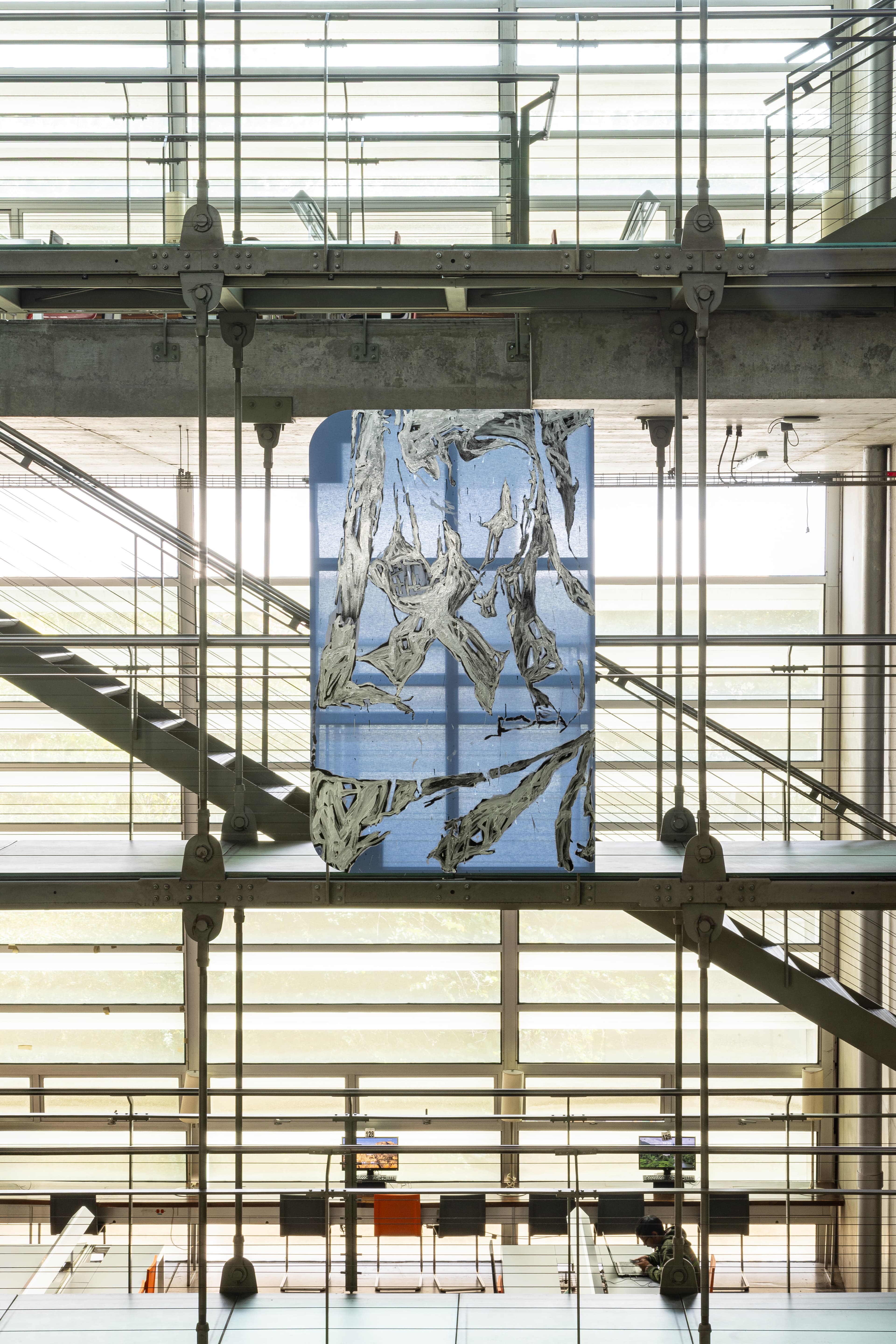
Installation view: Louis Jacquot: Tántalo, Biblioteca Vasconcelos, Mexico City, 2026. Photo: Gerardo Landa Rojano. Courtesy Villa Magdalena.
Word count: 920
Paragraphs: 7
Biblioteca Vasconcelos
January 31–March 1, 2026
Mexico City
Friedrich Nietzsche said that “the scholarly person is a genuine paradox: all around he is faced with the most horrible problems, he strolls past abysses and he picks a flower in order to count its filaments.” He knew that knowledge was an invoking force, something with a dark center and a gravitational pull to it that was capable of destroying our appreciation for reality as it is. Beset on all sides by this abyss, the painter Louis Jacquot, for his exhibition Tántalo at the Biblioteca Vasconcelos in Mexico City, has suspended his works within the floating racks and aisles of the library. The institution’s dramatic design makes the weight of knowledge and the text that conveys it feel unbound and infinite, an opportunity that the gallerist Cy Schnabel recognized for the artist, arranging for Jacquot’s paintings to be zip-tied to the bannisters and floating racks, hidden and dispersed throughout the labyrinthine complex. Jacquot has hung them in a way that you are never able to see more than four of the twenty paintings at a time. Instead, you are forced to roam to find the vantage points that allow you to see the exhibition through oblique corridors and angles. The search itself is a perfect pairing, a physical metonym that makes explicit the parallels between the networks of information that Jacquot distributes across painting with the archive of information that the physical space of the library represents, the physical corridors approximating Jacquot’s paintings’ ability to process and fragment cultural mnemosyne.

Installation view: Louis Jacquot: Tántalo, Biblioteca Vasconcelos, Mexico City, 2026. Photo: Gerardo Landa Rojano. Courtesy Villa Magdalena.

Installation view: Louis Jacquot: Tántalo, Biblioteca Vasconcelos, Mexico City, 2026. Photo: Gerardo Landa Rojano. Courtesy Villa Magdalena.
The paintings are roughly the size of a body. Their soft-cornered edges mimic the shape of Jacquot’s Moleskine notebook pages. Jacquot doesn’t apply their soft blue color but instead sources the material from French fabric stores. Both of these decisions fix the paintings within the context of readymades, as Jacquot chose to annotate a cultural signifier of color and material over personal expression. This sets up the paintings as direct and relational to cultural signification and, with the golden ratio of the Moleskine, presents each painting as chapters or hyperlinks. But they are not just archival semiotics because of their material and the way that Jacquot layers resin and reflective paint onto the soft blue of the fabric. The paintings shift dramatically over the course of the day. At times, they warm up from the cross-light of the late-afternoon sun. At others, they become translucent, or fully opaque and dark. Depending on your angle to them, they eclipse into dark objects, or they reflect your image as you walk past them. Each experience is unique.
Jacquot works in series—a painter interested in paintings’ ability to be implicated with networks and systems of knowledge, recalling what David Joselit contextualized in “Painting Beside Itself” as transitive painting—painting that acknowledges and is generated from the context of its circulation and interpretation. Jacquot approaches painting through the systems it can generate, a non-language that is adjacent to language in its formations of networks. The paintings don’t aestheticize knowledge but instead keep information and our access to ideas at a distance and within the realm of abstraction. For Jacquot, this means annotating inaccessible bibliographies. Painting for Jacquot is, unavoidably, an act of poetic mistranslation. The systems are broken links that originate an excess of sensuous misdirection. In some cases, the references lead back to themselves. In the works Ximena, Mirela, Soren and Elias (all 2026), Jacquot mirrors the same image, reflecting or copying each movement twice so that they index the others’ negative.
Jean-François Lyotard referred to the element of painting that cannot be understood or articulated in language—the inexpressable. It came from his belief that we can never truly share the same experience of a painting. Our eyes begin in different places. Our bodies and sight lines approach from different angles. At best, we can perceive our own vantage and try to close the gap through inadequate language. Jacquot’s exhibition makes this realization into a perceptible drama. The experience of seeing works during the cool light of the morning or the warmer light of the afternoon makes paintings flicker in and out of being noticed.

Installation view: Louis Jacquot: Tántalo, Biblioteca Vasconcelos, Mexico City, 2026. Photo: Gerardo Landa Rojano. Courtesy Villa Magdalena.
Jacquot is engaged in the painting of the morphological images, as what Aby Warburg might refer to as the psycho-historian, which saw images as a series of translations through culture. Jacquot applies this morphology to the density of the library’s knowledge, obscuring images into abstraction and oblivion so that they exist as forces of light and shadow. The paintings of these deferred images create a strobe-sense, a flickering of our perception with them that mimics the aleatory nature of us grasping at information in an increasingly screen-based world. There is a lingering sadness to the exhibition, an intimation that both paintings and the physical representation of libraries are the holdouts to an increasingly immaterial world. Tantalus was the Greek son of Zeus who was punished by being made to stand chin deep in a lake of water, going hungry and thirsty while surrounded by food and drink. The paintings utilize the images of the library while surrounded by its information, but taking it further, the title of the exhibition might suggest that painting is surrounded by knowledge without ever being able to adequately relay it. Painting is not a language, or a medium that passes along information. Instead, the more it attempts such things, the more it gets caught up in its own forms of intelligence and mystery.
Andrew Paul Woolbright is an artist, gallerist, and Editor-at-Large at the Brooklyn Rail, living and working in Brooklyn, NY. Woolbright is an MFA graduate from the Rhode Island School of Design in painting and is the director of the Lower East Side gallery Below Grand. He currently teaches at Pratt and School of Visual Arts in New York.