Sol LeWitt: Works from the 1960s
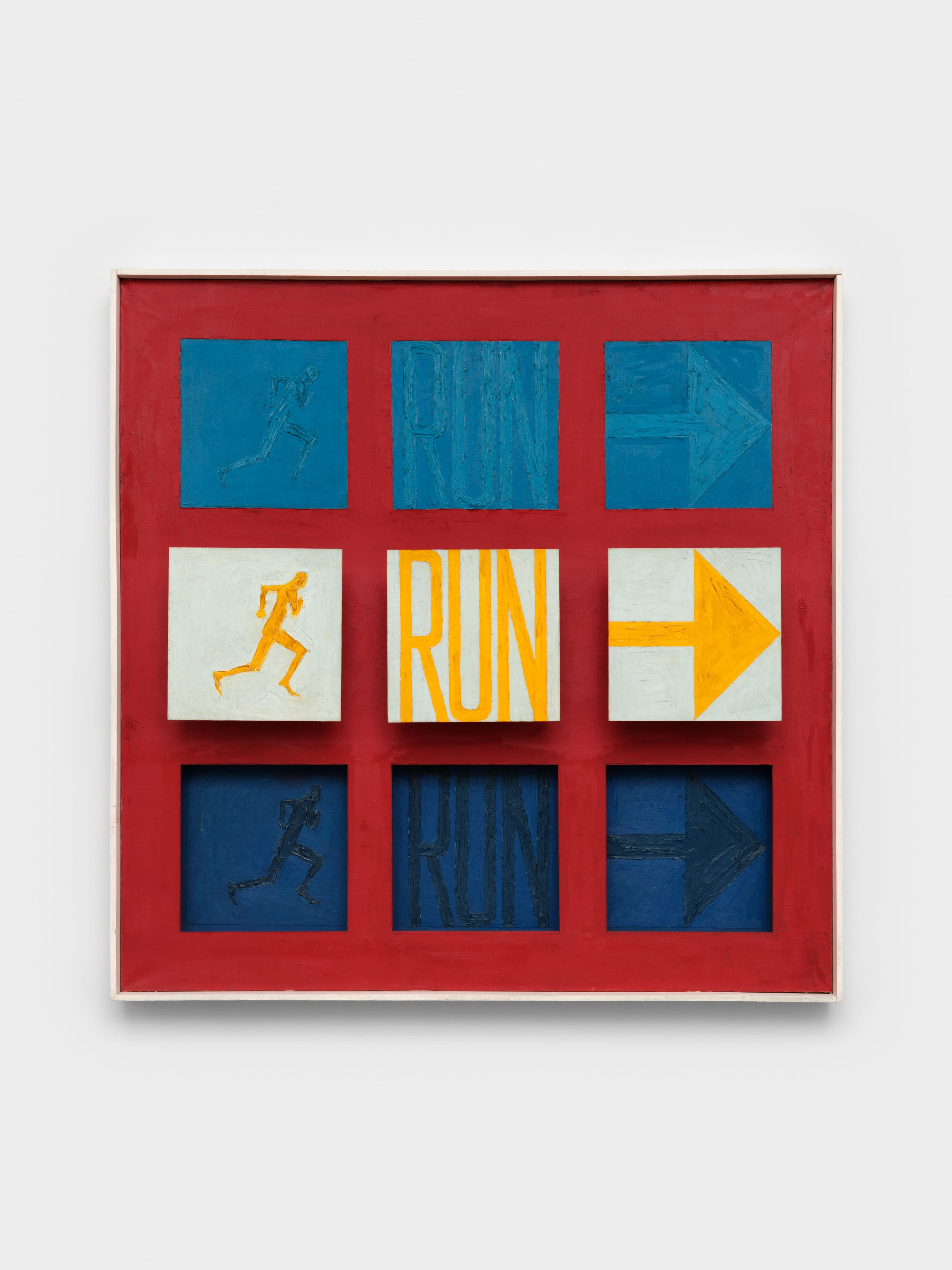
Sol LeWitt, Run I, 1962. Oil on canvas, painted wood, 61 x 61 x 8 inches. © 2026 The LeWitt Estate / Artists Rights Society (ARS), New York. Courtesy Paula Cooper Gallery, New York. Photo: Steven Probert.
Word count: 776
Paragraphs: 10
Paula Cooper Gallery
January 15–February 28, 2026
New York
A cabinet of curiosities? Trial and error? A retrospective of a practice TBD?
Knowing what we know now of Sol LeWitt’s career affects our reading of an exhibition in this instance. Sol LeWitt: Works from the 1960s, an exhibition meant to share a miscellany of his early works, is given a narrative of studio practice in the act of clarifying itself. So we engage the nature of a practice that is a function of striving to accomplish art—art answerable to a salient modernity, if not quite yet.
These pieces occupy the space of painting and sculpture. Or, putting it another way, the works are still seeking an identity that divests itself of painting and sculpture as fine art, to a structural limit that is indeed definitive.

Sol LeWitt, Floor Structure (“Well”), 1963/1964. Painted wood, 52 ¼ x 24 x 24 inches. © 2026 The LeWitt Estate / Artists Rights Society (ARS), New York. Courtesy Paula Cooper Gallery, New York. Photo: Steven Probert.
Organized to present and educate at once, the exhibition moves away from a painterly practice to demonstrations of painting. Specifically, for Run I (1962), composition is restricted, deriving from a uniform division of the surface into a grid of soured primaries. Through mediation, LeWitt has swapped out canvas and swapped in a relief fabricated of wood. Surface is made to be read in materially discrete terms: a compilation of several surfaces, each a fact. The mechanics of making is DIY. And to this roughly-built neutrality is an idiosyncratic application of a word “RUN” and a glyph—an arrow—fragments isolated from simple signage or commercial art, amalgamated rather than integrated into the fabricated thing. Trying for sequential moves, LeWitt is also working on how to isolate decision making, each as a discrete stage of fabrication.
Certain givens from the milieu of the sixties leave their traces inscribed also in RUN II (1962): the mechanics of the stencil, the page mark-up for the commercial magazine as co-equal to ”art” drawing. Yet certainly not incidental is the modernist genealogy of such: graphic arts borrowing a vocabulary from early in the century as inscribed in Cubist and Constructivist flat work and prominent in synoptic pictorial samplings from the thirties on, presupposed, if assiduously avoided here. For instance, think of the art of Joaquín Torres-García: paintings attaining an archaic modernity, compartmentalized and schematic, rudimentary in their graphic delineation of basic signs. Rather LeWitt is after something eluding him.
LeWitt inherits the cosmopolitan nature of modernity yet is an apprentice to its consequence. How to extricate a zone for working on his own terms is the real subject of the exhibition here. Wall reliefs, stripped of color as an art of any kind and calculated to impose themselves as such, take a decided step toward LeWitt’s independence. With its entirely clarified planarity throughout in dimensions of surface, height, and depth, Wall Structure, White (1962) is much more resolved: no longer a practice piece, it is a real thought form. Meanwhile, the studio practice continues to bring hypothetical solutions into actual space. Floor Structure (“Well”) (1963/1964) proposes the precursor of the lattice. Here are four embedded grilles to be viewed while looking down into the tall yellow interior of a walled volume. The implication of this buried “well” is structural, for to limit the vantage is to define the relevant spatiality. No limitless horizon dissipates this set of controlled relations.

Sol LeWitt, Modular Cube, 1966, remade 1999. Painted wood, 72 x 72 x 72 inches. © 2026 The LeWitt Estate / Artists Rights Society (ARS), New York. Courtesy Paula Cooper Gallery, New York. Photo: Steven Probert.
Sol LeWitt: Works from the 1960s culminates in definitive works that epitomize the sense of a studio practice LeWitt had undergone and transmuted to strategic perfection. Listed as untitled at the time curator Kynaston McShine chose it for his Primary Structures show at the Jewish Museum, Modular Cube (1966) has since acquired a descriptive title that directs intention—an intention to objectify sequences where agglomerative objects had been. To this end, by enlisting craft, the overall concept can be attained even from partial views of the open cube repeated, with controlled expansion as an instrumentality to realize temporality, in no small measure thanks to Kazuko Miyamoto for this 1999 reconstruction. Modular Wall Piece with Cube (1965—on view as reconstructed in 1977) is definitive as a material iteration paradoxically owing to its craft as sufficient to the conceptualization sustained.
Such is also the attainment in LeWitt’s wall drawing, for a grammar at its peak in the presentations at Paula Cooper and Dwan galleries long ago. Recreated for this exhibition is Wall Drawing #12A: Drawing Series I 1 (A and B) and III 1 (A and B) (color), a work conceived in 1969 and completed 1998. That same ordering principle of permutation and combination having been posited, then executed, was invaluable to the palpable realization, bringing Sol LeWitt's practice into alignment with the laboratory of European avant-garde serial systems.
Marjorie Welish is an artist and writer. Welish’s recent art exhibitions have occurred at Art-3, Brooklyn, Emanuel von Baeyer Cabinet, London, and La Terrasse, Nanterre. A presentation on her Fulbright occurred at Edinburgh College of Art.