Talisman
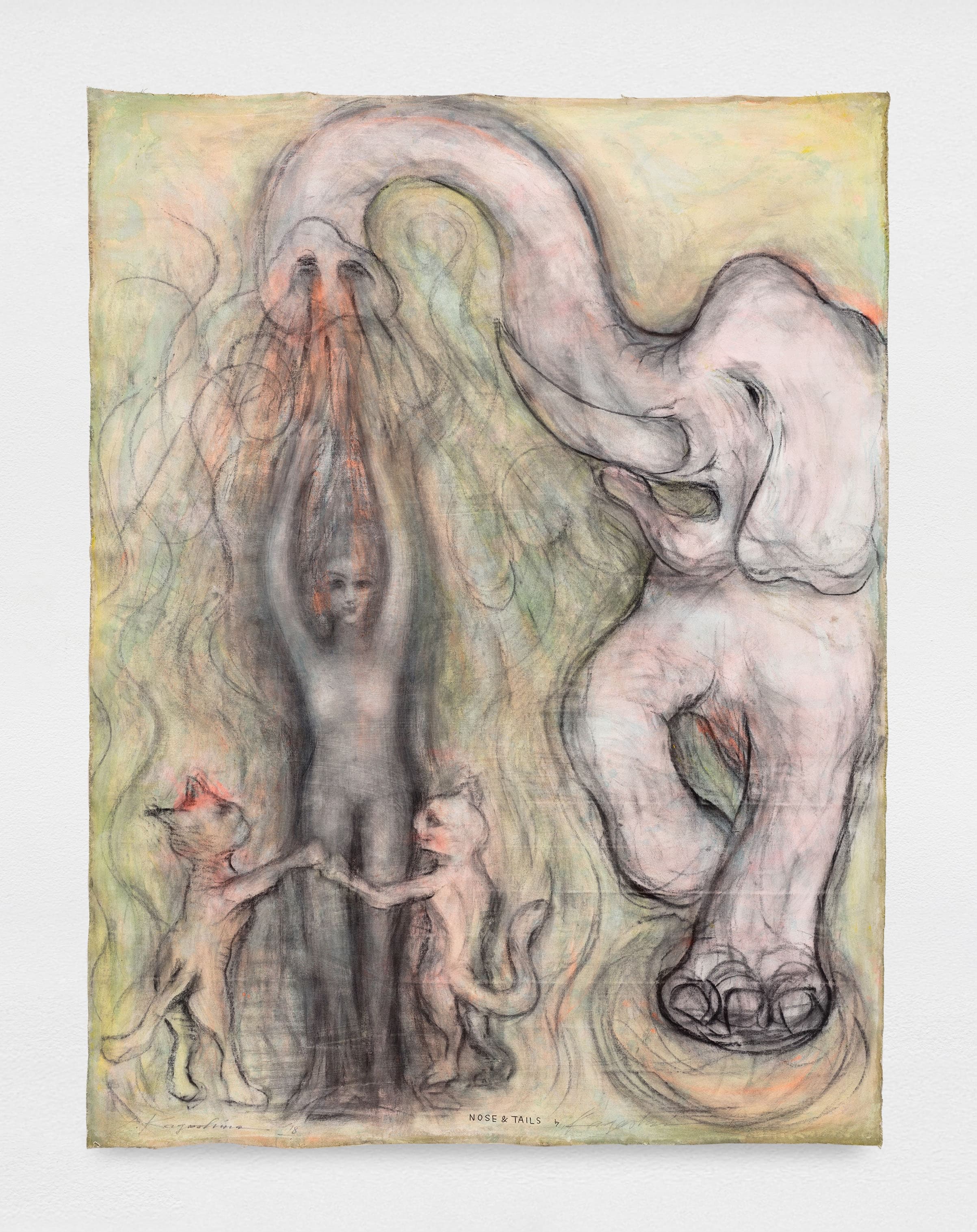
E’wao Kagoshima, Nose & Tails, 2018. Acrylic on canvas, 80 x 60 ½ inches. Courtesy the artist and YveYANG Gallery.
Word count: 882
Paragraphs: 9
YveYANG
January 9–March 7, 2026
New York
Can art still enchant? Curated by Hindley Wang, Talisman approaches the enchantment of art not as a solution to our general paralysis today, but as its very paradox of consumption and devotion. At YveYANG, this show enlists a few heavy hitters—Kiki Smith, Martin Wong—as well as a handful of emerging stars—Oliver Bak, Heidi Lau, Pauline Rintsch—in a dynamic and unexpecting sensorium seeped in spiritualism, myth, personal belief, and reification of desire.
E’wao Kagoshima’s whimsical painting hangs in a discreet alcove upon entry. As if done in a sweep, figures on Nose & Tails (2018) are entangled in gestural marks that push the rough edges of a loose canvas: a woman raises her arms high, appearing at once in an ascent into the trunk of a laughing elephant or a shower under its enchanted vapors. Beneath her knees, two anthropomorphic cats dance in a circle, oscillating between states of worship and hostage.
Through the corridor, Ker-Xavier Roussel’s Pastorale (ca. 1900) lends the show a distinct historical depth, yet is strikingly consonant in present. Here, the Nabi master abolishes linear perspective in favor of a radically flat monochrome for its time, which would become a prototype to the course of contemporary painting today. The green, idyllic oasis sees a seated young man in the center with his back turned to the viewer, entertaining a nude maiden reclining on a verdant hillside. The figure likely alludes to the ancient Greek god of the wild, Pan, who created his flute from the reeds that the wood nymph Syrinx transforms into in escape of his pursuit. Yet the flute, as the symbol of desire which later took on the function of animating the wild, was never explicitly painted by Roussel. Its absence, marked by a peculiar trace of removal, stages the talismanic as something that operates beyond material presence.
On both sides of Pastorale, three seemingly inconspicuous snails crawl across the otherwise bare walls. Collectively titled Wives and Mistresses (2019), these bronze miniatures by Kiki Smith are cast with astonishing detail: from the delicately extended feelers to the spiral ridges etched into the shells. Their placement animates the vivid green field in Roussel’s painting, as if they were on the verge of slipping into the mythic world Roussel conjured.

Wang Ye, The Cavities, 2025. Handmade silk embroidery, 29 ½ x 25 ⅝ inches (framed). Courtesy the artist and YveYANG Gallery.
As mythical sources crystallize into different forms of residue, flatness slips into illusions. Wang Ye’s embroidery “painting,” The Cavities (2025), magnifies a section of a queen sago palm with lustrous, delicate red silk, which turns the vegetal pattern to mimic anatomical structure, like a skinned rib cage. Alastair MacKinven’s hazy, ethereal brushstrokes depict the head of a fallen man who seems to be trapped in an endless dream, as a spider has quietly begun spinning webs on his face. Across the room, Oliver Bak’s phantasmagoric dancers emerge from a darkness sedimented with layers of wax and dabs of paint that seem to glimmer. Heidi Lau’s Humming From Within The Void (2023) evokes a wind instrument through cavernous structures in nocturnal and metallic glaze. Installed in sections like vertebrae—the ceramic rises into a fantastical grotto atop the supporting wall, as if unearthed from a depth of colonial ruins with no explicit symbolic referent, whispering on the verge of obsolescence.
Smaller works by three artists are placed on different levels on the walls beside the entry, like notes on a music scale: Martin Wong’s scriptures detail his surrealist urban imaginings from the late 1960s, whose taut forms seem to sketch a skyline. MacKinven’s colored pencil drawings of sleep paralysis in dreamscapes bear similar emotional textures as his paintings. At the lowest level sits Pauline Rintsch’s emblematic Untitled (facing the fears) (2025). Immersed in dim, stifling tones, five eerily red-tinged fingers clutch the top of a head whose eyes are wide open, their murky whites exposed, gazing upwards. Through the fingers runs its dampened hair, inducing a suffocating tension, an inescapability caught in willful surrender.

R.H. Quaytman, The Hieroglyphic, Chapter 0.4, 2025. Distemper, silkscreen ink, gesso on wood, 20 x 20 inches. Courtesy the artist and YveYANG Gallery.
The back room is exposed with its industrial backbones that add charm to display. Martin Wong’s Tibetan Painting (1972) fixes the central wall with iconoclast mischief. On the floor sits Kiki Smith’s Minou (2022), a crouching cat in bronze. Behind it, Anna-Maria Škroba offers an echo with the painting my favorite soft contrast (2024), unexpectedly revealing another feline figure, opaque like a negative. The edge of this cloud of opacity bleeds into the rough white background like fur, conducive to an almost magical sense of warmth. Beside the playful pairing of the cats, a more somber dialogue unfolds. The weeping face in Raphaela Simon’s Rain (2024) hangs across from the tilted extraction of Queen Elizabeth I’s head in R.H. Quaytman’s The Hieroglyphic, Chapter 0.4 (2025). While Simon’s expressionistic brushwork pours silent despair out of a blue totemic profile, Quaytman’s work performs an austere withholding behind the currency of the Queen’s face. Screen printed like a mask, the famous three-quarter view of the queen is interrupted by a tear-shaped razor in dark crimson, whose sharp position recalls a guillotine. Amidst this pictorial metaphor of beheading, the virgin queen’s indifferent, impassive expression attests to a sobriety in the aftermath of history, while her tokenized representation breaks the spell of any illusions, yet breeds a new order of mystery under the artist’s hand.
Lucie Ai is an art historian and writer from Beijing, China, currently based in New York.