Four Prose Poems
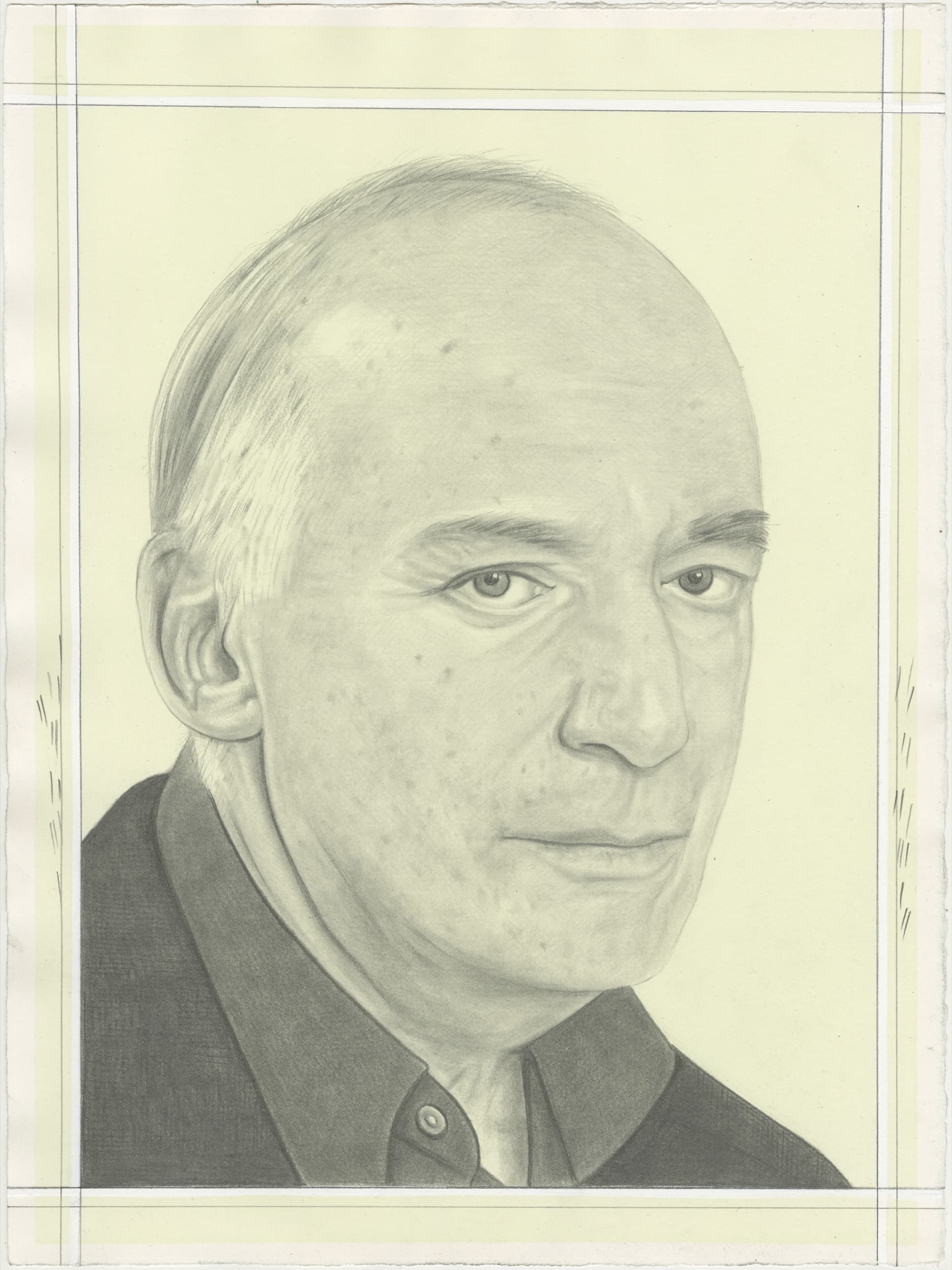
Portrait of Michael Fried, pencil on paper by Phong H. Bui.
Word count: 1028
Paragraphs: 27
Art Critic at Work
I imagine him writing the Salon of 1846 in a café,
or several cafés. Over countless cups of black coffee,
with now and then a glass of wine—but he has to be
careful, this will be no casual piece of journalism, his
intentions aim much higher. His instrument is a simple
pen, made of wood with a metal nib which he continually
dips into a small inkbottle that he brought
with him and will take away when he leaves. Writing
and scratching out, writing and scratching out.
Consulting the small Salon livret, and perhaps some
sketches made by him at the exhibition that have not
survived. Remember, too, I tell my students: although
he is twenty-five he has never spent a day in graduate
school, no fellowship supports him, he is fully on his
own in an unforgiving city, though he himself can’t
quite believe that, hence his continual dunning of his
mother. Which will not end well. But right now his
maternal fixation isn’t important; what is important
is the working out of a few favorite ideas, starting
with the thought, which delights him because it is
paradoxical, that when one first sees a truly first-rate
painting it is already part of one’s storehouse of memories
(repertoire des souvenirs). How can that be? He
doesn’t say but he drops clues. And he is haunted
by a pensée about force and justice by the profound
Pascal that will one day become notorious, the basic
terms of which he is artfully dispersing throughout
the pages rapidly stacking up as he proceeds. Politics,
too, is on his mind, we are nearing 1848, and shortly
after that Louis Napoleon’s coup, which will leave
his generation of superstars shipwrecked and cynical.
Art criticism—it’s a marvelous genre, he muses,
almost formless but allowing, indeed encouraging,
outbursts of praise (Delacroix!) along with eruptions
of scorn (Horace Vernet!), but at the same time lending
itself, if one has genius (Diderot!), to philosophical
excursions of the highest originality. By the end
of the Salon even Balzac will not be out of reach.
Years later he will repudiate the present text without
mentioning it by name, on the grounds of turning
away from what he will call “systems”. No doubt
from his point of view he will be right to do so. But
for someone like myself, who has practiced the genre,
Baudelaire’s Salon of 1846 remains unapproachable,
or rather approachable only in the proper frame of
mind—awe mixed with envy (ratio one to one).
(pp. 19–20)
Two Horses
At the Metropolitan Museum of Art, a large relief
in granite of two horses by the American sculptor
Charles Ray. In a room of its own. The horses are
standing quietly, facing to the left. There is no context,
no ground plane, no horizon—just the two horses.
The carving, executed by a computerized drilling
machine keyed to a full-scale clay model, is strikingly
shallow, especially as regards the second horse, which
appears barely present in comparison with the first.
The granite itself is streaked with what Ray beautifully
describes as “white turbulence that flows softly
through the stone”. I’m not the only viewer to be held
entranced by the relief for half an hour at a stretch;
the question is why, and what I find myself thinking,
without knowing exactly what this means, is that
the relief is the antithesis of a fossil. That is to say
(doing my best to unpack the thought) that the horses
are not images, much less remains, of creatures
that lived in an earlier epoch and are now preserved
in stone. Rather, they are a vision of futurity on the
part of the granite, an imagination of living forms
not yet in existence, the second horse still resolving
into dreamlike visibility, the implication being that
it will take millennia upon millennia before he fully
joins his companion. All this in inspired anticipation
of actual horses to come.
(p.83)
Trust
Louis Marin (b. 1931), the future philosopher and
semiotician, is thirteen years old and is crossing a
central square in Grenoble when suddenly dozens
of German soldiers appear from all sides, forming a
ring around him and his concitoyens. This happens
very quickly, whistles are blown, rifles are held at the
ready, dogs strain at their leashes, no explanation is
forthcoming but there are closed vehicles, Black Marias,
pulling up and everyone understands that they
are to be taken somewhere for questioning, no one
knows why. Louis is terrified, how could he not be,
but then he notices that one of the soldiers, an older
man, is beckoning to him and in fact is gesturing
toward his, the soldier’s, booted legs, which are wide
apart. Louis realizes that the soldier is inviting him
to come close and then to duck out of the encircling
ring, which he does, scarcely daring to believe his
luck. The experience never leaves him, as becomes
clear when he relates it to me forty years later. It’s
a gripping story, one that goes a long way toward
explaining Louis’s wholesale trust in human nature,
which for the most part does him no harm but now
and then proves his undoing.
(p. 176)
Caro’s Camel
A short time after Tony Caro died in October 2013 at
the age of 89 (all of us who knew him counted on his
reaching 100) his widow, the painter Sheila Girling,
got in touch to say that Tony would have wanted
me to have a last work by him and to what address
should she have it sent. When it arrived it turned
out to be a framed charcoal-and-soft-lead drawing
of a camel with two humps, signed “A. Caro 2013”.
Obviously done sur le vif. I was touched, naturally,
but also puzzled—what was the story behind this unexpected
gift? I asked Sheila, who replied: “Tony’s
animal drawings were some of the last he did. He decided
he would love to draw camels at the zoo and he
went with a few people from the studio who pushed
him in a wheelchair. We planned to go again in the
autumn but it was not to be”. Earlier that year Caro
had exhibited a dozen monumental abstract steel
sculptures, the stupendous Park Avenue Series, one
of the crowning achievements of his life, at Gagosian
in London; in his Camden Town studio at the time
of his death he was completing another series of abstract
pieces using colored Perspex. All works of the
highest imaginative power. And he found in himself
the impulse to draw camels.
(p. 313)
All prose poems from Michael Fried, Collected Writings, Vol. II, The Edge of the Table, Eris/Columbia University Press (February 2026).
Michael Fried is Professor Emeritus of the Humanities at Johns Hopkins University. He is the author of numerous scholarly works—most recently What Was Literary Impressionism?, Painting with Demons: The Art of Gerolamo Savoldo, and French Suite: A Book of Essays—and four volumes of poetry.