
Word count: 1786
Paragraphs: 8
On View
Gladstone GalleryTo Be Other-Wise
May 2 – June 15, 2024
New York
Abstract painters will generally tell you that they cannot explain how they know when a painting is finished. That reflects less on the painters than on the premise itself, which is flawed. Finish is a question of increasingly miniscule degrees, a slowing of momentum. It is sometimes necessary to take a painting further and further into the weeds, covering layer after layer with discordant moves, building up something that, even if it lacks cohesion, is testament to the time spent working at its muck. The hard part is seizing on a moment in that uncertainty where an endgame seems visible; it requires covering up darling sections that have survived too many layers or adding in a new element recklessly opposed to the program. Ask about the moment when it becomes clear a painting could be finished. It’s like finally wrestling your finger into the heart of a too-tight knot, looping it around a strand, and pulling with confidence. A measure of painting’s success could be the stakes it achieves at that crucial moment.
Amy Sillman, who describes abstract painters as “doomed to work in between hoping and groping,” has provided the premier example of how far a painting can be pushed and brought back; her canvases teem with stop-and-start traces, film-still swipes of action, and veils of limbs bending time like metastatic clock faces. The stakes of abstraction, of “lumpen form,” as Sillman has written, can have to do with “body politics” and “care and repair,” or with “merely try[ing] to beam out an electrifyingly personal and strange signal that wakes up the receiver for a moment—one weird moment that could shift the sense of things.” Strange and weird point to the unknown, and to the simple paradox that a painting is something you make because you’ve never seen it before. So what happens in finishing is a fastening of the mind’s kernel to the pulp of this world.
I remember Sillman’s 2020 show in the same galleries, which embraced erasure as a finishing move in acrylic and ink canvases paired with studies of blooming flowers, and how the oils used halted horizontal stripes to complicate form much like the mottled interior of the tiger lily. Or her 2016 show at Sikkema Jenkins, which had paintings full of growths and appendages getting swallowed and spit out. Sillman prefers “metabolism” to “style,” and in her essay “Notes on Awkwardness” describes the former as “the intimate and discomforting process of things changing as they go awry, look uncomfortable, have to be confronted, repaired, or risked, i.e., the process of trying to figure something out while doing it.” In this kind of painting—intensely bodily rather than architectonic—every embellishment is a gauze to the layer beneath. “Finding a form is building these feelings (in this case, dissatisfaction, embarrassment, and doubt) into a substance.” Doubt may be the most elusive and useful of these emotions in building substance; unlike shame, it stifles and paralyzes, letting sediment stubbornly hold on too long. But in Sillman’s paintings, that standstill moment at the end of all the accretion has always been countered with a risk or a wager, a move that brings the composition to a definite resting state, however uneasy or awkward it may look.

These new paintings, though, continuously absorb and deflect the eye around their fractious structures. It is as if Sillman has placed an increasing trust in doubt as a compositional engine, letting the marks build up until they have no choice but to overwhelm the senses in a way that feels like composition. To generalize, they take each border as an invitation to improvise, deploying color, texture, direction, and speed as markers of difference. While each difference itself then constitutes a border, the paintings are far from fractal; they instead build into knots with painterly bursts slipping out of temporal place, so that the eye has no choice but to try and unravel their facture. It is both what makes them so engaging up close and prevents me from standing back and taking them in at once. To take just one jagged edge of a canvas and try to figure out the order in which paint was applied is almost an impossible task—in Clownette (2024), for example, there is an underlying texture of drips and scrapes that has been covered by a thin layer of red and blue, and then dry vertical strokes of white that catch the initial texture. Between those layers are wet strokes of different blues and reds that are smeared inconsistently by the thick white, and sometimes cancel out the underlying opacity, as if they had been individually applied, at a granular level, mid-brushstroke. It is a trick having to do with the overload of chromatic and textural information—one that I do not fully understand—but in front of the canvas, I had the impression that this volatile substance had been manipulated like the latticed crust of a pie. The same is true for the frenzied surface of The Banana Tree (2023), which fractures like some combination of Duchamp’s Nude Descending a Staircase and morning light streaming through venetian blinds. The entire picture plane is invaded by curved strokes of black and gray—perhaps overripe peels of the titular fruit, or a regiment of apostrophes lifted off the page. They could also read as notations of creases and folds in flesh, and in their disruptive relation to the speed of the blurred layers below, they concretize the slapstick inherent in the picture, like skid marks of a parallel park attempted at irresponsible speeds.
Sillman’s work is inherently funny. Some of the pieces on paper here have tottering letters that read “ugh.” Multiple canvases have thin, blotted sections of paint that still bear the quilted imprint of Bounty paper towels. One of her signature animations in the gallery’s lobby displays shifting screens of isolated brushstrokes and stages of paintings set to comedic sound effects. There is an increasing tendency toward patterning, which sometimes veers toward the harlequinesque. It is all a very sober comedy—no wonder she has written on Franz Kafka, Carroll Dunham, Rachel Harrison, and Philip Guston. Of Guston’s self-image, she wrote something supremely prescient: “Doubt regenerates him.” It is hard, too, to not think of Kafka’s hunger artist withering away into a pile of straw in his cage, when faced with a painting like Sillman’s Ravenna (2024), which is basically a procession of upright curves waltzing and winnowing across the canvas, a ghostly hand grasping out and catching its own skeleton; or Albatross 1 (2024), in which the seabird is neither predator nor trophy, instead a limp adornment on a pile of vague and roughly animal slabs.
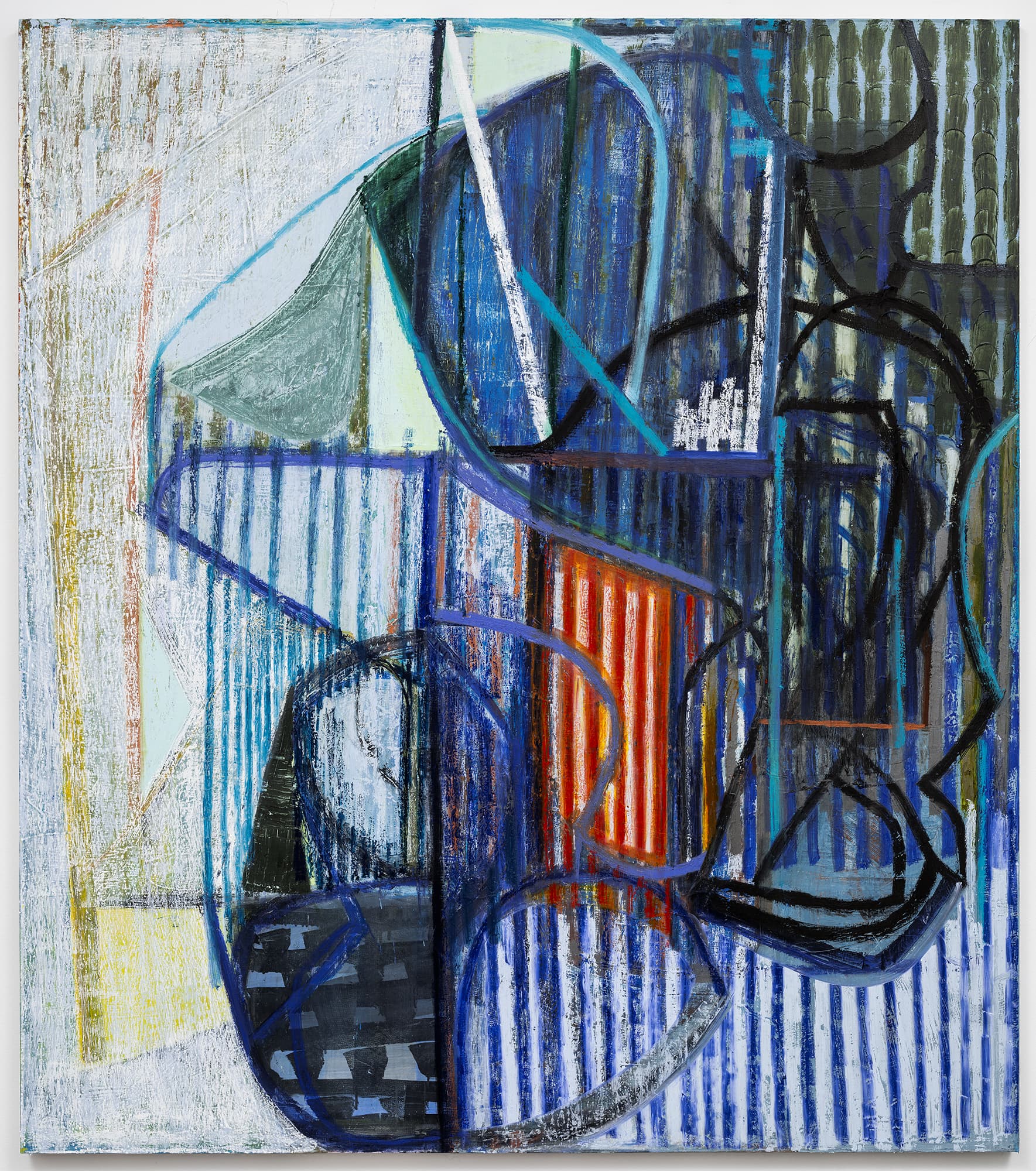
At the show’s center are three large canvases inflected with blue, which, more than any other pairing, seem to constitute a series. Harpie (2023–24), especially, is an astonishing study of verticality, its self-conscious stripes measured against the dragged pattern of dry pigment and its looping, blooming sketch coming in and out of focus against a gleaming orange center. The composition’s flickering, pleated surface would seem untenable in previous shows, where the background would have been solidified, the contours sharpened, and the whole thing given more body. If there is a trend in these recent paintings, it is toward an airy dissolution of parts. It is a complication of Sillman’s trajectory, in that the figurative aspects of the paintings are now more thoroughly dissected, implicated rather than composed of actual mass. Consider, also, the pairing on one wall of oh, Clock (2023) and Almost Blue (2024), the former totally involved in a Cubist space where each facet responds politely but differently to its neighbor, the latter a composition of lonely parts floating in a ghostly field. They could almost be made by different artists, except for the unmistakable vertical and diagonal brushstrokes that pull across their surfaces like demarcations on a sports field. The line has always been important to Sillman, and she categorizes certain artists as “draw-ers,” regardless of their medium: those who work from the inside out versus the outside in, moving “sideways, abductively, from particular to particular.” There is of course a whole lot of both going on in these canvases filled to the brim with lines cascading down without necessarily clarifying anything. Maybe, ironically, they serve to draw the eye to that which they refuse to describe: the bright red slashes on oh, Clock could be like reflective safety strips on a bicycle or a country driveway, except that what is being made highly visible in the fray of the painting is just the paint itself, the individual smears and pools of color. I am reminded of an Indian tantric painting composed of a dense field of pink arrows pointing in all directions, designating only themselves, vibrating like atoms.
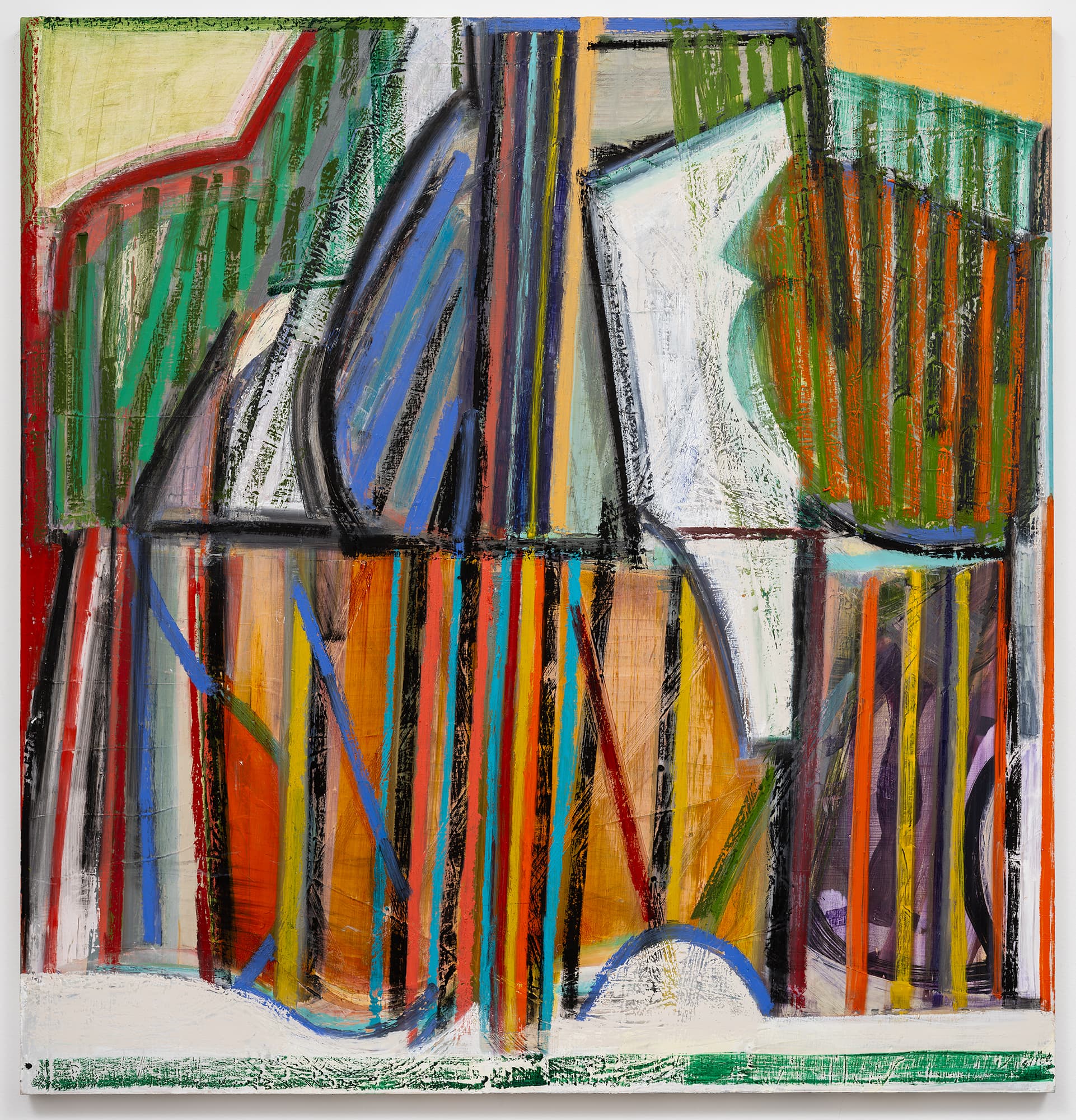
There is an outlier, Little Instrument (2023–24), which is on a medium-sized canvas that is almost square. Whatever underlying picture it may have held, it has been completely overwhelmed by Sillman’s multicolor lines, which have gathered into a sort of rainbow ribcage or radiator. It suggests that this current stage, of intensely alienating and fractured compositions, might once again begin to take on mass. Where Sillman had previously channeled the awkwardness of Gregor Samsa’s transformed body in an inhospitable apartment, these new paintings might get at another, more universal aspect of Kafka’s comedy. The canvases hold your attention not with aggression, but with a certain deadpan insistence. They have reached the maximum stakes of their medium, a cliff where meaning falls off at exponential speeds. Rather than turn back and clarify, the best of these new paintings trudge on ahead. Little Instrument is a weird and strange apparition—it seems to exist only because some absurdity kept pushing it forward—but it is in some ways the most human of all these pictures, pushing abstraction to embody something new rather than pulling apart the known. It calls to mind one of Kafka’s parables, where an emperor has conveyed some dying words to a messenger, who is trying in vain to deliver the message to the reader, rushing past a series of obstructing walls, staircases, crowds of princes, throng after throng filling various arteries of the palace. His journey is one that lasts thousands of years, because even after clearing all the imperial courts, he is faced with the capital, “the center of the world, crammed to bursting with its own sediment.”
Louis Block is a painter based in Brooklyn.