Susan Harris

Susan Harris is a writer and curator. She is on the Executive Boards of Printed Matter, the Brooklyn Rail, and the International Association of Art Critics, United States section (AICA-USA).

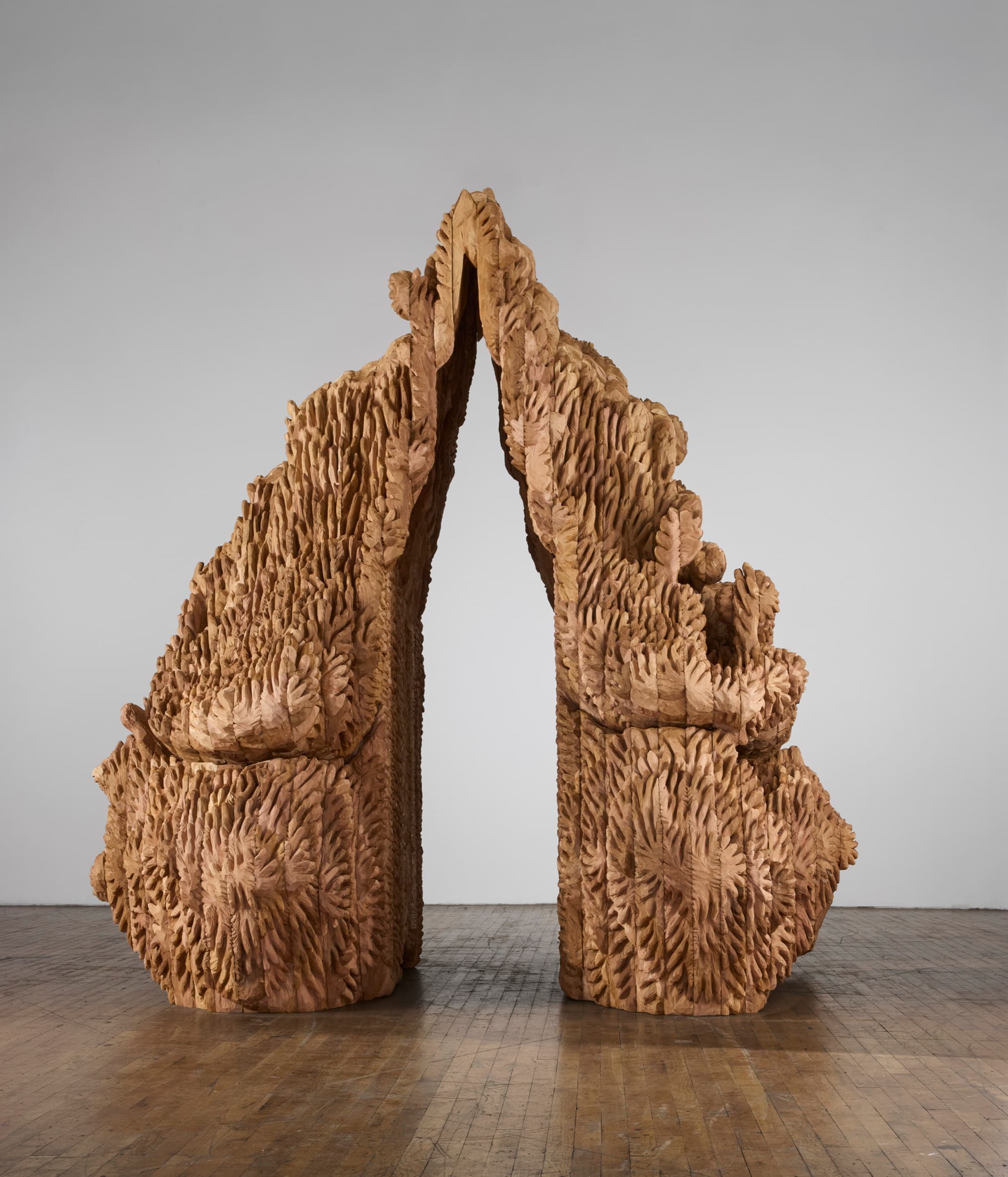
Ursula von Rydingsvard’s current exhibition presents an array of sculptural and graphic gestures that demonstrate an unceasing fluidity and openness. New forms, allusions, strategies, and inventive surface articulations expand upon the artist’s already rich sculptural vocabulary and distinctively intuitive approach to process and materials.
Ursula von Rydingsvard

Ali Banisadr: The Alchemist is a sweeping survey of the artist’s last twenty years of work in which visitors bear witness to dazzling personal and collective worlds and embedded gestures that explode across and beyond the confines of the canvases.

Ali Banisadr, The Alchemist, 2025. Bronze, 16 x 17 x 9 inches. Courtesy the artist and Katonah Museum of Art.

Robert Feintuch and Saul Steinberg: Sunset Emergency presents an unlikely pairing of two artists of different generations and backgrounds who never knew each other. As the conception of gallerist David Totah, however, the exhibition is layered with delights and enigmas as viewers consider the art and sensibilities of Feintuch and Steinberg separately and together.

Saul Steinberg, Gulliver Table, 1986. Carved wood with oil, colored pencil, crayon, incised and inked copper and tin sheets, metal handle and string, 36 1/2 × 28 x 26 inches. Courtesy TOTAH.

Second Nature, the title of David Kennedy Cutler’s new exhibition at Derek Eller Gallery, is a term that commonly refers to repetitive and habitual behaviors that take place without thought, such as breathing, sleeping, and eating. But the phrase also suggests the possibility of a remaking, as in a second chance.

David Kennedy Cutler, Bed, 2022. Inkjet transfer, acrylic and clear coat on canvas, armature wire, 132 1/2 x 89 x 3 1/2 inches. Courtesy the artist and Derek Eller Gallery.

“Obsessed by memory, I have always believed that art can be redemptive, a force in healing the world,” says Tobi Kahn, whose work is rooted in the connection between remembrance and healing. Memory and Inheritance: Paintings and Ceremonial Objects by Tobi Kahn at the Museum at Eldridge Street is Kahn’s first one-person exhibition in New York City in over ten years.
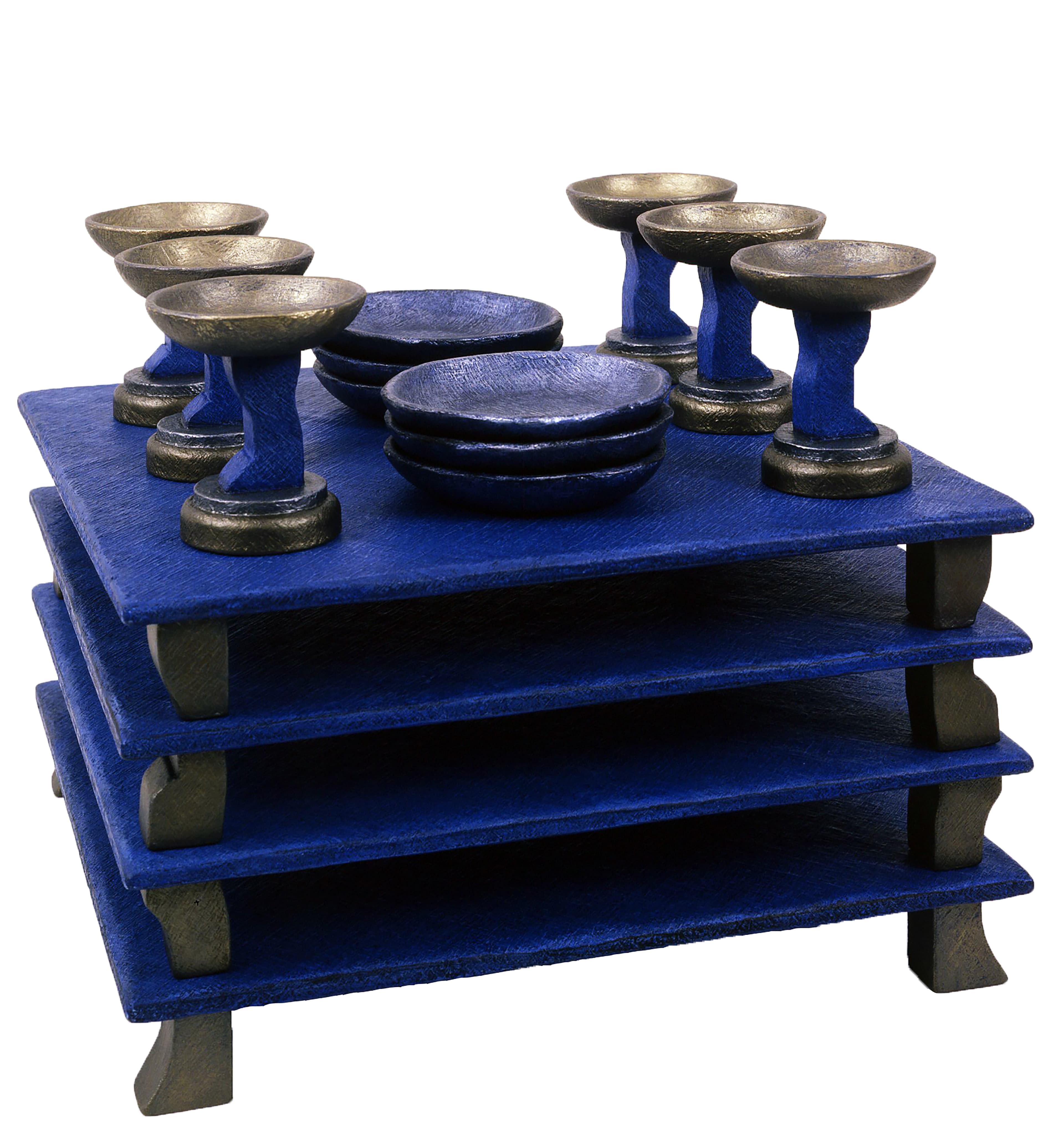
Toby Kahn, ERHU II (Seder plate), 2008. Acrylic on wood, 12 x 14 x 14 inches. Courtesy the Museum at Eldridge Street.
Stepping off the elevator onto the seventh floor of Pace’s West 25th Street headquarters, viewers stand at the edge of a field of sculptures that are a mix of formal/classical and exotic/non-Western forms and surfaces that gently pulsate, oscillate and, from certain perspectives, dematerialize. This is Tara Donovan: Stratagems, the artist’s current show of eleven discrete sculptures (all 2024) ranging in height from 8–10 feet made entirely from CD-ROMs.
Tara Donovan, Stratagem II, 2024. Sculpture, CDs, 88 × 15-1/2 × 15-1/2 inches. © Tara Donovan. Courtesy Pace Gallery.
Fort Marion and Beyond: Native American Ledger Drawings, 1865-1900 is an exhilarating presentation of nineteenth century drawings that illuminate an essential and complex piece of American art and history. The exhibition features over one hundred Plains Ledger drawings created by Arapaho, Cheyenne, Hidatsa, Kiowa, and Lakota warrior artists that testify to the power of the image both in its making and in its capacity to speak to the depths of the human spirit.
Ledger Drawing, anonymous artist, Cheyenne, Central Plains, ca. 1870, ink and coloured pencil on paper, 6" H × 4  7/8 " W. Courtesy Donald Ellis Gallery and David Nolan Gallery.
Swathed in sumptuous tribal garments and adorned with opulent accessories, a Native American Crow chief and his young wife are the subjects of a black-and-white photograph taken in 1873 by a white photographer to commemorate their visit to Washington, DC.
Wendy Red Star, Portrait of Perits-Har-Sts (Old Crow) with His Wife, Ish-Ip-Chi-Wak-Pa-I-Chis (Good or Pretty Medicine Pipe), 2017. Pigment print on archival photo-paper, 17 x 25 inches. Courtesy the artist.
Richard Tuttle: 18×24, the exhibition of new, exuberantly colorful wall reliefs on view at Pace Gallery in Chelsea, is an absolute affirmation of the supremacy of joy that can be had in the making and viewing of art despite—or, maybe because of—the divisiveness, anger, fear, and untruths that abound.
Richard Tuttle, 18 x 24, #1 (TBC), 2022–23. Foam board, acrylic paint, acid-free archival bond paper, nails, 16 x 14 x 1 inches. © Richard Tuttle, courtesy Pace Gallery.
Brad Kahlhamer: Swap Meet is a succinct yet expansive exhibition composed of drawings, paintings, sculptures, and a mobile home trailer woven into a uniquely personal cosmology. Walking into the large open space of the Scottsdale Museum of Contemporary Art reminds me of Kahlhamer’s account of his first visit to the Heard Museum in Phoenix in the late 1970s.
Brad Kahlhamer, Nomadic Studio Sketchbooks, 2020–2022. Mixed media on paper; 5 x 8 1/2 inches. Courtesy the artist and Garth Greenan Gallery, New York. Photo: Claire A Warden.
The disparate parts of Rona Pondick's metal hybrids came together as unified, albeit disconcerting, wholes, but deliberate disjunctions characterize the new pigmented resin and acrylic pieces that accentuate their literal and spiritual ruptures.
Installation view: Rona Pondick, Marc Straus, New York, 2022. Courtesy Marc Straus.
Beverly Semmes’s current show at Susan Inglett Gallery represents the multitude of modes and media with which she has been engaged for the last thirty years while introducing notable new elements that invite reflection on the relationship between her signature dress and ceramic sculptures and her “Feminist Responsibility Project” (FRP), an ongoing series in which she paints and draws over ’90s-era porn magazine pages.
Beverly Semmes, Copper Curtain, 2021. Acrylic and glitter over photograph printed on canvas, 91 1/2 x 54 1/4 inches. Courtesy Susan Inglett Gallery, New York.
Installed in the first of the two back galleries of Sikkema Jenkins are several suites of modestly scaled drawings from the series “Book of Hours.” Referencing medieval Christian books of hours, the drawings on view reinforce the primacy of privacy. Viewers bear witness to the outpouring of stream-of-conscious thoughts, feelings, and reactions that Walker channels through line and liquid media onto paper.
Kara Walker, Prince McVeigh and the Turner Blasphemies, 2021. Video, color, sound: original score by Lady Midnight, 12 minutes, 6 seconds. Courtesy Sikkema Jenkins, New York.
Combining painting, poetry, video, and sound in an immersive installation that invites attendees into the inner sanctum of his mind, Ceremonies is a powerful new work commissioned by The Kitchen as part of In Support, an exhibition that reflects on ways institutions offer and receive support.
Installation view: In Support, The Kitchen, New York, 2021. Pictured: Papo Colo, Ceremonies, 2021. Photo: Iki Nakagawa.
Taylor’s subject material in Future Promise, at James Cohan Gallery, has taken a turn toward the personal in paintings that reflect the impact of quarantine on her as an artist, mother, and person.
Alison Elizabeth Taylor, Anthony Cuts under the Wburg Bridge, Sunset, 2021. Marquetry hybrid, 73 x 53 inches. © Alison Elizabeth Taylor 2021. Image courtesy the artist and James Cohan, New York. Photo by Dan Bradica.
Huma Bhabha: Facing Giantsis a tour de force of new sculptures and painted and drawn collaged works on paper that expands upon and distills Bhabha’s 30-year passage in transforming common and discarded materials into powerfully expressive testaments of the human condition.
Installation view: Huma Bhabha: Facing Giants, 2021. Courtesy of the artist and Salon 94, New York. Photo: Dan Bradica.
Since her breakout moment in 2014 when she was catapulted into an arena where art meets fashion meets popular culture, Chloe Wise has become an art fair darling and has demonstrated herself as a witty observer of, and participant in, her millennial generation and culture.
Chloe Wise, I'm so-and-so and I exist!, 2021. Oil on linen, 48 x 36 x 1 1/2 inches. Courtesy Almine Rech. Photo: Dan Bradica.
Mildred Thompson: Throughlines, Assemblages and Works on Paper from the 1960s to the 1990s cracks the veneer of the 20th century, modernist canon to highlight a little-known body of work by an African American abstract artist who, in spite of being overlooked and criticized for her race, gender, and style, remained resolute in her vision.
Mildred Thompson, Stele, ca. 1963. Acrylic on found wood, 38 x 7 3/4 x 8 1/2 inches. © Estate of Mildred Thompson. Courtesy Galerie Lelong & Co., New York.
James Luna:e a Picture with a Real Indian is a posthumous installation at Garth Greenan Gallery of a performance/installation originally commissioned by the Whitney Museum’s downtown branch in 1991. The piece takes on issues of Native American identity and stereotypes, and explores how they land in largely non-Native spaces of viewing and writing about art.
James Luna, Take a Picture with a Real Indian, 1991. Chromogenic silver gelatin, and Polaroid prints, nails, wood, artificial turf, tripod, Polaroid camera, Polaroid film, tape recorder, audio cassette, sound, vinyl text, and chairs, 240 x 76 x 120 inches. Courtesy Garth Greenan Gallery.
Brad Kahlhamer speaks with Susan Harris about how he got his start in the art world, his working relationship with the Heard Museum, and his multi-discipline practice.
Portrait of Brad Kahlhamer, pencil on paper by Phong H. Bui.
Harold Ancart is a Belgian-born, New York-based painter who seems to have catapulted into the limelight in recent years. His first one-person show at David Zwirner in New York fills two of Zwirner’s adjacent 19th Street locations with large, dazzling paintings, all created in 2020, that provide ample opportunity to consider his contribution to the recent reappearance of a familiar conversation concerning painting.
Harold Ancart, Untitled, 2020. © Harold Ancart / SABAM, Brussels. Courtesy the artist and David Zwirner.
Surveillance marks a vast leap in a new direction. Working on, experimenting with, and percolating this new body of work for years, Shepherd dug deep into her self and her process to figure out how to make paintings that would essentially make themselves instead of her superimposing images on them.
Installation view, Kate Shepherd: Surveillance, Galerie Lelong & Co., New York, 2020. Courtesy Galerie Lelong & Co., New York.
His artworks create opportunities for contemplation, reassessment and, hopefully, healing for Native and non-Native people alike.
Hock E Aye Vi Edgar Heap of Birds, Standing Rock Awakens the World, 2019. 24 primary mono prints and 24 ghost prints on paper, 90 x 176 inches. Courtesy the artist and Fort Gansevoort, New York.
Spanning nearly 400 linear feet, this body of work took ten months to realize and represents Steir’s largest painting installation to date.
Installation view: Pat Steir: Color Wheel, Hirshhorn Museum and Sculpture Garden, 2019–20. Photo: Lee Stalsworth. Courtesy of Pat Steir and Lévy Gorvy.
The “Autobiography” series came about after a near fatal crash in which Pindell sustained severe injuries and memory loss. Early works from this series on view at Garth Greenan bear witness to the artist literally and figuratively piecing together fragments of her past.
Howardena Pindell, Autobiography: Oval Memory #1, 1980-1981. Mixed media collage on paper, 13 x 32 x 3 inches. Courtesy Garth Greenan, New York.
Entering Alain Kirili’s exhibition, Who’s Afraid of Verticality, is like joining a gathering of benevolent beings in a space that lifts one’s gaze and spirit.
Installation view: Alain Kirili: Who's Afraid of Verticality? Susan Inglett Gallery, New York, 2019. Photo: Adam Reich, NYC. Courtesy Susan Inglett Gallery, NYC.
It is a thrill to see Leon Golub’s in-your-face paintings on the brutalist walls of the Met Breuer. During his lifetime, American painter Leon Golub received little institutional recognition—particularly from museums in the US.
Leon Golub, Two Black Women and a White Man, 1986. Acrylic on linen, 120 x 163 inches. Courtesy Ronald Feldman Gallery, New York. © The Nancy Spero and Leon Golub Foundation for the Arts/Licensed by VAGA, New York, NY
You’ve done a beautiful job, a great service to us all in bringing to light so much valuable information on this quiet visionary, Dick Bellamy, who, by your account, was unintentionally drawn to, and pinpointed artists who went on to speak to and define a whole generation.
John Cohen, Dick Bellamy on a publicity carriage ride for Pull My Daisy, 1959. Courtesy L Parker Stephenson Photographs, NYC.
As serious, trained professionals who care deeply about art and artists, and place a high value on the disciplines of art history and art criticism, we regularly reflect on the role of the art writer/critic—what it is today and what it should be in a rapidly changing art world.
Portrait of Susan Harris. Pencil on paper by Phong Bui. From a photo by Zack Garlitos.
Ralph Humphrey’s exhibition at Gary Snyder Gallery illustrated his unique contribution to American abstract painting. In contrast to the metaphysical aspirations of the Abstract Expressionist painters whom he admired when he arrived in New York in the late 1950s, Humphrey’s territory was secular and nonspiritual.
Nancy Spero’s recent exhibition at Galerie Lelong reaffirms the artist’s status as a national treasure.
Nancy Spero, "Birth," 1960. Watercolor on paper, 17 1/4" x 21 3/4". © Nancy Spero. Courtesy Galerie Lelong, New York.
On the occasion of the traveling retrospective Kiki Smith: A Gathering, 1980–2005, the artist’s first full-scale survey (on view until February 11, 2007), Kiki Smith welcomed Rail publisher Phong Bui and independent curator/writer Susan Harris to her home and studio to discuss her life and work.
Photo by Paula Crossfield.
Ursula von Rydingsvard’s commanding new sculptures in natural, rough-hewn cedar are captivating in their correspondences to and departures from the awe-inspiring and warmly welcoming works that have defined her thirty-year oeuvre.
Ursula von Rydingsvard, Installation view of Sylwetka at Galerie Lelong, New York. September 8–October 21, 2006. Pictured, clockwise from left: “Plate with Dots” (2006), “Wall Pocket” (2003–2004), and “Weeping Plates” (2005). Courtesy of the gallery.

Close

Home