Tobi Kahn: Memory and Inheritance
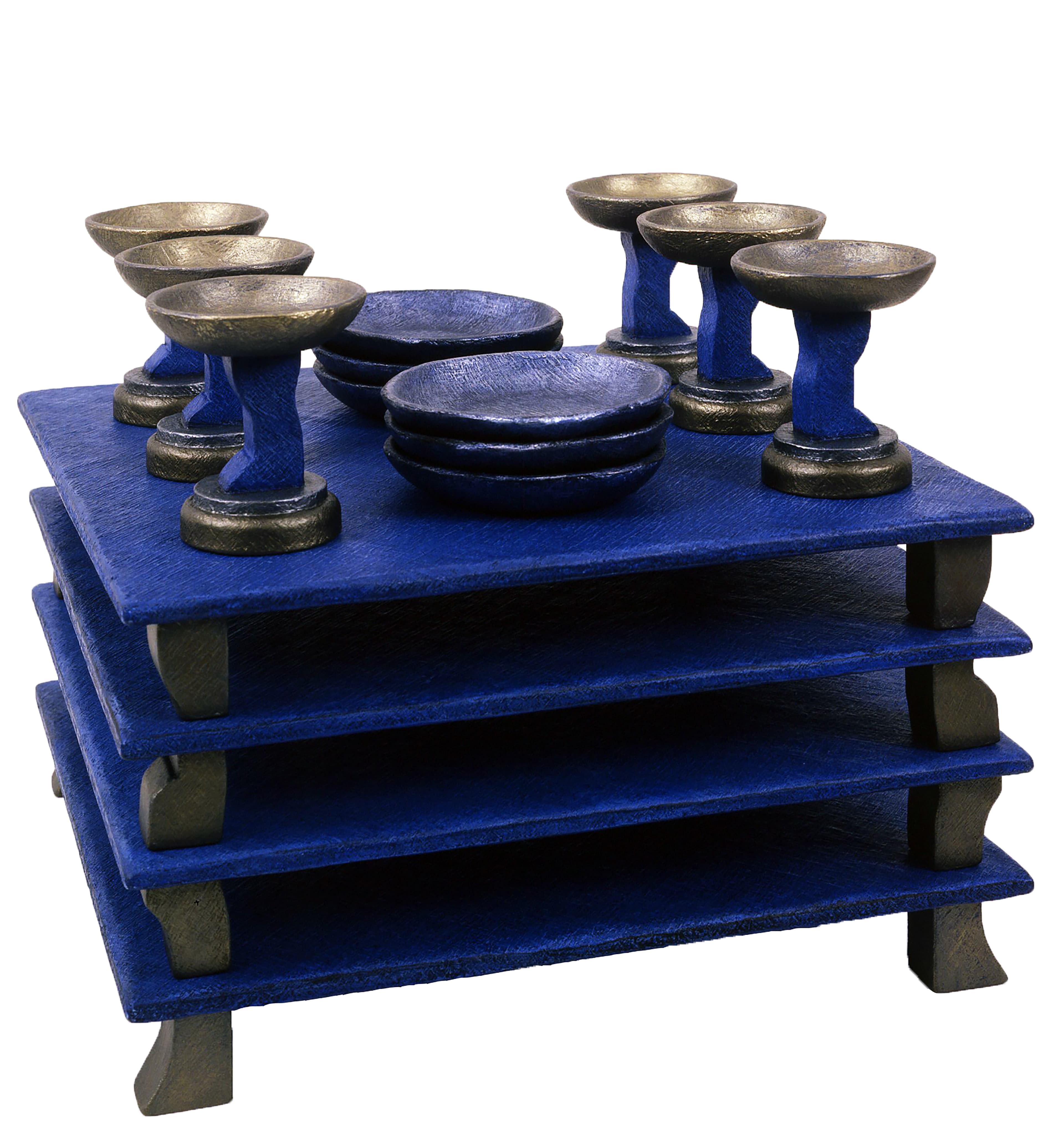
Toby Kahn, ERHU II (Seder plate), 2008. Acrylic on wood, 12 x 14 x 14 inches. Courtesy the Museum at Eldridge Street.
Word count: 1038
Paragraphs: 9
Museum at Eldridge Street
May 16–November 10, 2024
New York
“Obsessed by memory, I have always believed that art can be redemptive, a force in healing the world,” says Tobi Kahn, whose work is rooted in the connection between remembrance and healing. Memory and Inheritance: Paintings and Ceremonial Objects by Tobi Kahn at the Museum at Eldridge Street is Kahn’s first one-person exhibition in New York City in over ten years. Though compact, the rich installation of paintings, sculptures, ceremonial objects, furniture, and photographs of large-scale, indoor and outdoor meditation spaces speaks to the personal and the universal as it resonates in fine-tuned harmony between the art and its context, and a generosity of heart and spirit shared by and emanating from both.
The Eldridge Street Synagogue, built in 1887 as a spiritual home for some 2.5 million immigrant Jews, many of whom from Eastern Europe, who, with their newly found religious freedom, settled on the Lower East Side, houses the Museum at Eldridge Street. Designated a National Historic Landmark in 1996, the renovated building is an architectural jewel that has been recognized for its significance in the continuity of not just American Jewry but of the diversified, American immigrant experience. A 2010 commission by Kiki Smith for a monumental stained-glass window is a dazzling tribute to the synagogue’s past and future prominence as an actively functioning community space and its mission to “inspire reflection on cultural continuity and foster collaboration and exchange between people of all faiths, heritages, and interests.”
Kahn was born in 1952 to German-Jewish Holocaust survivors who had immigrated to New York, and raised in an observant Orthodox Jewish household and community. He was named for his uncle who is believed to have been the first Jew murdered by the Nazis, an ancestor whose life and persona had a great impact on the artist. I met Kahn in the early 1980s as he was coming into his own as a painter of quiet, contemplative landscapes characterized by interlocking, archetypal shapes denoting land, water, and sky. The unusual cropping and arrangement of forms that still characterize his compositions might be explained by his study of photography at Hunter College before continuing on for an MFA in painting at Pratt Institute. Kahn’s own photographs are the source of all of his paintings. I was struck then, as now, by the range of his artistic influences, from Cycladic art and Stonehenge; to early American modernist painters such as Arthur Dove, Marsden Hartley, and Georgia O’Keeffe whose explorations of organic abstract shapes as potent equivalents for the beauty of the natural world informed his search for a contemporary language of landscape painting; to New Image painters of the late 1970s (Lois Lane and Susan Rothenberg, in particular, who heralded a return to painting when the focus in contemporary art had been on conceptual and minimal art); and to Myron Stout, Eva Hesse, Martin Puryear, and Agnes Martin for the personal mysticism with which they infused their austere vocabularies.
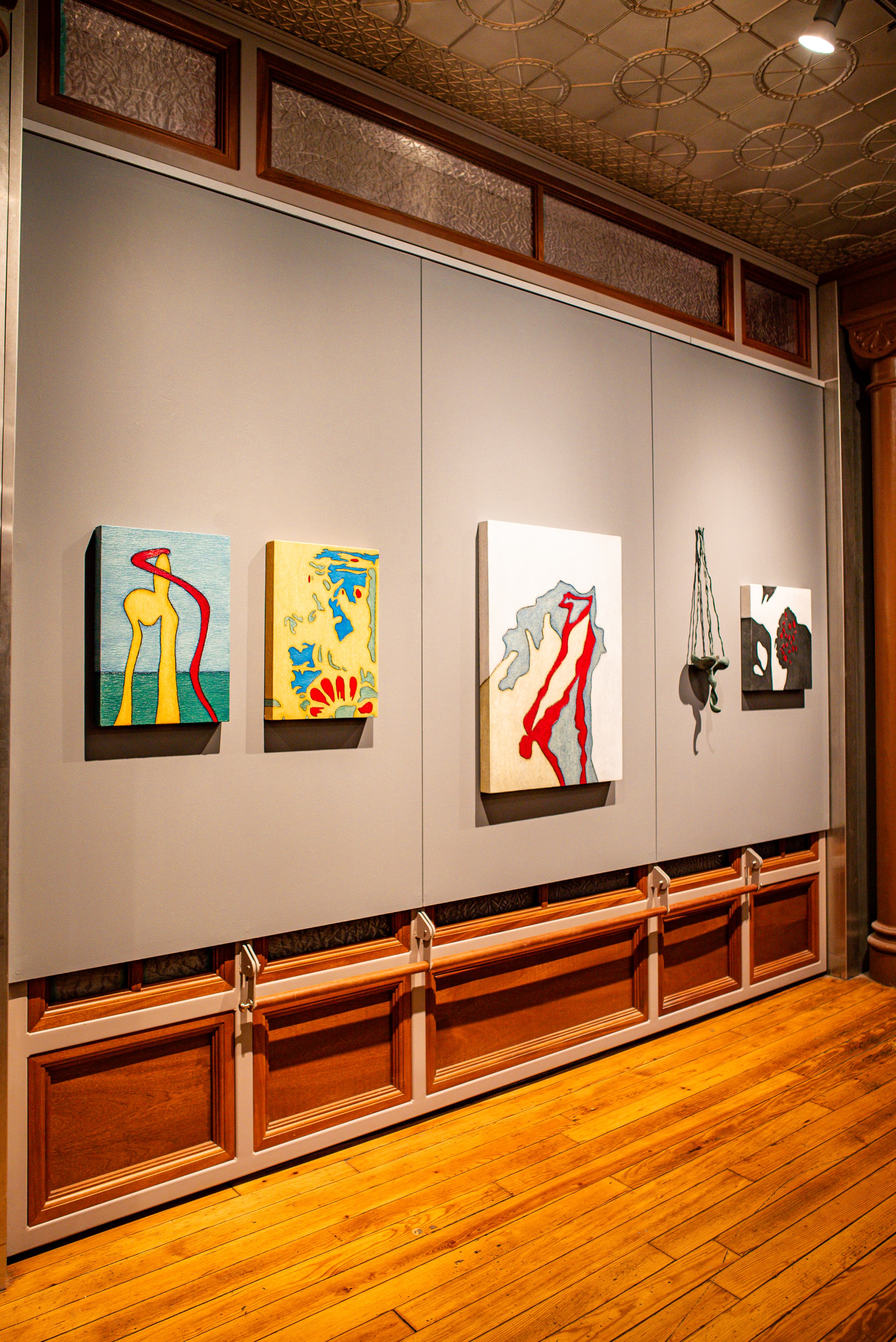
Installation view: Tobi Kahn: Memory and Inheritance, the Museum at Eldridge Street, New York, 2024. Courtesy the Museum at Eldridge Street.
Memory and Inheritance is comprised of forty-eight works from the last thirty years and, while the size of the space prevents inclusion of his largest paintings and installations, it allows for a thoughtful consideration of Kahn’s oeuvre. His paintings are, at once, forces of physical matter and springboards to elusive realms of perception. Comprised of over twenty layers of paint that he builds up through a laborious, painstaking process with more opaque layers at the bottom and increasingly translucent layers towards the top, the resultant surfaces have a textured luminosity while imparting a complex sense of depth and movement.
Kahn, familiar with the Eldridge Street Synagogue space, oversaw the exhibition’s organization and installation, which included his own construction for the vitrines housing his ceremonial objects. Kahn has made ritual objects as vessels of natural and divine energy throughout his career, but their inclusion in the exhibition marks the first time they have been shown in an art space. While clearly fitting in this context, their installation amongst his paintings throughout the downstairs galleries and on the third-floor balcony overlooking the synagogue and stained glass window affords an opportunity to consider them as sculptures as well as objects for religious rituals. Ushering in viewers with a symbol of freedom is ERHU II (Seder Plate) (2008), a highly crafted, nontraditional seder plate used in the Jewish Passover celebration of the exodus from slavery in Egypt.
A triad of works follows, setting a personal/mystical tone that prevails throughout the show. ATSYZ (2012) suggests the benevolent spirit Kahn’s grieving heart felt watching over his mother upon her death. Inspired by the evocative light and shadows filtering through the trees at the cemetery, he limited his palette to the black abstracted forms of a hulking figure, a bird, and vegetation against a white ground heightened by small red circles representing stones placed on her grave. KAYOM (Eternal Light) (1997), a painted sculpture with a light, seems to float on the wall to allude to a sense of otherworldliness. TSELA (2018), a painting of the interior of an orchid that, simultaneously, suggests a male/female figure and a craggy landscape, consolidates Kahn’s fascinations with the wonders of nature, the shifting and subjective aspects of experience and perception, and the healing power of art.
Painting after painting reveals the artist’s joy, reverence, and inclination for commingling of earth and heaven. AH PAHL v.2 (2014) expresses the profundity of a nighttime walk in a tree lined landscape. The golden, moonlit sky reaches down to touch a waterfall in a gesture that evokes Adam’s outstretched arm in Michelangelo’s Creation of the World (1508–12). AHDYN (2020), a work of nine blue on blue panels that come together as a singular entity, is one of an ongoing series of “Sky and Water” paintings that Kahn regards as his most religious work. He captures the poignancy and stillness in the communion between heaven and earth through color and line, the divinity existing in the everyday. Mounted during troubled times, Memory and Inheritance is an homage to the historical and spiritual significance of the Eldridge Street Synagogue as well as to the artist’s belief in art to help people heal themselves, and the world.
Susan Harris is a writer and curator. She is on the Executive Boards of Printed Matter, the Brooklyn Rail, and Art21.