David Kennedy Cutler: Second Nature

David Kennedy Cutler, Bed, 2022. Inkjet transfer, acrylic and clear coat on canvas, armature wire, 132 1/2 x 89 x 3 1/2 inches. Courtesy the artist and Derek Eller Gallery.
Word count: 945
Paragraphs: 7
Derek Eller Gallery
February 28–April 12, 2025
New York
Second Nature, the title of David Kennedy Cutler’s new exhibition at Derek Eller Gallery, is a term that commonly refers to repetitive and habitual behaviors that take place without thought, such as breathing, sleeping, and eating. But the phrase also suggests the possibility of a remaking, as in a second chance. Embracing the latter meaning, Kennedy Cutler found his inspiration in art historian Martin Kemp’s explanation for Leonardo Da Vinci’s impulse to both record and defy nature: as the press release tells us, you “can take things from nature and put them together in a different way and you can invent things that nature didn’t invent, so that you act as a second nature in the world.” The task of reimagining and transforming nature into a new more vibrant reality is the key to Kennedy Cutler’s art.
Growing up straddling analog and digital technologies and keenly aware of how our consciousness is being altered by digital media, Kennedy Cutler is one of a group of artists addressing the aesthetic ramifications of the way we navigate digital spaces. For over a decade, he has been photographically scanning the immediate things in his life, then modifying them with digital-imaging software and printing them on a huge inkjet printer. He cuts, manipulates, and collages these images onto materials such as plywood, aluminum, plastic, or fabric—essentially returning the flat digital images to three-dimensional forms as surrogates of the original. Exploring the psychology of life and identity in a world inundated with endlessly replicated images, Kennedy Cutler’s scrappy harnessing of digital technologies has evolved into a language expressive of our times. As the fractured, abstracted, and interpenetrating painted planes of Cubism reflected the new complexities and consciousness of the early twentieth century, Kennedy Cutler’s constructions, which exist, simultaneously, as three-dimensional objects and their disembodied, digital stand-ins, speak of a twenty-first century culture largely dependent on technology and obsessed with images over actual things.
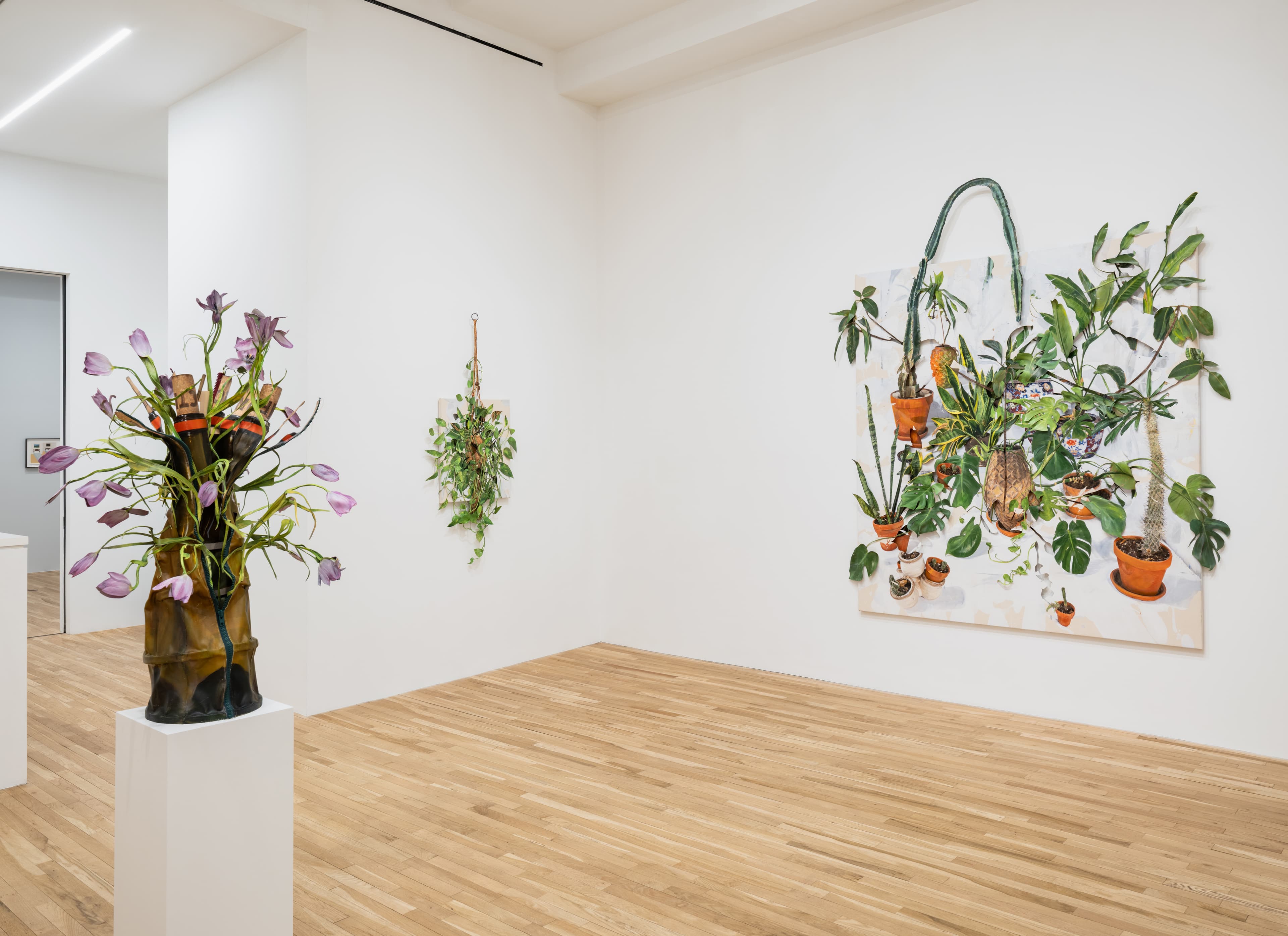
Installation view: David Kennedy Cutler: Second Nature, Derek Eller Gallery, New York, 2025.
On opposite walls at the entrance to Second Nature are two monumental works that open into the artist’s personal domain: a towering vertical inkjet transfer image on canvas showing the artist’s bed with brass rods and flowers bursting from the sheets, and an expansive horizontal depiction in the same medium of his couch with a throw and pillows in vibrantly colored patterns that conjure up a southwestern landscape. The bed and couch paintings are joined by other artworks that feature Kennedy Cutler’s shorts, pillow, stool, flowers, houseplants, vegetables, and bottle of wine that, together, compose a three-dimensional still-life of the artist’s world. His Bed (2022) recalls Robert Rauschenberg’s Bed (1955), a once-radical mashup of art and disheveled quotidian life that challenged conventional categories of painting and sculpture with messy brushstrokes and drips of paint slapped over a real pillow, quilt, and sheet mounted on the wall. Having earned his own reputation for literalizing the notion that a work of art serves as an extension of the artist’s self, Kennedy Cutler achieves a new level of sophistication and elegance in Second Nature through the disruptive fusion of painting, sculpture, photography, printing, and collage in his ongoing ruminations over the impact of digital culture on our consciousness.
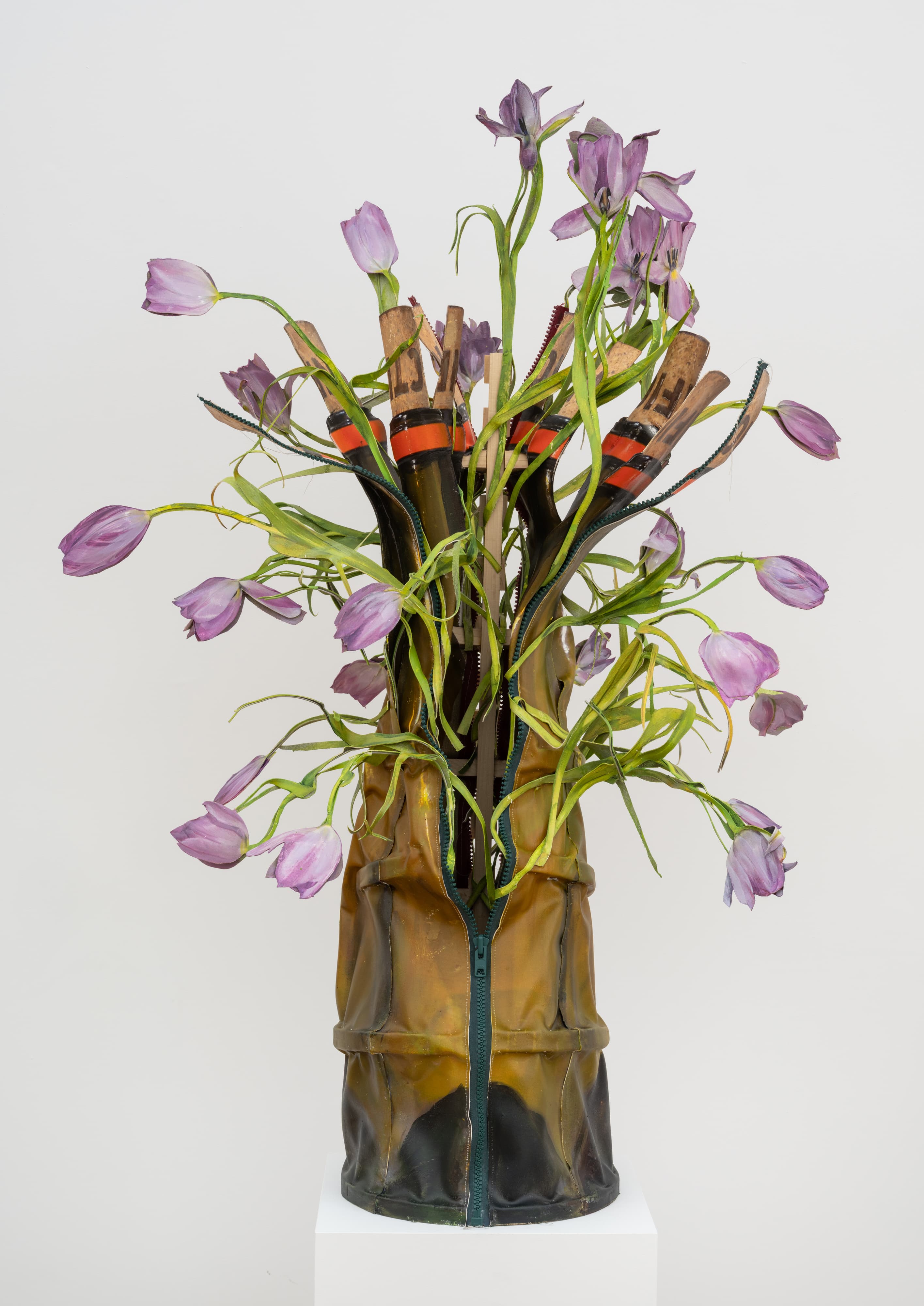
David Kennedy Cutler, Fiction, 2024. Inkjet transfer, acrylic and clear coat on canvas, armature wire, wood, zippers, 49 x 28 x 28 inches. Courtesy the artist and Derek Eller Gallery.
Graduating from RISD in 2001 with a BFA in painting, Kennedy Cutler until recently rejected the medium of painting, which freed him to discover a new hybrid space. It is ironic, then, that his investigations, particularly into performance, have led him back to painting. Second Nature is made up primarily of paintings, although it also includes two freestanding sculptures. The paintings are complex and unorthodox, like those of Elizabeth Murray and Frank Stella, but they do adhere to the vocabulary of painting. We find cuts and slices into which the viewer can peer, gaining access to Kennedy Cutler’s process of creation, in paintings such as Meteorite I and Meteorite II (both 2024), which show sweet potatoes overgrown with networks of sprouts, or Stoppage (2025), with its bewildering replication and interweaving of a studio stool with flower stems, or Ensemble III (2025), a symphonic depiction of the artist’s potted plant collection amassed as a still life of leaves, stalks, and pottery. One thinks of Lucio Fontana’s cut canvases of the 1950s and ’60s, the result of a violent act that opened up the space of painting to include the real environment in which it hung. While the slices in Kennedy Cutler’s surfaces are driven by process and often expose the wall behind, it is the layers of images below the surface plane which have been cut, folded, intertwined, and pulled up through the canvas that open onto a beguiling world of an endless confounding of real and virtual planes.
In Second Nature, paintings are sculptures and sculptures are paintings—and all of them are photographs. Fiction (2024) (aptly titled) is a freestanding sculpture of a wine bottle with multiple spouts that form a bouquet with a bunch of purple tulips. Walking around it, the viewer takes in its spinelike structure and realizes that it only exists as a wine bottle by virtue of being dressed in an outer skin or “outfit.” Similarly, Pillow (2025) is merely an assembly of ribs and stalks that metamorphoses into a pillow when encased in a simulacrum of a pillowcase. In spite of—or because of—the relentlessly mediated reality that Kennedy Cutler’s art embodies, Second Nature ultimately serves an ode to the personal “stuff” that brings meaning to our everyday lives. It is about what defines us as individuals and a culture as much as it is an affirmation of the devout, complex, and sometimes bonkers endeavor of making art.
Susan Harris is a writer and curator. She is on the Executive Boards of Printed Matter, the Brooklyn Rail, and Art21.