Raymond Foye

Raymond Foye is a Consulting Editor at the Brooklyn Rail.

Like her paintings, Jacqueline Humphries has established a subliminal presence in the art world, composed of intrigue and integrity. One of our most requested subjects for an interview over the years, her innate sense of privacy always returned a polite “no.” Finally we met in a large brilliant white studio in Red Hook, Brooklyn, where the paintings loomed over us—cathedral-like machines of light and energy. Our conversation veered obliquely around topics small and large, and Humphries asks as many questions as she answers.
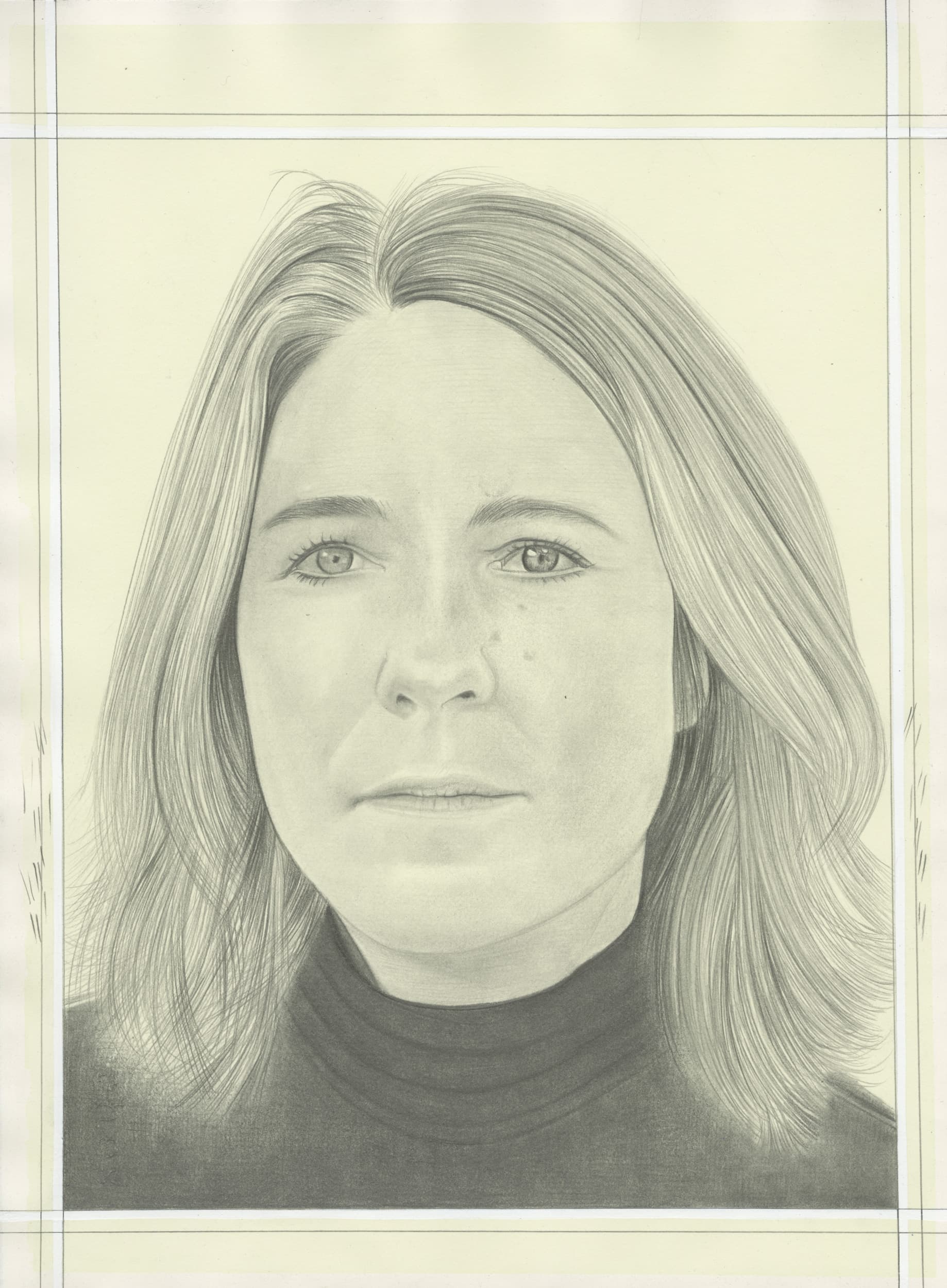
Portrait of Jacqueline Humphries, pencil on paper by Phong H. Bui.

Two strange things happened when Neeli Cherkovski died. First, the phone stopped ringing. This is a joke, for he was famous for calling all his friends every day, usually several times a day. The second strange thing was… I realized he was a great poet.


Portrait of Neeli Cherkovski, pencil on paper by Phong H. Bui.
For almost sixty years Jordan Belson lived in the same charming corner of San Francisco, the bohemian enclave known as North Beach, named after the region of Italy from where the locals emigrated—the Gulf of Trieste. Rents were cheap and neighbors tolerant.
Jordan Belson Apartment & Studio, San Francisco. ca. 1960. Photographer unknown. Jordan Belson Archives. Courtesy Matthew Marks Gallery.
With Dylan, a few words go a long way. Nothing is belabored. When you are discussing songwriting, and you are arguably the finest songwriter of your era, it needn't be. I wouldn't call it shop-speak, it's more insider knowledge.
Bob Dylan’s The Philosophy of Modern Song
Raymond Foye speaks with Michael Snow about his pioneering work as an artist and filmmaker.
Portrait of Michael Snow, pencil on paper by Phong H. Bui.
We talked for hours—surrounded by his books and objects—about language and its origins, about technology, US-Mexican politics, and primordial societies, themes we were pursuing in the translation of his texts.
Portrait of Peter Lamborn Wilson, pencil on paper by Phong H. Bui.
Poet, musician, and translator, Louise Landes Levi was an original member of Daniel Moore’s fusion orchestra and experimental theater troupe the Floating Lotus Magic Opera Company in Berkeley, in the late 1960s, where she played alongside Angus MacLise and Terry Riley in outdoor productions that included Balinese gamelan, Tibetan ceremonial instruments, actors, puppets, and chant. Four decades later, Levi continues to practice this tradition in her own way.
Louise Landes Levi. Courtesy Blank Forms. Photo: Lena Shkoda.
“I’m exploring the world at large and my interior dialogues at the same time.”
Portrait of Thomas Kovachevich, pencil on paper by Phong H. Bui
Hard to sum up the Dylan show last week, but in short it was great, for all the reasons big music shows are usually not. It was layer upon layer of weirdness, a sense of dramatics somewhere between kabuki and Artaud's Theater of Cruelty. It was definitely a performance, but it was also terribly real.
Bob Dylan In The Bardo
Gerd Stern is a poet, painter, sculptor, and media artist. His oral history, From Beat Scene Poet to Psychedelic Multimedia Artist: 1948–1978, was published by The Bancroft Library, University of California, Berkeley.
Portrait of Gerd Stern. Pencil on paper by Phong Bui.
Whenever I am asked which Dylan biography one should read (if you are only going to read one) my answer is always Clinton Heylin's Behind the Shades Revisited, the 2001 revised second edition of his probing and provocative 1991 classic.
"Look Out Kid" (early draft manuscript of "Subterranean Homesick Blues"). Copyright © 1965 by Warner Bros. Inc.; renewed 1993 by Special Rider Music. Additional lyrics, Copyright © 2018 Special Rider Music. Courtesy of THE BOB DYLAN ARCHIVE® Collections, Tulsa, OK.
Poet Charles Stein teaches art writing at the MFA program of the School of Visual Arts, New York. His work comprises a complexly integrated field of poems, philosophy, art theory, mathematics, translations from ancient Greek, drawings, photographs, lectures, conversations and music performances. Born in 1944 in New York City, he is the author of fourteen books of poetry. He holds a Ph.D. in literature from the University of Connecticut at Storrs.
Charles Stein, Untitled, 2017. Ink on paper, 15 x 10.5 inches. Collection the artist. Courtesy Station Hill Press.
You want to keep the classical, as one root, and have respect for the beauty of that particular cultural contribution. But then, I support not freezing a culture, especially if it’s not mine, in some attempt to keep it pure.
Tamara Gonzales, untitled, 2015. Colored pencil on paper. 15 x 11 inches. Courtesy the artist and Klaus von Nichtssagend Gallery, New York.
Jazz, at its best and most essential, is a way of making music that is embodied in the musicians, in what they are imagining and playing in the moment. A fundamentally oral tradition, and one of the most sophisticated of its kind, jazz is far less ably served by written and recorded documents than almost any other kind of creative human activity. Jazz is the players; know jazz by following them, seeing them, hearing them.
Portrait of Henry Threadgill. Pencil on paper by Phong Bui.
When I lived in San Francisco (1977 – 79) the person I most wanted to meet (after Bob Kaufman) was Jordan Belson. But he had already become quite a famous recluse and all attempts were rebuffed.
"It's a glorious thing if you don't expect an explanation." Jordan Belson on his Art
When Phong Bui asked me to edit the Critics Page of the Brooklyn Rail I felt I could not refuse, since it’s the only art magazine I read anymore. Ezra Pound said culture is news that stays news, and for me the Brooklyn Rail is the news.
Portrait of Raymond Foye. Pencil on paper by Phong Bui.
Growing up in Lowell, Mass., I often took the train to Boston to visit Gordon Cairnie’s Grolier Poetry Bookshop in Harvard Square, hoping to encounter an authentic poet.
RR by Allen Ginsberg, 1986. Courtesy of the Allen Ginsberg Estate.
Raised in the redwood forests of Northern California, Eric Walker turned up in San Francisco at the age of 15, his poetic identity very much intact. He believed he was the reincarnation of Arthur Rimbaud—hard to deny when confronted with the astonishing flow of words and images, not to mention his stunning physical beauty.
Introducing Eric Walker

Close

Home