JACQUELINE HUMPHRIES with Raymond Foye
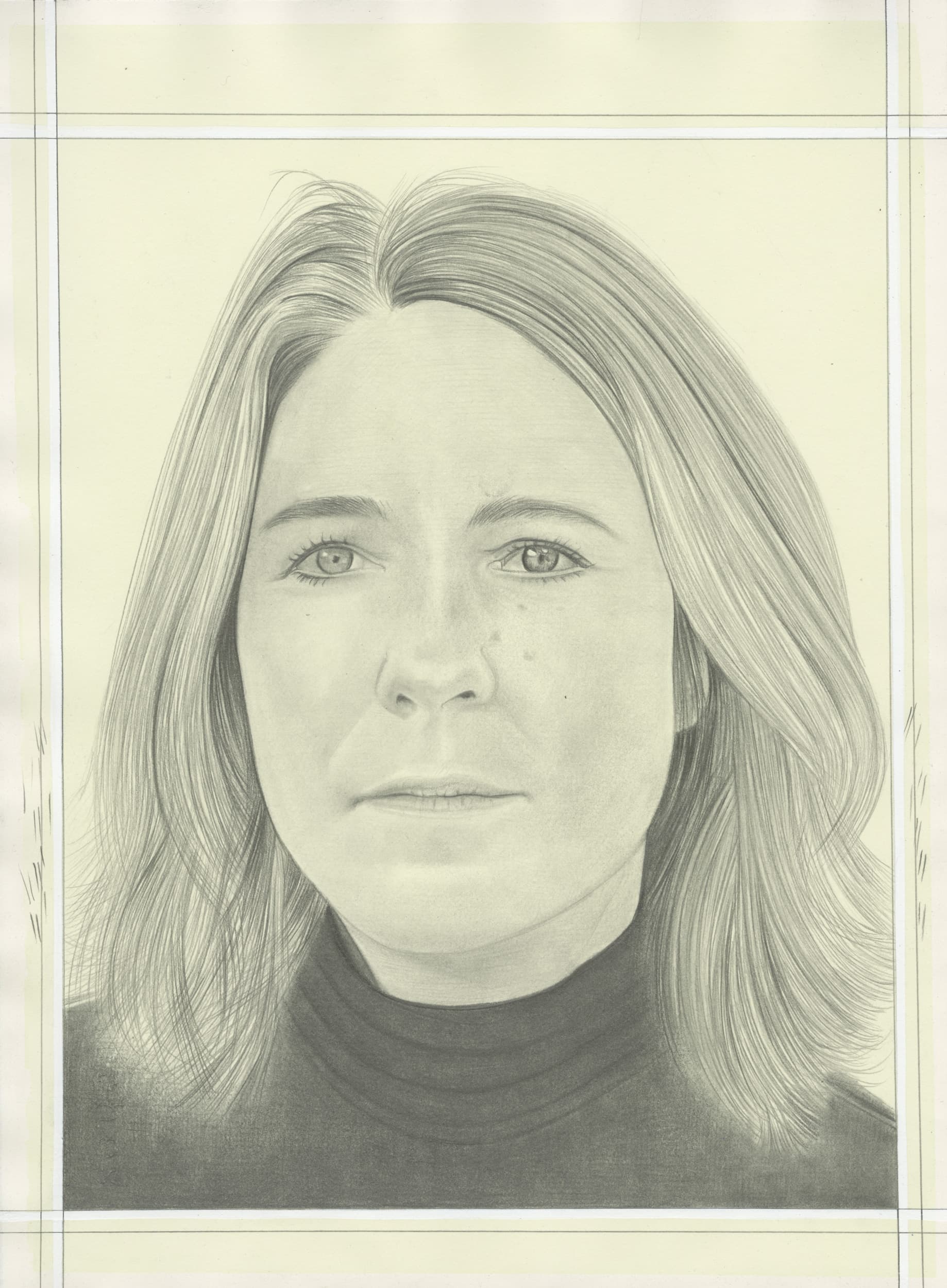
Portrait of Jacqueline Humphries, pencil on paper by Phong H. Bui.
Word count: 4936
Paragraphs: 126
February 19–April 5, 2025
Los Angeles
Like her paintings, Jacqueline Humphries has established a subliminal presence in the artworld, composed of intrigue and integrity. Since the 1980s she has played out brilliant variations on endgame theory in painting—while time and again turning the dark end into an inspired beginning. Hers has been an ontological dialogue with the medium and its history, unstable and complex, while staring down the constant shadow of nihilism.
One of our most requested subjects for an interview over the years, her innate sense of privacy always returned a polite “no.” Finally we met in a large brilliant white studio in Red Hook, Brooklyn, where the paintings loomed over us—cathedral-like machines of light and energy. Our conversation veered obliquely around topics small and large, and Humphries asks as many questions as she answers.
Raymond Foye (Rail): These new paintings have an interesting vocabulary of marks—random, and yet very determined.
Jacqueline Humphries: Some of these are taken from forensic crime sites, where they are analyzing blood splatter patterns from murder scenes. It’s another idea I’ve been working on with the horror paintings—drippy letters like in The Rocky Horror Picture Show, kind of cheesy horror movie tropes.
Rail: Do you watch a lot of those?
Humphries: I sort of think horror is the genre of our time. I do like a lot of those.
Rail: It doesn’t bother you to have violent images in your head?
Humphries: Well, a line can be crossed and then I can find things disturbing and I don’t watch, but usually it’s so fake and obvious.

Jacqueline Humphries, 4946HJ, 2022. Oil on linen, 111 x 100 inches. Courtesy the artist and Greene Naftali, New York. Photo: Ron Amstutz.
Rail: It’s choreographed, yeah. Is there a gambler’s instinct operative where you’re pushing the painting further and further, and you might be afraid of losing something that you have, but you still want to carry it somewhere else?
Humphries: Yes, that’s always a hard thing—you have something, but you want more from it. Am I just being selfish? One ruins paintings that way. I’ve sort of trained myself to wait and watch, just keep looking. I’m in a dialogue with the painting. I have an idea for it, I might have more than one idea for it. If I have more than one idea, I do nothing.
Rail: What would be the percentage of looking to making, if you could express that in an equation?
Humphries: Oh, that’s a good question. It depends, because I work in phases. I have an experimental phase where I’m going pretty slowly. Maybe I’ll be working on one painting for a long time, as well as working on other things, with new ideas creeping in all the time. I’m pondering things or just trying things out. And then I get tired of that, I start to get bored and I just put all that aside. I retain what I need to remember and forget the rest. Then I start to work with more intent, going very fast.
Rail: Intuitively…
Humphries: Intuitively but also counterintuitively. Maybe you see something in the painting, then go against that. But you’re making decisions in a very rapid way. “Okay, I’ve done the thinking, I’m just going to act now, let it rip,” you know? Mobilize all the things I’m doing, suspend that slower, calm, critical judgment, and just start doing.
Rail: That’s improvisation, isn’t it?
Humphries: Yeah, it’s like gathering up this set of things that you know, like notes or tunes in an improvisational context. Learning them, becoming familiar with them, and then forgetting all of that and just doing it. Gathering up experience and then just releasing it while giving in to impulse. At that stage in the painting everything takes place in a much more compressed time frame.
Rail: I don’t think there’s any relation between the amount of time it takes to make a painting and whether the painting is any good or not.
Humphries: No, and so much of the difficulty is training yourself to be highly attuned to the thing you’re looking for, regardless of how much time you spent on the painting, or conversely, how easy it was for you. Not overinvesting your own labor in the specific object, but also not looking a gift horse in the mouth, in terms of accepting something as right even though it might have seemed too easy. Who is looking and who is making? Does a viewer in a sense make or remake what’s presented in the painting?
Rail: There’s a synergy there, no doubt. Is it about self-knowledge? Or self-interrogation?
Humphries: I don’t think about the self, or myself, so much. It’s more about the subject: who is the subject? I’ve worked and played a lot with personas. I used to make persona paintings. This is who the painter is, and then that persona would make the paintings. I guess that’s a more oblique way of getting at selfhood, subjecthood—for people to look at, for me to look at.
Rail: I guess these ideas about identity are at the intersection of a lot of things that are current now—in a practical sense with social media—where we have all these ways in which to identify ourselves.
Humphries: It has something to do with self, or the way in which self is expressed, yet without conscious self-presentation, so to speak. “I’m a woman starting a painting”—that would be the last thing I would think of. Am I myself when I’m making a painting? No, not really.
Rail: It’s easy to mistake the art for the artist. Sometimes you’re just visiting a place. It’s not necessarily who you are.
Humphries: Right, yeah, I don’t think about myself at all when I’m here in the studio. What is the self, anyway?
Rail: An obstacle. It must be difficult as you go on as an artist when you’ve made a lot of things and suddenly you have an identity that starts getting in the way. I’ve been visiting the Robert Frank show at the MoMA: he’s really working intently against his reputation—against what people think of him. Does that get in the way for you?
Humphries: It can. I think you have to objectify that as much as anything else, distance yourself from it. There are always things that get in the way and that’s just one. When I come in the studio I want to lose myself as much as possible. I have to leave a lot at the door. The studio is a place where I can do that—must do that.

Jacqueline Humphries, JH123, 2024. Oil on linen, 127 x 114 inches. Courtesy the artist and Greene Naftali, New York. Photo: Ron Amstutz.
Rail: I want to ask about the scale of your paintings. They really have a presence that one can enter into, and it seems to have a kind of a rightness. The scale reminds me of late de Kooning paintings—ratio, proportion, and measure all seem to be in accord to an uncanny degree. How did you come upon these sizes?
Humphries: Years of working and trying different sizes. I painted on only squares for many years. I make very large and very small paintings and everything in between. I work in all sizes.
Rail: Is that the reason for a 60 by 68 inch? Something that is close to a square, but not quite.
Humphries: Right, because it compensates for bilateral vision. A square canvas over a certain size doesn’t feel square anymore. It tends to collapse inward on the vertical axis. So it has to be wider to have that feeling of squareness. And then if you turn that canvas forty-five degrees, it loses that feeling of square and becomes much more vertical than expected—almost a new size despite having the same dimensions. It was just this shift that happened almost accidentally that got me out of a certain set of habits.
Rail: Does that relate to reach?
Humphries: It relates to reach and also to the viewer. A small canvas can be like the face and you can see it all at once. Six feet is more human size that you relate to with a body. Then much larger where the painting becomes more like a field or a billboard: epic space.
Rail: How do you deal with the top part?
Humphries: Big ladders, a shelf.
Rail: Do you work on the floor at the beginning?
Humphries: In the beginning they go on the floor. I’m throwing paint, I’m pushing paint around with big brooms. Really what I’m thinking about is how to mobilize the paint, how to get the stuff on there. And that’s the fun part—the how. What I’m really going for in the end is the kind of ecstatic space that feels like it’s happening right in front of you.
Rail: I wanted to ask you about ambient music—white noise—this genre which has now become so popular.
Humphries: Maybe it’s getting away from popular music, where every space becomes the melody.
Rail: It’s another aspect of composition by field. You become more aware of the microtonal nuances that are taking place. I find it does away with a lot of the mind/body dualism.
Humphries: It’s a whole different form of attention. It’s like inattentive attention, where you can float and free-associate, unlike most things today that are screaming for your attention. A kind of oblivion with simultaneous hyper-attention. I like things that focus your attention but free the mind at the same time, like driving.
Rail: In your paintings you’re utilizing all these elements of vision that we don’t usually use, things that are peripheral or incidental. Oftentimes what captures our attention in life is not the most important thing, so we end up looking at things that are not very interesting. I find looking at paintings a very good way to counteract that.

Jacqueline Humphries, JH753JH753J|, 2023. Oil on linen, 96 x 90 inches. Courtesy the artist; Greene Naftali, New York; Modern Art, London; and Galerie Gisela Capitain, Cologne. Photo: Simon Vogel.
Humphries: I wonder. I think of my own thing as being not visual, really. It doesn’t mean they’re not to be looked at, it means more that there are so many other things going on—like the materiality of the object, and the kind of pressure that it exerts on the room, and how space is more than what is perceived by the eye. Take a photograph of a painting. If the painting were a purely visual thing, the photograph would be equal to the painting, right? But we know that isn’t the case, so we have to think about this a little more broadly than what is understood as a “visual” culture.
Rail: It’s a disembodied image flow?
Humphries: Our realities now are our screens, and our screens only relate to other screens. So a big question for me became, “What kind of image will you commit to painting?” I wanted to restate the object as a material fact, while evoking a sense of impermanence. I was trying to make paintings that evoke a constant shifting or morphing of one thing into another. More about the frame of the thing, where the structure becomes the object. Or just a reality, rather than an image which is about reality. It’s hard to state. These things can only be addressed abstractly.
Rail: Do you believe in presence and aura in the work of art?
Humphries: I would not use those words, necessarily. They seem to belong to an earlier era.
Rail: They reek of spirituality?
Humphries: I don’t like that word either. That’s not how I would explain it, no. But then in a sense, perhaps that’s what I’m getting at: something that seems to occupy the space and just sort of … remains interesting. Something that speaks. I suppose that links it to the idea of presence, which is usually about some kind of living being, right? Some kind of illusion within those troublesome boundaries, where something else is going on. This brings us back to the idea of attention. But it’s a mystery to me. I’ve no formula for it, you know?
Rail: For me, abstraction is more about a state of being, rather than ideas or theories.
Humphries: I always want to try new things to see if I can make that quality I’m looking for emerge: a sense of what I want a painting to be, which I cannot articulate any other way, other than making a painting.
Rail: One image I always think about in relation to your work are those photographs of Andy Warhol’s Silver Factory. There’s a photograph where the police have just arrived, and the Factory is filled with people and it’s painted silver and there are Disaster paintings leaning all over the place, and in the corner the Velvet Underground are playing. What an incredible thing. It’s a total environment, total aesthetic. I think about how much has come out of that moment.
Humphries: A lot. Warhol did things in such a big way. Just in terms of setting something in motion, rolling out a new way of looking—at everything, not just objects. I choose to see him as a painter more than anything, but really expanding on this idea of painting. I think a lot of my students tended not to see him as a painter, like that was just one thing he did—or his assistants did—which is absurd, because his touch is in every single one of them. Warhol was really restoring the primacy of painting. He was constantly diverting your attention from what’s important in order to have it enter the mind in a new way. Always playing with presentations and interpretations. How he wanted you to think that he wasn’t really working. These diversions also created a kind of erotic allure to everything that he did, a sense of secrecy or of something hidden. But when I arrived in New York in the 1980s, Andy Warhol was despised and hated.
Rail: Oh I remember.
Humphries: But then I started meeting young artists in art school who revered him, like Meyer Vaisman, who was at Parsons when I was there. There was the beginnings of a neo-Warhol fan club emerging in the art world. Then in the 1990s it kind of exploded into this general reverence.
Rail: Yes, that was his second life.
Humphries: But once you accept Warhol fundamentally as a painter, Pop art and Conceptual art and all the various things that he touched upon—everything that signified the end of painting—were from the beginning really about an expanded notion of painting and its place in the world, with grandeur. These are the ancient markers of ambitious artistic enterprise.
Rail: One time I went to the Factory with Henry Geldzahler because Andy had done Henry’s portrait, and he asked if I wanted to go see the paintings. So we go there and Andy had done four portraits from an SX-70 photograph, and they were lined up against the wall. Henry’s looking at them and Andy says, “You can have any one you want.” And Henry says, “I don’t want one.” And Andy says, “Why not?” Henry said, “You left something out.” Andy said, “What?” and Henry said, “The art.” And Andy said, “I knew I forgot something!” So Andy redid them, and they’re often singled out as being among the very best of all the portraits.
Humphries: So Henry was saying, “This is just not good enough.”
Rail: Exactly. You’ve got to put more into this. Henry wasn’t afraid to say things like that. They really were quite lackluster, and then Andy went back to work and found a way of really upping it.
Humphries: Well see, this is the importance of the critic—which is something that is disappearing now, or seems to be, or it’s in remission. Everything we do here doesn’t make much sense without the critic, right?
Rail: No.
Humphries: Like, we need that, you know?
Rail: Well, that’s my problem with a lot of reviews: they’re too soft. Like, when are you going to really take somebody apart? If everything is good then nothing is good. It’s almost as if the philistines today are the people who say they understand your work.
Humphries: Yeah, like, where’s the critique? It’s how we used to gain respect for people. If they disagreed with us or were critical of something, that was the means of engagement.
Rail: What do you remember about bad reviews of your own work?
Humphries: Of my own work?
Rail: How did that make you feel?
Humphries: Better than indifference.
Rail: It didn’t hurt you personally?
Humphries: Of course it does.

Jacqueline Humphries, JH123091HJ, 2023. Oil on linen, 96 x 90 inches. Courtesy the artist; Greene Naftali, New York; Modern Art, London; and Galerie Gisela Capitain, Cologne. Photo: Ron Amstutz
Rail: The thing that a lot of people don’t understand is that if you are an artist, everything someone says about your work is highly personal.
Humphries: Well, I think that used to be very well understood. It takes courage to launch a personal attack on someone about something as personal as their art. But then for that very reason, that’s what constitutes art making as a courageous act: that you’re exposing yourself to that, you know?
Rail: Then does that make art criticism a courageous act?
Humphries: Sure, I think so. Because it’s laying down certain principles for judgment, and without that we just have the market, and you know what that’s like.
Rail: Well, we lost somebody great in Gary Indiana a few weeks ago. I’ve been with him when artists have come up to him and just laid into him because of what he said about their work. And he laid right back into them. I’ve seen this.
Humphries: Merciless, right? Well, because it fucking matters, you know? We can’t all just pretend we’re at some nice high school graduation, some collective celebration. This is a battle of ideas, so it should really matter, it should be personal, it should hurt. Well, it’s the professionalization of the art world. I don’t like it.
Rail: No, I don’t like it either. Gary was like a walking wound. Rene Ricard was the same. They both had deep grievances with society which they were playing out in their criticism. But we have to make a place for these people and appreciate them, because one of the interesting things about the art world has been how it’s always been this varied ecosystem.
Humphries: And the critic was always part of that, laying down stakes, saying, “This is the conversation that’s worth having.” It’s not much fun penetrating the difficult spaces of becoming Gary Indiana’s friend. But earning his respect meant something.
Rail: Who else is fierce in that way, if you think of art critics?
Humphries: David Rimanelli, for example. It takes courage to make more than an adulatory statement. And what is more fun than reading a critic really skewering something? I’m not saying it was always laudable, or that there were never personal or political motives— scoring points off an artist, or just being cavalier. But there has to be some risk involved, and one of those risks is ridicule. Those are the stakes of this thing we call culture. Something has to be achieved to deserve attention. Now it’s the market that dictates that: “This painting is worth two million dollars.” Oh great, let’s go see two million dollars.
Rail: Or those hilarious descriptions of artworks in auction catalogues that Leo Steinberg used to read with a deadpan face in his lectures, and the audience would be laughing hysterically. Did you see Christopher Wool’s show last year in that trashed office building?
Humphries: Several times, yeah. I thought it was great. Especially the sculptures. It was a very personal show.
Rail: I thought Christopher was reaching for a space that was somewhere between the studio and the gallery, something very new and fresh.
Humphries: I think there was a desire to see things in a way more like how you see them in your studio. And can they still work in the dirty scruffy world. With that show, I feel Christopher memorialized this period in New York that’s now largely plowed under and disappeared, which is “downtown” New York. It felt like what we were living in, that was our environment. And so he’s done a hugely important service there, on top of everything else that his work is.
Rail: I think everyone’s reference is very much about when one enters the game. That’s always going to be the golden moment, that’s always going to be your perspective. This is what I have to remind myself when I’m dealing with young artists and writers. My reference point is not their reference point.
Humphries: That is one of the strange things about getting older: the world that I know is disappearing and me with it. As you get older, you kind of become invisible to younger people, if you remember being that age and how old people were invisible to you—unless maybe they were Andy Warhol. It’s just strange when you realize all your feelings were impermanent or unstable. Or just, you know, I’m not real.
Rail: And it gets more unreal, particularly as one’s body begins to fall apart, which I’m just beginning to experience, and it really has a mythic dimension to it. But I’m much more content now. When I was young I was really unhappy.
Humphries: At a certain point I realized that struggling in your studio can be a choice. I gave a lecture at RISD years ago, showing paintings that I had worked on arduously. I had photographed the paintings in various stages of development. They changed a lot while I was working on them and there was a lot of struggle. It was a very long lecture, and at the end I found myself saying, “I think I just wanted to suffer.” So that’s a choice, right? Periods of struggle are inevitable, but it doesn’t always have to be like that. Sometimes you just know what to do and how to do it.
Rail: One thing you realize about New York when you go somewhere else and come back is: smart people. They’re here.
Humphries: New York is self-selected, most everyone is from somewhere else.
Rail: We all left somewhere to be here.
Humphries: To come here and do something. We were socialized misfits. An island of broken toys.
Rail: On the subject of art history, what are some of your favorite books?
Humphries: Michael Fried’s Manet’s Modernism. The Painting of Modern Life by T. J. Clark, and all his books. Painting as Model by Yve-Alain Bois, he’s very important. Hubert Damisch’s The Origin of Perspective is a hugely important book for me. Before that, Meyer Schapiro and Leo Steinberg. When I was at Bennington, they were teaching a lot of the French post-structuralists before it became such a big part of the curriculum in the American university system, so it felt very avant-garde at the time. I love Gilles Deleuze and Félix Guattari’s book What Is Philosophy?—the way they describe philosophy in almost physical terms, as this plane of imminence. It helped me envision something that I needed to happen in my own painting.
Rail: Frank Stella said there are only two questions. What is a painting and how do you make one?
Humphries: The “what” and the “how”: that’s the whole thing, from an artist’s perspective. The “what” is harder—I think I’m paraphrasing Richter there.
Rail: I think the invention of the JPEG made images much more homogeneous.
Humphries: And always being ready to be displaced by another image that it doesn’t relate to in any way whatsoever, to the point where images become meaningless. It’s a very new reality, and only there for the second that it takes for another image to displace it.
Rail: What do you do for socializing these days, if you want to go out?
Humphries: See some friends. I’ve been going to Film Forum a lot. I’m rediscovering going to the movies—everything that is. Recently I saw a restored copy of Robert Bresson’s film Lancelot du Lac and I thought, “Oh my God, I forgot that those colors can exist.” All the sense memory returned.
Rail: Yes, film is a chemical process—it’s a soup of molecules, as opposed to a neat packet of zeros and ones: clean, arranged, gridded. I think digital actually cancels out a lot of ethereality. So where do your paintings fit within this dilemma?
Humphries: Well, they can’t be captured by photography, especially digital photography.
Rail: You found this out pretty quickly, right?
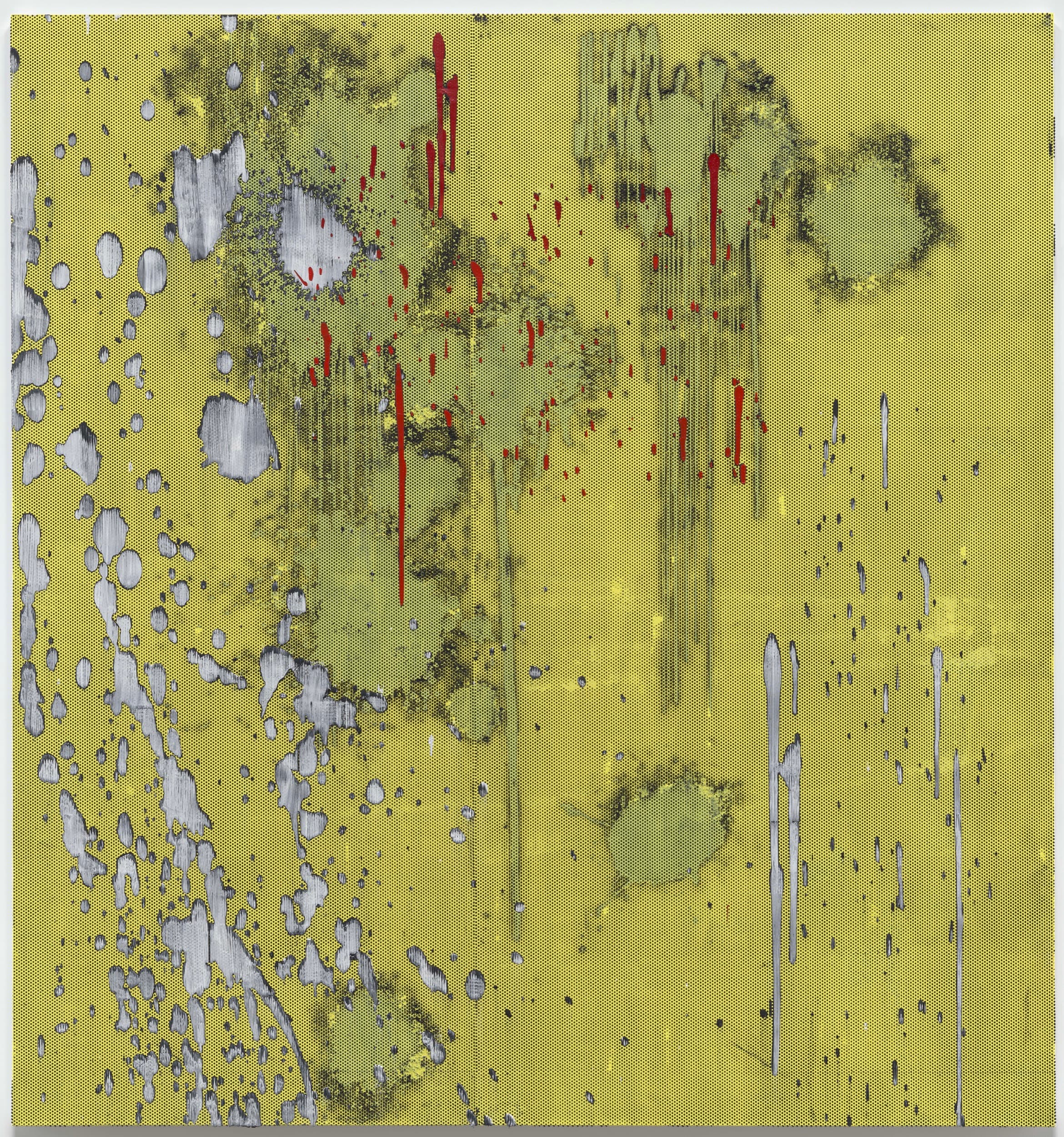
Jacqueline Humphries, JH123, 2024. Oil on linen, 96 x 90 inches. Courtesy the artist; Greene Naftali, New York; Modern Art, London; and Galerie Gisela Capitain, Cologne. Photo: Ron Amstutz
Humphries: Yes. So now that has become part of my motive: I deliberately make paintings that can’t be photographed. A photograph of a painting is just a photograph. And then I’ve built that idea into other ways of making paintings, through a process where they become just keyboard characters, sort of like burning all the flesh off the painting. What really matters to me is that the painting is in a room and someone is looking at it. The rest is just everything else.
Rail: Who have been some of the artists through the years that you’ve had a meaningful dialogue with about art?
Humphries: Actual dialogue? My friends, Rachel Harrison, Charline von Heyl, Tony Oursler, who I was married to. I like hanging out with younger artists too, like Felix Bernstein, Gabe Rubin, and Alex Kwartler, who was my student at Cooper Union. I also spend a lot of time with my three studio assistants, Peter Granados, Paul Kopkau, and Francesco Vizzini, who are all artists. We travel a lot together. When I was much younger, I was in dialogue with older artist friends like Lawrence Weiner and Tony Conrad. We used to get together and talk about painting more than we do now. As we get older we all sort of disperse our lives. I think at this later stage you just get more into what you’re doing, less focused on what other artists are doing. But certainly my work was formed in that crucible, and it was really fun.
Rail: But one doesn’t have to stay there all the time.
Humphries: Well, you can’t, because then a younger generation comes in and it’s their stage, you know?
Rail: You can’t be twenty on Sugar Mountain.
Humphries: Exactly. I used to tell my students, “Buy into your community. Your opinions about each other’s work are more important than mine.” In my twenties and thirties I had a lot of friends from CalArts—Blake Rayne, Pieter Schoolwerth. And I had this other group of friends from the semiotics program at Brown University. There was a lot of mixing between artists and writers, and we weren’t just talking about art—we were talking about music, we were talking about the novel, we were talking about film, we were talking about everything. I’m not privy any more to the smaller goings-on in the conversations out there, but I know they still exist. They must, otherwise these people wouldn’t be here—that’s why they still come.
Rail: One thing I really miss from those days is zine culture. It was so fragile and personal. That was something the internet completely wiped out in a matter of about three years. Is that an aesthetic that influenced your work in some way?
Humphries: Maybe you’ve seen some of these recent publications I’ve made? One is a zine about the Neiman Marcus painting and the other a more glossy mag about what I call “Pre-Vandalized” paintings. Do you know who Sam Lipsyte is? He’s a novelist who wrote an essay for this one. These are images I pulled off the internet of climate activists throwing paint in museums.
Rail: To me this is a form of iconoclasm: attacking the holy image. And it’s really showing just what power paintings still have.
Humphries: Also, these photographs look like a lot of paintings I made in the past, with these pours, and my fascination with destruction and protest and terrorism—all the fantasies about power. They’re all coming together in this one act, and it’s interesting.
Rail: Even though we’re art people, I can’t really blame them in a way.
Humphries: I have a lot of compassion. Nor do I want them to destroy the Rokeby Venus.
Rail: No, let’s not.
Humphries: I was fascinated with these actions when they were going on—I don’t know if it’s still going on. I wanted to bring these actions into a more contemplative space to say, “Let’s think about this.” There’s the protest itself, and it’s obviously staged to get maximum views on social media, so there’s this viral thing going on. But there’s also this other thing of the joy of throwing paint at a famous painting, you know? Let’s think about that too. Or the joy of this destructive impulse, mixed with desire. We’re protesting the destruction of the world, but we kind of also want to do that: we want to tear it down because the weight of civilization has become too much.
Rail: What is at the root of this impulse?
Humphries: It has something to do with power, right?
Rail: Yes, sure.
Humphries: That is always running through artistic discourse. Roberto Bolaño wrote about that: unknown poets imagining their power, when of course they have no power over anything. Yet they are having a life or death struggle over this kind of poetry as opposed to that kind of poetry.
Rail: Well, I came out of the small press poetry scene and then got into the art world, and I had to deal with these dilemmas. Ultimately I decided these are issues that can’t be resolved. You just have to accept so many conflicts in the culture. I’m sure you’ve had that experience where capital is involved. Fame, money, power. All of these things are so destructive to the creative spirit.
Humphries: And yet this is painting too.
Raymond Foye is a Consulting Editor at the Brooklyn Rail.