Jessica Holmes

Jessica Holmes is a New York-based writer and critic. She is an Art Editor and ArTonic Editor for the Brooklyn Rail.

Mia Westerlund Roosen’s long interest in sculpture’s explicit relationship to the body is palpable when you hang out between Heat and Conical (both 1981), two monumental works that anchor Then and Now, her current exhibition at Nunu Fine Art.
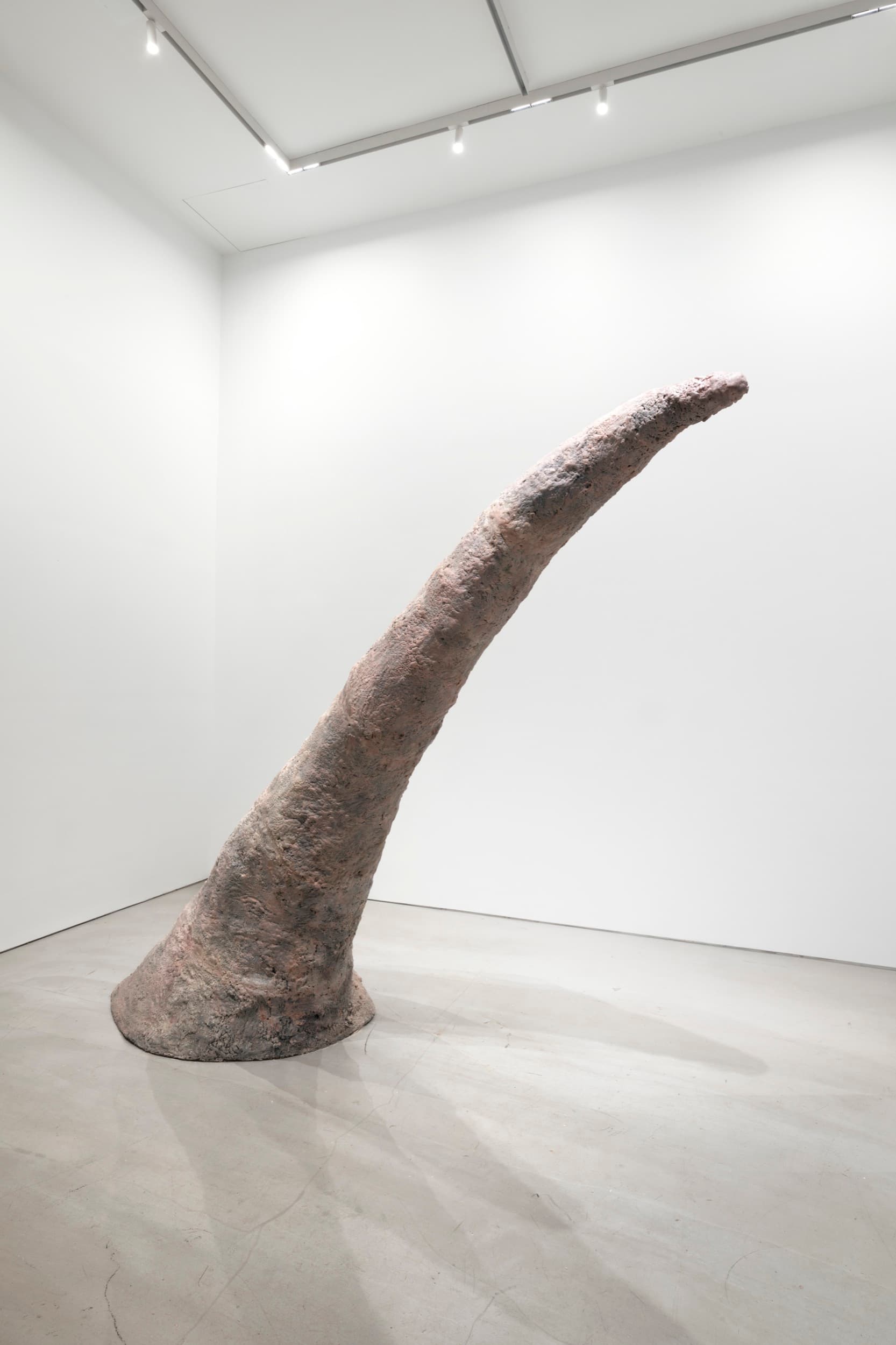
Mia Westerlund Roosen, Heat, 1981. Concrete and encaustic, 154 × 36 × 62 inches. Courtesy the artist and Nunu Fine Art.

The erudite exhibition on view at Sprüth Magers, Echoes & Evolutions: Nancy Holt’s Sun Tunnels outlines the narrative of how Sun Tunnels was birthed, using the artist’s drawings and schematics, models, photography, film, and ephemera to tell its story.

Installation view: Echoes & Evolutions: Nancy Holt’s Sun Tunnels, Sprüth Magers, New York, 2025. © Holt/Smithson Foundation, licensed by VAGA at ARS, New York. Courtesy Sprüth Magers. Photo: Genevieve Hanson.

Until now, most commendations artist Mercedes Matter (1913–2001) received have been made in the same breath as mentions of the New York Studio School, her best-known legacy. The eye-opening mini-retrospective now on view at Berry Campbell seeks to reclaim Matter’s position as a lodestar in the constellation of twentieth-century American art.

Mercedes Matter, Untitled (Maine Landscape), ca. 1957. Oil on board, 16 × 20 inches. © Estate of Mercedes Matter. Courtesy Berry Campbell, New York.

The dual-venue presentation informally begins at Sprüth Magers, where the exhibition, Material, is largely composed of older works.

Rosemarie Trockel, Blind Mother 1, 2023/2025. Diverse print on paper, frame 60 x 58 7/8 × 1 1/2 inches. Courtesy Sprüth Magers and Gladstone © Rosemarie Trockel / Artists Rights Society (ARS), New York. Photo: David Regen.

In one of her best-known poems, “The Soul Should Always Stand Ajar,” Emily Dickinson opines on behalf of receptivity, of being open to the ecstatic experience of being. That just a sliver of Dickinson’s title is used for the exhibition Louise Fishman: always stand ajar at Van Doren Waxter is apropos—the show is a collection of paintings that the artist titled similarly, plucking expressive phrases from poems she loved. 

Louise Fishman, Loose The Flood, 2009. Oil on jute, 66 × 39 inches. Courtesy Van Doren Waxter.

In Alfie Caine’s show, the viewer is invited to consider the myth of the chalk horse through the artist's distinctive frame within a frame: the subjects of his paintings appear set within windows, or viewed as if upon a stage.

Alfie Caine, Chalk Horse, 2025. Vinyl and acrylic on linen, 59 x 78 3/4 x 1 inches. Courtesy the artist and Margot Samel. Photo: Matthew Sherman.

For those committed to the act of looking, those delighted by the parsing of layers, and those intrigued by the hypotheticals of time itself, the recent exhibition of Nancy Goldring’s work at a83 offered a wealth of satisfaction.

Nancy Goldring, Amavarati model, 1997. Paper, graphite and Mylar, 24 1/4 x 20 3/4 x 4 inches. Courtesy the artist and a83.

With more than two hundred works on view, A Black Revolutionary Artist and All That It Implies is a sprawling show that rewards slow looking and repeated visits to absorb Elizabeth Catlett’s artistic prowess as well as her intellectual rigor.

Elizabeth Catlett, Black Unity, 1968. Cedar. Courtesy Crystal Bridges Museum of American Art, Bentonville, Arkansas. © 2024 Mora-Catlett Family / Licensed by VAGA at Artists Rights Society (ARS), NY. Photo: Edward C. Robison III.

In earlier bodies of work, artist Gina Beavers has probed the excesses of late-stage capitalism—especially those that expose the often uneasy relationships we have with our bodies—with a wry, gimlet-eyed humor. Succulent lips, sourced from online makeup tutorials, become macabre valentines, while the fingernails of an over-styled manicure resemble the viscous human heart their hand clutches. Food, a perennial symbol of dissolution, has been a frequent motif in her work.

Gina Beavers: Divine Consumer
When the Rubin Museum of Art closes its doors in October, transitioning from a traditional museum to a “global model” that does not include a physical location, New York will say goodbye to a cultural mainstay in Chelsea for the past twenty years.
Chitra Ganesh, Silhouette in the Graveyard from "The Scorpion Gesture", 2018. Digital animation, 1 min. 22 sec. The Shelley and Donald Rubin Private Collection. Courtesy the artist and the Rubin Museum of Art.
When polymath Peter Nadin moved from New York more than thirty years ago to live at Old Field Farm, his rural property in the Catskill Mountains, he consciously left behind his role as a key figure in the city’s downtown art scene for a more contemplative lifestyle. Despite this, Nadin never stopped painting and two years ago had a debut exhibition at Off Paradise, The Distance From a Lemon to Murder.
Peter Nadin, Sharkey's Donkey Watching a Fish (A Migration of Golden Orfe), 2023. Oil on panel, 77 5/8 x 49 3/8 inches. Courtesy the artist and Off Paradise.
Yves Klein and the Tangible World at Lévy Gorvy Dayan brings together a sumptuous array of Klein’s paintings, performances, films, and ephemera in a powerhouse exhibition that elucidates Klein’s beautiful, singular mind, one that he seems to have fully committed to making art, for art’s sake.
Yves Klein, Anthropométrie sans titre (ANT 77), ca. 1961. Dry pigment and synthetic resin on paper mounted on canvas, 61 × 145 1⁄4 inches. © The Estate of Yves Klein c/o Artists Rights Society (ARS), New York / ADAGP, Paris.
Sculptor Richard Hunt (1935–2023), who died in December at the age of eighty-eight, is honored with a comprehensive exhibition of his early works, currently on view at White Cube. Early Masterworks homes in on the artist’s output from 1955–1969, a fruitful decade that saw the young Hunt—later to become acclaimed for his large, public sculptures—testing, experimenting, and refining the distinctive style that would become his own.
Richard Hunt, Linear Peregrination, 1962. Welded chromed steel, 52 x 66 x 103 inches. © 2024 The Richard Hunt Trust / ARS, NY and DACS, London. Photo © On White Wall.
The exhibition takes its title from the works on view, a selection from Suh’s “Memory Gap” series, all of which are composed on hanji. The paper itself appeals to the senses, thick and creamy, and striated with pulpy veins that suggest the lined and wrinkled hands of your grandmother.
Installation view: Memory Gap: Yoonhee Ryoony Suh, Monira Foundation, New Jersey, 2024. Courtesy the Monira Foundation.
Organized by Buffalo AKG (where the exhibition will travel next year as part of a multi-venue tour), Marisol: A Retrospective now open at the Montreal Museum of Fine Arts seeks to resurrect Marisol’s reputation and shed new light on her recently, and undeservedly, neglected life and career.
Marisol, Mi mama y yo, Buffalo AKG Art Museum, 1968. Bequest of Marisol, 2016, 2018:15a-d. © Estate of Marisol / Artists Rights Society (ARS), New York. Photo: Brenda Bieger, Buffalo AKG Art Museum.
In 1894, John Hyrum Koyle, a Utah Mormon, received a message from the Angel Moroni in his dreams. Moroni, a major prophet of the Mormons and the Latter Day Saint theological movement, instructed Koyle to tunnel a mine through a mountainside located in Salem, Utah, where he would uncover gold and riches that would provide untold financial wealth and security to the church and all its believers, especially through the end times.
Robert Hawkins, Endless Wealth (Relief Mine), 2017-2023. Oil on canvas. 50 x 40 inches. Courtesy the artist and Off Paradise, New York.
Mark di Suvero: Steel Like Paper, now on view at the Nasher Sculpture Center in Dallas and organized by the museum’s Chief Curator Jed Morse, includes thirty sculptures in addition to a wide array of lesser known drawings and paintings. Across these bodies of work, which span from the late 1950s through the present, di Suvero’s much-lauded vitality and generosity of spirit pervades the show, bestowing the viewer with a lingering sense of joie de vivre that is sometimes hard to come by in an oft-antiseptic contemporary museum setting.
Installation view: Mark di Suvero: Steel Like Paper, Nasher Sculpture Center, Dallas, 2023. Courtesy Nasher Sculpture Center. Photo: Kevin Todora.
As frosty air and bleak clouds give way to warmth and color the sense of renewal inherent to blooming tulips and budding leaves becomes palpable. And so it is witnessing the debut exhibition of a young artist full of promise—hope also blossoms. Girl on the Grass, a solo show of ten paintings by New York-based artist Angela China arouses a similar, buoyant expectation.
Angela China, Purple Landscape, 2023. Oil on canvas, 104 x 80 inches. Courtesy Malin Gallery.
Throughout her long career, photographer Uta Barth has probed the limits of human perception through deceptively simple imagery. Sheer curtains, glass pitchers, or bare tree branches are only ostensible subjects, conduits for an ongoing examination of what is her primary implement: light.
Uta Barth, ...from dawn to dusk (December), 2022. Mounted color photographs (pigment prints), dimensions overall: 32 7/8 x 100 3/4 inches, edition of 6, 2AP. Courtesy the artist and Tanya Bonakdar Gallery, New York / Los Angeles.
Though at the outset, his compositions may seem haphazard, the careful viewer will come to appreciate his nimble deflections, crooked pathways, and masks and mirrors that pull you along on one trajectory only to deftly change course. Before you’ve realized it, you’re somewhere else entirely.
Noah Purifoy, The Door, 1988. Construction, 48 x 40 inches. Courtesy Tilton Gallery, New York.
Matthew Wong: The New World, Paintings From Los Angeles 2016 at Cheim & Read allows the viewer space to tune out from the mythological Wong and instead focus on the material Wong.
Matthew Wong, BEACH AT NIGHT, 2016. Acrylic on paper, 12 1/4 x 9 1/8 inches. Courtesy Cheim & Read.
Newman: Notes — Marden: Suicide Notes, now on view at Craig Starr, exhibits two series by twentieth-century icons, Barnett Newman and Brice Marden, that show each artist shifting from painting to a focused exploration of the primordial mark of the line.
Barnett Newman, Note VIII - state I, 1968. Etching, printed in black on Italia white wove paper, 2 15/16 x 5 15/16 inches. Courtesy Craig F. Starr Gallery.
Across the barren landscapes of self-taught artist Marcus Jahmal’s recent paintings, barren trees dot empty horizons, bathed in the hot glow of ambers, burgundies, and reds. Stripped of any foliage, their limbs reach like outstretched arms towards the sky while hollows in the trunks form elongated mouths that look as if they are singing, moaning, or supplicating to the gods.
Marcus Jahmal, Tree still, 2021. Oil on canvas, 60 x 48 inches. © Marcus Jahmal. Courtesy the artist and Anton Kern Gallery, New York.
The accumulations of a sociable, cultivated, and well-traveled lifetime became the subjects of the watercolor paintings now on view in I Love Mud, Philip Pearlstein’s current exhibition at Betty Cuningham Gallery.
Philip Pearlstein, Antiquities on My Shelf I, 2021. Watercolor on paper, 30 x 23.5 inches. Courtesy Betty Cunningham Gallery.
Bruce Conner & Jay DeFeo (“we are not what we seem”) is a testament to the singular relationship, cultivated over decades, between these two stalwarts of the post-war San Francisco cultural scene.
Installation view: BRUCE CONNER & JAY DEFEO: (“we are not what we seem”) Paula Cooper Gallery, New York, 2021. Photo: Steven Probert. Courtesy Paula Cooper Gallery, New York.
In taking bits from across time and genre and processing them through his own synesthetic technique, Banisadr ultimately shucks convention, rendering paintings that are entirely new. It is a deeply intuitive process.
Ali Banisadr, Red, 2020. Oil on linen, 48 x 60 inches. Courtesy Kasmin Gallery, New York.
If someone had asked me six weeks ago to write a review of an exhibition I couldn’t physically go to see, I would have said no. Well, that was six weeks ago. On March 4th, the Met Breuer opened Gerhard Richter: Painting After All, a major show of work by one of the most celebrated artists of the late‐20th and 21st centuries.
Gerhard Richter, Abstract Painting, 2016. Oil on canvas, 78 3/4 × 98 7/16 inches. Private Collection. © Gerhard Richter 2019.
When artist Noah Davis succumbed to cancer in 2015 at the age of 32 he left behind an ambitious body of work. A studio of paintings revealed a flourishing artist already making preternaturally mature work, while a self-conceived exhibition space in Los Angeles, the Underground Museum, attested to the spirit of a social maverick. Rather than being overtly political, Davis’s politics were instead baked into a nuanced and sophisticated body of work.
Noah Davis, 1975 (8), 2013. Private Collection of Martin H. Nesbitt and Dr. Anita Blanchard. © The Estate of Noah Davis. Courtesy The Estate of Noah Davis.
Instigation, Aspiration, Perspiration, form a triumvirate of Pope.L experiences that are, or recently have been, unfolding across New York this autumn. Alongside Choir at the Whitney, member: Pope.L 1978–2001 at the Museum of Modern Art presents a historical survey of some of Pope.L’s most significant performance works. The opening of these shows in October was backdropped by Conquest (2019), a performance commissioned by the Public Art Fund that took place in September, where Pope.L coordinated more than 140 volunteers to undertake one of the artist’s venerable Crawl pieces through the streets of lower Manhattan.
Pope.L, The Great White Way, 22 miles, 9 years, 1 street, 2000–09. Performance. Courtesy the artist and Mitchell-Innes & Nash, New York. © Pope.L.
The drawing is the latest of the works on view at Hauser & Wirth, and was made shortly before Hesse’s premature death from cancer at age 34. Spanning two floors of the gallery, the exhibition proceeds in reverse-chronological order so that the viewer finds herself ambling backwards in time to more tentative beginnings.
Eva Hesse, No title, 1964. Collage, gouache, watercolor, ink and graphite on paper, 11 5/8 x 16 5/8 inches. Allen Memorial Art Museum. Gift of Helen Hesse Charash, 1983.
The Return of Tom Doyle signals an attempt to resurrect the career of a sculptor who in reality never really “disappeared,” but who remained blasé through most of his life to the vagaries of the art world.
Tom Doyle, Shiloh, c. 1959. Found mixed woods, 38 x 40 x 58 inches. Courtesy Zürcher Gallery, New York.
The Birth of the World hangs centrally in the first of the two galleries that comprise the show, positioned as the painting where Miró broke with the style of his earlier work.
Joan Miró, The Birth of the World, 1925. Oil on canvas, 98 3/4 x 78 3/4 inches. © 2018 Successió Miró / Artists Rights Society (ARS), New York / ADAGP, Paris.
What is an artist-endowed foundation? In the nexus of the art world, foundations are often perceived as mysterious nebulas. Unlike museums, which—at their most basic—share a duty to care for and protect works of art, and make them available to a viewing public, artist-endowed foundations are organizations that serve an array of purposes and uphold diverse missions.
Tiffany Foundation Fellows in studio, Laurelton Hall, c. 1920s. Photo: David Aronow. Courtesy The Charles Hosmer Morse Museum of American Art, Winter Park, Florida.
Berlin-based artist Jorinde Voigt is recognized for the luminosity of her cerebral, abstract drawings, which feature mathematical equations and annotations that explore her hermetic belief systems.
Installation view, Jorinde Voigt: Integral, David Nolan, New York, 2018. © Jorinde Voigt. Courtesy the artist and David Nolan Gallery, New York.
Mariko Mori, unafraid to shed the skins of her past, has made a career from surprising contemporary art audiences around the world through a process of constant renewal in her work. But as it turns out, these are not skins of the past but rather strata that are all part of a continuum stretching back into ancient times and forward into the most distant realms of the universe.
Portrait of Mariko Mori, pencil on paper by Phong Bui. Based on a photo by Zack Garlitos.
Though more closely identified with the San Francisco Beat artists and poets of the late 1950s and early 1960s, DeFeo also looked to the Surrealists a generation older than she, and drew from artists such as Yves Tanguy, Marcel Duchamp, and Man Ray, whom she once called her “north star.
Jay DeFeo, Traveling Portrait (Chance Landscape), 1973. Photo collage with acrylic and glue on paperboard. 14 1/2 by 19 inches. Courtesy Mitchell-Innes & Nash.
History is made up of layers. The present, like a creeping vine, overtakes the past and without studied remembrance it becomes easy to forget that times now are not always what times once were.
Thornton Dial, The Color of Money: The Jungle of Justice, 1996. Fabric, shoe, gloves, jigsaw puzzle pieces, artificial flowers and plants, dolls, stuffed animals, rope carpet, toys, cotton, found metal, other found materials, oil, enamel, spray paint, industrial sealing compound, on canvas mounted on wood. 77 x 86 x 12 inches. Courtesy David Lewis, New York. © Estate of Thornton Dial. Collection of the Souls Grown Deep Foundation.
Always taciturn on the nature of his art, Alexander Calder once quipped, “That others grasp what I have in mind seems unessential, at least as long as they have something else in theirs.”
Calder with Cirque Calder (1926–31), 1929. Photo Courtesy of: Calder Foundation, New York. Artist Copyright: © 2018 Calder Foundation, New York / Artists Rights Society (ARS), New York. Photography Credit: André Kertész © Ministère de la Culture / Médiathèque de Patrimoine, Dist. RMN-Grand Palais / André Kertész
A woman, face blemished with grime, sleeps in a half-sitting position, her head propped in one hand. Her body curls protectively against those of two small children. One appears to be only an infant, and the other is wound into a thin blanket fast asleep, shadows encircling her eyes and mouth agape in an expression of utter exhaustion.
Käthe Kollwitz, Municipal Shelter, 1926. Lithograph on off-white wove paper. Signed, lower right. 16 1/2" x 22" (42 x 56 cm). From the edition published for members of the Kunstverein Leipzig in 1926. Knesebeck 226/b. Courtesy Galerie St. Etienne, New York.
His dramatic camerawork draws out the luster of the bronze panels, and the audience is treated to an opportunity to examine their delicate detail in an intimate way.
Hiroshi Sugimoto, Pantheon, Rome, 2015. Gelatin silver print. © Hiroshi Sugimoto.
On the 50th anniversary of Smithson’s Passaic stroll, America is catching up to him in the sense that our assumptions of what a monument is have been deeply shaken, and what was once presumed to be a given now is not.
The portrait’s subject, a young woman with a snub nose in three-quarter profile, stares back at her viewer, the wide-set brown eyes direct but inscrutable. Something wry tugs at the corners of her mouth, leaving her with neither a smile nor a frown.
Marie Darrieusecq: Being Here is Everything: The Life of Paula M. Becker
A convergence of influences is at play across painter Ali Banisadr’s body of work. In writing dedicated to his paintings a reader will find frequent reference to Northern Renaissance and Venetian art, Persian miniatures, as well as more modern touchstones like Francis Bacon and Willem de Kooning. Banisadr has acknowledged the effects of literature and cinema upon his thinking, and although these influences are apparent in his recent exhibition, Trust in the Future, certain paintings achieve something different—and more exciting.
Ali Banisadr, Myth, 2016, oil on linen, 66 x 88 in. (Photo credit: Robert Vinas, Jr, (c) Ali Banisadr, Courtesy Sperone Westwater, New York.)
In the early days of Sue Williams’s career, her work frequently centered on male violence perpetrated on women. Vignettes of rape, sodomy, and battery pervaded her canvases, rendered in comic-book style with figures depicted in black-and-white, and incorporated text.
Installation view: Sue Williams, 303 Gallery, New York, March 2 – April 14, 2017. © Sue Williams. Courtesy 303 Gallery, New York.
For the artist Romare Bearden—born in 1911 in Mecklenburg County, North Carolina—the American South always loomed large. His parents, driven north to Harlem during the Great Migration three years after his birth, quickly established themselves among the burgeoning black intelligentsia. Though Bearden remained an established New Yorker, annual childhood summer trips to visit grandparents who remained below the Mason-Dixon line supplied provocative fodder for his imagination and nourished a lifelong connection to the South.
Romare Bearden, The Conjur Woman, 1979. Collage and acrylic on fiberboard. 6 x 9 inches. Courtesy DC Moore.
Writing in the immediate aftermath of the U.S. presidential election, the craft of criticism feels more urgent than ever, a skill to continually hone at all costs. When I was first asked the question, “What is criticism?” upon entering the Art Writing MFA program at the School of Visual Arts five years ago, I’d suggested that good criticism, in the context of considering art, is a civility.
Across the board, Caitlin Keogh’s work appears at first formally sound and visually engaging. Her paintings, rendered in flat acrylics, display a surface sexiness that draws the viewer in, underscored by a sophisticated color palette.
Caitlin Keogh, Interiors, 2016. Acrylic on canvas, 84 × 63 inches. Courtesy the artist and Bortolami, New York.
What strikes first upon entry to Pace Gallery on West 24th Street is the persistent thrum of muted noise: the creaking of shaky machinery, a droning waaah, an intermittent snippet of what sounds like a vacuum cleaner’s motor.
Installation view: Tim Hawkinson, Counterclockwise, Pace, New York, Feb 26 – Apr 23, 2016. Courtesy Pace Gallery. Photo: Tom Barratt.
“Once you leave New York City, America begins,” or so the old maxim goes. The notion that the city is a threshold, that it stands apart from the rest of the country, is a potent cultural marker, one that many New Yorkers subscribe to.
Nona Faustine, A Proper Place, 2015. Archival pigment print, 26 × 40 inches. Edition of 5 + AP.   Courtesy the artist and Smack Mellon Gallery.
Ralph Eugene Meatyard, a married father of three children, was an optician who lived and worked in Lexington, Kentucky, where he owned an eyeglass shop called “Eyeglasses of Kentucky.”
Ralph Eugene Meatyard, Untitled, 1962. Gelatin silver print, 6 3/4 x 6 1/4 inches. © The Estate of Ralph Eugene Meatyard. Courtesy DC Moore Gallery, New York, and Fraenkel Gallery, San Francisco.
Puerto Rican-born, New York-based artist Angel Otero has refined a singular, labor-intensive process for making paintings. He applies thick oil paint to Plexiglas slabs and allows it to nearly dry before painstakingly peeling the oil skins away and reapplying them to canvas, to which he then adds and scrapes additional paint, resulting in an entirely new composition.
Angel Otero, Wind Chimes, 2015. Oil paint and fabric collaged on canvas, 96 × 72 × 2  inches. Courtesy the artist and Lehmann Maupin, New York and Hong Kong. Photo: Martin Parsekian.
Cranes, steel beams, and industrial rigging don’t easily evoke carnality, sensuality, and human connection, but after reading Mark di Suvero, it might be impossible to subtract these bodily qualities from the artist’s mighty steel sculpture.
Mark di Suvero
Chuck Close once said in an interview in the pages of this publication that “Painting [. . .] makes space where it doesn’t exist, but you relate to it through life experience.” If a viewer takes pause from looking at the new paintings on display in “Chuck Close: Red Yellow Blue” at Pace Gallery in order to observe her surroundings, she will note the insight of that remark.
Chuck Close, Self-Portrait I, 2014. Oil on canvas, 101 7/8 × 84 1/8 inches. Courtesy Pace Gallery. Photo: Kerry Ryan McFate.
Rodríguez Calero—who was born in Puerto Rico but has lived most of her life in New York and New Jersey—is an artist whose methods and processes are so intricate that she has had to invent unique terms of classification to describe them.
Rodríguez Calero, Transcendent, 2013. 48 × 36 in. Courtesy of the artist.
“If you ponder a rose for too long you won’t budge in a storm.” The work of octogenarian artist Emily Mason shares roots with those words by poet Mahmoud Darwish, on the importance of adhering to one’s intuition.
Emily Mason, "Untitled" (2001). Carborundum monoprint on paper, 18 × 19˝. Courtesy of Russell Janis.
In our globalized art world, it is strange that an artist whose work is included in the collections of the Museum of Modern Art, the Whitney Museum, and the Tate Gallery, and who has had more than 75 solo exhibitions since the mid-1950s, could also somehow be considered, if not unknown, then at least not very well known.
Tony DeLap: Painting Sculpture & Works on Paper 1965 – 2013
The danger of the art world constantly searching for the “next big thing” is that quieter, more introspective work, like that of painter Bill Lynch is easily overlooked. Thankfully, he has just been given his inaugural—and posthumous—New York exhibition at White Columns.
Bill Lynch, "Untitled (Waterfall and Pink Flowers)," n.d. Oil on wood, 541/4 × 34 × 1/2 ̋. Image courtesy of White Columns.
Two trains of thought about Larry Clark’s artistic output consistently pervade consideration of his work, which for the past 40 years has almost exclusively examined the debauched underbelly of adolescent life in America.
Larry Clark, "Knoxville II (homage to Brad Renfro)," 2012. Diptych; color photographs and blood on foamcore, each work, 48×96 ̋. © Larry Clark; Courtesy of the artist and Luhring Augustine, New York.
Howardena Pindell has been making work steadily since the late 1960s, when she arrived in New York after receiving her M.F.A. at Yale. A founding member of the landmark feminist artists collective A.I.R. Gallery in 1972, she has taught at SUNY Stony Brook since 1979, all the while consistently producing bodies of work both complex and multifarious.
For a photographer, the prospect of creating an image that will resonate with its audience is no doubt a daunting prospect. Three artists currently on view in Metro at Julie Saul Gallery—Reinier Gerritsen, Adam Magyar, and David Molander—attempt to tackle this problem by stitching together, though varied processes, patchworks of other photographs in order to make a new whole.
Reinier Gerritsen, Fear and Loathing, 2009. Pigment print mounted on Sintra, 2.5 x 43¢Ã¢â??¬. Edition 4/5.
“In place of a hermeneutics, we need an erotics of art.” Susan Sontag offered this challenge to a critic in her 1964 essay, “Against Interpretation.” She argued that the task of a critic was to elucidate for the reader how a work of art “is what it is,” rather than to show “what it means.”
Among the small and passionate subculture of mycophiles, it is well known that there is much joy to be found in methodically combing a damp forest in order to unearth rare fungi. In much the same way, art, like mushrooms, rarely lays bare its secrets.
Installation view. Courtesy of the Journal Gallery.
Interconnections lie at the heart of artist Jason Middlebrook’s work. The uneasy coexistence between natural phenomena and human-made objects, art’s grappling with the places it inhabits, and the collisions of disparate facets of art history all surface in Middlebrook’s paintings, sculpture, and installations.
Jason Middlebrook, "Falling Water," 2012-2013. Styrofoam, steel, water, PVC pipe, plastic, pump, water tank, rubber, chicken wire, insulation, paint. Approx. 30 feet high. Photo credit: Karen Pearson. Courtesy the artist and DODGE gallery, New York.
Inside the Gary Snyder Gallery, a woman struck up a friendly exchange with another viewer about the current exhibition. They were strangers to each other but the connection seemed natural.
Prior to the opening reception of the writer/artist's new show at 1:1 gallery, (Vanishing Art & Hoodoo Metaphysics, September 23 – October 20) a group of students the Art Criticism and Writing M.F.A. program at the School of Visual Arts drove upstate to speak with Peter Lamborn Wilson.
Portrait of the artist. Pencil on paper by Phong Bui.
In the form of a rebus, the announcement translates something like this: “Louisa had a Caesarean. They cut her open and got the baby, and then they stitched her back up. Is she okay? Yes, she’s okay. I am happy.” So wrote Alexander Calder to his sister Peggy in California shortly after the birth of his second daughter, Mary Calder, on May 25, 1939.
Mary Calder Rower, MacDougal-Sullivan Gardens, New York City, 1992. Photograph by Holton Rower. Photograph (c) 2011 Holton Rower. Photo Credit: Calder Foundation, New York / Art Resource, N Y.

Close

Home