Mercedes Matter
Word count: 837
Paragraphs: 8
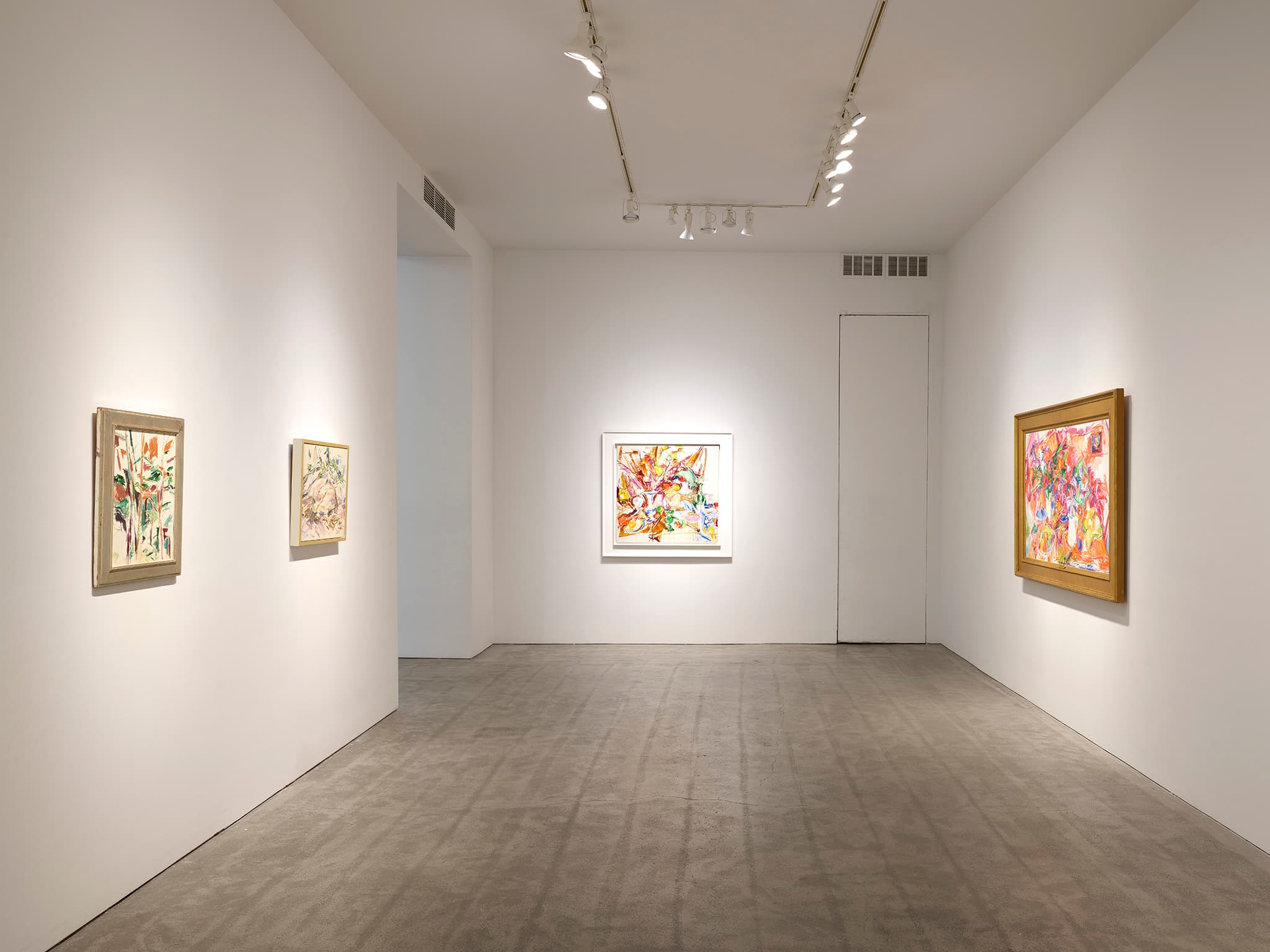
Installation view: Mercedes Matter, Berry Campbell, New York, 2025. Courtesy Berry Campbell, New York.
Berry Campbell
September 5–October 4, 2025
New York
Until now, most commendations artist Mercedes Matter (1913–2001) received have been made in the same breath as mentions of the New York Studio School, her best-known legacy. As founder of the school in 1964—the year after she published her manifesto, “What’s Wrong With U.S. Art Schools?” in ARTnews—Matter became synonymous with the institution, where she continued to teach until only a year before her death. She was a formidable instructor, consigned to the philosophy that the truest path to becoming an artist lay in a commitment to the studio and working from one’s own life and experience, combined with a belief that learning to draw well was foundational to an art education. To add to this, Matter was undeniably glamourous; elegant and urbane, she was born into a richly artistic family (her father was the painter Arthur Beecher Carles, and her mother Mercedes de Cordoba was a dancer and sometimes-model for photographer Edward Steichen) and grew up among creatives and intellectuals throughout a peripatetic childhood.
Matter resolved to become an artist at an early age, and she did so, with remarkable focus and tenacity. After studying briefly with Alexander Archipenko, she began taking classes with Hans Hofmann at the Art Students League, who would prove to be a lasting influence. By the mid-1930s, she was an active artist for the Works Progress Administration and included among the founding members of the historic and influential group, Abstract American Artists. Later, she was an essential comrade (and only one of three women) in “The Club,” the crowd of New York-based Abstract Expressionists who met regularly at the Cedar Tavern for discussion, debate, and hard drinking. However, it’s an age-old tale that when a woman is empirically good-looking—and with renown for teaching, to boot—her own intellectual and creative achievements can easily fall by the wayside. This seems to be the fate from which Matter’s body of work has suffered.
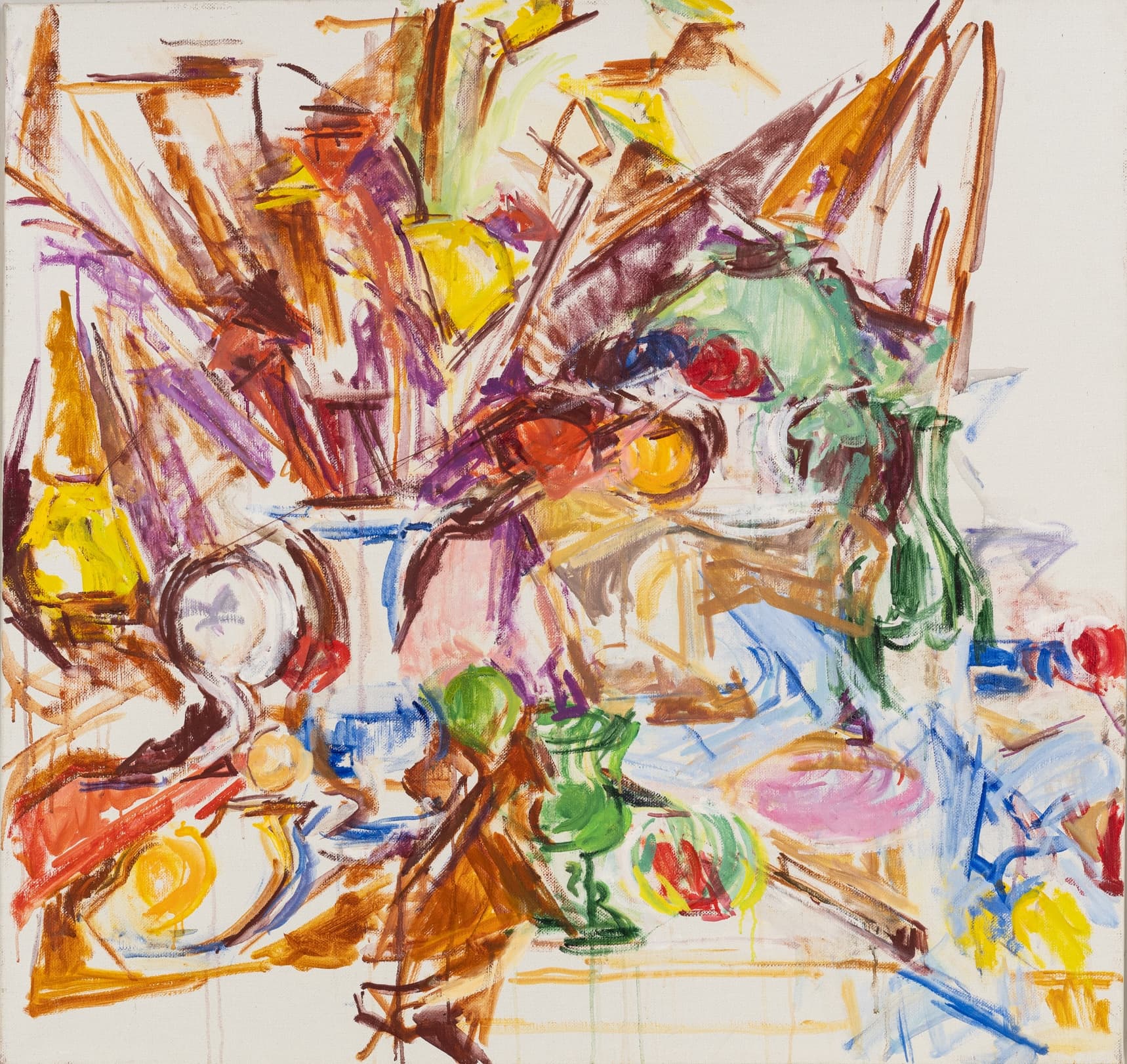
Mercedes Matter, Untitled (Still Life), ca. 1978. Oil on canvas, 38 × 40 inches. © Estate of Mercedes Matter. Courtesy Berry Campbell, New York.
The eye-opening mini-retrospective now on view at Berry Campbell seeks to reclaim Matter’s position as a lodestar in the constellation of twentieth-century American art. Beginning with a small selection of early 1930s charcoals from her student years with Hofmann, where her aforementioned fidelity to drawing is already evident, the exhibition spans nearly six decades of her career, allowing the viewer to appreciate her precocious growth as an artist and follow that line through her mature output. Among her peers, Matter developed a singular practice that hovered fruitfully between abstraction and figuration. A youthful, untitled self-portrait from around 1935 even then displays her concerns—a regal Mercedes with an imperious stare and chin held high looks down upon her audience as her face fragments into geometric slivers of black and white, blue, and red.
An untitled work from about 1942 shows her experimenting with brushstrokes, as well as the proportions of painted and unpainted canvas; by the latter half of the decade, these considerations coalesced into a sprightly and musical visual language. Another untitled work from around 1948 tells much using a modicum of paint. Matter’s amber, ochre, and pewter gestures seem to erupt from a central point along the bottom edge, scattering across its plane in an economical dance that helms the surface while also ceding to its innate austerity. A masterful work from ca. 1956—one of the rare occasions where she worked on a larger canvas—exhibits an inclination towards narrative without ever diving directly into it. As the eye crosses the horizontal, alighting on daubs of paint in aubergine, apricot, and slate, certain of her forms seem to knit together to suggest an airplane’s wing, the mouth of a beast, a flag in the wind—before disassembling again into lilting and provocative brushwork.

Mercedes Matter, Untitled (Maine Landscape), ca. 1957. Oil on board, 16 × 20 inches. © Estate of Mercedes Matter. Courtesy Berry Campbell, New York.
These hints towards the representational became more pronounced as the decades wore on. Matter made shrewd and playful use of both still life and landscape painting, using their time-honored precepts to reinvent the genres according to her precise vision. In a vivid still life (ca. 1978), the suggestion of a vase with flowers, a drinking goblet, and a tabletop lamp are all referenced within the frame without explicitly giving way to formal likeness. Sparing strokes in earthen and verdant tones move from left to right in a Maine landscape (ca. 1957), setting up the structure of a landscape painting but not succumbing to actual depiction of trees or skyline, meadow or sea. Yet, the feeling of gazing across a panorama is unequivocal.
“Everything moves so fast; the changing of the avant-garde is as swift as the time to make something real is slow,” Matter lamented in her 1963 tract, a contention that seems as fresh today as when she wrote it. “The surface of the scene is as noisy and variable as the resistance of one artist of conviction is stable and quietly unyielding.” Matter’s work pulls us up short and plants us firmly among something that is actual and true, made by an artist who refused to yield.
Jessica Holmes, a co-editor of the Artseen section for the Brooklyn Rail, has also contributed to its pages for over a decade. Her writing has also featured in BOMB, Hyperallergic, New York Observer, Vanity Fair Spain, among many others, and has been included in over two dozen exhibition catalogues and monographs. Previously, Jessica worked for the Calder Foundation for nearly two decades, including six years as its Deputy Director.