Hovey Brock

Hovey Brock is an artist and has an MFA from the School of Visual Arts Art Practice program. He is a frequent contributor to Artseen. hoveybrock.com

In The God of the Bay of Roses, eighteen contemporary artists react to the eponymous painting from 1944, made by Salvador Dalí when he was living in exile in California, through their own paintings and sculptures.
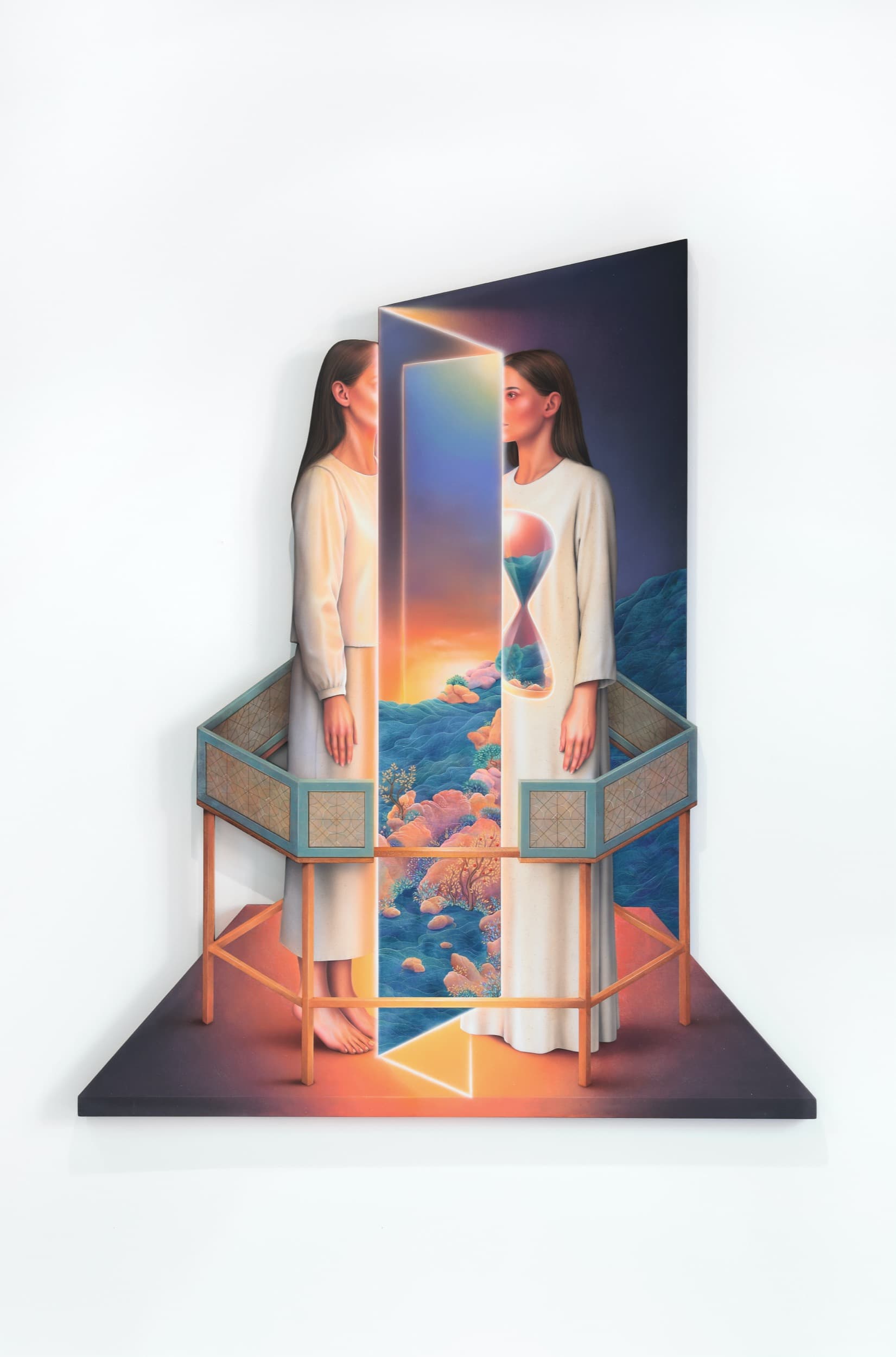
Arghavan Khosravi, Through the Hourglass, 2025. Acrylic on canvas mounted on shaped wood panel, 50 × 60 × 1 ½ inches. © Arghavan Khosravi. Courtesy the artist and Main Projects.

After nearly five years, German artist Thomas Scheibitz returns to the United States with Argos Eyes, named after Argos Panoptes, Hera’s giant watchman whose body was covered with eyes. Representations of eyes abound in this show’s paintings and three-dimensional constructions.

Thomas Scheibitz, Argos Eyes, 2024. Oil, vinyl, and pigment marker on canvas, 98 1/2 x 66 3/4 inches. Courtesy the artist and Tanya Bonakdar Gallery, New York / Los Angeles.

Other Beings: Four Painters Bringing Roughly 20 Unique Faces at Bill Arning Exhibitions is a group show of portraits by Hannah Barrett, Richard Butler, James Esber, and Cruz Ortiz.

Cruz Ortiz, Yanaguana Girl in Piedras Negras, 2024. Oil on canvas, 16 x 12 inches. Courtesy the artist and Bill Arning Exhibitions.

While Catskill Art Space’s group show James Esber, Jane Fine, J. Fiber, Tracey Goodman, Jim Lee has no thematic throughline, the works in each gallery emphasize a distinct creative faculty.

James Esber, Yes, Love, 2021. Acrylic and ink on paper, 9 x 12 inches. Courtesy the artist.

Nine contemporary artists explore the origins and consequences of the climate crisis through textiles, sculptures, paintings, installations, drawings, videos, and even scents in Displacement at the MassArt Art Museum.

Displacement
Gary Gissler’s exhibition there there amounts to a mini retrospective of his meticulously executed paintings and drawings. His work as a psychoanalyst has given him intimate knowledge of the limits of speech as a medium for interpersonal communication. For the last twenty years, he has combined traditional art materials, such as oils, gesso, and ink, with collage elements like linen and mylar to explore the ways language both conveys and conceals meaning.
Installation view: Gary Gissler: there there, 1053 Gallery, Fleischmanns, NY, 2023. Courtesy 1053 Gallery.
Ovation, a solo show of oil paintings by Eva Lundsager, extends the artist’s long-standing investigation of abstract landscape. Over the last thirty years, she has honed her painting language into a polished vocabulary of gestures: drips and pours, wet into wet, calligraphic line, and more.
Installation view: Eva Lundsager: Ovation, Praise Shadows Art Gallery, Brookline, MA, 2023. Courtesy Praise Shadows.
Minerva Cuevas’s research-based, socially engaged art makes manifest the latent connections between ethno-nationalism, income inequality, the climate crisis, and neo-colonialism.
Installation view: Minerva Cuevas: In Gods We Trust at kurimanzutto, New York, 2023. Courtesy the artist and kurimanzutto, Mexico City / New York. Photo: Genevieve Hanson.
The throughline for all three artists is an insistence that what we overlook, reject, or discard is precisely what we need to connect with.
Installation view: Samuelle Green, Catskill Art Space, Livingston Manor, NY, 2023. Courtesy the artist and Catskill Art Space. Photo: Zach Hyman.
With gob-smacking visual impact, Kimono Style showcases the sophistication of Japanese production techniques, traditional and industrial, in the service of intricate textile designs that range from the elegant to the bold.
Meisen Kimono with Large Checkered Pattern, Showa period, 1930s. Plain-weave machine-spun silk in resist-dyed large ikat (ōgasuri) with gold-thread weft, 59 × 49 inches. Promised Gift of John C. Weber. Courtesy The Metropolitan Museum of Art.
Much of the sculpture in this maiden exhibition has a post-Minimalist vibe that feels right at home in the spare elegance of the former showroom space, but even those pieces that skew toward something more figurative benefit from Assembly’s spaciousness and natural light. If you’re heading upstate this summer, put Assembly 1: Unstored on your itinerary.
Installation view: Assembly 1: Unstored, Contemporary Sculpture from Mexico, Assembly, Monticello, New York, 2022-23. Courtesy Assembly.
Named for Veruca Salt’s 1994 grunge hit, Seether is composed of artworks by Alexandra Hammond, Jackie Slanley, and Virginia L. Montgomery (VLM) that invoke resistance and rebirth through themes found in nature and myth.
Installation view, Seether, BEVERLY'S, New York, 2022. Courtesy of BEVERLY'S.
Whitfield Lovell returns to DC Moore for his second show, Le Rouge et Le Noir, which borrows its title as much from Nina Simone’s rendition of Jacques Brel’s “Ne Me Quitte Pas” (“Do Not Leave Me”) as Stendahl’s novel. The title also refers to the two bodies of work in the gallery. One, titled “Reds”is a series of assemblages pairing vintage objects with black conte crayon drawings on red paper. The other, titled “Winterreise” (“Winter’s Journey”) after Schubert’s 24 song cycle, has silver conte crayon drawings, some paired with objects, some not, on black paper.
Installation shot, Whitfield Lovell: Le Rouge et Le Noir. Courtesy DC Moore Galley.
Eva Davidova’s Global Mode > Omnivores is an ambitious project that takes on a swath of topics—politics, history, climate change, the mythopoetic—in new media works by Davidova and her guest artists.
Eva Davidova, Cassandra > Low Witness Objects, 2020. Courtesy Instituto Cervantes NY.
Double Take brings together five paintings from 2020–21 and 33 photographs by the New York-based artist Erick Johnson. Taken over the last five years, the 33 untitled photographs come from Johnson’s Instagram feed @erickjohnson9. Mostly taken in New York, each one is a street scene that somehow triggered Johnson’s aesthetic sense.
Installation view: Erick Johnson: Double Take, Brattleboro Museum of Art, Vermont, 2021. Courtesy Brattleboro Museum.
Kozloff brings to bear her considerable Pattern and Decoration chops, reinterpreting with bold compositions and colors the plans created by Union and Confederate soldiers. On every map, she also paints renderings of the COVID-19 coronavirus, juxtaposing past and present in an urgent appeal to confront the forces—political, economic, and cultural—that have made this country as divided as it has ever been since the Civil War.
Joyce Kozloff, Uncivil Wars: Battle of Vicksburg, 2020. Acrylic on canvas, 60 x 40 1/4 inches. Courtesy the artist and DC Moore Gallery, New York.
Lost & Found is an invitation to stop, take a breath, and engage with these artworks sans an agenda, perhaps to discover the unexpected.
Kayode Ojo, Ice Queen, 2020. Zara Sequin Knit Dresses, Voarge Set of 20 Keyrings with Stainless Steel Key Rings, Carabiner Hooks with Key Fob 25 mm (Silver), Ikea TobiasChairs, Clear Amac Boxes, Glacier Bay Beveled Edge Bath Mirrors, Victorinox Swiss Army Knives silvertech, 48 x 72 x 30 inches. Courtesy Martos Gallery.
This exhibition extends James Hyde’s current practice of combining photographic imagery with paint and other materials on a variety of flat surfaces, including linen, board, and steel. Playing with the conventions of painting, these works have aesthetic appeal, but Hyde is after bigger game.
James Hyde, Tumble, 2015. 16 x16 inches. Courtesy Freight + Volume, New York.
Jones’s paintings are painstaking explorations of the disjunction between the world as it comes to us through our senses—the information we consume during our waking hours—and the world of our interiority—memories, imaginings, and reflections.
Mary Jones, Hatchling, 2020. Oil, silver leaf, spray paint, and feathered wallpaper on canvas, 11 x 14 inches. Courtesy High Noon, New York.
Individually, the artworks by Letha Wilson, Sonia Almeida, Heidi Norton, and Claudia Peña Salinas offer much to appreciate. Collectively, they enjoy lively correlations of color, texture, materials, techniques, and imagery. They also raise questions about the relationship between nature and artifice, a pairing that has only become more complicated with the climate crisis. Sussing out how these artists connect and at times diverge on that topic is the real pleasure of Vantage Points.
Installation view: Vantage Points, GRIMM, New York, 2020. Courtesy the artists and GRIMM Amsterdam | New York. Photo: Pierre Le Hors.
David Levi Strauss’s Co-Illusion: Dispatches from the End of Communication (2020) asks the fundamental question about the Trump presidency: “How did we get here?”
David Levi Strauss's Co-Illusion: Dispatches from the End of Communication
Workers don’t sacrifice their time and energy on a whim to agitate for better working conditions. As is happening to so many other workers today, the adjuncts are fighting because their backs are against the wall.
Because of a growing understanding of their importance to world climate change, the tropics of South America loom large in the popular imagination of Americans but still feel as remote, to most of us, as the bottom of the sea. Not so for Tatiana Arocha.
Tatiana Arocha, El Valle de los frailejones, 2019. C-print on canvas hand-painted with gold acrylic, 30 x 8 1/2 feet. Photo: Timothy Lee Photographers.
Communicating why another artist’s work matters—to me, or anyone else—forces me to flex the same muscles that I use to discern the germ within the husk of my painting habit. Art, if it deserves the name, demands that I meet it on its own terms, where I least expect it: at the margins, in the interstices, in the places I thought I knew and consequently ignored.
Joan Synder, Winter Rose, 2014. Oil, acrylic, paper mache, pastel, and glitter on linen, 64 x 30 inches. Courtesy the artist.
James Prosek's love affair with trout fishing at age nine has turned into a life-long obsession with the natural world. After consulting with biologists about trout species at age 11, he realized that there was a profound mismatch between the way scientists classified trout and the way trout actually appeared in nature.
Portrait of James Prosek, pencil on paper by Phong H. Bui.
The paintings are visually seductive, but their very opulence overwhelms any sense of connection to Klinghoffer’s life. All we can really see are beautifully airbrushed surfaces, while objects that connect us to Klinghoffer’s personal history fade into the background.
Installation view: Rachel Klinghoffer: Suspended in My Masquerade, Ortega y Gasset Projects, Brooklyn, 2020. Courtesy Ortega y Gasset Projects.
Starting out as a graffiti artist in Paris and its banlieues—the suburbs that house so many low-income immigrants—JR quickly realized that his real calling was documenting, through photography, the lives of those who inhabit the city’s grittier neighborhoods. Portrait of a Generation was the public project that launched his reputation.
JR, Migrants, Mayra, Picnic across the Border, Tecate, Mexico--U.S.A., 2017. Installation image. Wheat-pasted poster on table. © JR-ART.NET.
Alex Sewell puts his considerable skills to work in paintings with trompe l’oeil flourishes that mimic the effects of pen, pencil, and chalk, as well as illusionistic interiors and landscapes.
Alex Sewell, Into the Void, 2019.Oil on linen, 8 × 10 inches.
Paintings, prints, fabrics, ceramics, furniture, jade carvings, and lacquerware bear elements of Buddhism, Taoism, and folklore. These objects show the fluidity of spiritual and religious beliefs in China, including the fusion of Taoism and Buddhism.
Unidentified artist, possibly Ding Guanpeng (active 1726–71) Luohan, after a set attributed to Guanxiu, China, Qing dynasty (1644–1911). Stone carved in 1757; rubbing 18th or 19th century, ink on paper, 47 1/4 x 20 1/2 inches. Courtesy The Metropolitan Museum of Art.
A dominant strategy for the three artists pits decorative symmetry against the dynamic patterns of living forms.
Installation view: Soft Fascination: Jolynn Krystosek, Erin LaRocque & Heidi Norton, Elijah Wheat Showroom, New York, 2019. Courtesy Elijah Wheat Showroom.
While his art history scholarship has earned David Driskell international acclaim, his paintings and works on paper have yet to receive that level of recognition. Resonance: Paintings, 1965-2002 makes a good case that they should.
David Driskell, Yoruba Forms #5, 1969. Oil on canvas, 41 1/4 x 34 inches. Courtesy DC Moore, New York.
Every drawing in Unmanned, Sarah Grass’s first solo show, is a high-wire act of technical virtuosity.
Sarah Grass, Hermetic Mercury, 2018, Ink on Aqua Resin coated foam, 8 inches. Courtesy the artist and Doppelgänger Projects.
Tim Rollins and K.O.S. was also about the power of love to transform communities. Workshop brings that legacy to life and anticipates the road ahead for Studio K.O.S.
Installation view: Tim Rollins and K.O.S.: Workshop, Lehnann Maupin, New York, 2019. Courtesy the artist and Lehmann Maupin, New York, Hong Kong, and Seoul. Photo: Matthew Herrmann.
Sarah Trigg’s small assemblages of aluminum, resin, acrylic, and other media, combine a painter’s command of color and surface with a sculptor’s penchant for innovative shapes and materials.
Sarah Trigg, Diety of the Farthest Sphere, 2019, acrylic, epoxy clay, and aluminum, 17.75 x 15.25 x 18 inches. Courtesy the artist and Black Ball Projects.
Seldom does a contemporary art exhibit leave an aftertaste of joy. But this one does.
David Weiss, Untitled (from Weltkarten/World Maps 1-14), 1980. Watercolor and ink on paper, 8 1/4 x 10 3/4 inches. © The Estate of David Weiss. Courtesy Matthew Marks Gallery.
Perhaps best known for his canonical essay linking Abstract Expressionism to America’s postwar hegemony, Max Kozloff has left an indelible mark on art history and art criticism, informed by his own practice as a photographer and painter.
Max Kozloff, Creatures From the Orange Lagoon, 2002. Oil on linen, 38 x 48 inches. Courtesy the artist and DC Moore Gallery, New York.
Simms’s reputation rests on his sculptures, which typically include discarded objects. In this show we get six works from across a range of dates from 1992 to the present.
Arthur Simms, The Big Picture, One Halo, Sculptures and Drawings, installation view, Slag Gallery, 2018. Courtesy the artist and Slag Gallery. Photo: JSP Art Photography.
In his essay “The Paranoid Style in American Politics,” the historian Richard Hofstader labeled entire groups as pathological based on their inclinations to see events through the lens of conspiracy.
Mark Lombardi, Bill Clinton, the Lippo Group, and Jackson Stephens of Little Rock, Arkansas (5th version) (detail), 1999. Graphite on paper, 57 3/4 x 78 inches. Collection of Mickey Cartin. Courtesy the Lombardi Family and Pierogi Gallery.
Ann McCoy is a passionate defender of the spiritual in art, particularly what Henry Corbin, in his treatise on the Andalusian Sufi Ibn Arabi, called creative imagination, or, as Ibn Arabi would have put it, “seeing with the heart.”
Ann McCoy, The Invisible College, bronze processional with projections, GRIDSPACE, Brooklyn. Photos Paulina Kim Joo
One of the pleasures of Mural Studies is taking in Krasner’s formal inventiveness as the studies cover an expanse of compositional variations.
Lee Krasner, Untitled Mural Study, 1940. Gouache on paper, 17 x 22 inches. © 2018. Pollock-Krasner Foundation / Artists Rights Society (ARS), New York.
The ten shimmering gouaches at Ellen Lesperance’s solo show at Derek Eller Gallery introduce an artist whose execution and ideas complement each other with rare precision. The works extend Lesperance’s research on the Greenham Common Women’s Peace Camp, a 1981 action by a group of women from Cardiff, Wales.
Ellen Lesperance, “How Does It Feel in Your Chicken Coop, Soldiers? Little Macho Cockrells Parading the Wire? Strutting in Your Dustbowl, Arid and Treeless, You Obey Orders but We Are Free!”, 2018. Gouache and graphite on tea stained paper, wool sweater hand-knit by the artist, 22 x 29.5 inches. Courtesy Derek Eller.
As the title suggests, Declaration, the inaugural exhibition at the Institute for Contemporary Art (ICA), Richmond’s first institution dedicated solely to contemporary art, is a declaration—or more exactly, a series of statements—introducing Virginia Commonwealth University (VCU) as a major player in the art world.
View of the Institute for Contemporary Art at VCU Garden at dusk. Photo: Iwan Baan.
James Hyde has spent the better part of his career investigating the conventions of painting. That inquiry has followed several paths. On one, he has a practice of using non-traditional materials to create two-dimensional compositions, such as chair webbing tacked to the wall, or painting on Styrofoam, glass sheets, metal, and more.
James Hyde, Observatories, 2018, acrylic dispersion on archival inkjet print sealed with urethane and uv varnish on stretched linen, 86 x 44 inches.
In The Thrum and The Thrall, writing desks, drawings, taxidermy dogs, hatboxes, glass heads, and other sundry artworks crowd the viewing room at Marlborough Contemporary.
Robin Winters, The Thrum and The Thrall, installation view, 2018. Courtesy the artist and Marlborough Contemporary, New York and London.
For his first solo exhibition in the United States, London-based artist David Austen presents film, painting, watercolor, and collage made over the period of a decade.
David Austen, Smoking Moon, installation view, 2006. Courtesy Totah Gallery.
If a late Kandinsky and a Fauve-era Matisse had had a love child, and fed it growth hormones, it might look something like Mildred Thompson’s (1936 – 2003) pulsating abstractions from the 1990s.
Mildred Thompson, Radiation Explorations, 1994. Oil on canvas, 81.1 x 133.25 inches. © The Mildred Thompson Estate Courtesy Galerie Lelong & Co., New York
Unlike typical grid painters, Zapkus has no use for reduction. To the contrary, his work strives for a comprehensive grasp of the world around him as each gestural phrase adds up to some kind of occluded sign: a whisper of a flag, the hint of a traffic sign, or a miniature El Lissitzky.
Kes Zapkus, installation view. Courtesy Silas von Morisse Gallery.
Timed to coincide with the Chinese New Year that begins on February 16, 2018, An Assembly of Gods consists of one painting and explanatory panels, which give close-ups of the painting to identify the dizzying number of over 80 gods that populate it.
Anonymous, Chinese New Year Pantheon (detail), Qing dynasty (1644–1911). Ink and colors on paper. 84 1/4 x  44 1/8 inches. Private Collection. Photo: John Bigelow Taylor 2017. Courtesy the Asia Society.
The Whitney Museum’s concurrent exhibitions for artists Jimmie Durham and Laura Owens make for a terrific conversation, a convergence definitely more than the sum of its parts.
Jimme Durham, Self-Portrait Pretending to be a Stone Statue, 2006, Color photograph 31 3/4 x 24 in. (80.7 x 60.9 cm) Collection fluid archives, Karlsruhe, Germany; courtesy of ZKM | Center for Art and Media, Karlsruhe.
Carolee Schneemann’s art has radically re-oriented preconceptions about painting away from the primacy of the visual to the primacy of the haptic.
Carolee Schneemann. Up to and Including Her Limits. 1973-76. Crayon on paper, rope, harness, Super 8mm film projector, video (color, sound; 29 min.), and six monitors. Dimensions variable. The Museum of Modern Art, New York, Committee on Drawings Funds and Committee on Media and Performance Art Funds, 2012. © 2017 Carolee Schneemann. Courtesy the artist, P.P.O.W, and Galerie Lelong, New York.
In Girlhood, Joyce Kozloff has extended her 20-plus year practice of map paintings in a new and very personal direction. During the poignant chore of going through her parents’ effects after their deaths, Kozloff discovered a collection of her grade-school art assignments.
Installation view of Girlhood (Courtesy DC Moore Gallery)
How is satire even possible in the age of Tr*mp, when his words and deeds, in their shamelessness, parody themselves? Peter Saul’s new paintings, with their hyperactive, surrealist blend of Pop Art, art history, and political commentary, gave a pretty good answer in his latest show, Fake News.
Peter Saul, Quack-Quack, Trump, 2017. Acrylic on canvas, 78 x 120 in. © Peter Saul. Courtesy Mary Boone Gallery, New York.
Los Angeles-based artist Amanda Ross-Ho has built a career focusing on the studio as locus, metaphor, and container for the creative process. Keeping her interests tethered to this line of inquiry has given her the freedom to cover a swath of art practices including sculpture, painting, photography, installation, and performance.
Amanda Ross-Ho, Untitled Timepiece (COCA COLA), 2017. Gesso, silkscreen, acrylic, gouache, coffee, wine, and graphite on canvas covered panel, 52 x 52 in. © Amanda Ross-Ho; Courtesy the artist and Mitchell-Innes & Nash, NY.
Maybe Lüpertz is executing a kind of aesthetic Judo throw, redirecting Classicism’s colossal influence on Western painting’s canon into an open, subjective space of a paradoxically “felt” Classicism, something embodied rather than intellectual.
Markus Lüpertz, Narziss I (Narcissus I), 2016,39 1/4 × 32 in. (100 × 81 cm) (Courtesy Michael Werner Gallery, New York and London).
The wave images harbor their own contradictions, or rather multiplicities, as they speak to the double edge of nature’s power—its majesty and its destructive potential, now exacerbated by climate change.
Clifford Ross, Wood Wave LXXX, 2015. Cured inkjet on wood, 74 x 114 in. © Clifford Ross; Courtesy of the artist and RYAN LEE, New York.
Roxy Paine’s first show of his sculptures at Paul Kasmin spans two adjacent spaces in Chelsea. The 293 10th Avenue space has two mordantly funny dioramas and a very disturbing installation of a burnt-out forest floor. The 297 10th Avenue space has eight of his signature Dendroids, stainless steel imitation tree constructions.
Roxy Paine. After the Flood, 2017
stainless steel. 41 3/4 x 55 5/8 x 25 1/2 inches. Courtesy of the artist and Paul Kasmin Gallery. Photo: Christopher Stach.
The archeological record from the Qin and Han dynasties in Age of Empires, which includes over 160 artworks, should be a revelation to anyone who hasn’t had the opportunity to visit China’s leading regional museums in the last twenty-five years. The period it covers, roughly contemporaneous with the rise of Rome up to its imperial heyday, laid the foundations for China’s imperial system that managed to endure, in successive iterations, for another staggering 1700 years.
Strongman, Qin Dynasty (221 - 206 B.C). Earthenware sculpture. 61 3/4 x 29 1/2 inches. Courtesy Metropolitan Museum of Art.
Did you know United States President Teddy Roosevelt had a tat? This and other peculiar facts abound at the New York Historical Society’s 300-year purview of this ancient and universal art form as practiced in the city and its surrounding regions.
John Simon after John Verelst (1648–1734), Sa Ga Yeath Qua Pieth Tow, King of the Maquas, 1710. Mezzotint. New-York Historical Society Library.
For those still wandering around in shock wondering what the next four years will bring, this survey from the museum’s collection of early 20th-century Russian art packs in so much energy, verve, and optimism that it may come as a welcome massage to furrowed brows.
El Lissitzky, Record, 1926. Gelatin silver print. 10 1/2 × 8 13/16 inches.
This first ever retrospective of Kerry James Marshall (b. 1955) at the Met Breuer proves he has pulled off a stunning two-fold accomplishment.
Kerry James Marshall, Past Times, 1997. Acrylic and collage on canvas. 9 feet 6 inches × 13 feet. Metropolitan Pier and Exhibition Authority, McCormick Place Art Collection, Chicago. © Kerry James Marshall. Photo: Nathan Keay, © MCA Chicago.
What’s in a beard? Certainly, when considering the surfaces and materials of Jean Dubuffet’s mature works, the word “rebarbative” (from the Latin barba, meaning beard) comes to mind.
Jean Dubuffet, Rue des Petits-Champs (Bombance), 1962. Gouache. Fondation Dubuffet, Paris. © 2016 Artists Rights Society (ARS), New York / ADAGP, Paris.
With 170-plus examples of haute couture and ready-to-wear designs from the 19th century to the 21st, Manus x Machina largely lives up to its ambitious agenda of examining the symbiosis between traditional handcrafted work and technological innovation in fashion’s history.
Installation view: Manus x Machina: Fashion in an Age of Technology. The Metropolitan Museum of Art, May 5 – September 5, 2016. Lower Level Gallery View: Pleating. © The Metropolitan Museum of Art.
Gerhard Richter has always experimented with a range of production techniques, but in this current exhibition, high touch wins out over high tech.
Gerhard Richter, 14. März 2015, 2015. Oil on color photograph. 4 15/16 x 7 5/16 inches. Courtesy Marian Goodman Gallery.
Iceland has been punching well above its weight in the cultural arena for the last twenty years. Tibor de Nagy’s pairing of two artists from Iceland shows the country’s impact on their sensibilities.
Installation view: Louisa Matthíasdóttir: Icelandic Landscapes and Hildur Ásgeirsdóttir Jonsson: Woven Works. Tibor de Nagy Gallery, May 5 – June 17, 2016. Courtesy Tibor de Nagy Gallery
The cumulative impact of seeing Munch’s work in this exhibit was so strong that upon leaving, the streets of Manhattan almost morphed into the cityscape of Munch’s print Evening on Karl Johan, (1892).
Edvard Munch, The Artist and His Model (1919–21). Oil on canvas. © The Munch Museum Oslo / 2016 Artists Rights Society (ARS), New York.
The twenty-four black-and-white photographs from the estate of master portraitist Peter Hujar (1934 – 1987)included in Lost Downtown, document a pivotal moment in the New York art world and, at the same time, manage to convey something essential about the medium itself.
Peter Hujar, Sidney Faulkner (II), Hospital, 1981. Vintage gelatin silver print, 20 × 16 inches. © The Peter Hujar Archive, LLC.
Lori Ellison’s most recent show, which includes twenty-two works on paper and twenty-three paintings on panel, largely made during the last two years of her life, marks a fitting tribute to a life dedicated to art.
Lori Ellison, Untitled, 2014 – 15. Pencil on notebook paper, 11  × 8 inches. Courtesy McKenzie Fine Art, New York.
MoMA’s not-to-be-missed retrospective of Pablo Picasso’s three-dimensional work fills up its entire fourth floor with 141 pieces across eleven galleries, which span a mind-boggling sixty-two years—from 1902, his last year in Barcelona, until 1964, nine years before his death.
Pablo Picasso, Guitar, 1924. Painted sheet metal, painted tin box, and iron wire, 43 11/16 × 25 × 10 1/2 inches. Musée national Picasso–Paris. (c) 2015 Estate of Pablo Picasso/Artists Rights Society (ARS), New York.
he twenty-two paintings in this ten-year survey of Amer Kobaslija’s work at the George Adams Gallery varied widely in size. The two largest were well over six feet across, while the smallest measured three-and-a-half inches to a side.
Amer Kobaslija, Ruined House Near Kesennuma Port II, 2013. Oil on plexi-glass, 3 1/2 x 3 7/8 inches. Courtesy George Adams Gallery.
Robert Overby, the Los Angeles-based graphic designer, educator, and artist who died in 1993 of Hodgkin’s disease had an art career that never came into national—much less international—prominence during his lifetime. Since then, thanks in part to the efforts of his widow, the painter Linda Burnham, his art has finally gotten the attention it deserves, with solo exhibitions and retrospectives in Europe and the U.S., and a presence at art fairs.
Robert Overby, Loft Window, 5 June 1971, 1971. Latex rubber, 113 × 60 inches. Courtesy the Estate of Robert Overby and Andrew Kreps Gallery, New York.
When I was a child, I had a set of forty colored pencils that I arranged, rearranged, and then rearranged again in a seemingly endless parade of color sequences, or “rainbows,” as I called them. This play brought me great joy.
"Robert Swain: Color Energy," Minus Space, 2015. Courtesy Minus Space.
Joan Snyder’s current exhibition takes its title from the ancient Roman code of party decorum, where the image of a rose on the banquet hall ceiling functioned as an emblem of confidentiality reminding merrymakers to keep secret the indiscretions made by tongues unhinged by wine—not unlike “what happens in Vegas stays in Vegas.”
Joan Snyder, "Winter Rose" (2013). Oil, acrylic, paper mache, pastel, and glitter on linen, 64 × 30 ̋.
Julian Hatton’s recent paintings speak to a healthy self-confidence not only in his artistic process, but also in the very enterprise of abstract painting.
Julian Hatton, "Drift Pin" (2014 – 15). Oil on
canvas, 60 × 60˝.
Hadieh Shafie’s recent works—brilliantly colored rolls and stacks of paper packed into white rectangles, squares, tondos, and even a cube—managed to walk a thin line between painting and object, concept and image, Iran and the West, with rare stumbles.
Hadieh Shafie, "Spike 9" (2015). Ink, acrylic and paper with printed and handwritten Farsi text, "Eshgh" (Passionate Love), 17 x 17 x 3.5".

Close

Home