Daniel Giordano, Davana Robedee, Kathy Ruttenberg
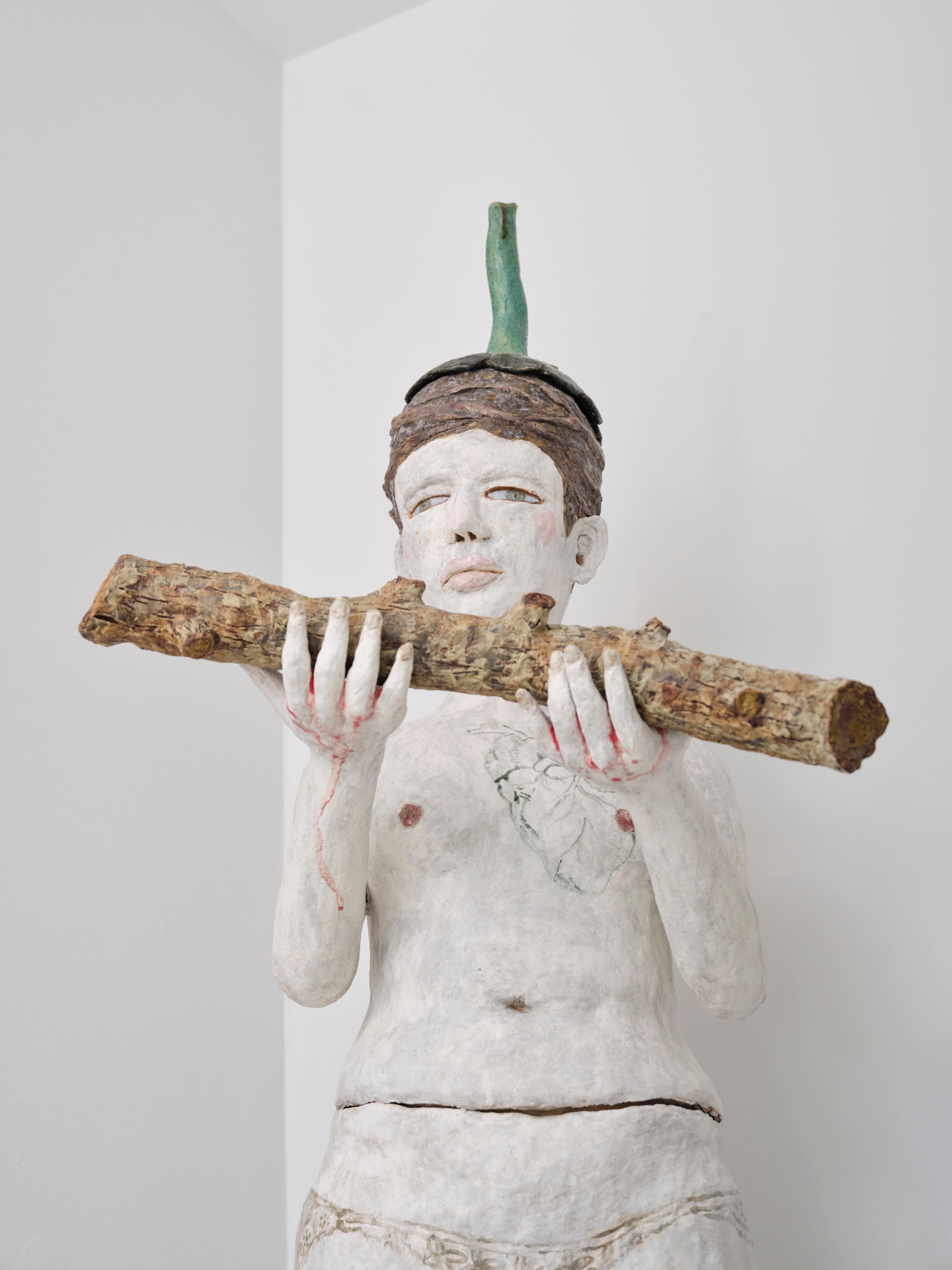
Kathy Ruttenberg, Blood on Her Hands, 2021. Ceramic stoneware, cast concrete. Courtesy Catskill Art Space. Photo: Zach Hyman.
Word count: 789
Paragraphs: 7
Catskill Art Space
March 7–April 25, 2026
Livingston Manor, NY
The artists in the group show currently on view at Catskill Art Space—Daniel Giordano, Davana Robedee, and Kathy Ruttenberg—share a fascination with personal identity. Giordano’s sculptures cobble together food, personal hygiene products, makeup, fabrics, and other unlikely materials in ecstatic expressions of decay. Humor, autobiography, and sense of place drive the logic for assemblages shot through with pathos. Kathy Ruttenberg’s ceramic sculptures borrow from folk art. They show fantastical transformations like those found in myths or fairy tales, but the tableaux they create pose serious questions about ecology and the relationship between animals and humans—particularly women. Robedee’s indigo textiles rely on traditional craft techniques, referring to genetics, hypnagogic awareness, and other topics that concern the physical body. Where Robedee sees her identity as bound up with her embodiment, Ruttenberg focuses on her experience as a woman, while Giordano thinks of his identity within the context of his upbringing.

Davana Robedee, Single Chromosome Handmirror, Chromatin Handmirror, Duplicated Chromosome (L–R), all 2025. Stitch resist shibori, dyed with homegrown and pre-reduced indigo on cotton. Courtesy Catskill Art Space. Photo: Zach Hyman.
Robedee’s installation in Catskill Art Space’s east gallery features indigo wall hangings measuring about 96 by 66 inches, smaller indigo pieces about 8 inches square, and pieces of the same size woven from silk dyed with marigold and gold wire. In the indigo pieces, Robedee gets her patterning through shibori, a traditional dying technique that relies on stitching, folding, twisting, and other manipulations of the cloth (in this case, cotton) that create a range of resists, from total to partial, and thus a range of shades. Three of the large hangings have titles that refer to chromosomes: Single Chromosome Handmirror (2025), Chromatin Handmirror (2025), and Duplicated Chromosome Handmirror (2025). The central motif of all three is created by the fabric fully absorbing the dye to create a dark void that the artist calls a “portal.” Robedee suffers from chronic pain, which has made her acutely aware that the body’s biological mechanisms (for example, chromosomes) are hidden from her conscious control. For Robedee, the body is also a container for life energy or spirit. The paradoxical dualism of body and spirit is a mystery she can grasp through the portals of dreams and hypnagogic consciousness: the title of the silk piece, In Lieu of a Sleep Paralysis Demon… (2026), refers directly to mental states between sleeping and waking.
In the west gallery, Ruttenberg has placed several ceramic sculptures and one tapestry that include figures of women, animals, and plants. Men are absent. A jacquard tapestry, Fertile Ground (2020), amounts to an eco-feminist manifesto. A woman, nude except for a pair of high heels, lies on the ground in the woods, surrounded by all kinds of critters: a snail, a butterfly, a snake, a deer, a squirrel, and even a cat lurking in the upper left corner. A bird perches on her right thigh looking down on a nest with three eggs perched on the woman’s pubis. The woman is a part of nature’s fabric. Her “eggs”—her ability to produce life—suggest an affinity with the rhythms of the natural world. Ruttenberg makes this more explicit in Crossing Corridors (2025), a painted ceramic and metal piece of a kneeling woman turning into a tree that grows out of her back. In her hands she cradles a flower, around whose base lies a fox. Ruttenberg’s figure expresses a nurturing and reciprocal relationship to the natural world that stands against patriarchal models of exploitation and dominance.

Daniel Giordano, from “Study For Brother” series. Courtesy Catskill Art Space. Photo: Zach Hyman.
Giordano’s constructions in the central gallery find inspiration in his “absurdly dysfunctional upbringing” (as he puts it in an artist’s statement) in an Italian American family. A wall of almost thirty works from the “Pleasure Pipe” series refer to the artist’s grandfather, Frank Giordano, who loved to smoke tobacco from a wooden pipe. Here, the “pipes” come in all shapes and sizes. Pleasure Pipe IV (2019–2021) resembles a wooden pipe with a wire topped by a black blob of glass sticking up out of the bowl. At the other end of the pipe, a wire extends from the stem with a red blob of glass on the end. It is an elegant work compared to Pleasure Pipe XXI (2019–2021), made from a plastic asparagus stem with false eyelashes glued to it. Giordano also includes three standing figures in the show—the come from another series, “Study for Brother,” a tribute to his beloved older brother Anthony. Study for Brother as a Cyclops (2017–2025) combines earthworms, gold leaf, “my hair,” and a laundry list of other eccentric materials.
In their rich, detailed artworks, all three artists featured here convey what it feels like to be in their shoes. By doing this, Giordano, Robedee, and Ruttenberg each forge intimate bonds with the viewer that have rare staying power.
Hovey Brock is an artist and has an MFA from the School of Visual Arts Art Practice program. He is a frequent contributor to Artseen. hoveybrock.com