Other Beings: Four Painters Bringing Roughly 20 Unique Faces
Word count: 791
Paragraphs: 7
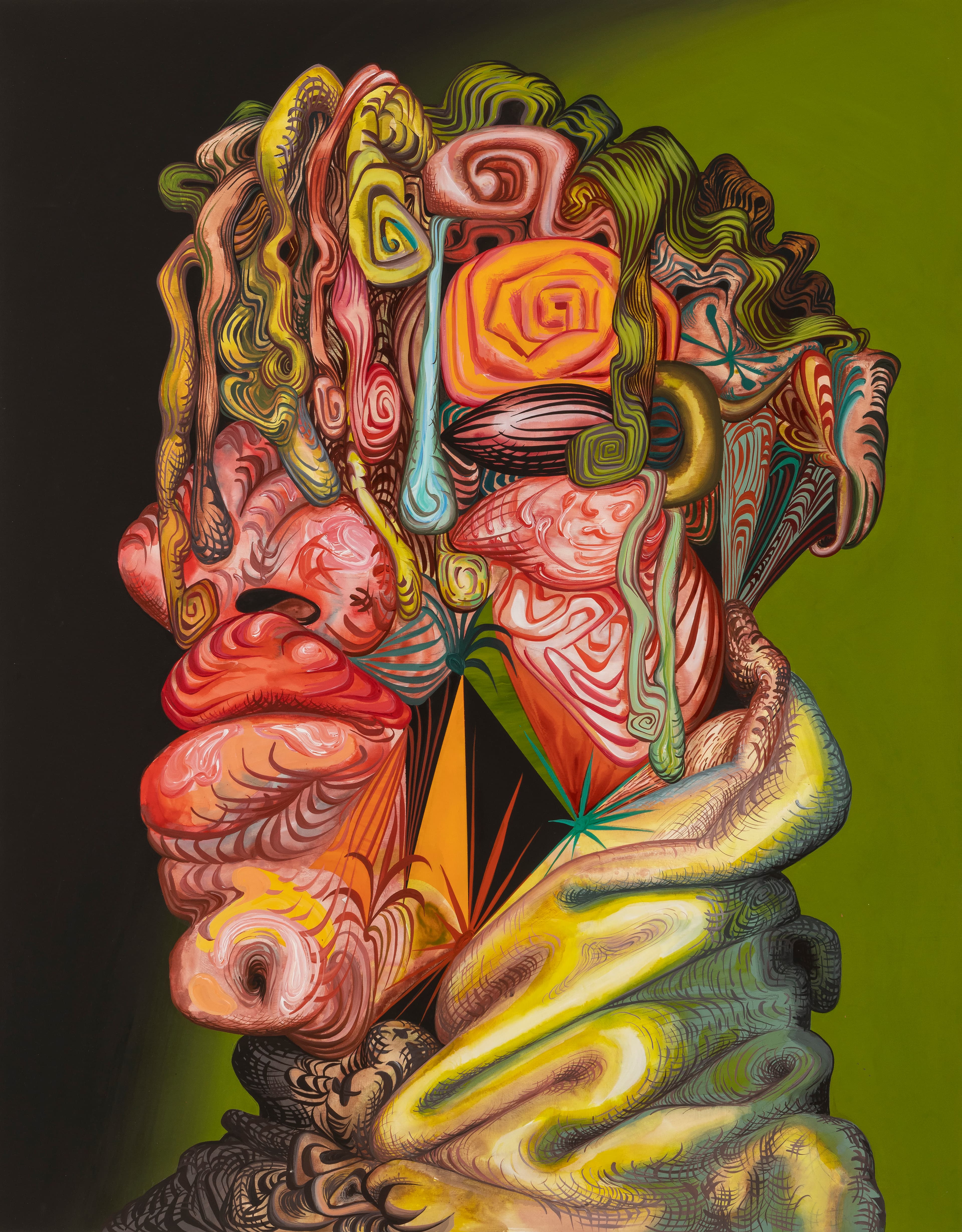
James Esber, Teenager, 2023. Acrylic on PVC panel, 48 x 38 inches. Courtesy the artist and Bill Arning Exhibitions.
Bill Arning Exhibitions
August 16–October 13, 2024
Kinderhook, New York
Other Beings: Four Painters Bringing Roughly 20 Unique Faces at Bill Arning Exhibitions is a group show of portraits by Hannah Barrett, Richard Butler, James Esber, and Cruz Ortiz. Their approaches differ widely. Esber’s heads fuse abstraction and representation. Barrett depicts quotidian scenes with fantastical monsters. Ortiz paints stylized portraits intended to inject the Mexican-American story, particularly the Tejano version, into the greater art conversation. Butler’s pieces come closest to representation, but he distorts his subjects with passages of thick paint. In their own way, each of these artists brings new life to the genre of portraiture.
Over the course of his career, Esber has long alternated between abstraction and representation that has topical overtones. The four heads in this group are recognizable as heads but distorted with surreal flourishes that are both funny and disturbing. The face in Teenager (2023) has a recognizable nose, a chin, and thick lips that look like slabs of raw salmon. The rest of the head is made up of a riot of curlicues and blobs that could pass as hair. Esber articulates these shapes with sharp lines that imitate the strokes of a cartoonist’s crow quill. His practice emphasizes spontaneity, and the fun in looking at Esber’s work is watching his hand do the thinking, so to speak, as it makes decisions on the fly. Considering he works in acrylics, which tend to be unforgiving with mistakes, the surface of Teenager shows no evidence of overpainting. These portraits are high-wire acts that use the vernacular of comic book graphics as painterly pretext.

Hannah Barrett, One Ring, 2022. Oil on canvas, 28 x 22 inches. Courtesy the artist and Bill Arning Exhibitions.
Barrett’s portraits also use humor but in a satirical vein. They show monstrous characters answering to conventional stereotypes in banal workplace situations, such as sitting before a computer or answering the phone. Barrett paints these scenes in a flat, faux-naïve, cartoonish style that allows the artist to manipulate shapes with greater freedom and give colors more intensity. Scented (2022) depicts a monster with horns, fangs, and sultry eyelashes in a cute pink dress replete with capped sleeves and flowers embroidered on the front. Standing against a backdrop of perfume bottles on shelves, they are holding an atomizer in their hirsute, three-taloned right hand, inclining their head slightly to perhaps take in the aroma. The paintings’ amusing swipes at heteronormative markers invite us to abandon stodgy gender binaries and imagine alternative realities. Barrett shows considerable skill with oil paints, achieving surfaces with an even matte finish and precise linear details not so easily executed in that medium.

Cruz Ortiz, Yanaguana Girl in Piedras Negras, 2024. Oil on canvas, 16 x 12 inches. Courtesy the artist and Bill Arning Exhibitions.
Ortiz is a member of Readying the Museum, a cohort which aims to shift the narrative away from Eurocentrism, white supremacy, colonialism, and patriarchy among other barriers that have historically disallowed many artists to participate in America’s museum culture. In this show, most of his portraits feature a woman whose stylized image he repeats over multiple oil paintings whose surfaces have a light, restless touch. She looks Latina by way of Mexican descent with high cheekbones, hoop earrings, and a vaquero hat. 4U (2023), presents a male figure, similarly behatted, painted not in oils as in the woman’s portraits, but with tierra de Terlingua—or “earth from Terlingua,” a town rich in history located in Texas’s Big Bend region along the border with Mexico. The dirt’s origin brings to life la Frontera, or the borderlands, a culture unto itself where Mexican, Anglo, and indigenous influences meld in complex ways. The motto in Spanish and English on the man’s t-shirt speaks to that mix: “Siempre Un Lover 4U.”

Richard Butler, Maggie in Camo, 2020. Oil on canvas, 56 x 40 inches. Courtesy the artist and Bill Arning Exhibitions.
Butler, who founded the post-punk band The Psychedelic Furs after graduating from art school in the late seventies, considers himself a painter who happens to be a singer. The freedom in the way he handles his brush testifies to a lot of practice. As with the rest of Butler’s portraits in this show, Maggie in Camo (2020) casts the subject against a dark background, with the figure’s hair in this case fading into the gloom. The sitter wavers under our gaze, as if we were looking through water. The mood is at once distant and intimate. We seem to be catching her unaware, her eyes downcast as if lost in thought. Paint strokes going off in all directions roil the surface. In Butler’s work, the act of painting appears to be the chief protagonist, with his figures acting as foils for his movement across the canvas. The high levels of expertise and commitment throughout the paintings in Other Beings make a good case for how portraiture can continue to evolve and why this ancient practice still matters.
Hovey Brock is an artist and has an MFA from the School of Visual Arts Art Practice program. He is a frequent contributor to Artseen. hoveybrock.com