Tim Kent: Edges Off A Model
Word count: 855
Paragraphs: 6
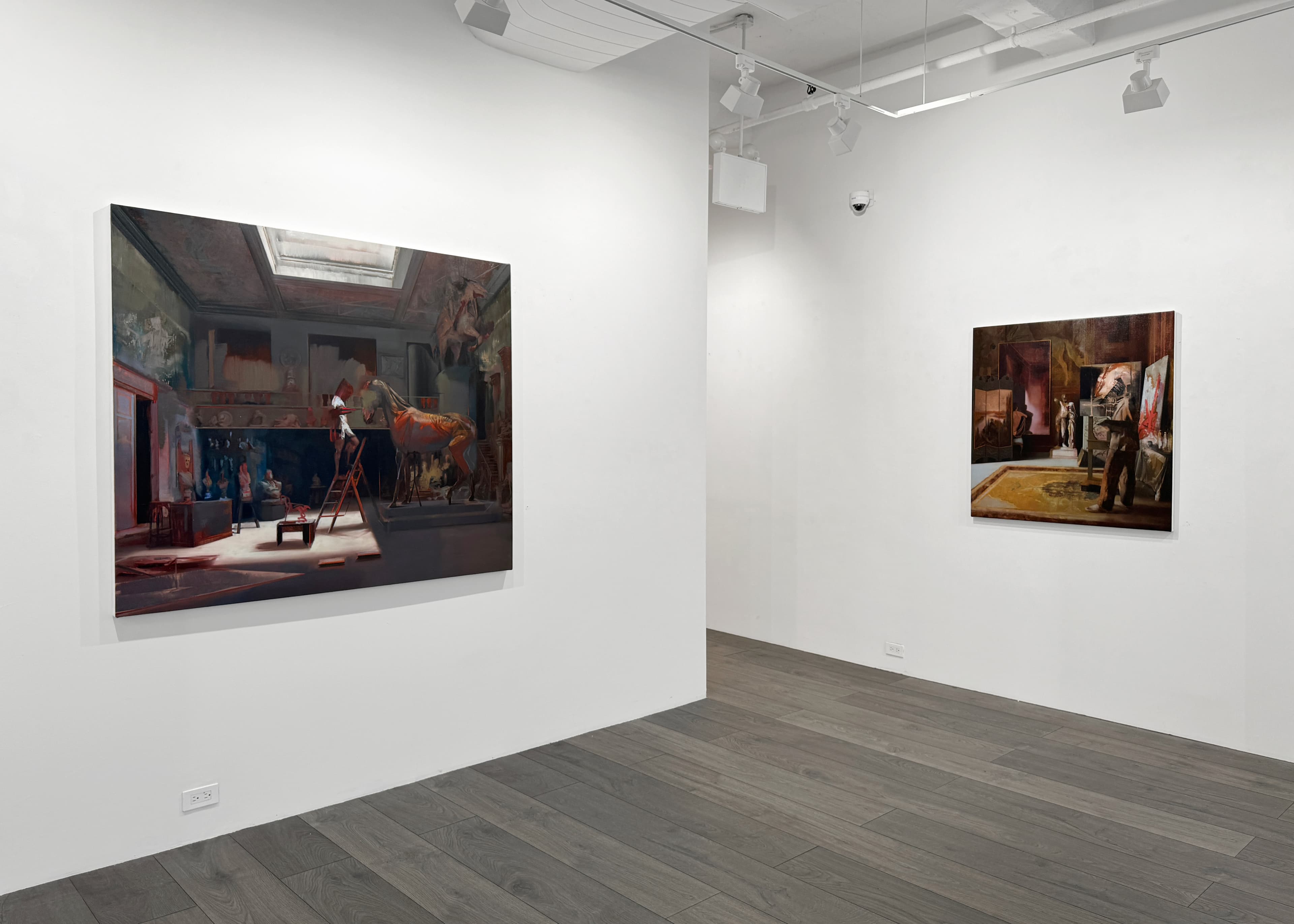
Installation view: Tim Kent: Edges Off a Model, Hollis Taggart, New York, 2024. Courtesy Hollis Taggart, New York.
Hollis Taggart
September 12–October 12, 2024
New York
It’s a distinctively terrifying but delicious feeling to be trapped in a beautiful place. In the paintings now on view at Hollis Taggart, Tim Kent has built a claustrophobic neoclassical mansion in which we can wander endlessly, but we cannot leave. In each room, of which there are nine, we are aware that something is taking place, we just don’t know what. The rich interiors and vaguely furtive figures we encounter are reminiscent of a brainy game of Clue, but Kent pushes the energy way into the darker recesses of the human psyche. There are the accoutrements of luxury: Persian carpets, silk curtains, marble mantels, and of course art, whether paintings, busts, murals, or equestrian sculptures. These treasures are in disarray, often hung in a tight salon-style, with more works piled and leaned on top, often overlapping to conceal explanatory details. In Vault (2024) any approximation of order has vanished and the piled artworks have slipped to block our passage. There is a seemingly useless ladder up to a skylight, but we can’t get out. This isn’t Colonel Mustard in the Conservatory with the lead pipe, but the dusty, tragic imprisonment of Ms. Havisham, or Donald Sutherland being silently hunted by an unknown horror through the crumbling churches and decrepit streets of Venice in Don’t Look Now (1973).
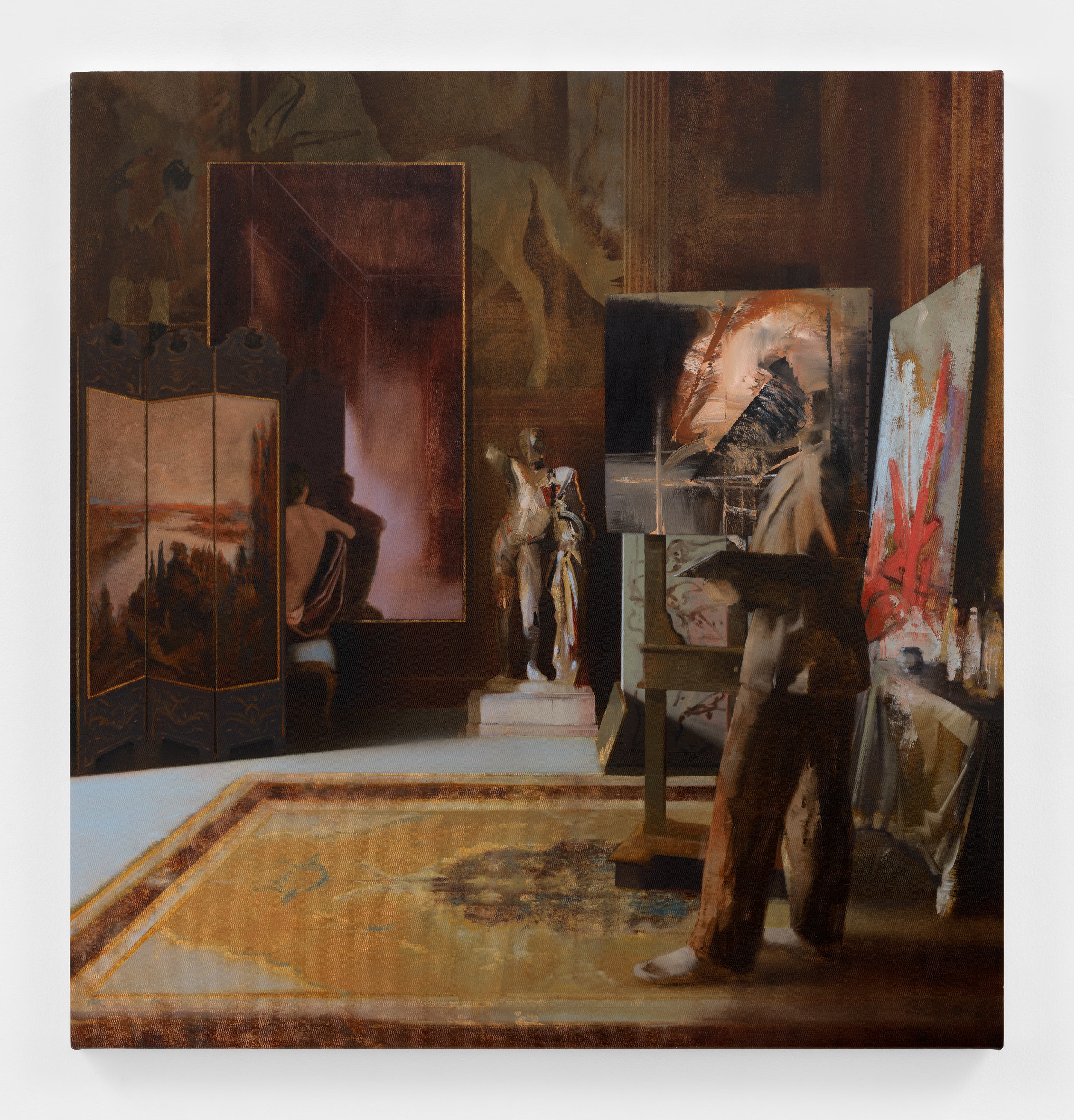
Tim Kent, Venice, 2024. Oil on canvas, 42 x 40 inches. Courtesy Tim Kent and Hollis Taggart.
Kent’s cast of characters are mostly artists and models, and the glorious sitting rooms, galleries, and morning rooms they inhabit are pressed into unlikely service as artist studios. Spattered pigment on the floor and well-worn easels and paint boxes vie with Louis XV Rocaille chairs. Furniture and people are interchangeable: in Venice (2024), the bare back of a nude emerges from the shadows behind a screen, her flesh tones and precise edges indicating she is a real person, while the headless, armless Roman copy of a Greek sculpture to her right is clearly art. But the painter himself is headless, cut off at the chest. In Rose Room (2024), what initially looks like a dark shapeless couch or rug turns out to be a lithe and narrow figure stretched out across the bottom of the picture plane in a very loose kind of anamorphosis, forcing us to shift our viewpoint in order to comprehend its blurry presence in an otherwise crisply-rendered and meticulously geometric space. The airless and claustrophobic atmosphere of these spaces is heightened by indirect lighting and rare presence of windows (we are never allowed to look out of those windows), and there is also the disorienting appearance of paintings within the exhibition also appearing on the walls in the paintings: Kent creates a stifling hermetic system that recalls Alain Resnais’s 1961 Last Year at Marienbad. We are gaining entry, to the painter’s mind, stuck in the metaphorical studio filled with boundless possibilities—simultaneously alone and unable to get away from yourself.

Tim Kent, Legacy, 2024. Oil on canvas, 40 x 38 inches. Courtesy Tim Kent and Hollis Taggart.
But in a larger sense, Edges Off a Model is an acerbic critique of the institutions of art history and art in general. Kent both embraces and lampoons the obsessive and servile devotion to history and precedent embodied by a painter like Giovanni Panini. But while that artist’s tributes to classical culture represent one extreme, the truth is that every artist is embroiled in a love-hate struggle with the various histories of art. In Kent’s case there is also a rebellion against the accepted methodologies of art as well, in particular the constraints of perspective. In Legacy (2024), a tony collector-type stares out at us, possessively guarding his piles of canvases, his face and many of the painted images in the process of melting into oblivion. Take Five (2024) depicts a weary artisan in another roseate chamber filled with Technicolor canvases staring at a lone black-and-white painting of a dusty road to nowhere. Rendition (2024) (a nifty and ambiguous politically charged word) presents an artist standing on a ladder as she puts the finishing touches on a magisterial Trojan horse that seems far too big to even get out of the studio.
But Kent’s simultaneous passion and preferred target is perspective, and his settings—neoclassical and palatial—with their rooms en filade, monumental doorways and ubiquitous moldings, paneling, and wainscoting, are a perfect foil for this guilty pleasure. His rejection of perspective is dramatized by the scaffold: an ambiguous manifestation that indicates both repair and decay, a jumbled series of isometric lines and planes that appears in several works, masking and distorting the pure lines of the stately mansions Kent can’t seem to leave. Ghost of an Idea (2021–22), for example, is a cavernous room which leads into other cavernous rooms. The plaster is falling off the walls, the floors are strewn with drawings and rubble, and a massive scaffold climbs up the wall nearest the viewer. A painter stands in front of an easel quietly working on an inscrutable canvas as if he’s painting something. It takes a minute to realize that there’s no subject facing him, only the crumbling wall and scaffolding itself. There’s nothing—that’s the punchline, painters paint nothing.
William Corwin is a sculptor and writer based in New York. He has been writing for the Rail for fifteen years.