ArtSeenDecember/January 2025–26
The God of the Bay of Roses
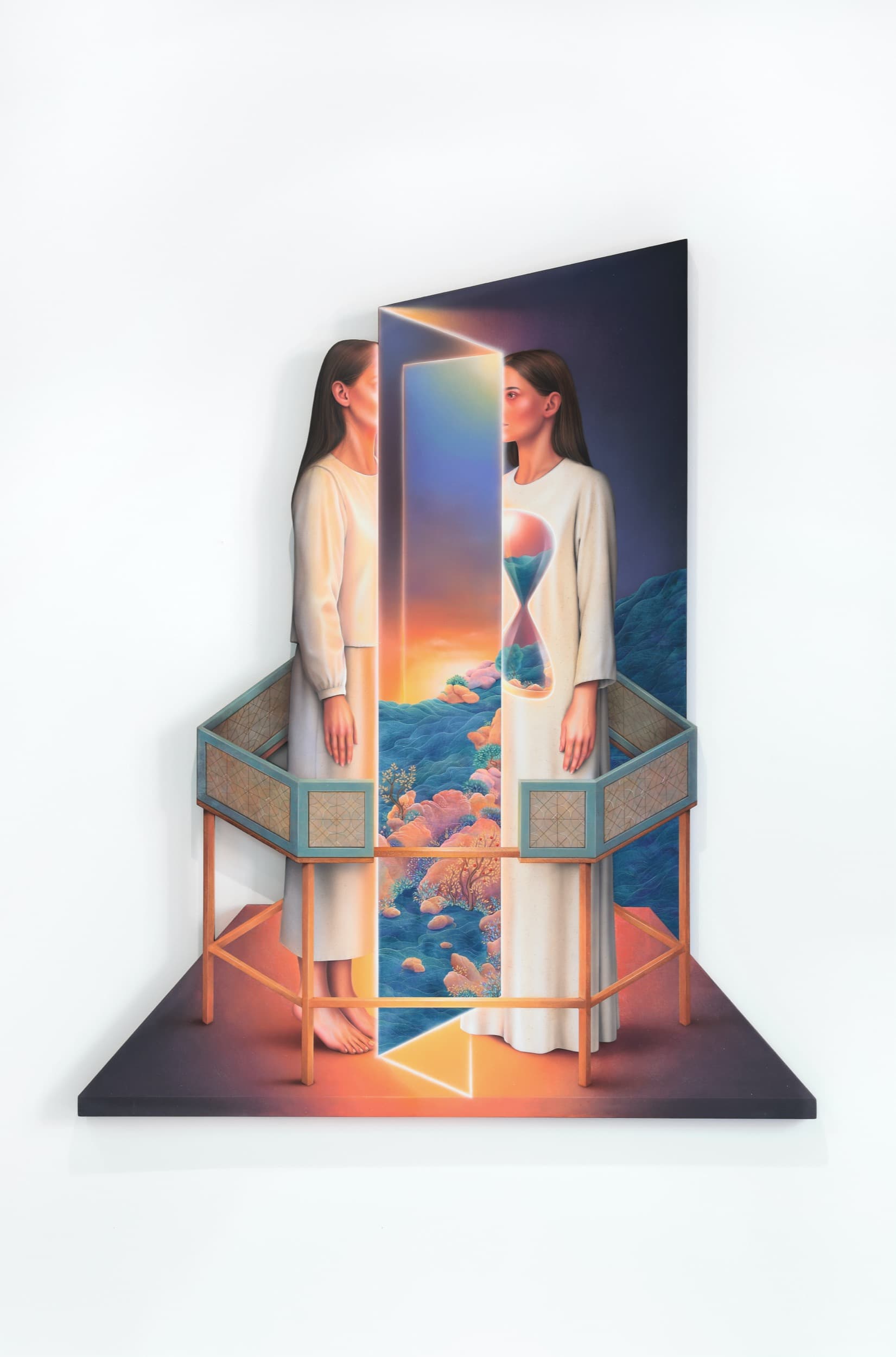
Arghavan Khosravi, Through the Hourglass, 2025. Acrylic on canvas mounted on shaped wood panel, 50 × 60 × 1 ½ inches. © Arghavan Khosravi. Courtesy the artist and Main Projects.
Word count: 763
Paragraphs: 6
Main Projects
October 16–December 18, 2025
Richmond, VA
In The God of the Bay of Roses, eighteen contemporary artists react to the eponymous painting from 1944, made by Salvador Dalí when he was living in exile in California, through their own paintings and sculptures. It’s sobering to consider that Surrealism began over one hundred years ago but feels more relevant than ever as the images in our information feeds have taken a decidedly oneiric turn with generative AI. Conversely, many of the artists in The God of the Bay of Roses match Dalí for vivid imagery while others foreground their materials to build their narratives. All but three of the pieces were made specifically for the show. Seeing how artists put their own spin on the many motifs in the original Dalí is an art history nerd’s delight.

Installation view: The God of the Bay of Roses, Main Projects, Richmond, Virginia, 2025. Courtesy Main Projects.
There’s much to unpack in the diminutive Dalí (held nearby in the Virginia Museum of Fine Arts’s collection): nostalgia, dream logic, references to myth, intersexuality, and the body as psychic crucible, to name the most obvious themes. In an idealized landscape suffused with the brilliant light typical of Dalí’s native Costa Brava, he sets up a dualistic composition of a phallic obelisk of natural rock on the right and on the left a statue of a hermaphroditic deity floating above a plinth surrounded by revelers. The deity has the face of his wife Gala, and a hole where the heart should be.
Arghavan Khosravi’s Through the Hourglass (2025), is a take on this dualistic composition. Painted with a technical virtuosity that rivals the original, Khosravi’s painting shows a young woman looking at a reflection of herself, an hourglass-shaped void in her chest prominent in her mirror image. Khosravi executes Through the Hourglass with glowing colors in the “stacked perspective” of Persian miniatures, as the text for the show puts it, conjuring a scene of quiet self-contemplation perfumed by the figure’s Iranian heritage. Julie Curtiss offers A Room with a View (2025), a still-life of two snails mating on the stem of an artichoke, cleverly invoking intersexuality through the gastropods, which are natural hermaphrodites. Her palette of the vegetable’s green and violet tones echoes Dalí’s color preferences. As the centerpiece of the painting, the edible thistle, at once spiny and luscious, fulfills Curtiss’s quirky meditation on sexual longing. Ryan Driscoll’s The last vision of a forgotten god (2025) takes on the theme of myth head-on. A delicate and controlled painting, intense hues portray an elegiac landscape where divinity, here in the shape of a green horned god—perhaps Cernunnos from Celtic lore—once walked the earth.

Installation view: The God of the Bay of Roses, Main Projects, Richmond, Virginia, 2025. Courtesy Main Projects.
Ginny Casey’s The Shape of a Void, After Dalí’s “God of the Bay of Roses” (2025) mirrors the colors in Driscoll’s and Curtiss’s works. Casey’s piece is more abstract than the Dalí, and her unusual surface, a mixture of watercolor and oil, recalls the experimental techniques of Surrealists like Joan Miró and Max Ernst. Casey reduces the Dalí composition to a trio of forms, one phallic, the second an inverted triangle with a vaginal void, and the third a tiny figure, maybe the progeny of the other two? It is a funny and weirdly affecting piece. Kim Dacres’s pair of totem-like sculptures, Revonda, Preserving Black History on Bruce Street and Patrice, My Gullah Gullah roots go deeper than your dusty lies (both 2024), are the most physically imposing works in the show. Each sculpture has an abstract head mounted on a plinth. The heads look as if they were made of black leather, but closer inspection reveals that the material is recycled bicycle tires. Rather than European references, Dacres turns to traditional Sahel and sub-Saharan African art, whose formal vocabulary had such an impact on early modernism. Shana Hoehn’s Tree Hollow (2025) is the most explicit endorsement of the Surrealist project to re-enchant the modern world by infusing objects and situations with the obscure energies of the Freudian unconscious. It is a hybrid of collage, painting, and sculpture depicting an oddly human-looking tree trunk with a hollow at its center. The crater, which projects in bas-relief from the tree trunk made of painted strips of canvas, takes on a mysterious charge as its empty black center suggests hidden depths, an apt metaphor for the unconscious. Indeed, unlike AI slop, which manages to be banal no matter how strange the imagery, all the works in the show have a power that pulls us in, making the exhibition an honest tribute to the Surrealist icon Dalí.
Hovey Brock is an artist and has an MFA from the School of Visual Arts Art Practice program. He is a frequent contributor to Artseen. hoveybrock.com