ArtSeenDecember/January 2025–26
Dreamworld: Surrealism at 100
Word count: 1652
Paragraphs: 18
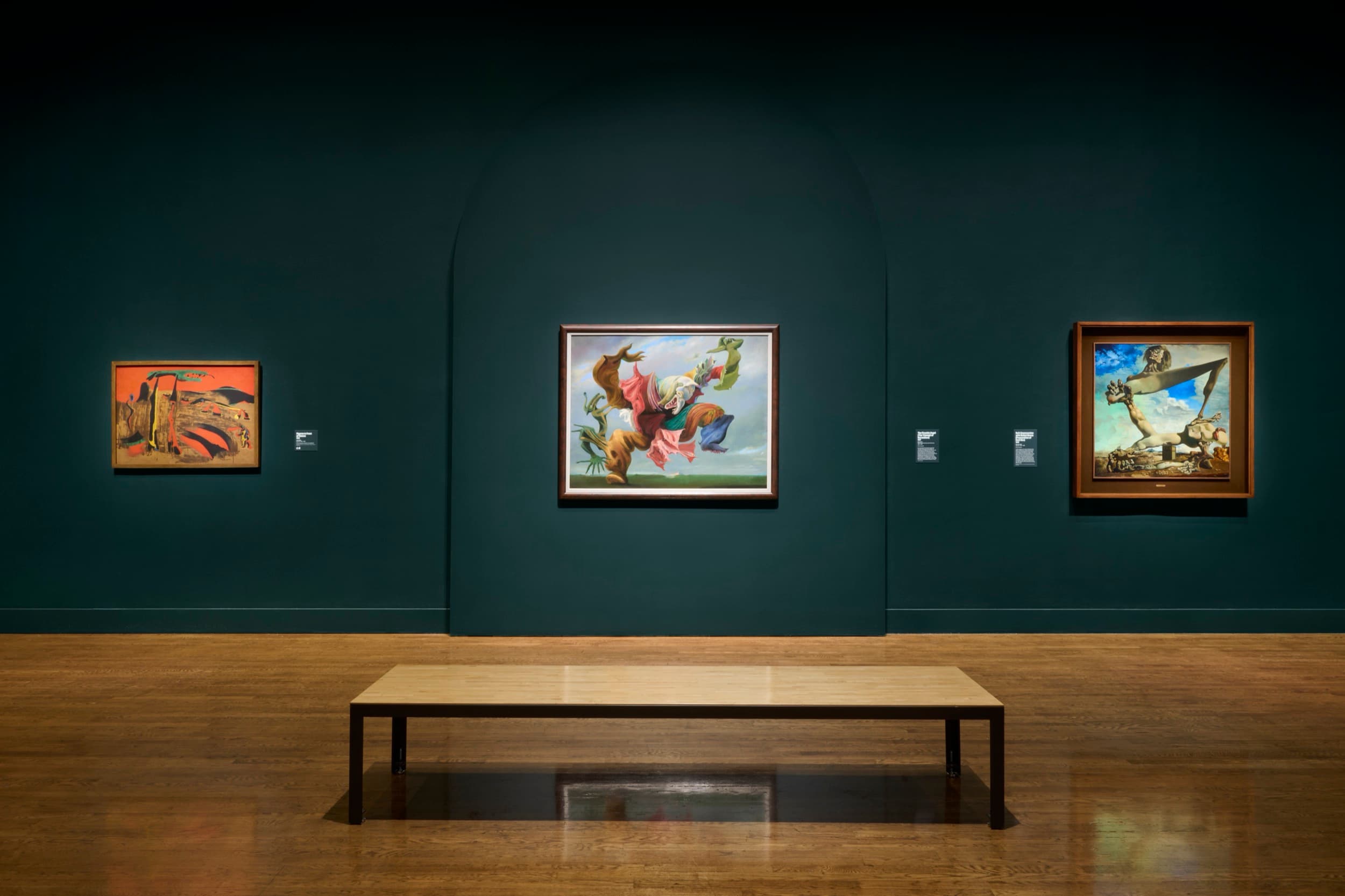
Installation view: Dreamworld: Surrealism at 100, Philadelphia Art Museum, Philadelphia, PA, 2025–26. Courtesy Philadelphia Art Museum.
Philadelphia Museum of Art
November 8, 2025–February 16, 2026
Philadelphia, PA
Before the Great War, we lived in “a static world, where the values appeared stable and where the meanings of abstractions seemed permanent and reliable,” the literary historian Paul Fussell wrote. “Everyone knew what Glory was, and what Honor meant.”1 But by 1929 Ernest Hemingway could write in A Farewell to Arms that “abstract words such as glory, honor, courage, or hallow were obscene beside the concrete names of villages, the number of roads, the names of rivers....”2 After the violent upheavals of World War I and the unsettling events that immediately followed—the Spanish flu (which took between fifty and a hundred million lives worldwide), the political revolutions in Germany and Russia, and a crippling global recession that lasted through 1921—reality itself felt unstable.
The traumas of the teens prompted artists to create Dada, which swept reality away, the extreme cynicism of German “New Objectivity,” and Constructivism, which attempted to build an imagined utopia from the ruins. In Paris, the frenetic and uncertain reality produced Surrealism. And against the backdrop of the Roaring Twenties, hyperinflation and the market crash, flappers and cabarets, Surrealism turned inward toward the psyche, privileging unconscious emotions, fears, and fantasies. The architects of Surrealism were writers. Guillaume Apollinaire invented the term surréaliste in 1917 to describe his absurdist play Les mamelles de Tirésias (The Breasts of Tireseas); André Breton, Antonin Artaud, and Philippe Soupault inaugurated the journal Littérature in February 1919 as Surrealism’s first vehicle. Artaud described Surrealism as a “complete liberation of the mind.”3 Breton defined it as “psychic automatism...the dream state.”4
Surrealism began as a literary movement and only later burst into celebrity as an art movement. Nevertheless, the list of visual artists who signed on, formally or informally during the 1920s and 1930s, is a roster of giants. Among the seventy artists included in the Philadelphia Museum’s current exhibition, Dreamworld: Surrealism at 100, are such artists as Giorgio de Chirico, Marcel Duchamp, Man Ray, Jean Arp, André Masson, Max Ernst, Joan Miró, Yves Tanguy, Pablo Picasso, Alexander Calder, René Magritte, Salvador Dalí, Dorothea Tanning, Leonora Carrington, Joseph Cornell, and Claude Cahun. Still more artists came to Surrealism in the 1940s and 1950s, when automatism and metamorphic imagery lay the foundation for such major developments as American Abstract Expressionism and then international Pop Art respectively. This vibrant, dynamically evolving, often theatrical movement remained prominent for forty years.
Curated by Matthew Affron, Dreamworld: Surrealism at 100 now in the Philadelphia Museum, lays out the story of Surrealism—its themes, its central preoccupations and its various and evolving morphologies—with brilliant clarity. Moreover, as much as a third of the roughly 200 works come from the museum’s own collections. The Arensberg and Gallatin collections, which came in 1950 and 1952, made the Philadelphia Museum one of the world’s great collections of modern, and especially Surrealist, art. Each of the five venues for this show – previously in Paris, Brussels, Madrid, and Hamburg—undertook to tell a distinct variation of the story as it pertained to their own history and collection, making each showing unique. This in itself creates a dynamic dialogue and a rejuvenatingly fresh take.

Giorgio de Chirico, The Soothsayer's Recompense, 1913. Oil on canvas, 53 3/8 × 70 7/8 inches. Courtesy Philadelphia Museum of Art.
Dreamworld: Surrealism at 100 in Philadelphia opens with the museum’s famous painting of The Soothsayer's Recompense (1913) by Giorgio de Chirico. This object sets many of the themes of the Surrealist dreamworld – a world of illusions, with mysterious meanings, illogical juxtapositions, allusions to classical myth displaced into contemporary settings, and wonder at the extraordinary in nature. It’s all about freedom of thought and the re-enchantment of the everyday. Affron casts “Surrealism as a rebellious philosophy of life,” a way of “rethinking the human condition.”5 The first rooms show us the complex dreamscape that set the movement’s preoccupations. In the following rooms, the exhibition takes a deep dive into a half dozen of the defining concerns, which the Surrealists thought would liberate the mind, while the sequence also roughly tracks the movement’s chronology. These sections explore “the marvelous” in nature, sexuality and Eros, and the strange, terrifying monsters of Ernst, Masson, Miró, and Picasso that foreshadow the onset of totalitarianism and war in the 1930s; here, Dalí’s well-known Soft Construction with Boiled Beans (Premonition of Civil War) (1936) —also in the Philadelphia collection—stands out. The exhibition then follows the flight of the artists from Europe and their regroupings in New York and Mexico City.

Salvador Dalí, Soft Construction with Boiled Beans (Premonition of Civil War), 1936. Oil on canvas, 39 5/16 x 39 3/8 inches. Courtesy Philadelphia Museum of Art.
The last section of Dreamworld, “Magic Art,” examines the Surrealists’ turn in the 1940s to an increasingly esoteric imagery of magical and alchemical beings, celestial figures, and symbols of the occult, as in such works as Maya Deren’s 1943 film The Witch’s Cradle and Dorothea Tanning’s 1942 Birthday. In the catalogue, Affron relates the story of Max Ernst’s visit to the studio of Dorothea Tanning, looking for works for an exhibition of women artists,6 and seeing this self-portrait on her easel,
in the guise of a sorceress, bare to the waist, with a Jacobean-style costume whose skirt is woven from tiny plantlike tendrils and writhing human bodies. A magical winged creature serves as her familiar or attendant. Ernst suggested a title—Birthday—that captured the underlying theme of the artist reborn in a Surrealist realm of the unknown as symbolized by the numerous thresholds and doorways in the background.7
Eighty years later, Birthday still has it’s magic; it’s eroticism and mysterious, otherworldly details, as in the skirt, continue to open doors psychologically.

Dorothea Tanning, Birthday, 1942. Oil on canvas, 40 1/4 × 25 1/2 inches. Courtesy Philadelphia Museum of Art.
A central underlying preoccupation of Surrealism is the subjective construction of reality amidst what Affron characterizes as its continual exploration of the human capacity for creativity and astonishment. In Surrealism and Painting (1928) Breton wrote that
The eye exists in its savage state....there is what others have seen, or claim to have seen, and that by means of suggestion they are able or unable to make me see; there is also what I see differently from the way in which anyone else sees it, and even what I begin to see which is not visible. And that is not all.8
Breton calls for “a total revision of real values” referring “to a purely internal model [his italics]....”9
In this book, Breton turns from positing the “superior reality” of the dream state, to how Surrealism was born in Pablo Picasso’s prewar Cubism. Breton illustrated Picasso’s 1912 Man with a Clarinet in his text, but it is not included in this exhibition. Without reading Breton’s full discussion of this painting and “that sudden flash of inspiration…some time between Factory, Horta del Ebro and Portrait of M. Kahnweiler,”10 it would have been difficult for a casual viewer to grasp why it was there. The centrality of Picasso’s 1909–14 Cubism for the genesis of Surrealism as Breton saw it is even too complicated for a wall label. In his book, Breton refers to Picasso paintings from “towards the end of 1909” to Woman in a Chemise of 1914, which he illustrates on the following page. So it falls to a reviewer to help visitors to think about what Breton saw in it. The Man with a Clarinet (like several Picassos around the corner in the permanent galleries of the Philadelphia Museum: Female Nude 1910, Man with a Violin 1911-12, Man with a Guitar 1912) represented, for Breton, a fundamental overturning of the way we see, a shattering of vision itself into a sequential assemblage of glimpses of things over time. For Breton, Picasso’s 1909-14 Cubism was a key precursor. The Surrealists interpreted it as a rejection of objective reality, exploring instead what they viewed as the higher reality of the mind. “Surrealism,” Breton wrote, “is based on the belief in the superior reality of certain forms of previously neglected associations, in the omnipotence of dream, in the disinterested play of thought.”11
Picasso’s radical re-thinking of perception itself, is anticipated in the discussion by the philosopher Maurice Merleau-Ponty of Paul Cézanne:
It is Cézanne’s genius that when the overall composition of the picture is seen globally, perspectival distortions are no longer visible in their own right, but rather contribute, as they do in natural vision, to the impression of an emerging order, of an object in the act of appearing, organizing itself before our eyes.12
In the same way, Picasso’s Cubism makes the illusion of perspective irrelevant. Surrealism sought to explore the definition and meaning of “reality” and Breton recognized that Picasso’s Man with a Clarinet shows reality as something we know through all the senses, as a totality, not circumscribed by reason. Picasso’s Man with a Clarinet reveals the artist’s mind assembling a concept over time from fragmentary perceptions—of three fingers, a shoulder, the top of the clarinet, a jaw line—layered into a sense of touch in the brushwork and imbricated with feeling. By the spring of 1912, this blurring of the boundaries between imagination, sensation, and real things in the world led Picasso to collage.
Breton’s examination of Man with a Clarinet of 1912 parallels Affron’s presentation of The Soothsayer's Recompense of 1913, as another touchstone for key underlying themes in what followed among the Surrealist artists. Both precedents are defining; yet each points to different aspects of Surrealist epistemology and whereas anyone can see how Soothsayer's Recompense set a trajectory for Surrealist thought, Man with a Clarinet would not have been understandable without a lot of explanation and the beauty of this exhibition is that everything is laid out so clearly for anyone just walking through and looking. Yet the underlying message of both the Picasso and the De Chiricois that they deliberately encountered reality through subjective apprehension, returning a sense of wonder to ordinary experience. It is in that sense that Affron sees Surrealism as a way of meeting the world. This stunning exhibition makes both the often wild multiplicity of Surrealism comprehensible—even coherent—and the grand spectacle of Surrealism exhilarating.
- Paul Fussell, The Great War and Modern Memory (Oxford: Oxford University Press, 1975), 21.
- Ernest Hemingway, A Farewell to Arms (New York: Charles Scribner's Sons, 1929). 191.
- The French Surrealist Group, “Declaration of 27 January 1925,” in Surrealism Against the Current: Tracts and Declarations, ed. and trans. Michael Richardson and Krzysztof Fijalkowsi (Pluto, 2001), 24; cited in Matthew Affron, Dreamworld: Surrealism at 100 (Philadelphia: Philadelphia Art Museum and Yale University Press, 2025), 13.
- André Breton, “The Mediums Enter” (1922), in The Lost Steps (Lespasperdus), trans. Mark Polizzotti (University of Nebraska Press, 1996), 90; cited in Matthew Affron, Dreamworld: Surrealism at 100 (Philadelphia: Philadelphia Art Museum and Yale University Press, 2025), 13.
- Matthew Affron, Dreamworld: Surrealism at 100 (Philadelphia: Philadelphia Art Museum and Yale University Press, 2025), 14.
- ”Exhibition by 31 Women,” Art of This Century, New York January 5-31, 1943 (exhibition brochure); cited in Matthew Affron, Dreamworld: Surrealism at 100 (Philadelphia: Philadelphia Art Museum and Yale University Press, 2025), 216.
- Dorothea Tanning, Between Lives: An Artist and Her World (Norton, 2001), 63; cited in Matthew Affron, Dreamworld: Surrealism at 100 (Philadelphia: Philadelphia Art Museum and Yale University Press, 2025), 216-17.
- Serialized as André Breton, “Le surréalisme et la peinture,” La révolution surréaliste, no. 4 (July 15, 1925), no.6 (March 1, 1926), no. 7 (June 15, 1926), nos. 9-10 (Oct.1, 1927); André Breton, Le surréalisme et la peinture (NRF, Librairie Gallimard, 1928); André Breton, Surrealism and Painting, trans. Simon Watson Taylor (NY: Harber and Row, 1972), 1.
- André Breton, “Le surréalisme et la peinture,” La révolution surréaliste, no. 4 (July 15, 1925); in André Breton, Surrealism and Painting, trans. Simon Watson Taylor (NY: Harber and Row, 1972), 4.
- André Breton, “Le surréalisme et la peinture,” La révolution surréaliste, no. 4 (July 15, 1925); in André Breton, Surrealism and Painting, trans. Simon Watson Taylor (NY: Harber and Row, 1972), 4-5.
- Breton, “Manifesto of Surrealism,” 26 (emphasis in original).
- Maurice Merleau-Ponty, “Cézanne’s Doubt,” Sense and Non-Sense (Studies in Phenomenology and Existential Philosophy), trans. Hubert L. and Patricia Allen Dreyfus (Evanston, IL: Northwestern University Press, 1992), 14.
Jonathan Fineberg is Director of the new PhD in Creativity at Rowan University and author of Modern Art at the Border of Mind and Brain (University of Nebraska Press) and the career survey Christo and Jeanne-Claude: On The Way To The Gates, 20th Anniversary Edition (Yale University Press, 2025).