ArtSeenDecember/January 2025–26
Jenny Saville: The Anatomy of Painting
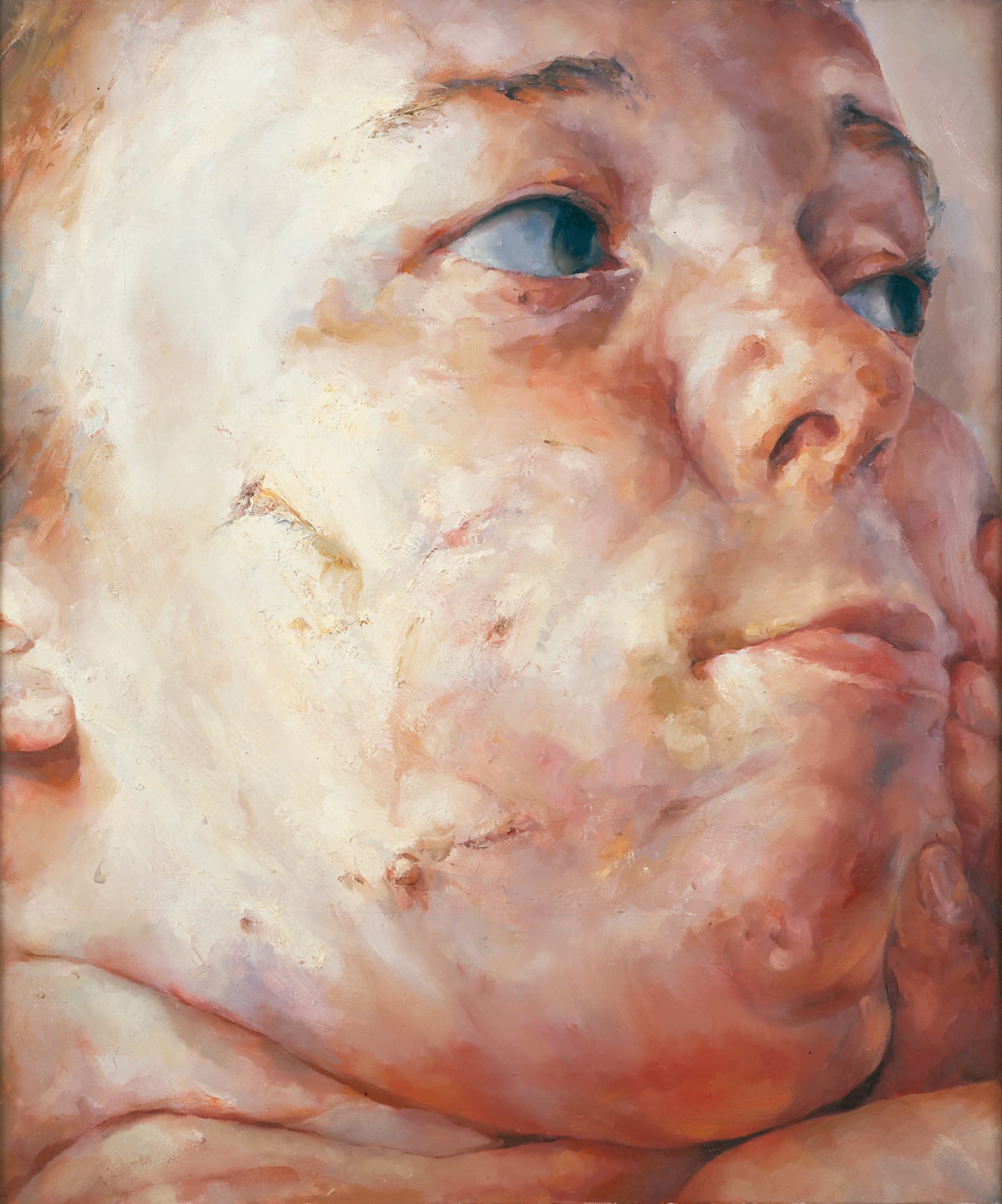
Jenny Saville, Interfacing, 1992. Oil on canvas, 48 × 40 inches. Courtesy Jenny Saville and Modern Art Museum of Fort Worth.
Word count: 916
Paragraphs: 9
The Modern Art Museum of Fort Worth
October 12, 2025–January 18, 2026
Fort Worth, TX
In Jenny Saville: The Anatomy of Painting, intimacies can be read in the dimples of our skin, in our folds, in our bloodshot eyes. Bodies meet, seemingly stitched and melded together. Skin is not a surface-level afterthought, but rather a pulsing record of internal lives and the impact of external influences. Saville’s career retrospective at the Modern Art Museum of Fort Worth is a testament to the artist’s evocative use of paint and how she continues to strip the human form of neatness in service of a more complex documentation of the body.
Initially, the skin appears warped, as if swollen or battered. In the first gallery, oil paint in shades of taupe, brown, and red pile on and against each other, merging figuration and abstraction. But the longer one stands before a Saville, the more familiar the discolorations and pock markings become. Indentations from undergarments—bra, underpants, the waistband of tights—are imprinted onto a torso in Trace (1993), a lingering reminder of the ways in which we restrain and contain ourselves. Interfacing (1992) offers a painted face in close-up, its ear and forehead lost to extreme framing. In this magnified state, age is ambiguous; the painted skin defies itself as a marker for time, and the chubbiness of our cheeks suddenly looms inescapable. From youth onward, we are etched with moles, acne, and blotches, our faces records of the spots where we picked, scratched, and pulled.

Installation view: Jenny Saville: The Anatomy of Painting, Modern Art Museum of Fort Worth, Fort Worth, Texas, 2025–2026. © Jenny Saville. Photo: Kevin Todora.
In Propped (1992), originally part of Saville’s graduation show at the Glasgow School of Art, a woman is perched on a stool, naked but for a pair of flats. In a scene that is otherwise vertically oriented, the woman’s knees and knuckles bulge outward, swollen, hued with pinks and blues, seeming mythological in their uncompromising abundance of skin. But these blues are familiar blues, indicating veins or innocuous bruises from the movements of daily living; my eyes drift to my own knuckles, their knobbiness suddenly apparent. In its original staging, Propped was displayed before a mirror.
Eyes are distinctly expressionless in Saville’s portraits. Their escape to some neutral mental space forces us instead to read the bodies and project our own emotional histories onto the figures. Are they bored, dejected, hungry? In the self-portrait Reverse (2002–03), the most abstract brushwork corresponds with areas of skin that are most blemished, calling attention to a redness—one cannot help but prescribe an incident, a narrative, a condition. Is this a rash or a burn? A record of being harmed or of harming? We have been trained to diagnose that which is epidermically inconsistent. The way our skin dries and dampens, folds and scars is a map of our living.
Saville is unrestrained in her exploration of this ever-exposed organ, though her method of exposure has evolved throughout the body of work, moving from a fleshy abstraction to one that is kaleidoscopic. In the artist’s works from the nineties and early aughts, markings and subject matter can be read as grotesque or even violent. Figure 11.23 (1996–97) is bloody in smears, stains, and cuts. Blood is external and seems to be swelling beneath the skin’s surface. The mouth of Witness (2009) is wrenched open, Saville’s brush pulling apart the wet and gummy orifice and exposing it to the unforgiving air. In one gallery is the carcass of a pig (Suspension [2002–03]), in the next, the corpse of a human (Still [2003]). But something softer and psychedelic is unlocked in Saville’s more recent works. Dead eyes catch the light and skin is shaded and textured in a rainbow of shades from yellows and greens to blues and pinks (Oracle [2019–23]). Pastels mix with paints to contour ears and jaw lines. The forehead is not simply framed out; it dissolves into a technicolor background (Chasah [2020]). In these later works, the skin meets a refracting light.

Jenny Saville, Reverse, 2002–03. Oil on canvas, 84 × 96 inches. Courtesy Gagosian.
The coming together and coming apart of the human body appears throughout Saville’s work. In her newer pieces, this looks like collage and fragmentation (Stanza [2020–22], Virtual [2020]). While there is something thrilling about the entropy effect of Saville’s oeuvre, of the restless skin that eventually explodes in color and comes apart, more affecting are Saville’s works in which two bodies meet. Here, skins must converse with each other, and for Saville, they merge, disappearing into one another. The exhibition’s monumental introductory piece, Hyphen (1999), depicts two sisters whose necks rest against one another, their bodies linking so closely they appear conjoined. This optical illusion appears again in Ruben’s Flap (1998–99) where three or maybe two women’s bodies are fused together through painterly collage. In pieces exploring sex, such as Fulcrum (1998–99) and Compass (2013), limbs and private parts intertwine, the boundaries of the individual body become blurred, calling to the state of our skin and minds in pleasure. In Anatomy of Painting, intimate relationships are not simply a relational closeness; they are a bodily entanglement in which we lose ourselves.
The childhood taunt, “your epidermis is showing,” would send a chill of fear through the body, then a wave of relief upon the twist: it’s only the skin. Saville’s distinct style of painting—using large brushtrokes, scrapers, and layered markings on a massive scale—reveals the secrets of the epidermis, the way it maps our identity and history, our wounds and desires. How brutally vulnerable it is to be showing, for all to see.
Madison Ford is a Texas-based writer, editor, and actor. Her work has appeared in Southwest Review, Texas Monthly, Glasstire and elsewhere. She holds an MFA in Fiction Writing from the New School.